論文解説
SPRING-5: Measuring Tool Documentation Repair for LLM Agents by Efficiency
SPRING-5:効率性で測るLLMエージェント向けツール文書修正
- 課題 ツール文書の修正研究は、主に作業成功率で評価されてきました。そのため、不要な反復呼び出しや、エラー信号が出ないまま誤った答えを返すケースを捉えられません。
- 手法 SPRING-5は、欠陥仕様、正直な仕様、バックエンド、正解キーから成る20個のファミリーで、理想経路に対する呼び出しコストを測定します。
- 結果 global-observerはバッチ方式で32.9%のcost gap closedを示しました。呼び出し量をそろえると、オンラインループとの差は小さくなりました。ノイズフロアとdudルールも併せて示されています。
ツール文書修正をコストで評価する課題
ツール文書の修正手法は、ほとんどが作業成功率だけで評価されています。しかし文書が不明確だと、エージェントは失敗する代わりに、同じツールを何度も呼び出してから正解を出したり、一度の正常な呼び出しで意味の違う数値を受け取り、エラー信号なしに誤った答えを出したりします。前者は精度の指標には表れないコストで、後者は一度の誤答として過小評価される欠陥です。SPRING-5は、この2つの側面を呼び出しコストと無言の失敗のcensusで併せて測定するよう設計されました。
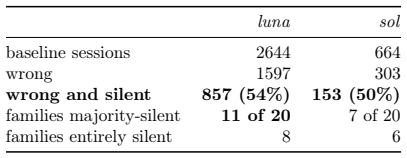
Table 3 :Silent failure measured per session. More than half of all wrong answers carry no signal any structural rule could read.
出典 · CC BY 4.0 · Guan Zheng Huang · SPRING-5: Measuring Tool Documentation Repair for LLM Agents by Efficiency · 論文の図を引用 · 元のPDFの12ページ目から図の部分を抽出しています。この研究は、ベンチマーク本体と、その結果を解釈するための検証ツールを併せて提示しています。各ファミリーは理想的な呼び出し経路を宣言し、コスト指数は実際の呼び出し数をこの値で割った値です。そのため、正解タスクあたりの呼び出し数も併せて報告しています。
データセット構成とコスト指標
各ファミリーは、1つのツールに欠陥を1つ埋め込んだdegraded仕様、その欠陥を解決する正直な仕様、決定的なバックエンド、正解キーで構成されます。手法はdegraded仕様から始まり、パラメータ名・個数・属性の集合は変更できません。正直な仕様は手法には渡されず、欠陥が原理的に修正可能であることをビルド時に確認するためだけに使われます。
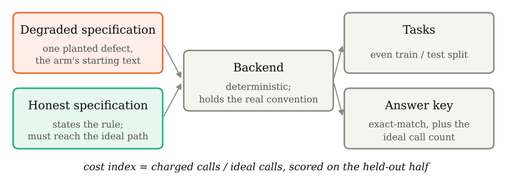
Figure 1 :OneSpring-5family. Methods start from the degraded specification and are scored on the held-out tasks. The honest specification is never given to a method; it exists to assert that the defect is repairable in principle, and that assertion is checked at build time.
出典 · CC BY 4.0 · Guan Zheng Huang · SPRING-5: Measuring Tool Documentation Repair for LLM Agents by Efficiency · 論文の図を引用 · 元のPDFの4ページ目から図の部分を抽出しています。この式では、Charged(A)をΣ(正解時はcalls(s)、そうでなければB)と定義し、CostIndex(A)=Charged(A)/(R·Σ_f ι_f)で計算します。正解タスクだけを対象にしたMatched costは、不正解に対する予算全体の計上を行わず、正解セッションの平均呼び出し数を見ます。
天井検証とノイズフロア
1つ目の検証ツールは、正直な仕様が宣言された理想呼び出し経路に到達するかを、ビルド時に確認する天井仮定です。著者らは、lunaでは6つのファミリー、solでは2つのファミリーがこの条件から外れると報告しています。そのうちevent_countは、正直な仕様が参照解に必要のない確認呼び出しを案内するため、体系的に1.46倍にとどまるデータセットの限界です。残りは、未完了のセッションが小さな理想経路を大きく揺らすケースです。
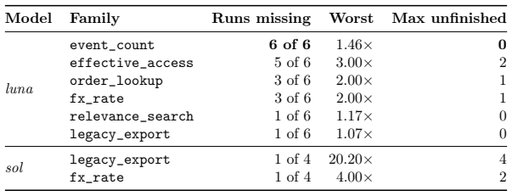
Table 1 :Families where the honest specification misses its declared ideal path.event_count is the only systematic violation: every run, and never with an unfinished session. Every other entry carries capped sessions on a small-idealfamily, where one unfinished task moves the ratio further than any specification could.
出典 · CC BY 4.0 · Guan Zheng Huang · SPRING-5: Measuring Tool Documentation Repair for LLM Agents by Efficiency · 論文の図を引用 · 元のPDFの9ページ目から図の部分を抽出しています。2つ目の検証ツールは、バイト単位で同じ仕様を2回評価して得られるノイズフロアです。直接推定器は基準仕様の反復パスを独立したサンプルとして使い、機会的推定器は手法が何も編集していないファミリーだけを使います。lunaでは直接推定のbandが0.642から1.557で、同じ仕様どうしの比較の11.9%が0.90という勝利の判定基準を超えます。機会的推定器は、編集されなかったファミリーから得られたサンプルに依存するため、solではbandが狭く出ており、分散を過小評価していました。
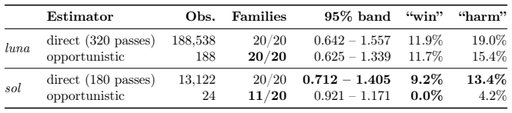
Table 2 :Evaluation noise on byte-identical specifications, two estimators at matched aggregation. Both have means within 0.03 of 1.0, so neither is biased in level; they differ in width. Passes are pooled only between evaluations over the same task set. The opportunistic one is close to the direct one where the arms leave every family with a control cell, a family that no arm edited, and collapses where they do not.
出典 · CC BY 4.0 · Guan Zheng Huang · SPRING-5: Measuring Tool Documentation Repair for LLM Agents by Efficiency · 論文の図を引用 · 元のPDFの10ページ目から図の部分を抽出しています。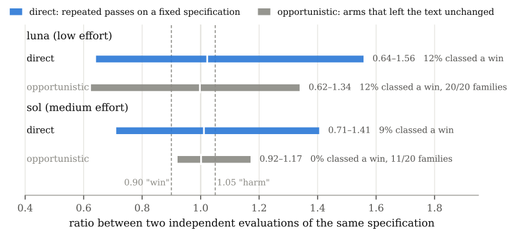
Figure 2 :Evaluation noise on identical text, by estimator. The opportunistic estimator tracks the direct one onluna, where all twenty families contribute a control cell, and collapses onsol, where only eleven do and those eleven are the quiet ones.
出典 · CC BY 4.0 · Guan Zheng Huang · SPRING-5: Measuring Tool Documentation Repair for LLM Agents by Efficiency · 論文の図を引用 · 元のPDFの10ページ目から図の部分を抽出しています。ヘッドルームのないファミリーの識別
3つ目の検証ツールはdud規則です。強いモデルが基本仕様だけで解けるファミリーには改善の余地がないため、平均に混ぜると他のファミリーの差が薄まります。著者らは、solではshift_schedule、price_history、effective_access、invoice_totalの4つのファミリーが1.35倍未満に落ち、lunaでは4.0倍から18.3倍の間にとどまると報告しています。そのため、このベンチマークの代表的な数値は時間とともに古くなりやすく、著者らは結果と併せてdudの数も報告することを勧めています。
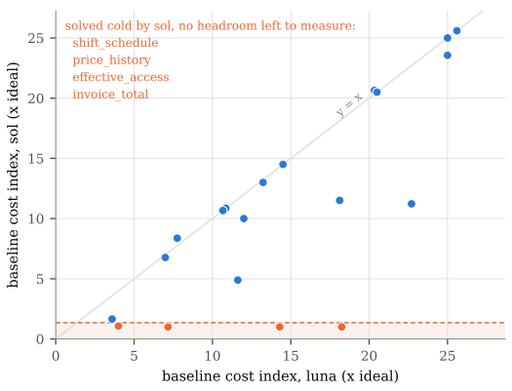
Figure 3 :Baseline cost index per family on both models. Sixteen families stay above the dud threshold of 1.35× on both, the closest beingaccount_link at 1.66× onsol. Four fall to the floor onsol: they are solved from a cold start, and any method scored on them can only be measured against noise. This is how a benchmark of this kind ages.
出典 · CC BY 4.0 · Guan Zheng Huang · SPRING-5: Measuring Tool Documentation Repair for LLM Agents by Efficiency · 論文の図を引用 · 元のPDFの11ページ目から図の部分を抽出しています。手法の比較とバッチ方式の優位性
5つの手法をlunaの20個のファミリー、2パスで比較した結果、スキーマだけを見るeasytoolはコスト指標で1.0%のgap closedを示し、draftは10.4%、オンラインループのsession-evoは12.9%でした。1回の呼び出しで学習用のすべての書き起こしを読むglobal-observerは32.9%を記録しました。global-observerは2つの公表済み手法よりも、信頼区間が0を超える差を示しました。ただし、session-evoとの差は信頼区間が0を含みました。
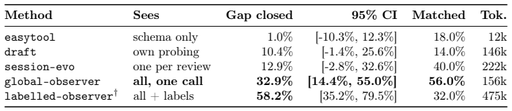
Table 4 :Five methods onSpring-5,luna, 20 families at two passes. “Gap closed” is on the cost index; “Matched” is gap closed on calls per correct task over the 60 tasks every method solved. Table 5 reports separate runs, so its figures for the same arms differ by run-to-run noise.†requires a correctness label and is a ceiling, not a deployable method.
出典 · CC BY 4.0 · Guan Zheng Huang · SPRING-5: Measuring Tool Documentation Repair for LLM Agents by Efficiency · 論文の図を引用 · 元のPDFの13ページ目から図の部分を抽出しています。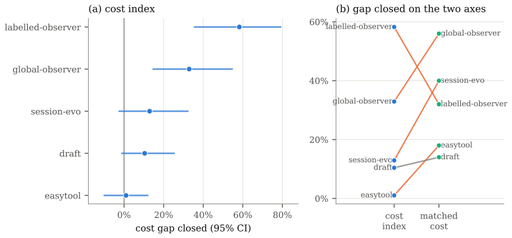
Figure 5 : (a)Cost gap closed with cluster-bootstrap intervals over families.(b)The same methods on the two axes. Lines that cross are methods the axes rank differently; orange marks a change of more than 12 points.
出典 · CC BY 4.0 · Guan Zheng Huang · SPRING-5: Measuring Tool Documentation Repair for LLM Agents by Efficiency · 論文の図を引用 · 元のPDFの14ページ目から図の部分を抽出しています。呼び出し量をそろえた実験では、global-observer-k1がループと同程度の全体露出量を使ったとき14.2%を示し、ループの10.6%との差はありませんでした。書き起こしを多く読むほど効果が大きくなったため、著者らはこの優位性がバッチ構造そのものよりも、より多くの証拠を読むことから来ると解釈しています。
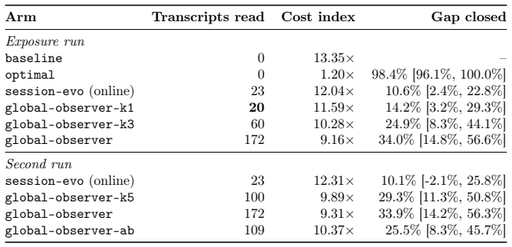
Table 5 :The batch proposer at several transcript budgets against the online loop,luna, 20 families, two evaluation passes, in two separate runs. Transcripts read is what reached a writer, not what was executed; for the online loop it is one per review.
出典 · CC BY 4.0 · Guan Zheng Huang · SPRING-5: Measuring Tool Documentation Repair for LLM Agents by Efficiency · 論文の図を引用 · 元のPDFの15ページ目から図の部分を抽出しています。適用範囲と限界
この結果は、著者らが意図的に埋め込んだ欠陥で測定されたものです。著者らは、コストの主張がこのデータセットの外では検証されていないと明記しています。global-observerは学習用の書き起こしをすべて保持していると仮定し、1回のバッチの書き起こしは同じバックエンドの振る舞いから生成されたと仮定します。エンドポイントが途中で変わると、バッチの前提が崩れる可能性があり、著者らはその条件では優位性が縮小するか、逆転しうると考えています。
また、ファミリーは20個しかないため、小さな差を切り分けるのは難しくなっています。著者らの検定力分析では、0.10の差を19%の確率でしか検出できませんでした。BFCLポートでは、ほとんどのクエリが基本スキーマで解けたため、コストの主張を直接検定することはできませんでした。
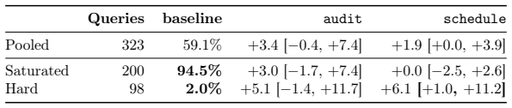
Table 7 :The BFCL transfer, pooled and split by whether the stronger model answers the query from the shipped schema. Arms are reported as the change from that stratum’s own baseline, with a cluster bootstrap over families. The two strata differ by 93 points of baseline accuracy. The two families carrying an out-of-schema query are excluded from the split rows for the reason given in Appendix A, and a family contributes to a stratum only where it has queries in it, so the split rows sum to 298 over 17 and 16 families rather than to 323 over 20.
出典 · CC BY 4.0 · Guan Zheng Huang · SPRING-5: Measuring Tool Documentation Repair for LLM Agents by Efficiency · 論文の図を引用 · 元のPDFの18ページ目から図の部分を抽出しています。論文情報
- 著者
- Guan Zheng Huang
- 学会・ジャーナル
- arXiv · プレプリント
- 公開日
- 2026年11月5日
- 登録日
- 2026年11月10日
- 更新日
- 2026年11月5日
- バージョン
- v1
- arXiv
- 2611.10040
- カテゴリ
- cs.SE · cs.AI · cs.CL
- ライセンス
- CC BY 4.0
- 掲載内容
- 論文情報・解説・論文の図
この解説は、Refivuの韓国語解説をAIで翻訳したものです。不正確な翻訳や誤りが含まれる可能性があります。論文と図の利用条件は各出典に従います。
アブストラクト
Methods that repair tool documentation automatically are mostly evaluated on task accuracy. We report a benchmark that scores them on cost. SPRING-5 is 20 tool families and 344 tasks, each with a deliberately degraded specification, a hand-written honest one, a deterministic backend and an answer key, scored on calls charged against the ideal call path. A wrong answer is charged the full call budget, so this cost index largely tracks the completion rate, and we report calls per correct task beside it, which carries no such charge. Over 2,644 baseline sessions, 54% of wrong answers arrive with no rejected call, no refusal and no retry. The benchmark carries three validity instruments. A build-time ceiling assertion requires the honest specification to reach the ideal path and fails systematically on only one family. A dud rule names the families a stronger model solves cold and catches four. A directly measured noise floor shows that two evaluations of a byte-identical specification differ by a 95% factor of 0.64 to 1.56, so about one comparison in eight crosses a conventional win threshold on noise alone, and the cheap way of estimating that floor is biased by which families happen to go unedited. Against these instruments, a schema-only method closes 1% of the baseline-to-ideal cost gap, an online self-evolution loop 13%, one batch rewrite over every training transcript 33%, and a variant given correctness labels 58%. The batch advantage over the loop is the evidence it reads: held to the loop's exposure it is no longer detectable. With five and ten tools in context the effect survives, the baseline cost does not change, and only machine-written descriptions sent calls to the wrong tool. On BFCL, 62% of held-out queries are already answered from the shipped documentation, which explains a pooled null there. Code, data and runs are released.
この論文を引用
Guan Zheng Huang (2026). SPRING-5: Measuring Tool Documentation Repair for LLM Agents by Efficiency. arXiv:2611.10040v1. https://arxiv.org/abs/2611.10040v1
BibTeX
@misc{huang2026spring,
  title = {{SPRING-5: Measuring Tool Documentation Repair for LLM Agents by Efficiency}},
  author = {Guan Zheng Huang},
  year = {2026},
  eprint = {2611.10040},
  archivePrefix = {arXiv},
  url = {https://arxiv.org/abs/2611.10040v1}
}