論文解説
Generating Diverse and Verified Synthetic Clinical Notes with Labels by Construction
構成段階でラベルが付与された多様で検証済みの合成臨床ノートの生成
- 課題 ドイツ語の臨床記録の非識別化ベンチマークは、正確なPHIラベル、現実性、制御された多様性を同時に満たすことが難しいです。
- 手法 SPARCLINGは、LLMを呼び出す前に構造化プロファイルをサンプリングします。生成LLMがPHIのプレースホルダを使ったテンプレートを書くと、値を決定的に埋めて文字単位の注釈を得ます。その後、決定的な検査とレッドチームLLMによる監査で、漏洩した文書を除外します。
- 結果 合成データで学習したmedBERT.deは、GraSCCoで89% F1を記録しました。
非識別化ベンチマークの限界と問題設定
ドイツ語の臨床テキストで非識別化モデルを評価するには、文字単位で正確なPHI注釈、臨床ノートとしての表面的なもっともらしさ、そしてモデルの失敗の傾向を明らかにできる制御された多様性が、同時に必要です。既存の実臨床データに基づくベンチマークは分布内にとどまり、多様性と極端な事例が不足しています。LLMで最初から生成したノートは多様性が限られ、ラベルの精度も不確かです。本論文は、この3つの条件を同時に満たす合成退院書簡の生成パイプラインSPARCLINGを提案しています。
構造化サンプリング、プレースホルダ生成、決定的な穴埋め
SPARCLINGは、LLMを呼び出す前に、患者・臨床・文書の属性からなる構造化プロファイルziを階層的にサンプリングします。まず文書レベルのメタ制御が決まり、その後に人口統計と臨床属性が条件付きでサンプリングされます。生成LLMはPHIの値を見ず、PHIの種類と文法情報だけを含むマスク付きプロファイルを受け取り、すべてのPHI言及をタイプ別のプレースホルダで示したテンプレートを書きます。その後、サンプリングされた値が決定的に置換され、文字オフセットが記録されるため、範囲注釈Yiが生成過程で正確に得られます。注釈を先に作り、値を後から埋める、逆の手順です。
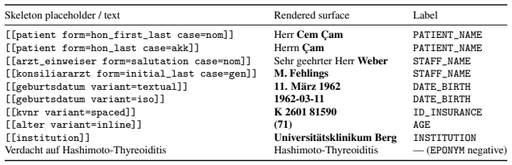
Table 10 : Selected examples of placeholder rendering. Boldface marks the resulting gold span. Negative examples are emitted as ordinary text and therefore do not produce an annotated span.
出典 · CC BY 4.0 · Matthias Lehmann, Madeleine Werthebach · Generating Diverse and Verified Synthetic Clinical Notes with Labels by Construction · 論文の図を引用 · 元のPDFの24ページ目から図の部分を抽出しています。二重検証と残留PHIの検出
検証段階では2つの漏洩経路を扱います。1つは、サンプリングした値が計画された範囲の外に現れる場合です。これは決定的なknown-PHI検査で、文字列の一致によって確認します。もう1つは、生成LLMがプロファイルにない識別子をプレースホルダの外に作り込む場合です。これは、PHIの範囲を隠した文書をレッドチームLLMが監査して見つけます。レッドチームLLMは正解ラベルではなく安全網として使われ、どちらか一方でも検出されれば、その文書は除外されます。
多様性と語彙指標の比較
SPARCLING-DEは1,019件のドイツ語退院書簡で構成されており、同じ規模に揃えた部分集合や、公開データセットのGraSCCo、GERNERMED、i2b2、MIMIC IV Noteと比較されました。Self-BLEU 0.014は、GERNERMEDの0.021やMIMIC IV Noteの0.060より低く報告されており、文書間の重複が少ないことを示しています。ただし、Self-BLEUは文書間のn-gram重複を測る指標なので、この値だけですべての多様性の側面で優れているとは言えません。語彙の豊かさを示すMTLDと文書長の分布も合わせて解釈する必要があります。コーパス・レベルの語彙統計はサイズに敏感なため、サイズを揃えた部分集合もあわせて見る必要があります。
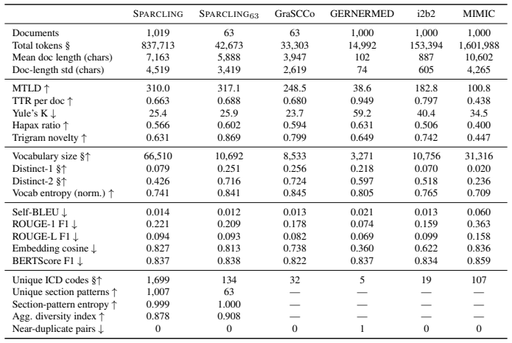
Table 15 : Full diversity metric suite across all corpora. Arrows give the "more diverse" direction (↑ higher, ↓ lower). Rows marked § are corpus-size confounded (grow with document count / token count) and should be read alongside the size-matched SPARCLING-DE 63 column, not the full corpus. Metrics are grouped into four classes: size metrics, per-doc lexical diversity, corpus-level lexical diversity, pairwise similarities, and content diversity. Pairwise-similarity metrics are sampled over document pairs. Section-structure and controllability metrics require generation metadata / section parsing and are only defined for SPARCLING-DE.
出典 · CC BY 4.0 · Matthias Lehmann, Madeleine Werthebach · Generating Diverse and Verified Synthetic Clinical Notes with Labels by Construction · 論文の図を引用 · 元のPDFの32ページ目から図の部分を抽出しています。ベンチマークとしての有用性と学習への有用性
SPARCLING-DEで学習したmedBERT.deは、GraSCCoで89% F1と84%の文字検出率を得たと報告されています。実データを用いた設定と比べると、合成データで事前学習した後に実データでファインチューニングした設定の文字再現率は0.975で、実データのみを使った0.955より高く報告されています。この結果はGraSCCoでの評価と、特定のmedBERT.deの学習設定で得られたものであり、他のモデルやデータセットでも同じ効果が現れるという結論までは広げられません。
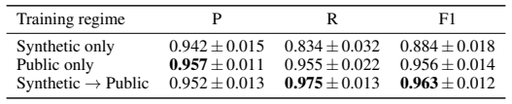
Table 4 : Main training results on GraSCCo at character-level.Synthetic onlyis a medBERT.de trained purely on SPARCLING-DE and evaluated on the held-out public folds;Public onlyis trained on the public training folds;Synthetic → Publicpretrains on SPARCLING-DE and finetunes on the public training folds. The hybrid regime improves span F1 over public-only on all folds.
出典 · CC BY 4.0 · Matthias Lehmann, Madeleine Werthebach · Generating Diverse and Verified Synthetic Clinical Notes with Labels by Construction · 論文の図を引用 · 元のPDFの9ページ目から図の部分を抽出しています。
Table 23 : Synthetic-to-real transfer of a detector trained exclusively on SPARCLING-DE. Results are mean ± standard deviation across seeds 42, 43, and 44. GraSCCo is entirely unseen during training, while the synthetic hold-out provides an in-distribution reference.
出典 · CC BY 4.0 · Matthias Lehmann, Madeleine Werthebach · Generating Diverse and Verified Synthetic Clinical Notes with Labels by Construction · 論文の図を引用 · 元のPDFの36ページ目から図の部分を抽出しています。限界と適用範囲
この研究の手法はドイツ語の退院書簡の領域でのみ検証されており、他の領域での検証は示されていません。また、LLMによる判定基準では、SPARCLING-DEの全体的な現実性スコアは2.08で、実際のドイツ語書簡GraSCCoの3.46より低く報告されています。そのため、臨床的な細部の現実性には限界があります。著者らは、この低い現実性を、多様性と困難な事例を優先した設計上の選択の結果と解釈しています。
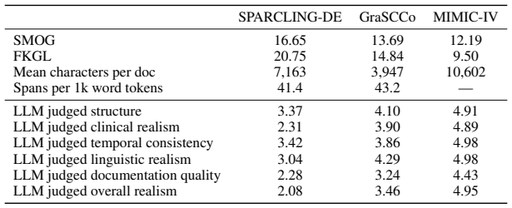
Table 2 : Surface-level and LLM-judged realism of SPARCLING-DE against two clinical reference corpora. LLM rows are mean judge scores (1–5). SPARCLING-DE matches the corpora on surface density and structure, but the LLM judge still separates it from real text on deeper clinical realism.
出典 · CC BY 4.0 · Matthias Lehmann, Madeleine Werthebach · Generating Diverse and Verified Synthetic Clinical Notes with Labels by Construction · 論文の図を引用 · 元のPDFの8ページ目から図の部分を抽出しています。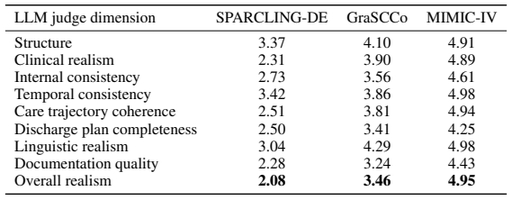
Table 16 : Full LLM-judge realism profile (mean scores, 1–5) across all nine dimensions. MIMIC-IV is judged near-ceiling on every axis and GraSCCo passes comfortably, whereas SPARCLING-DE scores lowest on the content-heavy axes (clinical realism, documentation quality, overall realism) while staying closest to real text on structure and temporal consistency.
出典 · CC BY 4.0 · Matthias Lehmann, Madeleine Werthebach · Generating Diverse and Verified Synthetic Clinical Notes with Labels by Construction · 論文の図を引用 · 元のPDFの32ページ目から図の部分を抽出しています。論文情報
- 著者
- Matthias Lehmann, Madeleine Werthebach
- 学会・ジャーナル
- arXiv · プレプリント
- 公開日
- 2026年11月7日
- 登録日
- 2026年11月10日
- 更新日
- 2026年11月7日
- バージョン
- v1
- arXiv
- 2611.10789
- カテゴリ
- cs.LG · cs.AI · cs.CL
- ライセンス
- CC BY 4.0
- 掲載内容
- 論文情報・解説・論文の図
この解説は、Refivuの韓国語解説をAIで翻訳したものです。不正確な翻訳や誤りが含まれる可能性があります。論文と図の利用条件は各出典に従います。
アブストラクト
Under strict privacy regulations in the clinical domain, de-identification is necessary to enable the use of clinical data such as for natural language processing. However, we currently lack sophisticated ways to tell which de-identification models actually are suitable. Specifically, we need benchmarks that are challenging, diverse, and clinically plausible, all while ensuring label correctness. To this end, we present SPARCLING, an LLM-based pipeline to generate synthetic discharge letters with character-exact PHI span annotations. Our pipeline combines structured attribute sampling, template generation, and red teaming to obtain diverse PHI-labeled discharge letters. In our experiments, we demonstrate this superior content diversity over existing public datasets. Further, we show SPARCLING's downstream utility as a benchmark to uncover failure modes of de-identifiers in the German clinical domain. Finally, our experiments show that training on our synthetic data can yield more capable de-identifiers than training on the scarce public data alone. Our code is available at https://github.com/Matt00n/phi_discharge_letter_generator.
この論文を引用
Matthias Lehmann, Madeleine Werthebach (2026). Generating Diverse and Verified Synthetic Clinical Notes with Labels by Construction. arXiv:2611.10789v1. https://arxiv.org/abs/2611.10789v1
BibTeX
@misc{lehmann2026generating,
  title = {{Generating Diverse and Verified Synthetic Clinical Notes with Labels by Construction}},
  author = {Matthias Lehmann and Madeleine Werthebach},
  year = {2026},
  eprint = {2611.10789},
  archivePrefix = {arXiv},
  url = {https://arxiv.org/abs/2611.10789v1}
}