論文解説
Learning When to Think: Adaptive Internal Computation for Reinforcement Learning
いつ考えるかを学習する:強化学習のための適応型内部計算
- 課題 反復型の方策は、すべての状態に同じ精緻化の深さを使うため、追加の精緻化の効用が低い状態にも計算を浪費することがあります。
- 手法 AICは、各深さの停止確率から停止深さの分布を作り、行動と停止の決定の結合確率を、PPOの目的関数と期待深さペナルティとともに学習します。
- 結果 AICは最大8回の上限で平均3.3回実行し、12個の課題のうち、報酬が固定深さの最強ベースラインを上回る課題が7つ、下回る課題が4つあります。
固定深さの方策の無駄という問題
反復型のニューラル方策は、判断のたびに同じ回数だけ表現を精緻化しますが、追加の精緻化が役立つ度合いは状態ごとに異なります。日常的な動きには短い処理で十分ですが、予期しない接触から抜け出す場面では、より多くの反復が必要になることがあります。そのため、計算コストが大きい環境では、すべての状態に同じ深さを使うと、一部の状態には過剰に、別の状態には不足する形で計算を使うことになります。この論文は、方策が各状態で精緻化をさらに行うか、今すぐ行動するかを、環境の報酬から学習できるかを問うています。先行研究のACTとPonderNetも入力ごとの反復回数を学習しますが、この論文では、停止の決定が行動を変え、その後の状態と報酬に影響するという点を強調しています。
AICの共同方策と停止深さ
Adaptive Internal Computation(AIC)は、行動の選択と停止の決定を、同じ方策の2つの決定として扱います。エンコーダが状態s_tからz_0を作り、深さdごとに共有された残差ブロックがz_dを更新します。各深さには、行動ヘッドπ_d、価値ヘッドV_d、停止確率h_d ∈ [0,1]を読む停止ヘッドがあり、最大深さでは停止が強制されます。実行中の停止深さの分布q_θ(d|s)は、各深さまで到達する確率S_d = ∏_{j<d}(1−h_j)から決まり、結合確率p_θ(a,d|s) = q_θ(d|s)π_{θ,d}(a|z_{θ,d}(s))で表されます。この結合確率がPPOの比率に入るため、停止決定の対数確率も報酬信号で更新されます。
期待深さペナルティは、停止分布から計算したE[τ|s]を最大深さで割った値にλ_cを掛けた項として加えられます。価値ヘッドは同じGAEの目標を予測するように学習される補助的な監督であり、推論時には価値の出力は読まず、停止決定はh_dが0.5を超える最初の深さで行われます。
状態依存の割り当てが有利になる条件
定理1は、簡単な状態と難しい状態が混在する分布では、状態に依存しない停止規則が同じ期待深さを使っても価値損失が残ることを示しています。定理では、簡単な状態の質量1−εはすべての深さで基準価値W*に到達し、難しい状態の質量εは深さK以上でのみ到達すると仮定しています。理想的な割り当て器は、簡単な状態に深さ1、難しい状態に深さKを与えることで、期待深さb = 1 + ε(K−1)で損失0を得ます。同じ期待深さを使うどの状態非依存の停止分布でも、Rµ ≥ ε∆(1−b/K) > 0となります。この結果は、簡単・難しいの分割を知っている理想的な割り当て器と、固定された行動方策という仮定に条件付けられたものであり、学習された停止方策がこの割り当てを回復するという結論を与えるものではありません。
12個の課題での固定深さの比較
主要な実験では、最大8回の精緻化ステップの下でAICを固定深さの方策と比較します。固定のベースラインは、同じエンコーダ、精緻化ブロック、PPOの目的関数を使いますが、学習深さK_train ∈ {1,2,4,8}で止まり、各予算ごとに別個の学習スイープを行います。B=8では、AICは9つの課題で予算ごとの固定ベースラインを上回り、7つの課題でp<.05となります。すべての予算で最も強い固定ベースラインと比べると、AICは7つの課題で上回り、1つの課題で同等、4つの課題で下回ります。下回った代表例は、RareEventで深さ1のベースラインが.6338を記録し、低異質性のAntMazeで.6916を記録したケースです。
この結果は12個の課題の集合と5シードの平均に関するものであり、平均3.3回の精緻化が合わせて報告されています。
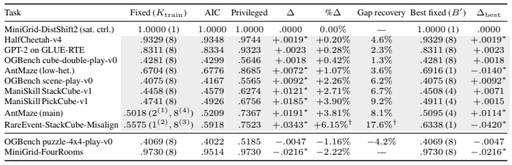
Table 1 :Benchmark comparison at nominalB=8.∆: AIC minus the per-budget fixed baseline, whose selected training depths appear in parentheses with seed counts as superscripts. Gap recovery is measured toward the privileged reference and is undefined when the reference does not exceed the fixed baseline. Best fixed: strongest fixed baseline at any budgetB ′ ≤8in Table 14, withB ′ in parentheses;∆ best is AIC minus that value. ∗:p < .05, two-sided Welch’st-test over five seeds with the standard deviations of Table 14.
出典 · CC BY 4.0 · Rohit Kumar Salla, Simon Stepputtis · Learning When to Think: Adaptive Internal Computation for Reinforcement Learning · 論文の図を引用 · 元のPDFの5ページ目から図の部分を抽出しています。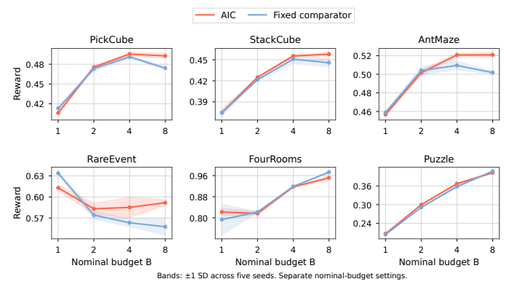
Figure 2 :Performance across nominal budgets on six tasks.Points are five-seed means with±1 standard-deviation bands (Table 14); each point is a separate budget setting and realized depth can differ between methods. RareEvent peaks atB= 1for both methods. Figure 4 shows the remaining six tasks.
出典 · CC BY 4.0 · Rohit Kumar Salla, Simon Stepputtis · Learning When to Think: Adaptive Internal Computation for Reinforcement Learning · 論文の図を引用 · 元のPDFの6ページ目から図の部分を抽出しています。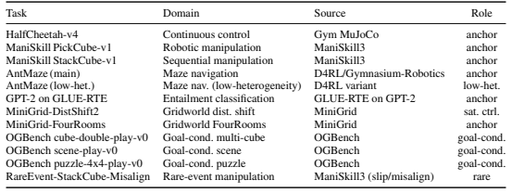
Table 8 :Tasks.Every benchmark setting, including DistShift, uses five seeds; Section S summarizes the protocols of the additional studies.
出典 · CC BY 4.0 · Rohit Kumar Salla, Simon Stepputtis · Learning When to Think: Adaptive Internal Computation for Reinforcement Learning · 論文の図を引用 · 元のPDFの29ページ目から図の部分を抽出しています。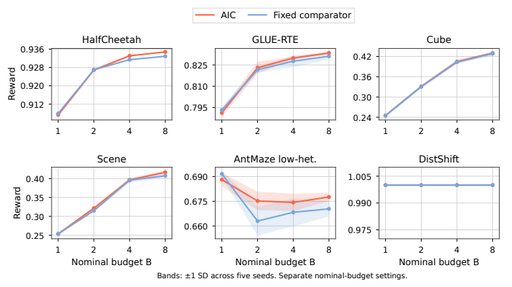
Figure 4 :Performance across nominal budgets on the remaining six benchmark tasks.Points are five-seed means and shaded bands are±1standard deviation from Table 14. The budget conven- tion and fixed-baseline definitions match Figure 2. DistShift is saturated at every budget; the other tasks respond differently to a larger budget.
出典 · CC BY 4.0 · Rohit Kumar Salla, Simon Stepputtis · Learning When to Think: Adaptive Internal Computation for Reinforcement Learning · 論文の図を引用 · 元のPDFの34ページ目から図の部分を抽出しています。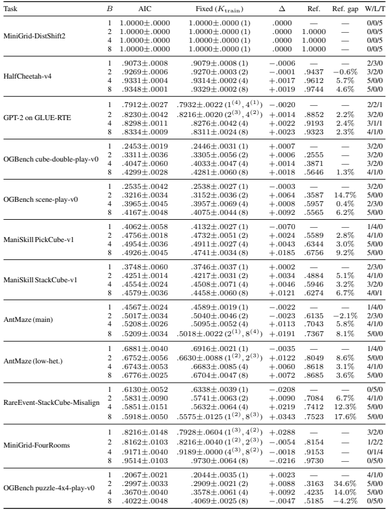
Table 14 : Full comparison at nominalB∈ {1,2,4,8}. Means±sample standard deviation over 5 seeds. Parentheses list training depths selected across seeds, with seed counts as superscripts when more than one depth was selected; executed depth ismin(K train, B). Ref.: reward of the budget- specific privileged reference. Gap recovery is undefined when the reference does not exceed the fixed baseline and is omitted atB= 1, where every method executes one refinement. MiniGrid- DistShift2 is the saturated control. AIC trails on MiniGrid-FourRooms and OGBench puzzle-4x4- play-v0 atB=8.
出典 · CC BY 4.0 · Rohit Kumar Salla, Simon Stepputtis · Learning When to Think: Adaptive Internal Computation for Reinforcement Learning · 論文の図を引用 · 元のPDFの39ページ目から図の部分を抽出しています。打ち切り、データ、補助的な監督の分離
打ち切りの分析では、深さの高い判断を深さ1に強制したときの報酬の低下を、同じ数のランダムな打ち切りと比較します。データ源のアブレーションでは、PickCubeとStackCubeで収集器と学習器を入れ替えて試します。停止と監督のアブレーションでは、4つの構成を独立に学習し、PickCubeとAntMazeでは停止の効果が監督の効果より大きく、RareEventでは監督の効果が大きくなります。非適応構成は深さ1を使い、適応構成は1.8–3.9回を使うため、停止の効果には追加の計算が混ざっています。
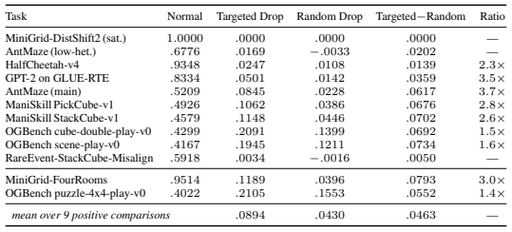
Table 3 :Sensitivity to targeted and random truncation.Targeted: decisions at or above the 75th- percentile depth, forced tod=1. Random: count-matched random early exits. Targeted drops exceed random drops on every non-saturated task, including the final two rows; ratios are omitted when the random drop is non-positive. Table 16 gives selected fractions, removed refinements and a random control matched on removed work.
出典 · CC BY 4.0 · Rohit Kumar Salla, Simon Stepputtis · Learning When to Think: Adaptive Internal Computation for Reinforcement Learning · 論文の図を引用 · 元のPDFの7ページ目から図の部分を抽出しています。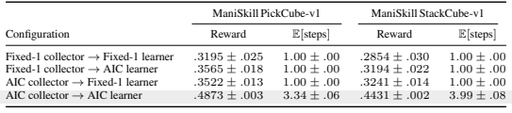
Table 4 :Data-source ablation.Rows are collector–learner pairs; columns give reward and the learner’s mean halting depthE[steps]. The combined gain exceeds the sum of the separate gains. Values are means±standard deviation over five learner seeds, each collector produced one dataset.
出典 · CC BY 4.0 · Rohit Kumar Salla, Simon Stepputtis · Learning When to Think: Adaptive Internal Computation for Reinforcement Learning · 論文の図を引用 · 元のPDFの8ページ目から図の部分を抽出しています。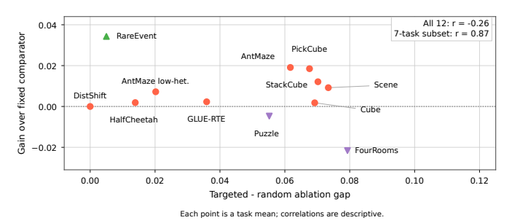
Figure 5 :Allocation diagnostic and fixed-baseline gain.Each point is a task mean from the twelve-task benchmark. The seven-task subset (DistShift, HalfCheetah, low-heterogeneity AntMaze, RTE, AntMaze, PickCube, StackCube) has Pearsonr= 0.87; including Cube and Scene givesr= 0.62and all twelve points giver=−0.26. The horizontal axis is count-matched trunca- tion sensitivity; the correlation depends on the included task set.
出典 · CC BY 4.0 · Rohit Kumar Salla, Simon Stepputtis · Learning When to Think: Adaptive Internal Computation for Reinforcement Learning · 論文の図を引用 · 元のPDFの35ページ目から図の部分を抽出しています。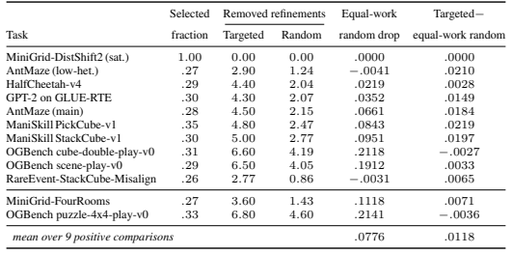
Table 16 :Removed-work accounting for the truncation study.Selected fraction: share of de- cisions at or above the seed’s 75th-percentile depth, including ties. Removed refinements are per intervened decision. Equal-work random: random truncation matched to the targeted set’s total re- moved refinements. Targeted drops are those of Table 3.
出典 · CC BY 4.0 · Rohit Kumar Salla, Simon Stepputtis · Learning When to Think: Adaptive Internal Computation for Reinforcement Learning · 論文の図を引用 · 元のPDFの40ページ目から図の部分を抽出しています。POGPと学習型停止手法との比較
HalfCheetah、Walker2d、Ant、Hopperの4つのMuJoCo課題で、AICは行動あたりの反復を22–28%少なく使いながら、平均リターンはPOGPと3–5の範囲内にとどまります。これはPOGPのディフュージョンバックボーンと8段階の上限で得られた結果です。学習型の停止手法との比較では、ACT-ponderと学習されたnon-VoCしきい値を含む7つの課題を見ます。AICは3つの手法のうち最も低い平均深さを使い、FourRoomsでは、低い深さがより低い報酬と同時に現れます。この比較は、同じエンコーダと精緻化ブロックを共有する実装の中で、停止の学習方式だけを変えた結果です。
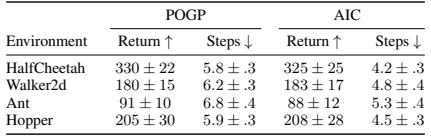
Table 2 :POGP–AIC comparison with an eight-step cap.Undiscounted return over 100-step episodes (Section D.2) and iterations per action, mean±standard deviation over five seeds.
出典 · CC BY 4.0 · Rohit Kumar Salla, Simon Stepputtis · Learning When to Think: Adaptive Internal Computation for Reinforcement Learning · 論文の図を引用 · 元のPDFの6ページ目から図の部分を抽出しています。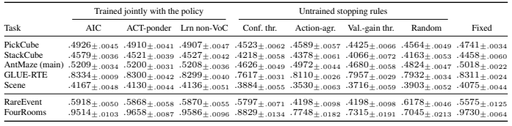
Table 6 :Adaptive halting baselines atB=8across 7 tasks.Mean reward over five seeds, with the seed standard deviation as a subscript; AIC and Fixed repeat Table 14. The trained methods reach similar rewards on several tasks at different mean depths. ACT-ponder leads on FourRooms and the random schedule, which executes one refinement there, leads on RareEvent.
出典 · CC BY 4.0 · Rohit Kumar Salla, Simon Stepputtis · Learning When to Think: Adaptive Internal Computation for Reinforcement Learning · 論文の図を引用 · 元のPDFの9ページ目から図の部分を抽出しています。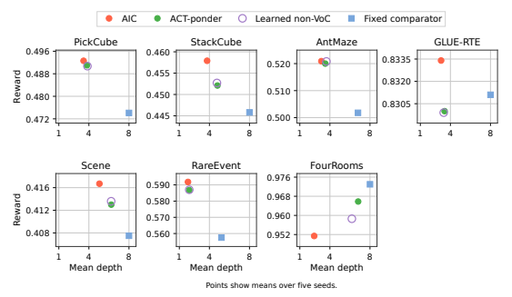
Figure 3 :Reward versus mean halting depth at nominalB= 8.Panels show AIC, ACT-ponder, learned non-V oC and fixed baselines, using Tables 6 and 10. A fixed baseline’s depth is the seed average ofmin(K train,8)over its selected checkpoints.
出典 · CC BY 4.0 · Rohit Kumar Salla, Simon Stepputtis · Learning When to Think: Adaptive Internal Computation for Reinforcement Learning · 論文の図を引用 · 元のPDFの9ページ目から図の部分を抽出しています。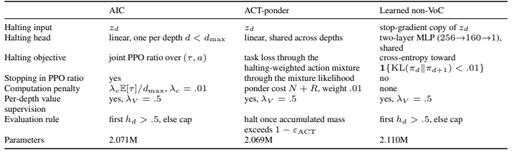
Table 9 :Jointly trained halting methods.All three share the encoder, refinement block, depth- specific action heads and value heads and use five seeds atB= 8.
出典 · CC BY 4.0 · Rohit Kumar Salla, Simon Stepputtis · Learning When to Think: Adaptive Internal Computation for Reinforcement Learning · 論文の図を引用 · 元のPDFの31ページ目から図の部分を抽出しています。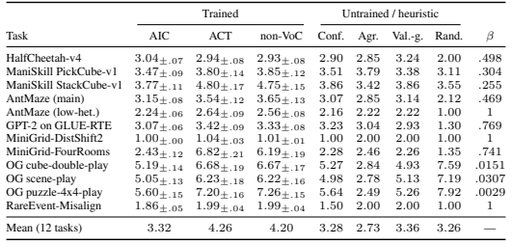
Table 10 :Mean refinement depth atB=8on all twelve tasks.Mean steps per state for the seven stopping methods; trained-method entries carry the seed standard deviation as a subscript andβis the random schedule’s per-task stopping probability (Section G). Fixed-Kcontrols execute exactlyK refinements. ACT and non-V oC halt deeper than AIC on eleven tasks; HalfCheetah is the exception. The final row is the unweighted task mean.
出典 · CC BY 4.0 · Rohit Kumar Salla, Simon Stepputtis · Learning When to Think: Adaptive Internal Computation for Reinforcement Learning · 論文の図を引用 · 元のPDFの31ページ目から図の部分を抽出しています。適用範囲と残る限界
この研究の結果は、小さな精緻化モジュール、シミュレーション課題、特定のバックボーンと深さの上限で得られたものです。FourRoomsは、試した損失重みのグリッド全体で固定深さのベースラインより低いままであり、パズルは価値の監督の重みに応じて符号が変わります。打ち切り研究は、計算量をそろえた比較でも状態と深さの関連を完全には切り離せず、著者らは深さの再割り当て実験が追加で必要だと述べています。共有GAEの目標は、強制された深さの反事実的リターンを識別せず、方策の価値の出力を変えても、凍結された停止方策は変わりません。
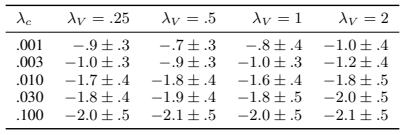
Table 11 : FourRooms: difference from the mean-depth-matched fixed baseline in percentage points of normalized reward (one point is.01in the units of Table 1), mean±standard error over five seeds.
出典 · CC BY 4.0 · Rohit Kumar Salla, Simon Stepputtis · Learning When to Think: Adaptive Internal Computation for Reinforcement Learning · 論文の図を引用 · 元のPDFの32ページ目から図の部分を抽出しています。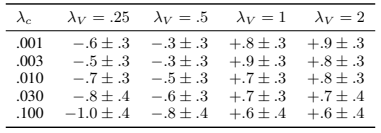
Table 12 : Puzzle: difference from the mean-depth-matched fixed baseline in percentage points of normalized reward, mean±standard error over five seeds.
出典 · CC BY 4.0 · Rohit Kumar Salla, Simon Stepputtis · Learning When to Think: Adaptive Internal Computation for Reinforcement Learning · 論文の図を引用 · 元のPDFの32ページ目から図の部分を抽出しています。論文情報
- 著者
- Rohit Kumar Salla, Simon Stepputtis
- 学会・ジャーナル
- arXiv · プレプリント
- 公開日
- 2026年11月7日
- 登録日
- 2026年11月10日
- 更新日
- 2026年11月7日
- バージョン
- v1
- arXiv
- 2611.10822
- カテゴリ
- cs.LG · cs.RO
- ライセンス
- CC BY 4.0
- 掲載内容
- 論文情報・解説・論文の図
この解説は、Refivuの韓国語解説をAIで翻訳したものです。不正確な翻訳や誤りが含まれる可能性があります。論文と図の利用条件は各出典に従います。
アブストラクト
Iterative neural policies usually spend the same computation on every decision, although the benefit of additional processing varies across states. We introduce Adaptive Internal Computation (AIC), an iterative policy that learns when to stop refining its latent representation and act. In AIC, we train action selection and stopping jointly, an expected-depth penalty values computation and intermediate value predictions provide auxiliary supervision. We show that when only some states benefit from further refinement, an ideal state-dependent allocator outperforms every state-independent stopping schedule at the same expected depth. With at most eight refinement steps per decision, AIC executes 3.3 steps on average across twelve benchmark tasks and lowers per-decision latency by 31--44% relative to a fixed eight-step policy on four control and robotics tasks. Its mean reward exceeds the best fixed-depth policy on seven tasks and trails it on four. Ablating adaptive stopping and value supervision separately shows that stopping accounts for most of the reward gain on PickCube and AntMaze, where it also executes more refinement steps and that supervision accounts for most of it on RareEvent.
この論文を引用
Rohit Kumar Salla, Simon Stepputtis (2026). Learning When to Think: Adaptive Internal Computation for Reinforcement Learning. arXiv:2611.10822v1. https://arxiv.org/abs/2611.10822v1
BibTeX
@misc{salla2026learning,
  title = {{Learning When to Think: Adaptive Internal Computation for Reinforcement Learning}},
  author = {Rohit Kumar Salla and Simon Stepputtis},
  year = {2026},
  eprint = {2611.10822},
  archivePrefix = {arXiv},
  url = {https://arxiv.org/abs/2611.10822v1}
}