Paper commentary
Map2SLAM: From Streaming Map Prediction to Real-Time SLAM
Map2SLAM turns streaming 3D models into a SLAM system that revises past predictions
- Problem Streaming 3D foundation models fix each pose once it is emitted, so loop closures cannot correct the drift that builds up over long sequences.
- Method Map2SLAM keeps LingBot-Map frozen and trains only a lightweight retrieval head. Its back-end re-runs the model over past frames with fresh context, so verified loops correct the trajectory online.
- Results On VBR, Map2SLAM reaches a mean ATE of 5.15 m, while the strongest uncalibrated baseline, ABot-Recon, reaches 9.97 m.
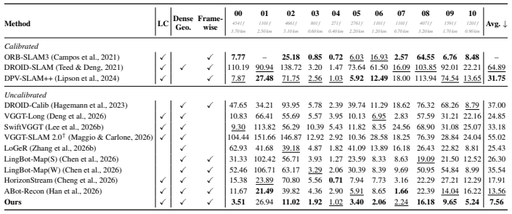
Table 1 : Absolute trajectory error (ATE, m) on KITTI (Geiger et al., 2012). “–” denotes tracking failure. LC, Dense Geo., and Frame-wise denote loop closure, dense geometry, and per-frame track- ing, respectively. LingBot-Map(S/W) denote the streaming/window modes. † VGGT-SLAM 2.0 uses native keyframes only and is excluded from ranking. The best and second-best results in each section are shown in bold and underlined, respectively.
Original paper · CC BY 4.0 · Jian Gao, Lin-Zhuo Chen, Yihang Chen, Jiagang Chen, Jiacheng Dong, Xun Cao, Nan Xue, Yinghao Xu, Yao Yao · Map2SLAM: From Streaming Map Prediction to Real-Time SLAM · Original paper figure · Extracted the figure area from page 7 of the original PDF.Why streaming predictions stop short of SLAM
Streaming 3D foundation models estimate camera poses and dense geometry for each frame as it arrives. Each prediction is fixed the moment it is emitted, so drift that builds up over a long sequence stays in the output. When the camera returns to a known place, the earlier estimates still can't be corrected.
Because a streaming model emits one geometric prediction per incoming frame, nothing later can revise what it already produced. The authors therefore conclude that current streaming 3DFMs can't yet replace SLAM.
Other methods attach loop closure to a streaming model, yet all of these invoke the model in a fixed pattern. The authors argue that the main lever is how model inference is scheduled and how its results are kept as revisable state.
Map2SLAM is built on LingBot-Map and keeps the model frozen, so the authors add only a lightweight retrieval head. Its front-end tracks each incoming frame with causal streaming inference and decides which frames become keyframes in the persistent state. Its back-end re-runs the model's joint inference over past frames with fresh context, so verified loops can correct the trajectory online.
The key idea: schedule the model and keep its output revisable
Map2SLAM changes the role of LingBot-Map from a final answer generator into an observation source for an external persistent SLAM state. LingBot-Map's weights stay frozen, and the only trained part is a lightweight retrieval head. The prefix-causal structure gives two inference modes: Bidirectional Prefix jointly reasons over several frames, while Causal Continuation infers frame by frame over long videos.
Map2SLAM sends the live stream through Causal Continuation and sends selected history back through Bidirectional Prefix. Every invocation reads one shared Frame Encoder pass per image, so re-invoking the model on history adds no encoding cost.
LingBot-Map uses its joint mode only for initialization, but the back-end calls that mode again with fresh context. Placing the revisit in the back-end keeps it separate from the live tracker, which keeps running. Loop Retrieval proposes revisit candidates from cached features, and Pairwise Geometry checks each candidate with a two-view prefix.
Because appearance matches don't guarantee geometric consistency, the verification step is needed before a loop reaches iPGO.
The authors argue that scheduling model inference and keeping its results as revisable state is the main lever for SLAM on streaming 3DFMs. Verified loop observations correct the trajectory online with iPGO, and segment observations refine dense geometry after the sequence. The paper reports 42.7 to 48.3% below the second-best results, and tracking above 28 FPS on an NVIDIA RTX 5090D GPU.
Front-end: bounded windows and Keyframe Probes
Running one streaming context over a long sequence causes trajectory jitter, so the front-end reinitializes the active Geometry Reasoner context at each window boundary. The first window starts with its first Np frames processed as a Bidirectional Prefix, which establishes the initial tracking context. For each later frame, one Causal Continuation step tentatively extends the active context into a Keyframe Probe.
The probe yields a pose, depth, and intrinsics, which the front-end uses to measure projective motion against the latest keyframe k(i). The projective motion m_i averages the squared pixel error over the valid pixels of keyframe k(i), after back-projection, relative-pose transfer, and reprojection. If m_i exceeds the threshold τ, the front-end accepts the frame as a keyframe and commits its KV cache update.
When the context reaches its budget N_b, an accepted frame triggers context reinitialization instead of a commit.
The replayed keyframes fix the alignment: their depth ratios give the scale w, and their poses give the rotation R_w and translation t_w. Each local prediction is mapped into the existing trajectory with R_i = R_w R̃_i, t_i = s_w R_w t̃_i + t_w, and D_i = s_w D̃_i. This alignment keeps cross-window continuity for later causal outputs.
Non-keyframes keep their causal pose relative to the latest keyframe, which the system later uses to recover the final trajectory. These sequential observations feed Online Trajectory Correction, which the back-end combines with verified loop constraints. The front-end therefore commits only frames that pass the motion test, while the back-end handles the drift that remains.
Finding and checking loops before correcting the trajectory
Loop Retrieval starts from the LingBot-Map Frame Encoder, whose intermediate tokens remain useful for visual place recognition. A lightweight SALAD aggregation head turns these cached tokens into one global descriptor per accepted keyframe, while the encoder stays frozen. Descriptor similarity proposes historical loop candidates, which then go to Pairwise Geometry.
A descriptor becomes searchable only after Q = 64 later keyframes have been accepted, so the candidate count stays small. Each query keeps at most K = 5 candidates whose SALAD similarity is at least τs = 0.40. Once a pair is verified, Map2SLAM suppresses further candidates within radius r = 5 around its two endpoints.
Appearance matches don't guarantee geometric consistency, so Pairwise Geometry checks each candidate with its own two-view run. The bidirectional depth consistency score γij counts a projected depth as consistent when its relative error is below ϵ = 0.10. Invalid projections count as inconsistent, and the pair score is the minimum of the two directions.
A candidate is kept as a verified loop only when γij reaches τg = 0.40, as Figure 3 illustrates. In Figure 3, one pair scored γ = 0.953 and passed, while another scored 0.005 and was rejected.
iPGO optimizes Sim(3) poses over the ordered accepted keyframes, using sequential constraints and verified loop constraints together. Each Sim(3) constraint fixes scale, rotation and translation jointly, and fixing the first keyframe removes the global gauge freedom. Verified loops can still conflict with the current trajectory, so GNC-TLS evaluates them against the sequential constraints.
Each verified loop receives a robust weight, and only loops with weight at least 0.5 enter the active set. The stateful iSAM2 graph adds states and constraints as they arrive, so the trajectory revises without rebuilding the graph.
After the sequence: segments and dense refinement
Sequential segments slide a window of N_s = 24 keyframes with an overlap of N_o = 6 over the accepted-keyframe order. A loop segment joins N_s/2 keyframes ending at k_j with N_s/2 keyframes starting at k_i, so the verified revisit lands on one adjacent seam. Sequential segments become available when their window completes, while loop segments wait until the loop is verified.
Each segment gets a fresh Bidirectional Prefix over its cached features, so every keyframe attends to all others in the segment. Reusing cached features means these runs skip another Frame Encoder pass and can overlap with Causal Tracking on the front-end.
Dense optimization starts once the input sequence ends and iPGO has produced its final active set. Each keyframe gets one shared pose, initialized from the final iPGO trajectory, and one log-depth field. Each retained segment contributes a Sim(3) alignment fitted once from its prefix-local poses to their iPGO counterparts, then held fixed.
The authors set σ_r = 0.1 and use a Huber loss with δ = 1.5, fixing the first keyframe pose.
Non-keyframes don't get their own refinement; they keep their causal poses relative to the preceding keyframe. The change from each keyframe's causal pose to its refined pose defines a Sim(3) correction. Those corrections are interpolated between adjacent keyframes and applied to intermediate non-keyframes, so no extra model inference runs.
Dense refinement runs only at sequence end, so online global correction depends on iPGO alone. Free segment alignment lowered RPE but raised mean ATE, which the authors resolved by fixing the iPGO-conditioned alignments.
Benchmark results against uncalibrated and calibrated methods
The authors measure trajectory accuracy on KITTI, VBR and Oxford Spires with ATE after one global Sim(3) alignment. On VBR, Map2SLAM reaches a mean ATE of 5.15 m, while ABot-Recon, the strongest ranked uncalibrated baseline there, reaches 9.97 m. The calibrated DPV-SLAM++ averages 31.18 m on VBR, so the gap to it is far wider than the gap to ABot-Recon.
The authors state that Map2SLAM has the lowest mean ATE among uncalibrated methods on all three benchmarks, 42.7 to 48.3% below the second-best results.
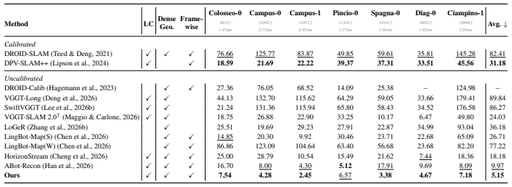
Table 2 : Absolute trajectory error (ATE, m) on VBR (Brizi et al., 2024). “–” denotes tracking failure. LC, Dense Geo., and Frame-wise denote loop closure, dense geometry, and per-frame tracking, respectively. LingBot-Map(S/W) denote the streaming/window modes. † VGGT-SLAM 2.0 uses native keyframes only and is excluded from ranking. The best and second-best results in each section are shown in bold and underlined, respectively.
Original paper · CC BY 4.0On KITTI, Map2SLAM averages 7.56 m, compared to 13.56 m for ABot-Recon and 17.91 m for HorizonStream. The best complete calibrated baseline on KITTI, DPV-SLAM++, averages 31.75 m.
Map2SLAM ranks first or second on 26 of the 28 sequences across the three benchmarks. The authors describe this advantage as consistent across sequences rather than limited to a few runs.
ORB-SLAM3 appears only on KITTI, and MASt3R-SLAM is omitted from all three benchmarks because it fails frequently. VGGT-SLAM 2.0 is shown for reference only, since it reports poses at keyframes and isn't ranked.
Which components earn their place in the ablations
Causal Tracking alone gives a mean ATE of 15.277 m over KITTI sequences 00 to 10. Adding Loop Retrieval and iPGO without the geometric check raises the mean ATE to 71.825 m, because false loop candidates reach the pose graph. Pairwise Geometry is the step that filters these candidates, and the authors call it critical for that job. With the geometric check in place, the mean ATE drops to 7.534 m, so removing the check is what lets the false loops in.
The loop candidates are judged by a two-view bidirectional depth consistency score, so a candidate passes only when its geometry agrees.
On VBR diag train0, GNC-TLS avoids a trajectory failure, and ATE falls from 35.641 m without it to 4.489 m with it. On the KITTI mean, adding GNC-TLS moves ATE only from 7.534 m to 7.568 m, so its average effect is small. GNC-TLS weighs each verified loop against the sequential constraints, and loops with weight below 0.5 are dropped from the active set.
Dense refinement runs only at sequence end, so online global correction comes from iPGO.
Is the cached-token retrieval head good enough?
The retrieval head reuses tokens that the Frame Encoder already produces, so the extra cost stays small. A 1.8M-parameter SALAD aggregation head turns these cached tokens into a global descriptor, and the Frame Encoder stays frozen during training. The head trains for 10 epochs on GSV-Cities at 224×224 resolution, which takes about 2 hours on one NVIDIA RTX 5090D GPU with mixed precision.
Because the encoder weights don't change, the head's training leaves the tracking backbone untouched.
Averaged over MSLS-val, Pitts250k-test and SPED, the head reaches a mean Recall@1 of 88.2. That result sits close to the CNN-based baselines EigenPlaces at 88.5 and MixVPR at 89.0. It trails standalone DINOv2 models built for VPR, such as SALAD and BoQ. The authors don't push the head to match those models, because it only needs to propose loop candidates.
Pairwise Geometry then checks each retrieved pair before it enters the pose graph.
Among the late Frame Encoder blocks, intermediate features beat the final block for retrieval. Block 18 reaches the highest mean R@1 of 88.20, and Block 19 follows at 88.13. The authors link this pattern to earlier DINO-based VPR work, where performance can peak before the final transformer layer. The authors take this as support for applying the head directly to cached intermediate tokens at the runtime shape.
Limits of the evidence
Dense geometric refinement runs only after the sequence ends, so online trajectory correction depends on iPGO alone. Refinement can't correct drift while the camera is still moving, so the online stage has no dense-geometry fix. The paper doesn't test a variant that runs dense optimization online, so its effect on long-run drift stays unmeasured.
The main evaluation covers KITTI, VBR and Oxford Spires only, so other driving or indoor benchmarks remain untested. MASt3R-SLAM is omitted from all three benchmarks because it fails too often, and ORB-SLAM3 appears only on KITTI. VGGT-SLAM 2.0 is included for reference only, since it reports poses at keyframes, so its rank is not counted.
Because MASt3R-SLAM is absent, the comparison to a dense real-time SLAM baseline isn't made on these benchmarks.
The retrieval descriptor trails DINOv2-based SALAD and BoQ on VPR, with a mean R@1 of 88.2 against those baselines. The authors keep the descriptor because it proposes loop candidates, and Pairwise Geometry then filters them. Block 18 was chosen on the same VPR benchmarks, so the choice of block isn't held out from the reported scores. The authors also note that free segment alignment improves local geometry at the cost of global consistency.
Fixing the alignments to the iPGO solution recovers the mean ATE, but the trade-off isn't resolved for free alignment.
Paper info
- Authors
- Jian Gao, Lin-Zhuo Chen, Yihang Chen, Jiagang Chen, Jiacheng Dong, Xun Cao, Nan Xue, Yinghao Xu, Yao Yao
- Venue
- arXiv · Preprint
- First published
- 2026-11-8
- Added
- 2026-11-10
- Updated
- 2026-11-8
- Version
- v1
- arXiv
- 2611.11169
- Category
- cs.CV
- Original paper terms
- CC BY 4.0
- What we show
- Paper info, commentary and permitted figures from the original paper
AI commentary is a separate explanation from the original paper and may contain errors. The original paper and figures follow each source's terms of use and any rights noted separately.
Abstract
Streaming 3D foundation models (3DFMs) estimate camera poses and dense geometry online, but they fall short of SLAM: their predictions are fixed once emitted, so loop closures cannot correct accumulated drift. With such models already providing strong geometric capability, a central question for SLAM becomes how to schedule their inference and how to keep its results as revisable state. We present Map2SLAM, which keeps LingBot-Map frozen, trains only a lightweight retrieval head, and builds SLAM on the model's inference interface, turning its predictions into observations of an external persistent SLAM state. The front-end tracks every incoming frame with the model's causal streaming inference and decides which frames are written to the persistent state as keyframes. The back-end asynchronously decides when and which past frames to re-observe, re-running the model's joint inference over them with fresh context; verified loop observations correct the trajectory online, and segment observations refine dense geometry after the sequence. All invocations share a single frame encoder pass per image, whose cached features also drive loop retrieval, so frequent re-invocation incurs no additional encoding cost. Map2SLAM achieves state-of-the-art performance on KITTI, VBR, and Oxford Spires, reducing mean ATE by over 40% compared with the best uncalibrated baselines, while maintaining real-time tracking at over 28 FPS at a resolution of $518\times154$ on an NVIDIA RTX 5090D GPU. Please visit our project page at https://robbyant-research.github.io/Map2SLAM/.
Quote from the paper
Jian Gao, Lin-Zhuo Chen, Yihang Chen, Jiagang Chen, Jiacheng Dong, Xun Cao, Nan Xue, Yinghao Xu, Yao Yao (2026). Map2SLAM: From Streaming Map Prediction to Real-Time SLAM. arXiv:2611.11169v1. https://arxiv.org/abs/2611.11169v1
BibTeX
@misc{gao2026map2slam,
  title = {{Map2SLAM: From Streaming Map Prediction to Real-Time SLAM}},
  author = {Jian Gao and Lin-Zhuo Chen and Yihang Chen and Jiagang Chen and Jiacheng Dong and Xun Cao and Nan Xue and Yinghao Xu and Yao Yao},
  year = {2026},
  eprint = {2611.11169},
  archivePrefix = {arXiv},
  url = {https://arxiv.org/abs/2611.11169v1}
}