Paper commentary
Uncertainty-Guided Reward Labeling for Reinforcement Learning under Limited Feedback
Uncertainty-guided reward labeling lets RL learn from few labels by keeping queried rewards
- Problem Prior reward selection for limited-feedback RL treats queried rewards as consumed by the policy learner. Those rewards are never kept to train a reward model, so the labeling budget is spent without reducing reward uncertainty.
- Method SURE, which picks which transitions to label, keeps the labels to fit a reward model. Each round it scores unlabeled transitions by reachability times reward uncertainty, then queries the top one.
- Results On Maze2d-Medium, SURE reaches near full-feedback return with 0.20% of states labeled, compared with 1.74% for RLLF-GUIDED.
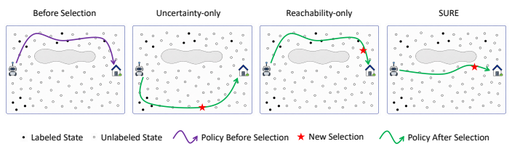
Figure 1 : Illustrative retained-label reward-selection example in a navigation task. The agent must reach the goal while avoiding a central obstacle. With the initial reward labels, the policy learned from the current reward model takes a long detour, while a more direct path remains possible. Uncertainty-only selection chooses a state where the reward model is uncertain, but the selected state may be far from trajectories that lead to high return. Reachability-only selection chooses a state that can lead toward regions assigned high value by the current reward model, but this estimate can be misleading when the reward model is inaccurate. SURE combines both signals, selecting for labeling a reward that is uncertain under the current reward model and lies on a reachable path toward currently high-value states, yielding a better policy with fewer reward labels. available. They do not address the question of which additional transitions should be selected for reward labeling. Information-directed reward learning (IDRL) is the closest related approach, as it actively queries feedback to learn a reward model for policy optimization. However, it acquires feedback online to distinguish the returns of candidate high-performing policies, rather than to determine which transitions in an offline dataset should be reward-labeled [ 26]. This leaves open the problem ofretained-label reward selection: actively selecting a small subset of transitions from a fixed, offline dataset for reward labeling, so that a reward model trained on those labels can annotate the remaining transitions and enable learning a high-performing policy from the resulting dataset.
Original paper · CC BY 4.0 · Renhao Zhang, Shreyas Chaudhari, Bruno Castro da Silva · Uncertainty-Guided Reward Labeling for Reinforcement Learning under Limited Feedback · Original paper figure · Extracted the figure area from page 2 of the original PDF.Why choosing labels is the bottleneck
Offline datasets often hold many transitions, but reward labels exist for only a small share of them. Each label can require a human judgment or an expensive simulation, so labeling everything isn't practical. The bottleneck therefore shifts from data collection to reward acquisition, and the central question becomes which subset to label.
Prior RLLF work studies this choice, but its queried rewards are consumed by the policy learner instead of being kept.
Partially labeled offline RL takes another route: the labels fit a reward model that annotates the rest of the dataset. Methods such as PDS take the labeled subset as given, so they don't say which extra transitions deserve a label. IDRL is the nearest related idea, but it queries feedback online to separate candidate policies, not to pick transitions in a fixed dataset.
That gap defines retained-label selection: pick a small set of transitions whose labels train a reward model that annotates the rest. Selected rewards affect policy learning only through the reward model they induce, so the choice matters. Selection cannot change the fixed offline dataset, so it can only shrink the reward-uncertainty term of the bound.
A bound that isolates the effect of labels
The authors bound the suboptimality of the policy learned from the labeled set Y^{[b]} after b selections, with probability at least 1 minus 2δ. The bound has a fixed offline-data term Γ_off(D, δ), which depends only on the dataset and δ, and a label-dependent term. The label-dependent term is 2α_b divided by (1−γ), times the square root of the expected squared reward uncertainty under the optimal policy's occupancy.
Because a labeling budget can't change the fixed dataset, only this second term is open to selection.
The optimal occupancy is unknown during selection, so the authors define a weighted uncertainty objective Φ(Y^{[b]}; µ) for any reference measure µ. This objective is the expected value of σ_b(s,a)^2 under µ, and the one-step acquisition function Δ is the drop in Φ after adding one candidate (s, a). The authors read the numerator as favoring feature directions that µ emphasizes, and the denominator as discounting directions the current labels already cover.
The exact gain needs Σ(ρ_b) for each round, so the authors look for a cheaper score that keeps the same two ingredients. They take the successor-guided reachability measure ρ_b as the reference measure in place of the unavailable optimal occupancy.
How SURE scores each unlabeled transition
SURE scores a candidate by multiplying two factors, so a candidate needs both reachability and uncertainty to rank high. Figure 1 shows why neither signal alone is enough, since uncertainty-only selection can pick states far from high-return trajectories. Reachability-only selection can mislead when the reward model is inaccurate, which is the failure SURE is designed to avoid.
In each round, SURE refits the pessimistic reward model on the retained labels Y[b] and runs the offline RL learner to obtain the policy π[b]. The policy learned from the current reward model provides value estimates Q_b on the offline dataset, and the top-K transitions by Q_b serve as targets. For a candidate (s_i, a_i) and target (s', a'), the successor overlap is the product of the successor features ψ^{π[b]}(s_i, a_i) with ϕ(s', a').
Averaging this overlap over the targets gives H_b(s_i, a_i), which the authors normalize over the unlabeled candidates into a successor-guided distribution. Mixing that distribution with the empirical behavior distribution using the weight β_b in [0,1] gives the reachability measure ρ_b. The behavior mixture guards against concentrating on the current value estimate when those estimates are inaccurate.
The computable SURE score is ρ_b(s_i, a_i) times σ_b(s_i, a_i)^2 divided by (1 + σ_b(s_i, a_i)^2), and SURE queries the candidate with the highest score. The first factor prioritizes candidates that reach currently high-value targets while keeping behavior-policy coverage.
The exact one-step gain in Proposition 1 has a closed form under the linear-MDP assumption, depending on the reference measure and the current labeled set. SURE replaces the reference measure with ρ_b, because the optimal occupancy is unknown during selection.
Checking the score on exact linear MDPs
The authors build finite linear MDPs with the simplex-feature construction of Jin et al., so the theoretical assumptions hold by construction. The environments have 32 and 48 states, four actions, and offline pools of 4,096 transitions. EXACTGAIN picks the candidate that maximizes the exact one-step gain in equation (8), so it serves as the reference for SURE.
With 48 states, SURE and EXACTGAIN each need 12 labels to reach 90% of the full-feedback return. Both methods also hit the 95% threshold with the same 12 labels. UNIFORM needs 68 labels for 90% and 132 labels for 95%. Because SURE and EXACTGAIN need identical label counts at every threshold, the computable score matches the exact gain here.
Table 1 reports the labels needed for 80%, 90%, and 95% of the matched full-feedback return in both environments. Swapping the exact gain for the SURE score doesn't cost labels when the assumptions hold.
Label efficiency on four continuous domains
The authors test whether the lead holds when the feature map has to be learned from data rather than given. They evaluate four continuous-control domains: TwoRooms, Maze2d-Medium, Maze2d-Large and HalfCheetah. For each domain, every strategy starts from the same fixed reward-free dataset. The authors collect the TwoRooms dataset themselves and take the other three datasets from D4RL.
Every method then follows the PDS pipeline, with IQL as the learner that produces the final policy. Each curve is the mean over 50 trials, with shaded bands for standard error and a dashed full-feedback IQL reference.
SURE achieves the best or near-best return over the feedback range in all four domains. The strongest competing baseline changes from one domain to the next, so no single signal wins everywhere. In navigation tasks, REACH is often competitive because the most useful labels point toward the goal. Under that condition, UNCERTAINTY becomes the stronger single-factor baseline than REACH.
IDRL is competitive on the maze domains, where low-dimensional geometry makes return differences easier to estimate. IDRL degrades on HalfCheetah, where the higher-dimensional dataset makes its acquisition signal less reliable. RLLF-GUIDED often stays close to UNIFORM, which suggests that one-step predecessor guidance is too local for these datasets.
REACH is stronger in navigation domains, so multi-step successor-guided reachability gives a more useful signal than immediate predecessors.
The domains differ widely in size, which is why the next section normalizes feedback by each domain's state set.
Feedback needed to approach full-feedback return
The table reports 95%, 90% and 80% of the full-feedback reference, so each domain is judged on the same fractions. At the 95% level, SURE needs the least feedback in every domain. It labels 3.17% of states in TwoRooms, 0.20% in Maze2d-Medium, 0.15% in Maze2d-Large and 0.71% in HalfCheetah.
In Maze2d-Medium at 95%, IDRL is the closest competitor at 0.32%, versus 0.20% for SURE. In Maze2d-Large at 95%, UNIFORM needs 2.88% of states, while SURE needs 0.15%. The gap widens against mismatched single-factor baselines, since UNCERTAINTY needs about 18.6× more feedback than SURE on Maze2d-Large. REACH needs about 5.8× more feedback than SURE on HalfCheetah, reaching 95% only at 4.10%.
At the 90% level, SURE needs 0.12% in Maze2d-Medium, 0.09% in Maze2d-Large and 0.45% in HalfCheetah. At 80%, SURE needs 0.05% in Maze2d-Medium, while REACH needs 0.06% there. On HalfCheetah at 95%, UNCERTAINTY is the strongest baseline at 2.49%, still well above SURE's 0.71%. Some baselines keep improving with larger budgets, but they need much more feedback to hit the same levels.
Figure 2 stops at the range where SURE has largely converged, so the comparison in Table 2 covers that range.
Reach-only and uncertainty-only rankings on maze rounds
Figure 3 ranks candidate cells on maze rounds under four criteria, starting from two different labeled sets. Each row covers one labeled set, and the columns show the exact one-step gain, the Reach-only score, the Uncertainty-only score and the SURE score. The exact gain comes from adding 50 sampled transitions from each grid cell, so it serves as a visual reference.
In that case Reach overlaps the exact gain more, while Uncertainty highlights scattered regions with weaker alignment.
Here Uncertainty aligns better with the gain, whereas Reach concentrates near regions that already have labels. The remaining columns show this pattern, with darker colors marking higher selection density.
SURE overlaps well with the exact-gain cells in both scenarios because it combines the two signals instead of committing to one. The SURE score multiplies the reachability factor by the uncertainty-reduction factor, so a candidate needs both. The authors argue this matters more in higher-dimensional domains, where a labeled set can't be pictured as evenly spread or grouped.
The labeled distribution also shifts as more feedback arrives, so SURE adapts across selection rounds. This comparison is qualitative on representative maze rounds, so it supports the design choice without giving a measured ranking.
Swapping the offline RL backbone
The authors swapped the backbone to CQL and TD3+BC throughout the loop, not only at the final policy step. The swap covers the policy and value estimates that the SURE score uses to build its reachability term. IQL stays the backbone for every other experiment, which isolates the effect of reward-label acquisition. This backbone test runs on Maze2d-Medium and HalfCheetah.
CQL is the more theory-aligned check because it explicitly encourages conservative value estimates. The formal condition enters the analysis only through the pessimistic offline-learning guarantee in equation (3).
Table 3 reports the feedback needed to reach 90% of each backbone's own matched full-feedback reference.
Across both alternative backbones and both domains, SURE needs 4.4× to 13.7× less feedback than UNIFORM. The authors read this as evidence that the acquisition gain isn't specific to IQL. Their conclusion says SURE stays more label-efficient across domains and offline-RL backbones. They didn't test backbones beyond IQL, CQL, and TD3+BC. The warm-start sensitivity appears in Appendix E.7, which this section doesn't cover.
Where the guarantees and experiments stop
The theory in Theorem 1 assumes the MDP is linear, so the bound rests on that structure. The continuous-control runs learn their feature map, and the paper doesn't assume exact linearity there. Those runs therefore fall outside the formal condition that the suboptimality bound relies on.
The exact one-step gain comparison ran only on small linear MDPs with 32 and 48 states. In those MDPs, every method received the same known 8-dimensional feature map, which the larger domains don't provide. Computing the exact gain for every candidate costs per-round complexity of order d cubed plus (|D| minus b) times d squared. The computable SURE score avoids that candidate-wise matrix-vector scoring, so it can run on larger datasets.
Continuous-control results average 50 trials per strategy, with shaded regions showing the standard error. The backbone checks cover only CQL and TD3+BC, and only on Maze2d-Medium and HalfCheetah. The authors didn't test other offline-RL learners, and they didn't extend the comparison beyond the five domains.
The ablation in Figure 3 is visual and covers representative maze rounds only. It shows how the Reach, Uncertainty and SURE scores rank cells, but it doesn't score those rankings numerically. So the claim that SURE tracks the high-gain regions rests on visual overlap.
Paper info
- Authors
- Renhao Zhang, Shreyas Chaudhari, Bruno Castro da Silva
- Venue
- arXiv · Preprint
- First published
- 2026-11-8
- Added
- 2026-11-10
- Updated
- 2026-11-8
- Version
- v1
- arXiv
- 2611.11091
- Category
- cs.LG
- Original paper terms
- CC BY 4.0
- What we show
- Paper info, commentary and permitted figures from the original paper
AI commentary is a separate explanation from the original paper and may contain errors. The original paper and figures follow each source's terms of use and any rights noted separately.
Abstract
In reinforcement learning from limited feedback (RLLF), only a small fraction of an offline dataset can be labeled with rewards, and the central question is which samples should be labeled to learn a high-performing policy from the resulting partially labeled dataset. Prior work formalized this as a reward-selection problem by focusing on the selection stage while treating downstream policy learning as a black box, in a regime where queried rewards are not retained for reward-model training. We instead study the retained-label setting, where queried rewards can be stored and used to fit a reward model before policy learning. We bound the suboptimality of the learned policy in terms of two sources of error: one arising from offline RL on a fixed, offline dataset, and the other from uncertainty in the reward model. Since reward selection cannot change the offline dataset, the limited labeling budget must be used to strategically reduce reward uncertainty. Motivated by RLLF's observation that useful rewards tend to keep the agent on high-return trajectories, we introduce Successor-Guided Uncertainty REduction (SURE), a novel method that uses successor features to select rewards that are both uncertain and associated with states from which high-valued states are reachable. We formally derive SURE from a bound-induced design objective and characterize its exact one-step marginal gain. Empirically, SURE reaches near full-feedback performance with few reward labels across a variety of domains and offline-RL backbones, yielding an effective method for feedback-efficient reinforcement learning.
Figures from the paper

Table 1 : Number of reward labels required to reach 80% / 90% / 95% of the matched full-feedback return in exact linear MDPs, averaged over 30 paired seeds. Full feedback corresponds to labeling all 4,096transitions in the offline pool.
Original paper · CC BY 4.0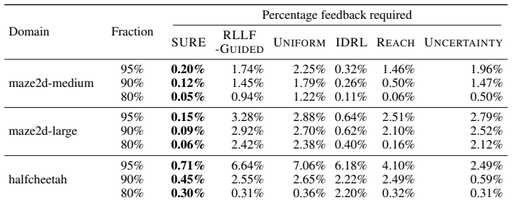
Table 2 : Percentage feedback needed to reach different fractions of thefull-feedback reference. The “Fraction” column specifies the target return as a fraction of thefull-feedback reference; “Percentage feedback required” reports the fraction of distinct states that must be labeled to reach that target.Bold indicates the smallest percentage feedback in each row.
Original paper · CC BY 4.0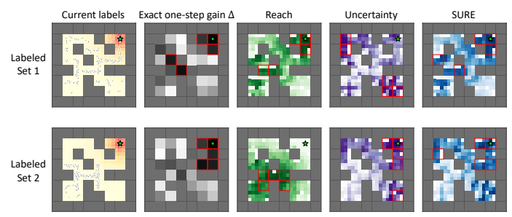
Figure 3 : Ablation of the SURE score on representative maze rounds. Each row shows a different stage of selection. From left to right: acquired feedback locations, exact one-step gain ∆(s, a;Y[b], ρb), Reach-only score, Uncertainty-only score, and SURE score. Red boxes mark the highest-scoring cells under each criterion, and the green star denotes the goal region.
Original paper · CC BY 4.0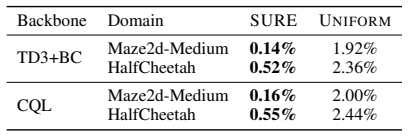
Table 3 : Percentage feedback required to reach 90% of each backbone’s own matched full-feedback reference, averaged over50paired seeds.
Original paper · CC BY 4.0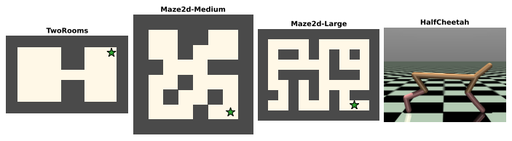
Figure 4 : Visualization of the four evaluation domains. From left to right: TwoRooms, Maze2d- Medium, Maze2d-Large, and HalfCheetah-Medium-Replay.
Original paper · CC BY 4.0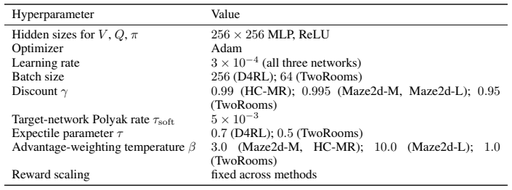
Table 4 : IQL hyperparameters.
Original paper · CC BY 4.0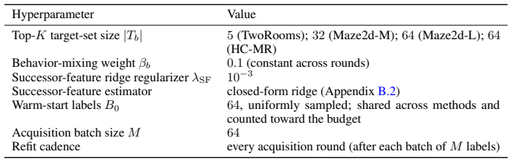
Table 5 : SURE acquisition-score hyperparameters.
Original paper · CC BY 4.0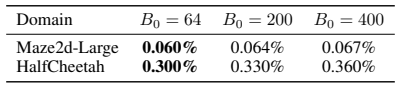
Table 6 : Percentage feedback required by SURE to reach 80% of the matched full-feedback return under different warm-start sizesB 0, averaged over50paired seeds.
Original paper · CC BY 4.0Quote from the paper
Renhao Zhang, Shreyas Chaudhari, Bruno Castro da Silva (2026). Uncertainty-Guided Reward Labeling for Reinforcement Learning under Limited Feedback. arXiv:2611.11091v1. https://arxiv.org/abs/2611.11091v1
BibTeX
@misc{zhang2026uncertainty,
  title = {{Uncertainty-Guided Reward Labeling for Reinforcement Learning under Limited Feedback}},
  author = {Renhao Zhang and Shreyas Chaudhari and Bruno Castro da Silva},
  year = {2026},
  eprint = {2611.11091},
  archivePrefix = {arXiv},
  url = {https://arxiv.org/abs/2611.11091v1}
}