Paper commentary
Lightfoot: Graph Retrieval-Augmented Generation with Exact, Model-Free Document Deletion
Lightfoot builds and deletes GraphRAG documents exactly, without model calls
- Problem Graph-based RAG is costly to build and hard to update, because removing a document leaves merged entity descriptions and community reports tied to it. Existing systems either lack a deletion path or must rerun model calls to rebuild the index.
- Method Lightfoot derives every graph record from per-passage extractions that carry chunk-level provenance. Deleting a document removes its extractions and recomputes only the touched components, so no model call is needed.
- Results After deleting 10% of MuSiQue documents, the graph matched a fresh index of the 10,262 surviving documents. Its index costs 26 to 31% less than HippoRAG 2.
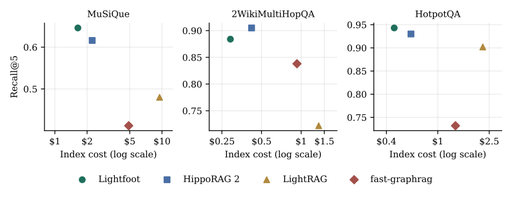
Figure 1 : Recall@5 against normalised index cost for each dataset. Points nearer the top left are better.
Original paper · CC BY 4.0 · Uday Allu · Lightfoot: Graph Retrieval-Augmented Generation with Exact, Model-Free Document Deletion · Original paper figure · Extracted the figure area from page 5 of the original PDF.Why GraphRAG indexes are hard to maintain
Plain similarity search misses multi-hop questions because the evidence sits in passages the question never names. The authors note that extraction dominates the index bill, so the cost of building a graph is the first thing to measure.
Deletion is the second property that published comparisons rarely measure. Retention rules, contract expiry and erasure requests all force a system to remove a document together with its derived data. A merged entity description has to be regenerated, so removing one document rewrites text built from many sources. A community report can't be attributed to its sources at all, which leaves no clean way to delete its share.
Machine unlearning addresses the same problem for model weights, but retrieval indexes usually go unmeasured.
The authors read the source code of 17 open-source GraphRAG frameworks. Five of them offer document-level deletion, yet none claims the result equals a graph that never held the document. Deleting the same documents cost LightRAG 2,187 model calls and 3.7 hours. fast-graphrag has no deletion path at all.
Because no record depends on a model call, deletion needs no model calls and stays exact. The authors check this at full corpus scale by deleting a seeded random 10% of documents. After deletion, the Lightfoot store matched a fresh index of the 10,262 surviving documents.
Deriving every record from chunk-level extractions
Lightfoot treats each chunk's extraction as the only source of truth and computes every derived record from those extractions. A form stores one occurrence of a name in a chunk, with its normalised name, its type and that chunk's description of the entity. An entity is a connected component of live forms, so its identifier and canonical name follow from the surviving forms alone.
Proposition 1 states that deleting set B from the store G(D) yields the store G(A).
Forms and fact assertions are per-chunk, so removing a chunk removes exactly what that chunk contributed. Components depend only on the live forms, so insertion order, batching and history don't change them. No record comes from a model call that reads several chunks, so no record mixes information from a deleted chunk. Deleting a set of chunks recomputes only the components and synonym edges it touched, and that yields the same records as indexing the survivors.
On the 11,402-passage MuSiQue corpus, the store after deleting 10,262 surviving documents matched a fresh index in every table. The fresh build made no model calls, and the fingerprints were identical.
Dropping the judge changed recall@5 by less than one point, and it saved 5,626 judge calls on the full corpus. That gap motivated the pairwise, history-free design, which is why deletion stays exact.
From one extraction call to a fused ranking
The call returns compact JSON listing up to 12 entities and up to 12 facts. Writing facts as arrays and dropping pretty-printing cut output from 436 to 269 tokens per passage in a 32-passage sample.
Retrieval starts by embedding the question with bge-base-en-v1.5 and then seeds a Personalized PageRank walk.
A local cross-encoder, bge-reranker-base, rescores those 30 passages. Its ranking is merged with the PageRank ranking by reciprocal rank fusion with k = 60, and that fused list is the retrieval output. The answer model, gpt-5.6-luna with reasoning turned off, is given the ten facts closest to the question, each with its quote, plus the top 10 passages in rank order.
Retrieval itself never calls a language model; only the final answer step does.
Does deletion really leave the same store
Each system's own API removes a seeded random 10% of MuSiQue documents during the audit. That deletion covers 1,140 of 11,402 documents, and every question is then re-run.
Lightfoot's post-deletion store was fingerprinted in one process. A second process built a fresh index of the 10,262 surviving documents from the extraction cache. The two fingerprints matched, and every table agreed exactly, including 68,455 entities and 63,514 synonym edges. The fresh build made no model calls, because it read the cached extractions.
That gap motivated the pairwise, history-free design of §3.2.
On 2WikiMultiHopQA and HotpotQA, the same kind of deletion took 165 and 330 calls. fast-graphrag has no deletion API, so its index must be rebuilt from scratch.

Table 4 : Deleting a seeded 10% of MuSiQue documents (1,140 of 11,402). Recall@5 on questions whose evidence survived (intact) and on questions whose evidence was deleted.
Original paper · CC BY 4.0On questions whose evidence survived, Lightfoot recall@5 rose from .648 to .661 after deletion. HippoRAG 2 moved from .625 to .639, and LightRAG moved from .491 to .507 on the same questions. For questions whose evidence was deleted, Lightfoot's recall@5 fell to .369. HippoRAG 2 dropped to .333 and LightRAG to .292 on those questions. That sharp fall shows the deleted information left retrieval, as the audit intended.
Accuracy against HippoRAG 2 and the other baselines
On MuSiQue retrieval, Lightfoot pulls ahead of HippoRAG 2 on the held-out questions 501 to 1000. Recall@5 is 2.8 points higher, with an interval from +0.5 to +5.1. The gap grows with k, reaching +4.3 points at recall@10 with an interval from +2.5 to +6.2.
The F1 gap on 2WikiMultiHopQA is −8.4 points, with an interval from −12.9 to −4.2. HippoRAG 2's model-based fact filter plausibly explains this, because most 2WikiMultiHopQA questions compare two named entities. On HotpotQA, exact match is 7.7 points higher for Lightfoot, with an interval from +3.0 to +12.3.
Answer scores on 300 questions move by noise alone. Between two runs that differed only in passage count, about 30 of 300 answers flipped. The authors therefore treat answer differences below roughly 4 points as ties, so the 3.4-point MuSiQue exact-match gap is a tie. Across the 15 comparisons with HippoRAG 2, Lightfoot is significantly better on 5 and significantly worse on 2.
Both significant losses fall on 2WikiMultiHopQA, and the remaining 8 comparisons are ties.
Lightfoot's retrieval settings were tuned on MuSiQue questions 1 to 500 only. The authors didn't test HippoRAG 2 with the 7B embedder used in its paper, so its absolute scores sit below those published.
Index cost and what drives it
On MuSiQue, Lightfoot's index costs $1.64, against $2.23 for HippoRAG 2, $4.89 for fast-graphrag and about $9.5 for LightRAG. Across the three datasets, Lightfoot's index is 26 to 31% cheaper than HippoRAG 2. It is also roughly 3 to 6 times cheaper than LightRAG and fast-graphrag. Every cost uses one fixed list price per model, so provider routing can't distort the comparison.
The gap follows mostly from model calls per passage, which the authors count alongside the price. Lightfoot makes 1.0 call per passage, while HippoRAG 2 makes 2.0, fast-graphrag 1.1 and LightRAG 2.5. HippoRAG 2 pays for two extraction calls per passage, which is why its index costs more. LightRAG adds further model calls to merge duplicate entity descriptions.
Lightfoot's extraction uses exactly one call per passage.
At query time, Lightfoot's retrieval makes no model call, while each baseline makes one per question. The baselines' per-question calls cover keyword extraction in LightRAG, fact filtering in HippoRAG 2 and query entity extraction in fast-graphrag. Median retrieval-only latency on MuSiQue, with the answer call excluded, was 0.53s for Lightfoot.
HippoRAG 2 took 1.56s on the same measure, and LightRAG took 0.81s. Latency with the answer call included varied with provider load, so the authors didn't compare it. The authors put answer cost at about $0.06 per 100 answers for Lightfoot, similar across systems.
Which parts of the pipeline carry the gain
Fusing the cross-encoder ranking with PageRank, rather than using the PageRank order alone, gave the biggest single gain, 3.4 points of recall@5. Turning facts into weighted entity-to-entity edges left the recall numbers unchanged and cut the graph by 40%.
Dropping the judge on name pairs scoring 0.80 to 0.92 moved recall@5 by under one point, which is noise over 141 questions on a 2,000-passage slice. The judge removal also saved 5,626 judge calls on the full corpus. The hybrid channel lifted gold-passage coverage of the context from 0.852 to 0.873 on one MuSiQue slice. Answer token counts grew by 35%, yet answers didn't reliably improve.
Each way of picking 10 passages from the combined graph and hybrid lists retrieved fewer gold passages than the graph list did on its own. Replacing the earlier eight-passage context, which included entity descriptions, with a ranked list of ten passages lifted HotpotQA exact match by 2.3 points. The other two datasets showed changes within noise.
In the run that included the hybrid channel, 183 of the 300 answered MuSiQue questions were wrong. For 109 of those, at least one gold passage was absent from the context, and the other 74 had every gold passage present. The first hop's entity is named in the question in 83% of cases, while the second hop's is named in 36% and the third and fourth hops' in 28%.
Keyword or dense lookups on the question itself never surface these passages; only walking the chain does. Starting the walk from the two closest facts can lock onto side details like release dates instead of the bridging fact. The authors suggest that HippoRAG 2's model-based fact filter targets this same problem, which may explain its lead on 2WikiMultiHopQA.
Two silent baseline failures would have distorted the comparison. LightRAG's first index run hit an embedding timeout, stopped most insertions, yet returned without error, leaving 31% of chunks indexed. HippoRAG 2 halted indexing once 24 of its 11,402 extraction results turned out to be invalid JSON. A lenient parser in the adapter recovered 11,397 of those passages, and five passages were indexed without entities.
What the evidence doesn't cover
The Lightfoot retrieval settings were tuned on MuSiQue questions 1–500 only, so that half of one dataset carried all the tuning. The 2WikiMultiHopQA and HotpotQA datasets were never used for tuning, which keeps them as untuned checks. Lightfoot is cheaper to index on all three datasets, yet its accuracy advantage doesn't hold uniformly across them.
The 2WikiMultiHopQA and HotpotQA results use 300-question samples, not the 1,000 questions that prior work commonly uses. With answers that small, differences below roughly 4 points on 300 questions should be read as ties.
The deletion exactness check covers Lightfoot only, so the authors can't claim the same property for the baselines. The authors note that HippoRAG 2's provenance-based deletion may also be exact, but they didn't test it. Every system shares one extraction model and one embedder, so HippoRAG 2 runs without the 7B embedder used in its paper.
Its absolute scores therefore sit below the published numbers.
The evaluation doesn't include corpus-level summarisation questions, which are the target of community-summary systems. The benchmarks therefore say nothing about how Lightfoot handles questions that summarise a whole corpus. The conclusion points to model-free second-hop retrieval as the next step for the remaining accuracy gap.
Paper info
- Authors
- Uday Allu
- Venue
- arXiv · Preprint
- First published
- 2026-11-7
- Added
- 2026-11-10
- Updated
- 2026-11-7
- Version
- v1
- arXiv
- 2611.11010
- Category
- cs.AI · cs.CL · cs.IR
- Original paper terms
- CC BY 4.0
- What we show
- Paper info, commentary and permitted figures from the original paper
AI commentary is a separate explanation from the original paper and may contain errors. The original paper and figures follow each source's terms of use and any rights noted separately.
Abstract
Graph-based retrieval-augmented generation (GraphRAG) improves multi-hop question answering, but deployed systems face two costs that research comparisons rarely measure: building the graph, and removing documents from it. We present Lightfoot, a GraphRAG system in which every entity, link, fact and synonym edge is a deterministic function of per-passage extractions carrying chunk-level provenance. Indexing makes one language-model call per passage, retrieval makes none, and deleting a document is a database operation with no model calls. On the full 11,402-passage MuSiQue corpus we verify that, after deleting 10% of the documents, the graph is identical to a fresh index of the surviving documents. We compare Lightfoot with HippoRAG 2, LightRAG and fast-graphrag under identical extraction, answer and embedding models on MuSiQue, 2WikiMultiHopQA and HotpotQA. Lightfoot builds the cheapest index on all three datasets, 26-31% below HippoRAG 2 and 3-6x below LightRAG and fast-graphrag. Against HippoRAG 2 it is significantly better on MuSiQue retrieval (+2.8 points recall@5 and +4.3 recall@10 on a held-out split) and on HotpotQA answers (+7.7 points exact match), and significantly worse on 2WikiMultiHopQA (-3.9 recall@2, -8.4 F1). Deleting the same documents took LightRAG 2,187 model calls and 3.7 hours; fast-graphrag has no deletion path. Code and per-question results: https://github.com/udayallu-ml/Lightfoot-GraphRAG
Quote from the paper
Uday Allu (2026). Lightfoot: Graph Retrieval-Augmented Generation with Exact, Model-Free Document Deletion. arXiv:2611.11010v1. https://arxiv.org/abs/2611.11010v1
BibTeX
@misc{allu2026lightfoot,
  title = {{Lightfoot: Graph Retrieval-Augmented Generation with Exact, Model-Free Document Deletion}},
  author = {Uday Allu},
  year = {2026},
  eprint = {2611.11010},
  archivePrefix = {arXiv},
  url = {https://arxiv.org/abs/2611.11010v1}
}