Paper commentary
Improving Analytic Constants via Interpretable AI-Guided Lean Proof Refinement
AI agent tightens proof bounds on analytic constants by refining a fixed Lean blueprint
- Problem Proofs of analytic constants contain loose intermediate estimates that are hard to tighten by hand. Rewriting the whole argument is hard to check and produces proofs nobody can follow.
- Method The method keeps a Lean blueprint, a graph of definitions, lemmas and theorems, with its dependencies fixed. An AI agent then edits only the intermediate estimates, so local gains propagate to a verified final bound.
- Results The agent raises the certified Korenblum lower bound from 0.3554 to 0.356565. It also gives an explicit Grothendieck upper bound, improving Krivine's 1977 bound.
Why analytic constant bounds stall
Bounds on analytic constants often come from long chains of inequalities, and many links in those chains are loose but convenient estimates. Tightening one such link can require nontrivial mathematical insight, even when the high-level proof structure stays intact. A full re-derivation is the obvious alternative, but it is hard to check and can yield an opaque proof nobody can follow.
The approach here is narrower: keep the high-level argument and improve only the slack inside it.
The Grothendieck constant shows the pattern clearly, since its upper bound rests on a rigid chain of analytic estimates. That chain perturbs a rounding partition, inverts the resulting correlation map, and controls Taylor coefficients by complex-analytic certification. Those concrete choices make the chain a natural target for AI-driven proof refinement.
Braverman et al. showed that Krivine's bound is suboptimal, but they gave no explicit numerical bound. The payoff is real, because these constants matter in approximation algorithms and quantum information.
Any tightening still has to pass two checks, since symbolic deductions and numerical estimates both need verification. A new idea therefore has to survive a checked argument, not just a plausible calculation. The bottleneck is thus less about finding a good idea than about carrying that idea through the checks.
A fixed dependency graph as the unit of change
A partially formalized Lean blueprint is a directed acyclic graph of definitions, lemmas, and theorems, paired with a Lean formalization that establishes a bound T(b). Each node is one of three kinds: a background fact, a deduction that Lean checks, or a numerical estimate certified by interval arithmetic. The key move is to freeze this dependency graph, so the agent edits only the intermediate estimates and the bound they propagate to.
The agent may also introduce auxiliary lemmas, discover new identities, or optimize intermediate parameters, provided the dependencies stay fixed.
Lean is slow at numerics, so the authors introduce some intermediate numerical lemmas as Lean axioms. Each such axiom is backed by a formal Arb certificate, so the reader doesn't have to trust the bound on faith. Background facts stay as explicit assumptions or Lean proofs, which keeps the stable part of the argument out of the agent's search.
The Archimedes polygon example shows the mechanics in miniature. The blueprint bounds sin x from below by x minus x cubed over c, and bounds pi by 4, with c set to 4 at the start. The final bound then gives kappa equal to 4 over c, so the initial choice yields kappa equal to 1. When the agent replaces the sine inequality with the sharper estimate x minus x cubed over 6, c moves from 4 to 6 and kappa drops to 2/3.
One refinement loop, step by step
The agent works inside a frame that stays fixed, so each refinement only touches the quantitative parts of the proof. Inside that frame, the agent identifies a loose intermediate estimate and proposes a sharper one. It can also add auxiliary lemmas, find new identities, or tune parameters, as long as the dependency graph stays the same. The agent implements each change in Lean, so the edit lives in the actual formal proof rather than in a sketch.
A human seeds the blueprint, and the loop then runs with a planner, a generator and an evaluator. Each candidate edit must compile in Lean and pass the interval arithmetic check before it is scored. An edit counts as a proof refinement only if it improves the final bound and keeps the dependency graph unchanged.
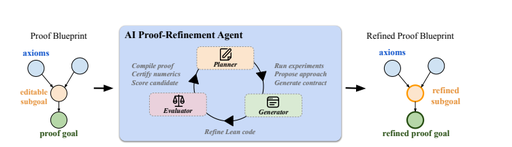
Figure 1 : AI-guided proof refinement. A human-seeded proof blueprint exposes editable lemmas and numerical certificates. An AI agent proposes local edits, the verifier checks Lean obligations and interval arithmetic certificates, and the result is fed back as the optimization signal.
Original paper · CC BY 4.0 · Rahul Saha, Alan Li, Anton Xue, Swarat Chaudhuri, Adam Klivans, Pravesh K. Kothari, Raghu Meka · Improving Analytic Constants via Interpretable AI-Guided Lean Proof Refinement · Original paper figure · Extracted the figure area from page 2 of the original PDF.The authors tried two naive extremes for giving the agent context, and both failed in their experiments. Giving the agent only the problem statement wasted its budget on unproductive problem decompositions. Giving it the entire proof architecture at once was brittle, because the agent drifted toward overly general subgoals. The partial blueprint sits between these extremes, giving enough structure to see where a local gain propagates.
It avoids overloading the agent's context, and downstream dependencies stay explicit.
Grothendieck constant: from C_r to the final bound
Before this work, the published bounds placed K_G between 1.676 and 1.782. Krivine conjectured that K_G equals π/(2 log(1+√2)), and Braverman et al. disproved this without giving an explicit numerical constant. The authors took the proof structure of Braverman et al. as their starting point. A tighter bound on C_r translates directly into a tighter bound on K_G, so the loop searches for sharper C_r bounds.
Figure 5 tracks how the bound moved over refinement iterations, with red marks for strategies that experts judged interesting.
The authors credit exact identities for derivatives of the inverse map, which replace worst-case estimates with structural formulas. They also say several of these identities are new in this setting. Some agent-found integral identities made the numerical evaluations far better conditioned. Before that change, Arb regularly timed out, while the same computation afterward took seconds.
Korenblum constant: from 0.3554 to 0.356565
The Korenblum constant K_K is the supremum of admissible radii, which measures how thin an outer annulus can be. Korenblum posed the problem in 1991, and Hayman proved that a positive admissible radius exists. The framework uses Wang's lower bound of 0.3554 as its baseline for proof refinement.
Wang's proof controls how much the squared magnitude of f can exceed that of g on the inner disk. The agent targets Step 3 of Wang's proof, which bounds the inner excess through the term Delta_in(c). That step is where the analytic slack remains, so local sharpening there can propagate to the final radius.
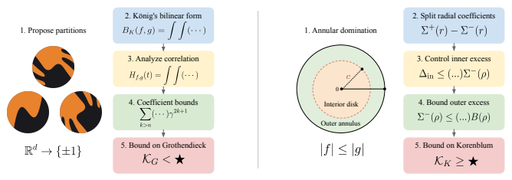
Figure 6 : The high-level strategies for bounding Grothendieck’s constant KG in Braverman et al. [9] (left) and Korenblum’s constant KK in Wang [47] (right). In each case, the final constant bound is dependent on a number of prior steps with analytical slack, which our framework tightens.
Original paper · CC BY 4.0The agent raises the certified lower bound from 0.3554 to 0.356565. Sharper integral estimates and new reformulations of the inner excess account for the gain. A single replacement of Wang's radial envelope carries most of the improvement, according to the appendix summary. Before the integral identities, Arb regularly timed out on these computations.
After the identities, the same computation took on the order of seconds.
The ablations rerun the Korenblum case from a checkpoint at c equal to 0.35646. They didn't test a larger token budget for every configuration, only the basic agent at three times the budget. Under that extended budget the basic agent reached c equal to 0.35653, still below the full framework.
Which components the gains depend on
The authors ablate the partial blueprint and the agentic system on both constants, against a full framework as reference. The basic agent reduces the agentic system to one tool-less model call per iteration, with a harness running the build and evaluator. The no agent configuration uses independent one-shot samples with no feedback, and keeps the best sample.
The no partial formalization configuration keeps the full agentic system but only the published bound as an axiom. Each configuration runs until it matches the full framework's wall clock and output tokens, so the budgets are matched.
Without the partial formalization, nothing improves on either constant. The agent still wrote 5,646 lines of Lean on Korenblum, with all evaluator runs passing. It had no intermediate claim to sharpen, so it spent its budget trying to rebuild one.
The authors read this as progress degrading as more of the agentic system is removed.
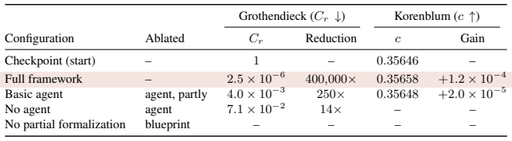
Table 3 : Ablations at a matched budget, one run per configuration, against the full framework (shaded). Arrows give the direction of improvement. Cr enters the KG multiplicatively, so we report its ratio to the checkpoint. A dash in a result column means no accepted candidate improved on the checkpoint.
Original paper · CC BY 4.0On Korenblum, the full framework lifts the certified radius from 0.35646 to 0.35658. The basic agent reaches 0.35648 under the same matched budget, a smaller gain. Given three times the budget, the basic agent reaches 0.35653, still below the full framework. The authors attribute the basic agent's shortfall to build failures, each of which cost a full model call.
What the results do not yet settle
The framework still leans on certified numerics, because Lean isn't meant to be a high-performance interval arithmetic backend. So the authors send the numerical computations to Arb, whose interval certificates the Lean blueprint can use. The setup also needs expertise, since a user must decide which parts of the proof are editable and what counts as a valid refinement.
Each new problem asks for that judgement again, so the method doesn't yet come with a ready recipe.
The Grothendieck gains come from a single run, and the authors report stability across five independent restarts from V0. Across those five runs the improvement averaged 7.3 ± 2.3 orders of magnitude, with a range of 4.7 to 10.5. The spread is wide, so the size of any one trajectory's gain depends on how that run unfolded.
The two new numerical oracles in the Grothendieck tool-less configurations have not had an independent dense-sampling cross-check. The evaluator re-verified them, but the authors didn't run that independent check, so their correctness rests on the evaluator alone. The full framework's result doesn't depend on those oracles, according to the authors.
The tool-less configurations ran in the same agent runtime with tools disallowed rather than through a bare API call. The authors say this setup favors the ablated configurations, because the system prompt stayed present. Each configuration is a single run, so the authors don't claim a variance estimate for the ablations.
Both constants have moved since submission, so the reported bounds describe the state of the literature at submission.
Paper info
- Authors
- Rahul Saha, Alan Li, Anton Xue, Swarat Chaudhuri, Adam Klivans, Pravesh K. Kothari, Raghu Meka
- Venue
- arXiv · Preprint
- First published
- 2026-11-7
- Added
- 2026-11-10
- Updated
- 2026-11-7
- Version
- v1
- arXiv
- 2611.10961
- Category
- cs.AI · cs.LG · math.NA
- Original paper terms
- CC BY 4.0
- What we show
- Paper info, commentary and permitted figures from the original paper
AI commentary is a separate explanation from the original paper and may contain errors. The original paper and figures follow each source's terms of use and any rights noted separately.
Abstract
AI agents are increasingly capable of discovering new mathematical results, yet their reasoning and generated proofs can be difficult to understand and verify. We introduce an interpretable framework for AI-guided mathematical discovery, focused on improving quantitative bounds on analytic constants. Our key insight is that existing proofs often contain slack in intermediate lemmas, which can be tightened without reconstructing the entire argument. To exploit this structure, we represent proofs as partially-formalized Lean blueprints: human-interpretable dependency graphs of definitions, lemmas, and theorems. An AI agent then iteratively refines the Lean code while preserving the blueprint's dependency structure, allowing local improvements to automatically propagate to a verified final bound. This interpretable structure allows humans to inspect the agent's refinements and understand how local improvements propagate to the final theorem. For Grothendieck's constant ($\mathcal{K}_G$), we obtain $$ \mathcal{K}_G \leq \fracπ{2\log(1+\sqrt{2})} - 10^{-17}, $$ an explicit numerical improvement over Krivine's 1977 bound. For Korenblum's constant ($\mathcal{K}_K$), we obtain $$ \mathcal{K}_K \geq 0.356565, $$ improving Wang's 2025 bound of $0.3554$. Our experiments demonstrate the potential of both partial formalization and iterative agentic refinement for interpretable mathematical discovery.
Quote from the paper
Rahul Saha, Alan Li, Anton Xue, Swarat Chaudhuri, Adam Klivans, Pravesh K. Kothari, Raghu Meka (2026). Improving Analytic Constants via Interpretable AI-Guided Lean Proof Refinement. arXiv:2611.10961v1. https://arxiv.org/abs/2611.10961v1
BibTeX
@misc{saha2026improving,
  title = {{Improving Analytic Constants via Interpretable AI-Guided Lean Proof Refinement}},
  author = {Rahul Saha and Alan Li and Anton Xue and Swarat Chaudhuri and Adam Klivans and Pravesh K. Kothari and Raghu Meka},
  year = {2026},
  eprint = {2611.10961},
  archivePrefix = {arXiv},
  url = {https://arxiv.org/abs/2611.10961v1}
}