Paper commentary
Seeing Isn't Enough: Unlocking Visual Reasoning by Bridging the Reasoning-Access Gap with TIGER
Text-trained reasoning can transfer to images when the gap is targeted directly
- Problem Multimodal models reason well over text but often fail on the same problem rendered as an image. Their perception is not the cause, since they read the image text accurately and recover near-text performance when given their own transcription.
- Method TIGER mines synthetic problems that the model solves as text but fails as a rendered image. It then post-trains the model on the image inputs with GRPO, instead of training on real multimodal annotations.
- Results On MathVerse, Qwen3-VL-8B rose from 54.5 to 65.8 with GRPO. TIGER was trained only on synthetic rendered-text images, and the gain carried over to held-out real benchmarks.
Why perception alone doesn't explain the drop
Multimodal models take their language backbones from text-trained LLMs, so one would expect them to carry text reasoning over to images. The dominant explanation blames perception: if a model can correctly extract the relevant visual content, it should reason over that content as well as it reasons over text.
The authors argue that seeing correctly is necessary but not sufficient to unlock reasoning. Their claim is that the failure is one of reasoning access: the model doesn't route the visual evidence it has perceived into reasoning abilities it already has. Existing multimodal benchmarks make this hard to test, because perception, grounding, abstraction and reasoning are entangled in one score.
So the authors test the same problem in two modalities and change only the input.
The diagnosis covers several model families, including Qwen2.5-VL, Qwen3-VL and InternVL3.5. Crucially, the gap isn't caused by perception errors, because models reach high OCR accuracy on the images. Feeding the OCR-extracted text back to the models largely recovers their original performance. That result suggests the reasoning capability sits in the language backbone but isn't accessed under visual conditioning.
The authors build on this diagnosis with TIGER, which targets the gap without manually curated multimodal data. TIGER starts from text-only reasoning datasets with verifiable answers and renders each problem as a semantically equivalent image. The model is then queried separately with both modalities, so the modality gap becomes a supervision signal.
Rendering the same problem as an image
The diagnosis starts from text-only reasoning problems, each paired with a verifiable answer. A rendering step turns each problem into an image, so the content stays the same and only the input modality changes. For each model, three inputs are run: the original text, the rendered image, and text extracted from the image by an OCR instruction.
The extracted-text condition acts as a perception control, so a drop on the image input can be separated from a misread image. OCR accuracy compares the extracted text with the original problem, which measures transcription fidelity directly.
On MATH-500, Qwen3-VL-8B scores 75.53±0.42 with text input, the highest text baseline among the four models in Table 2. Across the four model families, image inputs fall below each model's text baseline under both MATH-500-I and MATH-500-SI rendering. Table 2 places the text, extracted-text and image rows side by side, with red marking degradation against the text baseline.
OCR accuracy stays high, so the drop doesn't start at reading the image.
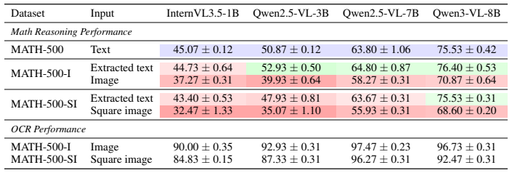
Table 2 : Performance on semantically equivalent text and image versions of MATH-500. Scores are colored relative to each model’s text baseline (purple): compared to the text-level performance, red indicates degradation, while green indicates an increase. Despite identical semantics, all models consistently perform worse on image inputs, revealing a robust modality reasoning-access gap. This gap persists across both rendering schemes (MATH-500-I and MATH-500-SI), indicating that it is not due to a specific transformation. OCR results remain high, suggesting that the bottleneck lies in reasoning from image-conditioned representations rather than reading ability.
Original paper · CC BY 4.0Feeding the OCR-extracted text back to the model largely recovers its original performance. The authors read this as a sign that the reasoning capacity sits in the language backbone but isn't reached under visual conditioning. So the gap survives once perception is ruled out, because the model reads the image correctly yet reasons worse from it.
Mining text-solved, image-failed cases
TIGER starts from text-only reasoning problems that come with verifiable answers, and it needs no image-text annotations. It renders each problem as an image that keeps the same content, so only the input modality changes. The model then answers both versions, and the pipeline keeps the problems it solves as text but misses as an image. The authors read these text-success, image-failure cases as evidence that the reasoning ability already sits inside the model.
The source problems come from OpenR1-Math-220, and each backbone gets its own training set built this way. Verification and filtering keep pairs with a correct text answer and an incorrect image answer. Stage 2 then trains with GRPO, using a correctness reward and a format reward. The same mined samples can also feed SFT or DPO, which serve as baselines.
Training targets the image input because that is where the failures occur, so the model learns to route visual content into its existing reasoning.
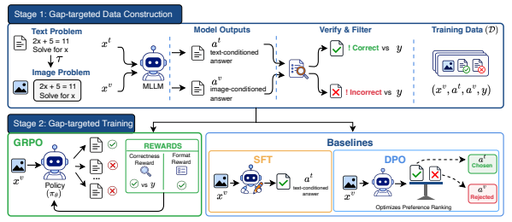
Figure 1 : Overview of the proposed pipeline. In Stage 1, we construct training samples by querying a MLLM with text and image versions of the same problem, then verifying and filtering the resulting outputs to retain pairs with correct text-conditioned answers and incorrect image-conditioned answers. In Stage 2, the resulting data is used for gap-targeted training using GRPO to improve image- conditioned reasoning and comparing with alternatives like SFT and DPO.
Original paper · CC BY 4.0 · Gregory Kang Ruey Lau, Minh Huynh Nguyen, Bryan Kian Hsiang Low · Seeing Isn't Enough: Unlocking Visual Reasoning by Bridging the Reasoning-Access Gap with TIGER · Original paper figure · Extracted the figure area from page 3 of the original PDF.Every setting fine-tunes the full model with a batch size of 128, so the objectives compare on equal footing. Random sampling from OpenR1-Math-220 improves the base model but trails the mined set by 3.1 points. The gap-targeted set isolates cases where the model can reason but struggles to apply that reasoning to images. The gains are measured on benchmarks that are not in training, such as MathVerse and EMMA.
GRPO gives the strongest and most consistent results among the objectives, while SFT and DPO don't transfer as reliably to real-world benchmarks.
Held-out gains by objective
GRPO gives the largest and most consistent gains among the three objectives on the synthesized benchmarks. On the real benchmarks, Qwen2.5-VL-7B moves from 43.9 to 47.5 on MathVerse and from 22.2 to 25.7 on EMMA. For Qwen3-VL-8B, MathVerse goes from 54.5 to 65.8 under GRPO. These are held-out tasks, so they test whether closing the gap on rendered text carries over to naturally occurring images.
SFT and DPO often lift the synthesized scores too, but those gains don't carry over as reliably. For Qwen3-VL-8B, both improve MathVerse yet lower the scores on MathVision and EMMA. So the authors argue that GRPO reduces the in-domain gap while keeping transfer to realistic tasks.
MMStar, MMMU, ChartQAPro and RoboSpatial-Home are four further benchmarks that were not used in training. TIGER improves all four at each model scale tested, with an average gain of 0.9 to 2.3 points. A one-sided Wilcoxon signed-rank test over the model-dataset pairs of these eight benchmarks gives a p-value of 4e-7, below the 0.01 threshold the authors use.
The test pools all pairs, so it speaks to the overall shift rather than to any single benchmark.
On a distinct multimodal base model, the gains are 1.0 to 3.0 points, averaging 1.5. The authors take this as evidence that the benefit isn't tied to one base model.
Does the mined selection matter?
The authors ask whether the gain comes from targeted selection or from simply adding more text data from OpenR1-Math-220. They draw three disjoint random subsets, each the same size as D, from the same source pool. Random training lifts InternVL3.5-1B from an average of 20.4 to 23.6 across the three benchmarks. The gap-targeted set D lifts the same base model to 26.7 on average, so D adds 3.1 points over random subsets.
On MATH-500-I, the base model scores 37.3 on images, against 45.1 on text. On MathVision, random subsets give 18.4 and D gives 21.2, against a base score of 15.8. On EMMA the spread is small, with random subsets at 8.5, D at 8.9, and the base at 8.1. Random training still helps the base model on every column, so extra data alone is not without effect.
The authors attribute the extra points to the selection rule, which keeps instances the model can reason about but struggles to apply to images. D is built from text-success, image-failure instances, so each example targets a concrete failure of image input. The table reports this comparison for InternVL3.5-1B only, so it doesn't show whether the same gap holds on other backbones.
Further analyses on additional datasets appear in Sec. F.1 of the paper. The authors also note that TIGER depends on the domain coverage of its source text corpora.
Stacking TIGER on RLVR checkpoints
RLVR methods optimize models with verifiable rewards over visual perception, grounding, or intermediate reasoning. The authors test whether TIGER adds anything on top of such methods by applying it to four Qwen2.5-VL-7B checkpoints. Each checkpoint is evaluated with and without TIGER on the same visual benchmarks, so each gain is measured against the checkpoint directly above it.
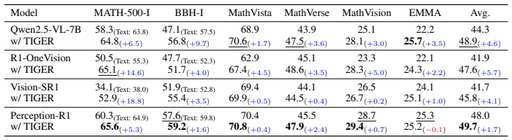
Table 6 : Comparison and complementarity with representative RLVR methods based on Qwen2.5- VL-7B. Each w/ TIGER row reports visual performance gains (drops) relative to the checkpoint directly above it. On each base/RLVR model row for synthesized benchmarks, subscripts show that model’s text-input accuracy as reference.
Original paper · CC BY 4.0The base Qwen2.5-VL-7B rises from 44.3 to 48.9 on average when TIGER is added, a gain of 4.6 points. R1-OneVision goes from 41.9 to 47.6, the largest average gain of the four at 5.7 points. Vision-SR1 goes from 41.7 to 45.8, a gain of 4.1 points. Perception-R1 goes from 48.0 to 49.7, the smallest gain at 1.7 points.
The authors read these results as TIGER complementing RLVR rather than replacing it. Every RLVR checkpoint still improves after TIGER training, so the two approaches stack on the average. The gains are largest for the checkpoints that start from the lowest averages, such as R1-OneVision and Vision-SR1. Perception-R1 starts from the highest average of the RLVR checkpoints and gains the least.
Limitations of the TIGER claims
The authors name domain coverage as the first constraint, since TIGER's training signal comes only from the source text corpora. Training uses only rendered-text images, so TIGER's transfer to natural visual content depends on the benchmarks evaluated.
The mechanistic claim rests on reasoning-subspace activation and activation patching, which the authors present as support rather than proof. Those analyses indicate that TIGER helps align visual-to-reasoning pathways toward text reasoning states. The paper reports RSA as internal latent components linked to effective text-side reasoning, so the causal link is an interpretation.
The authors leave extension to real-world multimodal tasks to future work. Because the test pools pairs, it doesn't give a separate significance result for each benchmark.
TIGER's gains on the RLVR checkpoints are reported as complementary, yet the ablation compares only against a random subset of equal size. The random-subset comparison uses InternVL3.5-1B, where D scores 26.7 against 23.6 for random data.
Paper info
- Authors
- Gregory Kang Ruey Lau, Minh Huynh Nguyen, Bryan Kian Hsiang Low
- Venue
- arXiv · Preprint
- First published
- 2026-11-7
- Added
- 2026-11-10
- Updated
- 2026-11-7
- Version
- v1
- arXiv
- 2611.10552
- Category
- cs.AI · cs.CV · cs.LG
- Original paper terms
- CC BY 4.0
- What we show
- Paper info, commentary and permitted figures from the original paper
AI commentary is a separate explanation from the original paper and may contain errors. The original paper and figures follow each source's terms of use and any rights noted separately.
Abstract
Multimodal Large Language Models (MLLMs) inherit strong textual reasoning capabilities from their language backbones and text pretraining, but often fail to apply the same level of competency to visual inputs. We show that this degradation cannot be attributed to only perception failures, by evaluating models on semantically-equivalent text and rendered-text image inputs: models can accurately read text in the images and recover near-text performance when provided their own transcriptions, but just cannot reason well on the images directly. We characterize this discrepancy as a modality reasoning-access gap, where models fail to route perceived visual content into existing reasoning machinery accessible with text. To bridge this, we propose TIGER (Text-to-Image Gap-targeted training for Enhanced Reasoning), which first mines synthetic modality counterfactuals where a model succeeds on a text problem but fails when provided the corresponding rendered image, and post-trains the model on the image input via Group Relative Policy Optimization (GRPO), along with SFT and DPO variants. Importantly, although trained exclusively on synthetic rendered-text images with no multimodal annotations, TIGER results in model performance improvements across diverse real-world visual benchmarks including geometric diagrams (MathVerse), multi-disciplinary sciences (EMMA, MMMU), complex charts (ChartQAPro), and embodied spatial reasoning (RoboSpatial-Home). TIGER also complements existing state-of-the-art RLVR visual reasoning methods, yielding further performance gains. Analysis involving reasoning-subspace activation and activation patching provide support indicating that TIGER helps to align visual-to-reasoning pathways toward text reasoning states. Our implementation is available at https://github.com/minhngh/Tiger.
Quote from the paper
Gregory Kang Ruey Lau, Minh Huynh Nguyen, Bryan Kian Hsiang Low (2026). Seeing Isn't Enough: Unlocking Visual Reasoning by Bridging the Reasoning-Access Gap with TIGER. arXiv:2611.10552v1. https://arxiv.org/abs/2611.10552v1
BibTeX
@misc{lau2026seeing,
  title = {{Seeing Isn't Enough: Unlocking Visual Reasoning by Bridging the Reasoning-Access Gap with TIGER}},
  author = {Gregory Kang Ruey Lau and Minh Huynh Nguyen and Bryan Kian Hsiang Low},
  year = {2026},
  eprint = {2611.10552},
  archivePrefix = {arXiv},
  url = {https://arxiv.org/abs/2611.10552v1}
}