Paper commentary
Calibrate Once, Grow the Vocabulary: Candidate-Independent Scores for Conformal Risk Control in Open-Vocabulary Segmentation
- Problem A conformal risk control threshold calibrated for a fixed label list can stop meeting its target when names are added, because each label's score depends on the other requested labels.
- Method Each candidate label is scored against a fixed reference bank of names instead of the requested vocabulary, so existing scores stay unchanged as names are added and one calibration can be reused.
- Results Released CAT-Seg and FC-CLIP reached 13.8–15.4% risk at 845 names on ADE20K against a 10% target, while the anchored models met the target at every evaluated vocabulary size.
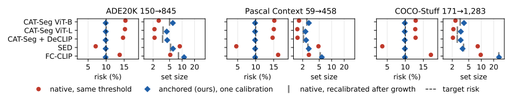
Figure 4 .The anchored models meet the target in every case.Risk and set size after growth, as in Fig. 1. Blue: our anchored models, with the threshold from the source vocabulary. Grey: native recalibration at the grown vocabulary. The values, in labels per pixel, are in Tab. S4.
Original paper · CC BY 4.0 · Md Tanveer Hossain Munim, Bijoy Ahmed Saiem, Muhammad Abdullah Adnan · Calibrate Once, Grow the Vocabulary: Candidate-Independent Scores for Conformal Risk Control in Open-Vocabulary Segmentation · Original paper figure · Extracted the figure area from page 7 of the original PDF.Why a threshold breaks when names are added
Its guarantee needs calibration and test images to be exchangeable, and it counts only the pixels whose true label belongs to the source vocabulary used for calibration. Adding names raises two questions: whether the guarantee for the source labels survives, and what can be promised for the new labels that were never annotated.
The trouble comes from candidate dependence, meaning that the score of one requested label moves when other labels are requested. CAT-Seg's code prunes each image crop to its 256 top-scoring labels, SED lets the labels attend to each other, and FC-CLIP applies a softmax across the whole list of names. Each of these couplings changes existing scores when a name is added, so a threshold fixed earlier no longer means the same thing.
On ADE20K, a threshold calibrated for a 10% risk at 150 names reaches 13.8–15.4% risk with CAT-Seg and FC-CLIP at 845 names. That excess appeared on all 500 random calibration splits, so it was not an artefact of one draw. SED fails in the other direction: under the same threshold its prediction sets grow several times larger than needed.
Scoring each label against a fixed bank
The released network is kept as it is, but its attention is restricted so that a candidate label does not attend to the other candidates. Each candidate instead sees the image, its own name and a fixed bank of label names, so its score cannot change when the rest of the request changes. The network processes the bank without any retraining.
Let \(s_V(x,p,c)\) denote the score of label c at pixel p of image x under vocabulary V. The score is candidate-independent when \(s_V(x,p,c)=s(x,p,c)\) for every vocabulary V that contains c, so adding names leaves every existing score unchanged. At threshold t, the prediction set at pixel p is \(C_t(x,p)=\{c\in V: s_V(x,p,c)\ge t\}\), so membership of an existing label depends only on its own score and t.
The set construction matters as well: rules that normalise over the requested vocabulary bring the dependence back even when the scores are fixed, which is why the per-label threshold is used. In CAT-Seg and SED the attention across labels is linear, so the bank can be summarised once per layer as a cached sum and reused for every candidate.
Calibrating once and reusing the threshold
For an image x, the loss at threshold t is the fraction of its source-labelled pixels whose annotated label is missing from the prediction set. A higher threshold gives smaller sets, so this loss never increases with t.
CRC searches a fixed grid of thresholds and keeps the largest one for which the calibration losses, averaged over the n images with a small correction term, stay at or below the target.
Growth results across three benchmarks
Five released models are tested: CAT-Seg with ViT-B, ViT-L and DeCLIP backbones, SED and FC-CLIP. The benchmarks are ADE20K from 150 to 845 names, Pascal Context from 59 to 458 names and COCO-Stuff from 171 to 1,283 names, with the added names taken from LVIS categories.
For FC-CLIP on ADE20K, the anchored sets are about three labels per pixel larger than the native recalibrated ones.
For CAT-Seg and SED, the mIoU of the anchored models is at most 1.7 points below that of the native models. This is the accuracy side of the trade: the guarantee is gained without a large loss in segmentation quality for those two models.
Guarantees for names that were never annotated
Because candidate independence makes a label's miss rate independent of the vocabulary, the calibration can treat labels as exchangeable units instead of images. For harder added labels, the excess is bounded by the gap between their mean miss rate and that of the source labels.
In the added-label experiments, the added-label risk is 7.5–9.6% at α = 10% and 2.5–4.6% at α = 5% across the models, with a random source vocabulary drawn in each trial. A single random draw can still exceed α, and 23–42% of the draws do so at α = 10%.
Inference time and memory of anchored scoring
On an RTX 5070 Ti with a 683-name bank and the lean bank pass, anchored CAT-Seg ViT-L takes 3.7× the native time per image. The full bank pass without the lean shortcut takes 4.3× the native time for the same configuration.
For Grounding DINO, which otherwise splits a large vocabulary into chunks, the anchored detector is about six times faster than the native one in the detection setting.
Memory separates the two arms sharply: native SED needs 27.39 GB at 3,380 names and runs out of memory at 6,760, while anchored SED stays at 6.62 GB across the listed sizes.
Where the guarantee and conversion stop
The source-label guarantee assumes exchangeable calibration and test images.
Softmax attention across labels is untested, so anchored scores are not validated for that case.
Recalibrating on one device takes 5.7 minutes for CAT-Seg ViT-L on a GH200 and 16.4 minutes on an RTX 5070 Ti. The anchored model's extra inference time of 3.7 times native for CAT-Seg ViT-L is the cost that limits it on constrained hardware.
Paper info
- Authors
- Md Tanveer Hossain Munim, Bijoy Ahmed Saiem, Muhammad Abdullah Adnan
- Venue
- arXiv · Preprint
- First published
- 2026-11-16
- Added
- 2026-11-17
- Updated
- 2026-11-16
- Version
- v1
- arXiv
- 2611.20715
- Category
- cs.LG
- Original paper terms
- CC BY 4.0
- What we show
- Paper info, commentary and permitted figures from the original paper
AI commentary is a separate explanation from the original paper and may contain errors. The original paper and figures follow each source's terms of use and any rights noted separately.
Abstract
Open-vocabulary segmenters accept class names at inference. Conformal risk control can bound how often their prediction sets miss the true label, but we show that this bound breaks when names are added after calibration. On ADE20K, a threshold calibrated for 10% risk at 150 names reaches up to 15.4% risk at 845 names in released CAT-Seg models. The risk exceeds the target on every calibration split, yet the prediction sets grow far less than the target requires. In SED they instead grow larger than needed. The cause is that pruning, cross-label attention and vocabulary normalisation make each label's score depend on the other requested labels. Scores can move either way, so a threshold recalibrated at a larger vocabulary need not hold at smaller ones. We remove this dependence without training by scoring each label against a fixed reference bank of names. A label's score then stays the same when names are added, so one calibration keeps its guarantee as the vocabulary grows. The guarantee holds whatever names are added, even ones chosen per image after seeing it. On three benchmarks and five segmenters, the converted models meet the target at every vocabulary size we evaluate. For CAT-Seg and SED at alpha=10%, they use at most one more label per pixel than the released models recalibrated at the grown vocabulary. Treating names instead of images as calibration samples also bounds the miss rate of added names. If the annotated names are a random sample of the names in the calibration images, an added name's expected miss rate on those images is at most the target. For harder added names, the excess is at most their gap in mean miss rate. Applied to Grounding DINO, which splits large vocabularies into chunks, the conversion also makes inference about six times faster.
Quote from the paper
Md Tanveer Hossain Munim, Bijoy Ahmed Saiem, Muhammad Abdullah Adnan (2026). Calibrate Once, Grow the Vocabulary: Candidate-Independent Scores for Conformal Risk Control in Open-Vocabulary Segmentation. arXiv:2611.20715v1. https://arxiv.org/abs/2611.20715v1
BibTeX
@misc{munim2026calibrate,
  title = {{Calibrate Once, Grow the Vocabulary: Candidate-Independent Scores for Conformal Risk Control in Open-Vocabulary Segmentation}},
  author = {Md Tanveer Hossain Munim and Bijoy Ahmed Saiem and Muhammad Abdullah Adnan},
  year = {2026},
  eprint = {2611.20715},
  archivePrefix = {arXiv},
  url = {https://arxiv.org/abs/2611.20715v1}
}