Paper commentary
DominoBench: Evaluating Multi-Step Physical Reasoning from Still Images
Vision-language models often fail to predict multi-step physical chain reactions from still images
- Problem Fluent scene descriptions don't show that vision-language models can predict a chain reaction. Models describe plausible chains but miss the one quantity that decides who survives.
- Method DominoBench is a benchmark of simulated scenes in minimal pairs that differ by one small step. Each pair's outcome is computed by a physics simulator, and hints go from a generic nudge to the exact deciding calculation.
- Results On DominoBench-1K, four Claude models score 57 to 61 percent on the deciding person unaided. With the deciding calculation written out, they reach 82 to 86 percent.
Why a fluent scene account is not enough
Vision-language models now answer questions about photos and diagrams, and they are being asked to act in the physical world. Acting depends on predicting what a scene does next, a skill that few benchmarks test directly. The authors stress that a good description of a scene does not guarantee a good prediction of it.
Figure 1 makes the gap concrete with a pushed ball that starts two rows of dominoes. A small ball then drops into a seesaw bucket whose spikes hang over a person, C, lying on the ground. The two items differ only in the stone counterweight, which is 1.25 squares wide in (a) and 1.50 squares in (b). Claude Opus 5.5 described a plausible chain and got both items wrong, but it got both right once the deciding calculation was given.
Existing benchmarks rarely isolate this failure, because their items rest on one mechanism, unfold over video, or sit too far from a tipping point. The question the authors ask is whether multimodal models can predict a multi-step chain reaction from one still image, and where they fail.
Building twin scenes at a tipping point
The key idea is to build every item as a pair of near-identical scenes that differ by one small step in one quantity, so that one person's fate flips. A physics simulator settles each scene and produces the ground truth, so the answer for both twins is known. Each chain links three to five of seven mechanisms, including ledges, pits, pendulums, recesses, seesaws, dominoes and jumps.
The scene programs are stored as plain JSON and built in pymunk, and they follow fixed rules of the world. Gravity is 9.81 squares/s2, and the push gives the first ball a speed of 1.5 squares/s. A person dies when any moving solid touches them and never moves or stops an object, a convention that keeps every outcome categorical.
Twins are found by a guided search rather than by hand. From one simulation the search reads quantities such as the arrival speed of the ball, and an idealized calculation then gives each person's fate as a function of the mechanism's placement parameter. Twins differ by one to three steps of 0.25 squares in a length.
Before a pair is kept, it passes several generation checks. The solvability check then confirms that a short calculation on the stated quantities predicts both outcomes, so the top hint never points to a wrong answer. Pairs in which a death came from a collision box that reached past the drawn figure were removed, which left 427 pairs.
H0 gives only the image, the rules and the question, H1 adds a generic nudge, H2 points at the deciding step, and H3 states the idealized calculation for that step. A text-only mode replaces the picture with the structured scene description, including exact coordinates.
How answers are scored
Models end with a JSON object giving each person's fate and a probability of death, and an answer that cannot be parsed or runs out of tokens counts as wrong.
Exact accuracy counts an item as correct only when every person's fate is right. Deciding-person accuracy looks only at the person whose fate flips between the twins, so an answer identical for both twins scores exactly 50% on that person. Both-twins accuracy counts a pair only when both items are fully right, which makes any answer that is the same for both twins score zero.
DominoScore combines the deciding-person accuracy of the seven mechanisms into one number. For each mechanism, the authors take the deciding-person accuracy \(a_m\) and compute the skill above chance as \(s_m = \max(0, 2a_m - 1)\). The score is a weighted geometric mean with a small smoothing constant:\[ \mathrm{DominoScore} = 100\left(\prod_m (\epsilon + s_m)^{w_m} - \epsilon\right), \quad \epsilon = 0.05 \] The geometric mean penalises a model that fails one mechanism more than an average would, and the constant keeps one failed mechanism from setting the score to zero.
The weights are proportional to each mechanism's difficulty, measured on the four Claude models at H3, and they are frozen so later models use the same scale, with pendulum at 0.300 and jump at 0.250.
Unaided accuracy stays low
The four Claude models that answered all 854 items reach at most 47% exact accuracy on DominoBench-1K. That result sits well above the 14% of the naive chain-reaction answer and the 25% of "everyone survives", with the four models at 39 to 47%. That margin comes from people whose fate doesn't flip between the twins, and these models judge those people correctly 85 to 90% of the time.
The exact score therefore says little about the quantity that flips between twins.
On the person whose fate flips, the same four models reach 57 to 61% in image mode. Their intervals only just clear the 50% that a coin flip would score. Both twins of a pair come out right in 15 to 16% of pairs. In 50 to 69% of pairs, the models give the same answer to both twins. The authors read this as models that describe a plausible chain but miss that one quantity has crossed a threshold.
With the calculation added, that share of identical answers drops to 22 to 24%.
Sonnet 4.5 and Haiku 4.5 score 48% and 52% on the deciding person in DominoBench-124, close to chance. Open-weight models on DominoBench-1K sit between 25 and 53% on that person, near or below chance. On DominoBench-124, Gemini 4 Argon, Carbon and Hydrogen reach 71%, 69% and 62% unaided. Text coordinates barely move the Claude models, which score 60 to 64% from text and 57 to 59% from images at H0.
Which hint rung unlocks the answer
Pointing at the deciding step helps Claude Sonnet 5.5 in image mode, rising from 58% to 73% on DominoBench-124. For Claude Opus 5.5, the same pointer moves accuracy only from 59% to 65%, and Haiku 5.5 moves from 57% to 59%. Knowing where to look isn't enough for these models, so the authors read the gap as a failure to compute at that point.
Writing out the calculation lifts all three Claude 5.5 models in both modes, from 57–64% to 79–91% on the deciding person. On DominoBench-1K, the four Claude models rise from 57–61% to 82–86% on the deciding person. Both-twins accuracy rises from 15–16% to 34–49% on the same models, so the calculation helps the pairs as well as single items.
The figure shows the hint ladder for Claude and for open-weight models, with image and text modes side by side.
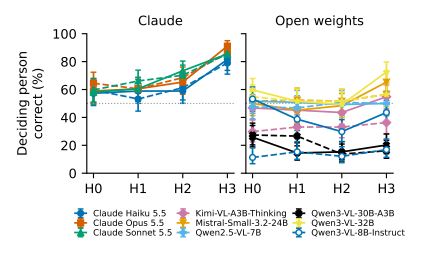
Figure 3 . Accuracy on the deciding person along the hint lad- der: H0 no hint, H1 a generic nudge, H2 a pointer to the de- ciding step, H3 the deciding calculation. Left: Claude. Right: open-weight models with a complete ladder. Solid: image mode; dashed: text only. Dotted line: 50%. Bars: 95% Wilson intervals. Data: DominoBench-124.
Original paper · CC BY 4.0 · Emilio Ferrara · DominoBench: Evaluating Multi-Step Physical Reasoning from Still Images · Original paper figure · Extracted the figure area from page 7 of the original PDF.Coordinates given as text barely change the unaided result on DominoBench-124. The three Claude 5.5 models score 60–64% from text and 57–59% from images at H0, a gap of at most 6 points.
GPT-6.1-Sol and GPT-6-Astra reach 72% and 70% on the deciding person unaided, the highest of the group. They gain least from the calculation, reaching 82% and 83%, so their DominoScore at H3 of 35–36 trails the Gemini models. The small open-weight models gain little from the calculation, with Qwen2.5-VL-7B and Qwen3-VL-8B-Instruct staying near chance.
The larger ones move a long way: Qwen3.8-27B rises from 47% to 82% and Muse Glimmer 30B from 55% to 80% on DominoBench-124. Some runs ran out of tokens, with 43% of Qwen3-VL-8B-Instruct and 69% of Qwen3-VL-30B-A3B answers unfinished at H3.
Mechanisms and stated confidence
Unaided, the Claude models sit near chance on the recess, the dominoes and the pendulum, at 49 to 57%. The dominoes rise to 77 to 95%, while the pendulum gains least among the near-chance mechanisms, going from 51 to 57% to 61 to 68%.
The jump doesn't move much, going from 68 to 76% to 71 to 72%. Its written calculation splits into two cases, whether the flight clears the wall or meets it, and the Claude models often fail that branch. The small open-weight models mostly don't gain that much.
Unaided, the Claude models are confident without being right. The four Claude models that answered all items put a probability of 0.8 or higher, or 0.2 or lower, on the deciding person's death in 63 to 76% of items. Those confident statements are correct in only 59 to 63% of cases. The larger open-weight models, pooled, are correct in 51% of their confident statements.
With the calculation, the Claude models' confident statements are correct in 83 to 90%.
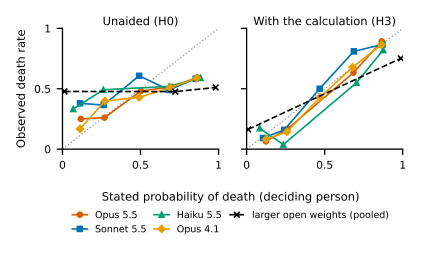
Figure 5 . Stated probability of death for the deciding person against how often that person dies, in bins of 0.2 (bins with at least 15 statements), image mode, all 854 items. Solid: the Claude models that answered every item; dashed: the five larger open- weight models of Fig. 4, pooled. Dotted: perfect calibration. Data: DominoBench-1K.
Original paper · CC BY 4.0DominoScore ranking and its robustness
DominoScore folds each model's deciding-person accuracy across the seven mechanisms into one number, using a weighted geometric mean. On DominoBench-124, the three Gemini 4 models score highest unaided, at 31 to 42, against 4 to 21 for the Claude models. With the deciding calculation, the Gemini 4 models reach 60 to 66, which is level with Claude Opus 5.5 at 64.
Their intervals overlap each other, so the three Gemini 4 scores don't separate cleanly.
With the calculation, the Claude models reach 47 to 54, with Opus 5.5 highest at 54, interval 48 to 60. The small open-weight models reach at most 11 once the calculation is given. The weights come from the error rate of the four Claude models at H3, with a floor at half the uniform weight. The pendulum carries the largest weight at 0.300, which is why it counts most in the score.
The authors check that coin-flip guessers stay low, with 95th percentiles of 6.2 on DominoBench-1K and 14.4 on DominoBench-124. Equal mechanism weights barely change the H3 rankings, with Spearman correlations of 0.95 and 0.96. A repeat run of Opus 5.5 stays inside its H3 interval, as the appendix reports.
Limitations of the still-image claims
DominoBench scenes are two-dimensional and drawn in one line-art style, so the benchmark can't show how models perceive photographs or depth. The rule that a person dies when any moving solid touches them is a convention that keeps every outcome categorical. Collision boxes reach slightly past the drawn figures, so the authors removed every pair where that decides a death.
The top hint supplies speeds and thresholds calibrated in simulation, which a still image cannot show. The H3 rung therefore measures whether a model can execute a stated calculation, not whether it can find the quantities itself. The authors didn't measure how well models make those estimates. The gap is widest at the quantitative step, where the written-out calculation lifts the four Claude models to 82 to 86% on the deciding person.
Coverage is uneven across models, and the text-only comparison for Claude rests on DominoBench-124 alone. The authors didn't measure human accuracy on DominoBench, so the gap between models and people stays unknown. Prior video work finds that people surpass vision models on rolling, collision and domino scenes. That evidence comes from video, so it leaves the still-image case open.
Closing the gap would require models that pick out the deciding quantity on their own and then compute it.
Paper info
- Authors
- Emilio Ferrara
- Venue
- arXiv · Preprint
- First published
- 2026-11-16
- Added
- 2026-11-17
- Updated
- 2026-11-16
- Version
- v1
- arXiv
- 2611.20385
- Category
- cs.CV
- Original paper terms
- CC BY 4.0
- What we show
- Paper info, commentary and permitted figures from the original paper
AI commentary is a separate explanation from the original paper and may contain errors. The original paper and figures follow each source's terms of use and any rights noted separately.
Abstract
Can a vision-language model look at a picture of a chain reaction and tell what will happen? Recent multimodal models describe scenes fluently and solve textbook physics problems, which suggests they should also predict how a scene of ramps, ledges, pendulums, seesaws and dominoes plays out once a ball is pushed. We tested this claim on 30 models from 10 families and reached a clear conclusion: unaided, no model predicts the outcome reliably. We built DominoBench, a benchmark of still images of 2D rigid-body scenes whose outcome a physics simulator computes. It holds 854 items in 427 minimal pairs, in which a change of one to three grid steps in one quantity decides whether one person survives, and every item comes with a four-rung hint ladder ending in the exact calculation that decides the outcome. Unaided, frontier models from Anthropic, Google and OpenAI are right about the person whose fate flips in at most 72% of items and answer both twins of a pair correctly in at most 34%. Pointing at the deciding step helps little, and exact geometry given as text barely helps, yet once the deciding calculation and the quantities it needs, including speeds that a still image cannot show, are written out, the same models reach 82-92% on the deciding person, while small open-weight models stay near chance. Physical prediction from a still image therefore fails at the quantitative step: the strongest models use the deciding quantity when they are given it, but do not produce it on their own. For models that plan or act in the physical world, a fluent account of a scene is thus no evidence of a correct prediction: such models must find and compute the deciding quantity unprompted, and DominoBench tests whether they do.
Quote from the paper
Emilio Ferrara (2026). DominoBench: Evaluating Multi-Step Physical Reasoning from Still Images. arXiv:2611.20385v1. https://arxiv.org/abs/2611.20385v1
BibTeX
@misc{ferrara2026dominobench,
  title = {{DominoBench: Evaluating Multi-Step Physical Reasoning from Still Images}},
  author = {Emilio Ferrara},
  year = {2026},
  eprint = {2611.20385},
  archivePrefix = {arXiv},
  url = {https://arxiv.org/abs/2611.20385v1}
}