論文解説
DominoBench: Evaluating Multi-Step Physical Reasoning from Still Images
DominoBench:静止画からの多段階物理推論の評価
- 課題 静止画だけから連鎖する物理イベントの結果を予測する能力が、実際にどの程度あるのかは十分に検証されていません。
- 手法 シミュレータで作った場面に最小対と4段階のヒントを組み合わせ、モデルの失敗が絵の読み違いによるのか、定量計算によるのかを分けて測定します。
- 結果 DominoBench-1Kでは、ヒントなしのClaudeモデルが決定人物を57〜61%で当てましたが、H3の計算を与えると82〜86%に上がりました。
静止画における連鎖する物理イベントの予測問題
この論文は、視覚言語モデルが1枚の静止画だけを見て、複数の段階にわたって連鎖する物理イベントの結果を予測できるかを問うものです。モデルは場面を流暢に説明し、教科書的な物理問題も解けます。しかし、ボールを押したときにどの人物が生き残るかを予測する能力は、ほとんど直接テストされてきませんでした。著者らは、この失敗が絵の読み違いによるものか、それとも決定を左右する定量的な段階を自力で実行できないことによるものかを区別しようとしています。そのため、場面、最小対、ヒントの階段を一緒に設計し、2つの原因を切り分けています。
DominoBenchの場面と最小対の構成
DominoBenchは、シミュレータで2次元剛体の場面を構成し、安定化させてからレンダリングして作成します。1回の押しが3つから5つの機械装置を経て1人を死なせる構造で、機械装置は崖、穴、振り子、くぼみ、シーソー、ドミノ、ジャンプの7種類から選びます。各項目には、1つのパラメータだけを格子の1〜2段階から3段階まで変えたペアがあり、臨界点を越えると1人の運命だけが反転します。最小対は、1つのシミュレーションから読み取った量をもとに臨界値の両側に配置し、理想化した計算とシミュレーションがどちらも一致するペアだけを残します。この解決可能性のチェックにより、H3のヒントが誤った答えを指すことはありません。
ヒントの階段とテキストのみの入力
各項目はH0からH3までの4段階のヒントで質問します。H0は絵、ルール、質問だけを与え、H1は一般的な後押しを与えます。H2は決定段階を指しますが、その結果は述べません。H3は決定段階の理想化した計算を必要な量とともに示しますが、正解は言いません。各段階は新しい文脈で問い合わせるため、前の答えが後の答えに影響することはありません。テキストのみのモードでは、同じ場面を正確な座標を含む構造化テキストとして提示し、絵の読み誤りがどの程度予測の失敗を説明するかを比較します。
DominoBench-1Kにおけるヒントなし予測の限界
ヒントなしで全854項目に答えた4つのClaudeモデルは、全体の結果が最大47%の項目でしか正解しませんでした。同じモデルは決定人物の運命を57〜61%の精度で当て、ペアの2つの項目をどちらも当てた割合は最大16%でした。一方、H3の計算を与えると、決定人物の精度は82〜86%に上がり、ペアの精度は34〜49%に高まりました。同じClaude Opus 5.5の事例でも、ヒントなしでは2つの項目をどちらも外したのに、H3を与えるとどちらも当てました。この結果は、定量段階の実行がボトルネックだという著者らの解釈を支持するものです。ただし、モデルが決定量を自力で見つける能力は測っていない点にも注意が必要です。
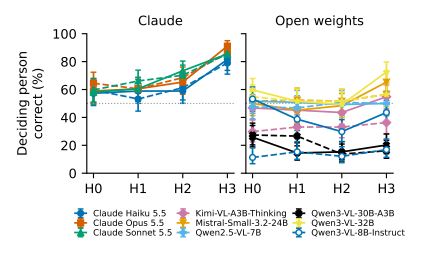
Figure 3 . Accuracy on the deciding person along the hint lad- der: H0 no hint, H1 a generic nudge, H2 a pointer to the de- ciding step, H3 the deciding calculation. Left: Claude. Right: open-weight models with a complete ladder. Solid: image mode; dashed: text only. Dotted line: 50%. Bars: 95% Wilson intervals. Data: DominoBench-124.
出典 · CC BY 4.0 · Emilio Ferrara · DominoBench: Evaluating Multi-Step Physical Reasoning from Still Images · 論文の図を引用 · 元のPDFの7ページ目から図の部分を抽出しています。DominoScoreの定義と集計
DominoScoreは、機械装置ごとの決定人物の精度a_mから s_m = max(0, 2a_m − 1) を求め、それを重み付き幾何平均で合算した点数です。式は DominoScore = 100 × (∏_m (ϵ + s_m)^{w_m} − ϵ) で、ϵ = 0.05 です。ここで s_m は、同じ答えをペアの両方の項目に与えた応答が得る、50%以上のスキルスコアを表します。重み w_m は H3 における4つのClaudeモデルの機械装置ごとの誤り率から決まり、固定して公開されています。すべての機械装置の精度が50%以下なら点数は0になり、常に正解すると100になります。この集計では、1つの装置で失敗したモデルがより大きく罰せられます。
ただし ϵ があるため、1つの装置での失敗が点数を直ちに0にすることはありません。
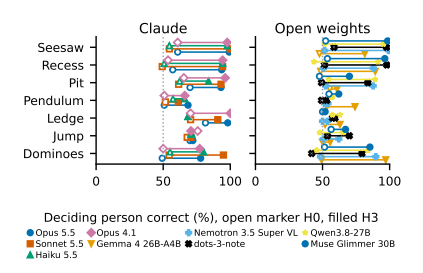
Figure 4 . Accuracy on the deciding person by deciding mecha- nism, from H0 (open) to H3 (filled), image mode, all 854 items. Left: Claude, right: open-weight models above DominoScore 20 at H3. Data: DominoBench-1K.
出典 · CC BY 4.0 · Emilio Ferrara · DominoBench: Evaluating Multi-Step Physical Reasoning from Still Images · 論文の図を引用 · 元のPDFの8ページ目から図の部分を抽出しています。場面表現と実験範囲の限界
人は、動く固体が触れると死に、自分で動いたり物体を止めたりしないというルールに従います。人の衝突判定の箱が絵よりやや広いために生じた6個または73個のペアは除外しました。そのため、元の生成ペアと公開セットの構成は異なります。H3の計算は、静止画からは見えない速度と臨界値を与えるため、最上位のヒントが測るのは計算の実行であり、必要な量をモデル自身が推定する能力ではありません。著者らは人間の精度は測定していません。
論文情報
- 著者
- Emilio Ferrara
- 学会・ジャーナル
- arXiv · プレプリント
- 公開日
- 2026年11月16日
- 登録日
- 2026年11月17日
- 更新日
- 2026年11月16日
- バージョン
- v1
- arXiv
- 2611.20385
- カテゴリ
- cs.CV
- ライセンス
- CC BY 4.0
- 掲載内容
- 論文情報・解説・論文の図
この解説は、Refivuの韓国語解説をAIで翻訳したものです。不正確な翻訳や誤りが含まれる可能性があります。論文と図の利用条件は各出典に従います。
アブストラクト
Can a vision-language model look at a picture of a chain reaction and tell what will happen? Recent multimodal models describe scenes fluently and solve textbook physics problems, which suggests they should also predict how a scene of ramps, ledges, pendulums, seesaws and dominoes plays out once a ball is pushed. We tested this claim on 30 models from 10 families and reached a clear conclusion: unaided, no model predicts the outcome reliably. We built DominoBench, a benchmark of still images of 2D rigid-body scenes whose outcome a physics simulator computes. It holds 854 items in 427 minimal pairs, in which a change of one to three grid steps in one quantity decides whether one person survives, and every item comes with a four-rung hint ladder ending in the exact calculation that decides the outcome. Unaided, frontier models from Anthropic, Google and OpenAI are right about the person whose fate flips in at most 72% of items and answer both twins of a pair correctly in at most 34%. Pointing at the deciding step helps little, and exact geometry given as text barely helps, yet once the deciding calculation and the quantities it needs, including speeds that a still image cannot show, are written out, the same models reach 82-92% on the deciding person, while small open-weight models stay near chance. Physical prediction from a still image therefore fails at the quantitative step: the strongest models use the deciding quantity when they are given it, but do not produce it on their own. For models that plan or act in the physical world, a fluent account of a scene is thus no evidence of a correct prediction: such models must find and compute the deciding quantity unprompted, and DominoBench tests whether they do.
この論文を引用
Emilio Ferrara (2026). DominoBench: Evaluating Multi-Step Physical Reasoning from Still Images. arXiv:2611.20385v1. https://arxiv.org/abs/2611.20385v1
BibTeX
@misc{ferrara2026dominobench,
  title = {{DominoBench: Evaluating Multi-Step Physical Reasoning from Still Images}},
  author = {Emilio Ferrara},
  year = {2026},
  eprint = {2611.20385},
  archivePrefix = {arXiv},
  url = {https://arxiv.org/abs/2611.20385v1}
}