Paper commentary
TactileLab: Sim-to-Real Dexterous Robot Manipulation with Efficient Shear-Sensitive Tactile Simulation
TactileLab trains shear-sensitive tactile policies in simulation without soft-body physics
- Problem Rigid-body tactile simulators are fast but give only depth-like signals, which miss the tangential motion that shear tasks need.
- Method TactileLab uses rigid-body simulation instead of soft-body physics to compute a dense tangential flow field at the contact interface. It pairs this simulated tactile flow with contact depth.
- Results In simulated in-hand manipulation, policies using depth plus flow reached a time-to-fail of 27.01 s, ahead of either modality alone.
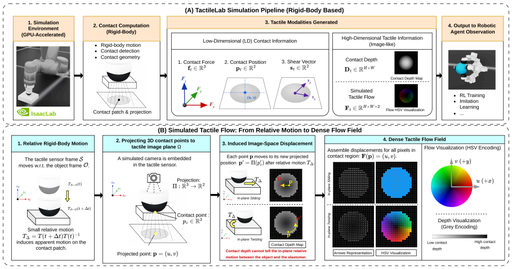
Figure 2 :Overview of the TactileLab simulation framework and simulated tactile-flow computation. The rigid-body simulation pipeline computes contact geometry and generates low-dimensional contact descriptors, contact-depth images, and dense tactile-flow fields for policy learning. Simulated tactile flow is obtained by projecting the three-dimensional contact patch onto the tactile image plane and calculating the image-space displacement induced by the relative motion between the tactile sensor and the contacted object.
Original paper · CC BY 4.0 · Yijiong Lin, Wenhao He, Toby Jack, Max Yang, Haoran Li, Nathan F. Lepora · TactileLab: Sim-to-Real Dexterous Robot Manipulation with Efficient Shear-Sensitive Tactile Simulation · Original paper figure · Extracted the figure area from page 4 of the original PDF.Why depth-only tactile simulation stalls on shear
Vision-based tactile sensors are attractive for fine manipulation because they give high-resolution and highly sensitive spatial observations. Simulating them for reinforcement learning, though, forces a trade-off between fidelity and speed. Scalable simulators still struggle to represent tangential interaction efficiently, yet many manipulation tasks depend on shear forces.
Soft-body simulators model compliant contact with high fidelity, but the authors note they can be too slow for large-scale RL. Full soft-body solvers are also computationally intensive, with generally lower throughput than rigid-body simulation. That cost limits parallel data generation for data-hungry methods such as RL.
Rigid-body simulators are fast and scalable, but they usually provide only depth-like signals describing normal contact. Rigid-body methods build their signals from contact geometry, penetration depth, or contact forces in physics engines. Depth alone misses shear, because two contact states can give similar depth images for distinct tangential motion patterns.
Depth-only observations therefore leave the task partially observable, so policies find it harder to learn.
Some recent simulators do model shear, such as TacSL, which computes dense normal and shear force fields. These approaches rely on geometry-dependent contact formulations and object-specific preprocessing, which adds assumptions. HydroShear models path-dependent hydroelastic shear, and both methods need the object's shape as a signed-distance-function representation.
The authors instead want shear cues that come directly from rigid-body simulation, without object-specific assumptions.
Turning rigid-body motion into a tactile flow field
The key idea is to keep the rigid-body contact and compute a dense tangential displacement field, so the elastomer deformation never has to be simulated. This flow is paired with contact depth, which says where contact occurs and how deeply the object presses in. Together the two give normal geometry and tangential motion without soft-body simulation.
The pipeline starts from a contact depth map \( D_t(p) \) over image pixels \( p \in \Omega \). A binary contact mask \( C_t(p) \) is set to 1 where the depth exceeds a small threshold \( \epsilon \), and 0 otherwise. For each contact pixel, the authors take the corresponding object-surface point \( x_t(p) \) and project it into the image with \( \Pi \).
The same surface point is moved by the rigid-body motion over one simulation step, and its projection gives the raw image displacement \( F^e_t(p) = \Pi(x_{t+\Delta t}(p)) - \Pi(x_t(p)) \). The final field \( F_t \) equals \( F^e_t(p) \) where \( C_t(p) = 1 \) and zero elsewhere, so it has size \( H \times W \times 2 \). Because the field comes from kinematics and camera projection, the authors argue the same formulation could later be computed from tracked points on a soft elastomer.
How the teacher-student policy and PETS-Net use the tactile inputs
The student policy starts from a teacher that sees privileged information the real robot never has. In stage 1, the teacher gets object mass, pose, twist, friction, and scale, plus the external perturbation forces and torques and the hand orientation. An extrinsic encoder maps this privileged state to a latent vector, zt = Eψ(et), and the base policy takes it as input.
The base policy predicts actions from the short proprio-action history and that latent, at = πθ(obase_t, zt), and RL maximizes the expected discounted return.
The module trains with a standard least-squares loss, Ladapt = ||zt − ẑt||², which pulls its estimate toward the privileged latent. The student then acts with the same base-policy input as the teacher, but with the predicted latent ẑt in place of the privileged one. Because ẑt comes only from real-available histories, the student can run on the real robot without privileged simulation states.
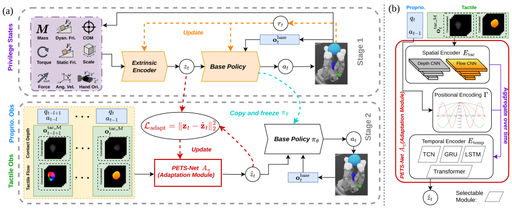
Figure 3 :(a) Overview of multimodal tactile policy learning for dexterous in-hand manipulation. To evaluate the benefit of our rich tactile observations, unknown random force and torque perturbations are applied to the manipulated object, making the task more challenging and requiring robust and informative tactile feedback. (b) The structure of the proposed PETS-Net for high-dimensional tactile policy learning.
Original paper · CC BY 4.0The authors propose PETS-Net as the adaptation module, because a standard adaptation module may have limited capacity for long histories. Those long histories include proprioceptive, action, and high-dimensional tactile observations, so the input is large. Positional encoding is applied to joint angles and action sequences, so these histories are represented more expressively.
The encoding uses K frequency bands, and each band maps a value to sine and cosine features, sin(2kπb) and cos(2kπb). The authors motivate this by the bias of neural networks toward low-frequency functions, which limits how well they represent rapidly varying input-output relationships. Spatial encoders, E_depth for contact depth and E_flow for tactile flow, turn the image-like tactile inputs into latent vectors.
A temporal encoder E_temp then aggregates these tactile features and the positional-encoded features over a window of length ℓ. A latent head E_lat turns the temporal output into the predicted latent ẑt, so the module reasons over both spatial structure and temporal evolution.
The authors claim that PETS-Net learns more efficiently than baseline policy architectures in their simulation experiments. This claim rests on PETS-Net fusing long-horizon proprioceptive histories with high-dimensional tactile observations.
Real-to-sim translation for sim-to-real deployment
Real-to-Sim-TacFlowNet turns a pair of real tactile images into the simulated tactile flow that the policy was trained on. The network output is a two-channel flow field, while the HSV flow images serve only for visualization.
During training, a paired simulated tactile-flow target supervises the prediction through a reconstruction loss. A discriminator D adds an adversarial loss on top of that reconstruction term. TactileLab keeps a separate real-to-sim translator for contact depth alongside this tactile-flow translator.
The authors collected paired real and simulated tactile data for press, slide, tilt, and twist motions. Each example compares real and generated sparse flow fields, and it also shows simulated contact depth and dense simulated tactile flow. They validated the translation across the sensor configurations listed in Table II, using MAE and R² for each entry.
Each entry reports results for simulated, real, and real-to-sim inputs, where real-to-sim means translated flow feeds the shear estimator.
For the markerless DIGIT, real-to-sim rotational MAE is 3.33 °/s with R² of 0.92, compared with 3.61 °/s from direct real input. Only the translator sees the real sensor's appearance, so the policy and simulator stay unchanged for a new sensor. External disturbances or abrupt contact changes may violate the no-slip assumption that the elastomer stays in sticking contact.
Simulated ablations: flow versus depth
In the dual-arm object-following task, the authors compare depth alone, flow alone, and their combination, with curves averaged over three random seeds. Tactile flow outperforms depth alone on this task. For approximately flat contacts, depth mainly captures normal deformation and gives limited information about tangential motion. Flow directly encodes shear displacement and implicitly reflects contact area, which improves both translational and rotational tracking.
Adding depth to flow accelerates learning but reaches a final performance similar to flow alone, so flow is the dominant modality.
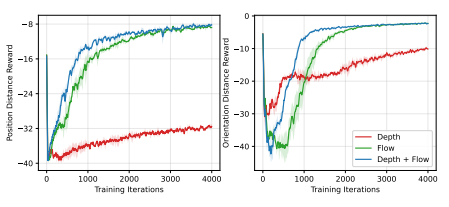
Figure 6 :Ablation studies of contact depth and tactile flow for the shear-sensitive dual-arm object-following task. Solid curves show the mean over three random seeds, with shaded regions denoting ±1 standard deviation.
Original paper · CC BY 4.0The in-hand manipulation task tests the same question on a more complex problem, with the depth, flow and combined comparison shown in Fig. 5b. Tactile flow again beats contact depth alone, which points to the value of tangential-motion cues for object rotation. Combining depth and flow gives the fastest convergence and the highest final reward.
Depth captures contact geometry, while flow describes fingertip–object shear motion, so the two modalities complement each other.
The simulated evaluation in Table I shows that the combination achieves the longest time-to-fail and the lowest fall rate. Within the training distribution, the combination reaches a time-to-fail of 27.01 s with an 11.76% fall rate. On OOD objects, it reaches 25.08 s with an 18.69% fall rate, again ahead of either modality alone. Depth stays complementary, since it supplies normal contact geometry and distribution cues.
Adding low-dimensional contact on top of the dense modalities gives only a marginal further improvement. The dense observations already seem to carry the key contact information needed for policy learning. With shorter histories, the dense modalities, flow above all, already plateau, so they need less temporal context. Proprioception-only and low-dimensional contact inputs, by contrast, gain substantially from longer histories.
Whether real tactile images recover the flow
Table II sets three inputs side by side: simulated test flow, raw real image pairs, and real images translated into simulated flow. Each entry reports MAE and R² averaged over 8 independently trained regressors with different weight initialisation and batch order. The velocities come from per-frame shear displacement MAE, assuming a 25 Hz sensor sample rate.
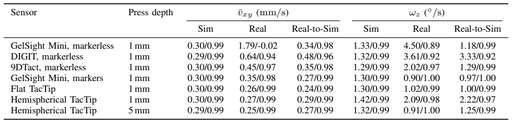
Figures from the paper Table II:Tactile-flow-based shear estimation performance for simulated, real, and real-to-sim inputs. Each entry reports MAE/R 2, averaged over 8 independently trained regressors (identical data, stochastic weight initialization/batch order). Sim denotes the in-domain result obtained directly from simulated test flow, Real denotes the result obtained directly from real tactile image pairs, and Real-to-Sim denotes the result obtained from real tactile image pairs translated into simulated tactile flow before shear estimation.
Original paper · CC BY 4.0For the markerless GelSight Mini, raw real images give a rotational error of 4.50 °/s with R² of 0.89. After translation, the same sensor drops to 1.18 °/s with R² of 0.99. Its tangential estimate moves from R² of -0.02 on raw real images to 0.98 after translation. For the markerless DIGIT, rotational error falls from 3.61 °/s on raw real images to 3.33 °/s after translation, both at R² of 0.92.
The authors trace the poor markerless GelSight Mini result to tangential deformation that must stay observable in the real images.
For the hemispherical TacTip at 1 mm press depth, translated flow gives a rotational MAE of 2.22 °/s with R² of 0.97. Increasing the press depth to 5 mm lowers the translated rotational MAE to 1.25 °/s and raises R² to 0.99. The authors attribute this gain to deeper contact making rotational shear more visible through larger marker displacements.
Flat TacTip, 9DTact and GelSight Mini with markers show qualitatively similar real-to-sim flow transfer. The authors still chose the hemispherical TacTip for downstream tasks, because it is more durable and has a larger elastic deformation range. Their real-to-sim transfer assumes the elastomer stays in sticking contact, so slip can break this assumption.
Real robot results: in-hand and dual-arm
The dual-arm policy was trained only in simulation on a rigid cube under randomized straight-line motions. On the real robot, the rigid cube gave mean errors of 0.91 mm and 0.019 rad for straight-line motion. For circular motion, the same cube gave 1.42 mm and 0.021 rad, which is the best result across the tested objects. The soft ball gave larger errors, which the authors attribute to object compliance.
The foam brain, the hardest object, gave errors of 4.20 mm and 6.43 mm, with all mean position errors below 6.5 mm.
For in-hand rotation, each method was tested from 10 distinct initial grasp configurations with a 30 s limit on out-of-distribution objects. Both rich-tactile policies held the object for the full 30 s, while the LD-contact and proprioception baselines ended earlier.
These real-world policies were trained in simulation only with capsule-shaped objects on the LEAP Hand. The authors attribute this to cube edges and corners producing contact states that capsule training never showed. Contact depth and tactile flow, by contrast, kept the rich-tactile policies rotating cubes, reaching 1.33 ± 1.00 with depth and flow.
Where the evidence stops
The real-to-sim transfer rests on a no-slip assumption, which treats the elastomer as staying in sticking contact with the object. Under that assumption, contact deformation is dominated by shear, so the flow reflects tangential motion rather than slip. External disturbances or abrupt contact changes could break this condition and lead to unrecoverable states.
Closing the sim-to-real gap on slip would need slip-detection capability inside the tactile simulation. The authors point to a sensor from their work that has shown effective slip detection, but they don't explain how to model slip in simulation.
Tactile flow is computed from rigid-body simulation, which the authors treat as an efficient approximation of shear cues. The same flow formulation could be extended to soft-body simulators, where flow comes from simulated elastomer deformation or rendered image motion. Rigid-body flow therefore trades some fidelity for the throughput that large-scale policy learning needs.
Extending the method to more diverse object shapes would need larger high-dimensional real-to-sim datasets. It would also need geometry-aware transfer models, because the same tangential motion can look different on different local surfaces. The in-hand policies were trained only in simulation on capsule-shaped objects. They didn't test training on a wider set of shapes in this work.
The real-world in-hand comparisons use one LEAP Hand setup with four vision-based tactile fingertips.
The efficiency claim for PETS-Net rests on the authors' simulation experiments. Those experiments replace PETS-Net with a standard adaptation module under representative observation settings. The PETS-Net ablation curves are averaged over three random seeds in simulation. Shaded regions in those curves show ±1 standard deviation across the same three seeds.
Paper info
- Authors
- Yijiong Lin, Wenhao He, Toby Jack, Max Yang, Haoran Li, Nathan F. Lepora
- Venue
- arXiv · Preprint
- First published
- 2026-11-5
- Added
- 2026-11-6
- Updated
- 2026-11-5
- Version
- v1
- arXiv
- 2611.07881
- Category
- cs.RO
- Original paper terms
- CC BY 4.0
- What we show
- Paper info, commentary and permitted figures from the original paper
AI commentary is a separate explanation from the original paper and may contain errors. The original paper and figures follow each source's terms of use and any rights noted separately.
Abstract
Robotic simulators that represent shear within tactile sensing are becoming increasingly important for contact-rich manipulation. However, simulating contact shear with high-fidelity deformable or soft-body simulation is computationally demanding, limiting scalability to large-scale reinforcement learning. Here we introduce \textit{TactileLab}, a scalable multimodal tactile simulation framework built on IsaacLab, with a particular focus on a new optical-flow-based tactile representation termed \textit{simulated tactile flow}. Instead of relying on soft-body physics to model shear deformation, TactileLab uses rigid-body simulation to efficiently estimate dense tangential motion at the contact interface, producing tactile flow fields that encode shear-relevant contact dynamics. This flow field complements geometric features from a contact depth field. We further introduce a novel policy architecture for jointly processing long-horizon proprioceptive signals and rich tactile observations. Across multiple contact-rich tasks, policies trained using simulated tactile flow learn efficiently at scale and exhibit emergent contact-aware behaviours. To facilitate sim-to-real policy deployment, we then propose a novel real-to-sim tactile translation method that maps real tactile image streams to simulated tactile flow and depth fields, together with a new tactile data collection method, and validate it across diverse tactile sensor designs. Using this pipeline, we demonstrate real-world deployment on tasks encompassing dual-arm and dexterous in-hand manipulation. Overall, TactileLab provides an end-to-end sim-to-real framework for scalable tactile policy learning, enabling diverse shear-sensitive manipulation across heterogeneous tactile robotic systems.
Quote from the paper
Yijiong Lin, Wenhao He, Toby Jack, Max Yang, Haoran Li, Nathan F. Lepora (2026). TactileLab: Sim-to-Real Dexterous Robot Manipulation with Efficient Shear-Sensitive Tactile Simulation. arXiv:2611.07881v1. https://arxiv.org/abs/2611.07881v1
BibTeX
@misc{lin2026tactilelab,
  title = {{TactileLab: Sim-to-Real Dexterous Robot Manipulation with Efficient Shear-Sensitive Tactile Simulation}},
  author = {Yijiong Lin and Wenhao He and Toby Jack and Max Yang and Haoran Li and Nathan F. Lepora},
  year = {2026},
  eprint = {2611.07881},
  archivePrefix = {arXiv},
  url = {https://arxiv.org/abs/2611.07881v1}
}