Paper commentary
How Far Can Lightweight LLMs Go in Intent-to-SLO Translation?
Lightweight open LLMs can translate operator intents into SLOs reliably
- Problem Intent translators usually run on large cloud-hosted LLMs that add cost and send monitoring data off-site. Small models look attractive, but usual evaluations hide risks like hallucination and unsafe rejection of invalid intents.
- Method The authors test ten open LLMs under 10B parameters on five dimensions within one framework. They score exact SLO matches, rejection, hallucination, energy and robustness to rephrasing.
- Results The best configuration scored 0.943 strict micro-F1, compared to 0.941 for the Intent Engine pipeline with GPT-4.1 mini.
Why translating intents is risky for small models
Operators state a goal in plain language, and the network has to turn it into SLOs that an orchestrator can enforce. Getting one SLO wrong, dropping one, or inventing one can push a service onto a poor node and break its QoS. Many systems lean on large cloud-hosted LLMs, which send the operator's monitoring data outside the domain and add cost to every intent.
Small models look attractive for that reason, but the usual way of judging a translator hides the main risks. Most works score output against a reference, often on test sets of 30 requests or 100 synthetic intents. Hallucination has no shared definition either, since Hammar et al. bound it through abstention while Intent Engine counts incorrect values and schema violations.
The study therefore asks whether a lightweight model can be trusted on all of these at once. It tests exact SLOs against the ground truth (RQ1), rejection of invalid intents (RQ2), and invented requirements (RQ3). It also measures energy per translation (RQ4) and changes in phrasing (RQ5). Robustness to rephrasing hasn't been studied for intent-to-SLO translation, so the paper adds it as a dimension of its own.
The task, the data and the prompt setups
The translator takes an operator's intent and a cluster snapshot, and it returns a set of SLOs. The snapshot records each node's layer, edge or cloud, along with its current capacity and utilization. A superlative request, such as the lowest memory utilization, takes its value from that snapshot, so it becomes an implicit SLO. An explicit SLO takes its threshold straight from the intent text, as in at least 4 CPU cores.
Provisioning from such an intent would push the operator toward requirements they never stated.
The data is the public set of 716 placement intents, all tied to one cluster snapshot. The cluster has six nodes, four at the edge and two in the cloud, managed as a Kubernetes cluster. Of the 716 intents, 521 are valid and 195 are invalid. The invalid intents split into 65 ambiguous, 49 conflicting, 35 malformed and 46 unsupported ones. Each valid intent gets a complexity level from 1 to 5, set by the number and mix of its SLOs.
The valid intents together carry 1,169 ground-truth SLOs, which serve as their reference output.
The prompt encodes six requirements that hold regardless of the model. They cover a fixed output schema, canonical units, and grounding of superlatives in the snapshot. A placement is allowed only when the intent names a layer, and invalid intents get an empty SLO list. The zero-shot prompt, zs, holds these rules, the snapshot and the intent, and nothing more.
The few-shot prompt, fs, adds three invented examples covering explicit thresholds, a conflicting intent, and implicit SLOs. None of these examples resembles a dataset intent or reuses a value from the real snapshot.
Native reasoning modes are disabled for all models, so the step-by-step reasoning comes from the prompt alone.
How correct SLOs and hallucinations are counted
An SLO counts as correct only when its type, metric, comparator, qualifier, value and unit all match a ground-truth SLO. The authors treat a misconfigured SLO as just as harmful as a missing one, so every mismatch in any of those fields counts against the translator. They pool true positives, false positives and false negatives over all intents to get strict micro-F1, which weights every SLO equally.
Exact-match rate is computed over the valid intents only, so invalid intents don't enter that score.
The false-rejection rate is the share of valid intents answered with an empty SLO set. The authors track it next to the rejection rate because over-eager refusal harms service availability.
Hallucination needs a sharper line than an ordinary mistake, and the paper draws it at whether the inputs contradict the output. A value off in its last digit, a "<" written for "≤", or an empty value counts as a mistake, because the model asserts nothing the inputs contradict. The hallucination rate is the share of parseable responses with at least one hallucinated SLO, since one unsupported requirement is enough to misconfigure a deployment.
Across 10 models, 4 prompts and 716 intents, the 28,640 responses contain 15,181 distinct mismatched (intent, SLO) pairs, which is far beyond manual labeling. For valid intents, the authors apply deterministic rules against the intent and the snapshot.
Invalid intents have no reference SLOs, so the authors must infer ground-truth SLOs from free text. Claude Sonnet 5.5, a model outside the evaluated set, read each invalid intent under these rules and wrote a per-intent specification of layers, metrics, directions and numbers. The pipeline then applied that specification automatically to every returned SLO.
A human annotator checked 250 stratified labels, 125 valid and 125 invalid, and agreed with 93% of cases.
How close the translations get to the reference
The top strict micro-F1 comes from Gemma-4-E4B with few-shot chain-of-thought, at 0.943 across the 40 configurations. The Intent Engine pipeline with GPT-4.1 mini scores 0.941, so the best configurations sit on par with it. Strict micro-F1 counts an SLO as correct only when its type, metric, comparator, qualifier, value, and unit all match a ground-truth SLO.
Averaged over the four setups, Qwen3.5-9B ranks first at 0.929, and Qwen3.5-4B follows at 0.912. Model family therefore matters as much as parameter count when an operator picks a translator.
Few-shot chain-of-thought helps most where zero-shot is weak, because the examples and the reasoning step fix the output format. Ministral-3-3B rises from 0.408 to 0.847 under this setup, compared with its zero-shot result. Gemma-4-E2B rises from 0.591 to 0.886 in the same comparison.
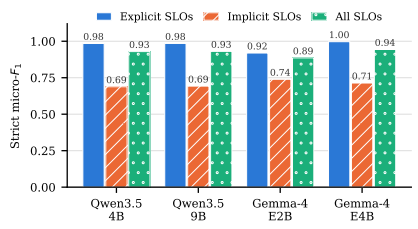
Fig. 2 . StrictF 1 of the two best model families withfs-coton explicit SLOs (thresholds stated in intent), implicit SLOs (values must be read from snapshot), and all SLOs. Errors lie mostly in implicit SLOs.
Original paper · CC BY 4.0 · Sabbir Ahmed, Hazem Abbas, Salimur Choudhury · How Far Can Lightweight LLMs Go in Intent-to-SLO Translation? · Original paper figure · Extracted the figure area from page 4 of the original PDF.The errors concentrate where the value must be read from the snapshot, which is the grounding step. With fs-cot, the four Qwen and Gemma models reach an F1 of 0.919 to 0.997 on explicit SLOs. On implicit SLOs, the same four models drop to 0.688 to 0.739. Explicit SLOs state their threshold in the intent, while implicit SLOs come from a superlative request and need the snapshot.
How often invalid intents get refused
Zero-shot instructions aren't enough to make the models refuse invalid intents. Under zero-shot, the rejection rate ρ ranges from 0.00 for Llama-3.2-3B to 0.80 for Gemma-4-E4B. Only three of the ten models exceed 0.6 under zero-shot. Adding examples and reasoning together, as in fs-cot, raises ρ for all ten models. The strongest configurations reject up to 191 of the 195 invalid intents, which the paper summarizes as up to 98%.
Conflicting intents are the hardest category, and the dataset holds 49 of them. Contradictory bounds, such as a utilization below 40% and above 80%, are rejected by Qwen3.5 and Ministral-3-8B with fs-cot. A layer conflict is harder, because it reads like a broad placement preference. A model can satisfy that layer conflict literally by writing both placements.
Across all configurations, 3,351 of the 7,800 answers to invalid intents still contain SLOs. Most of these answers hold a single placement, at 22–50% depending on the category.
With reasoning, at most 6.9% of valid intents are rejected, by Granite-4.1-3B with fs-cot. Qwen3.5-9B and Ministral-3-8B reject none of the valid intents.
Whether models invent requirements
Hallucination counts a response when it contains at least one SLO that the intent, its numbers, or the snapshot don't support. Reasoning lowered the rate for all ten models under zero-shot prompts, and for nine of ten under few-shot prompts. Examples alone lowered it for eight models, so the few-shot examples help even without reasoning. The lowest rates come from few-shot chain-of-thought, with Gemma-4-E4B at 0.008 and Qwen3.5-4B at 0.013.
The best configurations sit near about 1% of responses, which is the level the authors call trustworthy.
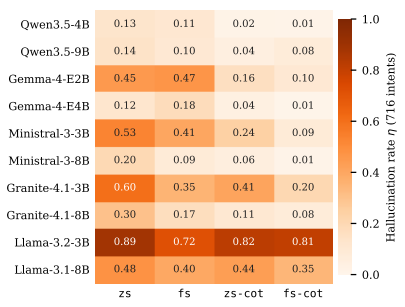
Fig. 4 . Hallucination rateηof each model and setup over all 716 intents (lighter = more trustworthy). Examples and reasoning (fs-cot) lower it for almost every model, down to about 1% in the best configurations.
Original paper · CC BY 4.0Pooled over two models and four setups, the hallucination rate per family runs from 0.080 for Qwen3.5 to 0.610 for Llama 3. Gemma 4 pools to 0.191, Ministral 3 to 0.203, and Granite 4.1 to 0.279. Qwen3.5 is the exception, with the 9B model at 0.093 against 0.068 for the 4B model.
In one valid intent, Qwen3.5-9B with zero-shot kept the right node but reported 18.0% from the storage utilization. The node was right, but the metric was wrong. Another case is Qwen3.5-9B with few-shot chain-of-thought, which added a placement layer that the intent never named.
What one translation costs in energy and emissions
Each translator ran on its own H100 NVL GPU with vLLM, and no other process shared that GPU. The authors read energy from the NVML counter and logged 11,808 requests across three load levels. With reasoning, the same intent costs 0.18–0.58 Wh, so reasoning multiplies the energy by 3.5–7.1 times. For Qwen3.5 and Ministral-3-8B, it buys at most 2 points, so reasoning pays off mainly for the weaker models.
Batching changes the picture, because serving 64 requests at once lowers energy per intent by a factor of 3.2–20.2. The median reduction is 6.1 times, and the gain is largest for the reasoning setups. Long reasoning generations benefit most from batching, since they keep the GPU busy for longer. So an operator can batch delay-tolerant intents, such as planned deployments, and serve urgent ones individually.
At realistic request rates, the GPU's idle power dominates the energy. The setting is a dedicated GPU drawing 101–108 W at idle, capped at 50% of its throughput and a 30 s latency. Under that setting, idle draw accounts for 81–97% of the daily energy, with a median of 93%. The daily total is 2.5–3.2 kWh at 10,000 intents.
With an industry-average PUE of 1.56 and the 2025 world grid intensity of 0.458 kg CO2e/kWh, the authors get 0.18–0.67 g CO2e per intent. The site matters more than the model here, because the same translation emits 0.016–0.061 g in France. In India, it emits 0.26–0.98 g, a difference of about 16-fold.
Rephrased operator intents
Real operators rarely write the short, one-line requests that the dataset uses, so the authors built messier versions of each intent. Variant C1 keeps the request close to the original and wraps it in task-related opening and closing sentences. Variant C3 turns the intent into a list with typically 3 to 5 typos and shortcuts such as "pls" and "mem".
Numbers, units, service names and layer words are never changed by a typo, and every invalid intent keeps its defect. The 716 intents yield 2,148 variants, and an LLM wrote them one intent at a time, with automatic tests checking the numbers. A human reviewer checked all three variants of 100 intents and agreed in 95% of cases.
F1 dropped in 14 configurations, by up to 9.4 points for Gemma-4-E2B with zs-cot. Zero-shot is the most fragile setup, losing 8.7 to 18.8 points of rejection. Few-shot examples reduce these losses, so Qwen3.5 and Gemma-4-E4B lose 4.4 to 11.4 points of rejection with fs or fs-cot. In those few-shot cases, the F1 loss stays at 2.5 points or less.
Wrapping (C1) makes broken fragments read like normal requests, which lowers the rejection of malformed intents. They didn't test multi-turn clarification of ambiguous intents, so the rephrased rejections aren't resolved by follow-up questions.
Limits of the evidence
The evaluation rests on one cluster snapshot, so every intent points at the same node states. The 716 intents come from a 6-node edge–cloud Kubernetes cluster with four edge nodes and two cloud nodes. Each model ran with vLLM on its own H100 NVL GPU, and the authors read energy from the NVML counter. The authors expect absolute energy values on edge accelerators to differ from their on-premises numbers.
They expect the relative effects of reasoning and batching to hold there, but they didn't measure edge hardware.
Ground truth for the 195 invalid intents doesn't come from direct labels, because an LLM-assisted procedure produced it. Claude Sonnet 5.5 read each invalid intent and wrote a specification that was then applied to every returned SLO. A human annotator checked 250 stratified labels and agreed with 93% of cases. Implicit SLOs remain the weakest part, since most errors concentrate there.
Robustness was tested on only two model families, Qwen3.5 and Gemma 4.
Energy was measured for only three model families, the three most accurate in RQ1. Native reasoning modes were disabled for all models, so the results don't cover thinking mode. At realistic request rates, the GPU's idle power dominates the energy, the authors report.
The authors state that their evaluation uses a single cluster snapshot and an on-premises GPU. Their claim about edge accelerators is therefore an expectation, not a measured result.
Paper info
- Authors
- Sabbir Ahmed, Hazem Abbas, Salimur Choudhury
- Venue
- arXiv · Preprint
- First published
- 2026-11-5
- Added
- 2026-11-6
- Updated
- 2026-11-5
- Version
- v1
- arXiv
- 2611.07982
- Category
- cs.NI · cs.CL
- Original paper terms
- CC BY 4.0
- What we show
- Paper info, commentary and permitted figures from the original paper
AI commentary is a separate explanation from the original paper and may contain errors. The original paper and figures follow each source's terms of use and any rights noted separately.
Abstract
Intent-based networking (IBN) promises QoS provisioning in which the network derives the configuration from operator-stated goals. Its first step, translating a natural-language intent into enforceable service-level objectives (SLOs) grounded in a live snapshot of the network state, increasingly relies on large language models (LLMs). These large models add cost and energy to the management loop and typically require multi-GPU, cloud-hosted infrastructure. Can lightweight open LLMs take over this step dependably? We answer this question with a five-dimensional evaluation of ten LLMs with <10B parameters from five families, under four prompting setups, on 716 placement intents. We evaluate translation performance, intent validation, hallucination, energy impact, and robustness to diverse phrasing. The best configurations translate intents with a strict F1 of 0.943 and reject up to 191 of 195 invalid intents. With few-shot reasoning, the strongest models hallucinate unsupported QoS requirements in only about one response in a hundred, whereas the zero-shot setup struggles. A translated intent costs 0.044-0.148 Wh of GPU energy without reasoning, and added energy cost for reasoning pays off for the weaker models. Furthermore, we show that realistic rephrasing lowers the rejection of invalid intents in 15 of 16 configurations for the best-performing models, leaving robust intent validation as a key open challenge for reliable IBN. Our code and data are available: https://github.com/ggck43/intent2slo.
Quote from the paper
Sabbir Ahmed, Hazem Abbas, Salimur Choudhury (2026). How Far Can Lightweight LLMs Go in Intent-to-SLO Translation?. arXiv:2611.07982v1. https://arxiv.org/abs/2611.07982v1
BibTeX
@misc{ahmed2026lightweight,
  title = {{How Far Can Lightweight LLMs Go in Intent-to-SLO Translation?}},
  author = {Sabbir Ahmed and Hazem Abbas and Salimur Choudhury},
  year = {2026},
  eprint = {2611.07982},
  archivePrefix = {arXiv},
  url = {https://arxiv.org/abs/2611.07982v1}
}