Paper commentary
Does the Citation Matter? Quality, Grounding, and Physician-Rubric Accuracy of Google's AI Overviews for Medical Information
Google's AI Overviews cite weaker health sources and often lack grounding
- Problem Users rarely check AI Overviews against their sources, and Google's traditional search was built to rank quality health sources first. It was unclear whether AI Overviews kept those standards.
- Method The authors audit 3,611 HealthBench health questions. For each, they compare the AI Overview's citations with the top five traditional results, and grade statement grounding and accuracy against physician rubrics.
- Results Only 44.4% of the traditional top five results were also cited by the AI Overview. AI Overviews scored 38.2% of available physician rubric points.
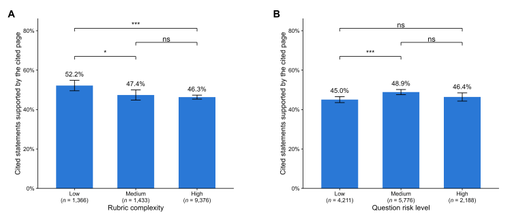
Figure 4 : Proportion of Cited Statements Supported by a Cited Page, by (A) Rubric Complexity and (B) Risk Level.n= scorable cited statements in each level. Error bars are 95% confidence intervals. Brackets mark pairwise (Holm-adjusted) chi-square tests within each panel. *p< .05. **p< .01. ***p< .001.
Original paper · CC BY 4.0 · Sam Agnoli, Brigid Reilly, Lily Barna, Emőke-Ágnes Horvát · Does the Citation Matter? Quality, Grounding, and Physician-Rubric Accuracy of Google's AI Overviews for Medical Information · Original paper figure · Extracted the figure area from page 7 of the original PDF.Why source selection is now Gemini's job
AI Overviews hand source selection to Gemini, a job that used to sit with the user. Gemini uses retrieval-augmented generation to write an answer and attach citations to users' questions. A user can now ask one question with many details and caveats, instead of running several searches. Users seldom check an AIO against its sources, so citations and accuracy become the main safeguards.
Google's traditional search was developed over the past 30 years to deliver high-quality information. For health pages, Google ranks academic and government domains above commercial ones. A study of non-healthcare AIOs found that they rely more on user-generated content than traditional results do. In a study of non-medical queries, 11% of AIO claims were unsupported by their citations.
Health queries are high stakes, because inaccurate information can lead to worse outcomes, including increased mortality. People place about as much trust in LLMs as in doctors, so weak citations carry real risk. A recent systematic review found that AI raises the perceived credibility of health misinformation. It remains unclear whether AIOs keep the quality standards Google built for health domains.
This study tests that question on source selection, source quality, statement grounding, and accuracy against physician rubrics.
Building the question set and the four checks
The design pairs each AI Overview with the traditional top five for the same HealthBench question, so both sides answer one query. The authors began with 5,000 HealthBench conversations and kept 3,611 that were in English and focused on a health problem a clinician could answer. Administrative tasks and vague prompts were excluded, and multi-turn items went to Google verbatim.
Google was queried through SerpAPI between September 16 to 18, 2026, with U.S. English locale, and one question failed to return results. For each question, the study kept the AI Overview with every source it cited, plus the first five traditional results without video.
Each question received a complexity label and a risk label, so results can be read by question type. Complexity counts rubric criteria: low is 2 to 3, medium is 4 to 7, and high is 8 or more. Risk groups HealthBench's seven themes by how much harm a poor answer could cause, and the authors built that grouping themselves. High risk holds emergency referrals and response depth, where a missed emergency or an oversimplified answer can do real damage.
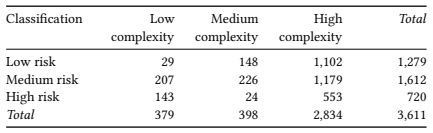
Table 1 : HealthBench Questions by Complexity and Risk
Original paper · CC BY 4.0A rule-based Python scorer rated every source on the four JAMA dimensions of authorship, attribution, currency, and disclosure, each as a binary item. The authors cut HONcode to two binary items, Authority and Complementarity, for a total of 0 to 2. Against human coders on 174 judgments, the scorer agreed on 84% and reached a Cohen's kappa of .68.
HallOumi, an open-source classifier, labels each statement as supported, unsupported, indeterminate, or uncited against its cited pages. Across the overviews, 24,060 statements were identified, and 12,175 were scorable against a cited source. HallOumi agreed with human coders on 81% of 100 manually coded statements, with a Cohen's kappa of .61.
GPT-4.1 grades each AI Overview against HealthBench's rubric, and the score is the sum of criteria met divided by the maximum possible points. The authors had no clinical expertise, so they relied on HealthBench's physician-validated grader. On a random subsample of 3,000 physician-graded examples, GPT-4.1 reached a macro-F1 of .707, above the .681 that physicians reached with each other.
Overlap and quality of cited sources
Only 44.4% of the traditional top five results were also cited by the AI Overview, while 55.6% appeared only in traditional results. That split covers 6,412 shared results and 8,031 traditional-only results. The comparison is lopsided by design, because traditional search was capped at five sources. The AI Overviews carried 23,657 sources in total, against 14,443 traditional sources.
AI Overviews over-represented commercial publishers such as WebMD and Healthline. Traditional results instead favored academic and government sites such as Cleveland Clinic and the National Health Service.
The quality check kept the paired design, so each question's AI Overview pages were averaged and set against its traditional top five. An automated, rule-based Python scorer coded every source on the JAMA criteria and the HONcode criteria. The authors reduced HONcode to two binary criteria, Authority and Complementarity. Against human coders, the scorer agreed on 84% of judgments, with a Cohen's kappa of .68.
Benjamini–Hochberg correction was applied across the six measures, and four of them still differed.
Traditional sources scored higher than AI Overview sources on all four measures that differed. HON Authority showed the largest gap, with a dz of −0.19 and p < .001. JAMA Disclosure followed at dz −0.12, then JAMA Currency at −0.09 and JAMA Attribution at −0.06. JAMA Authorship and HON Complementarity didn't differ between the two groups.
The authors call the overall gap relatively small, since every absolute dz stayed at or below 0.19. They read the pattern as AI Overviews relying on domains that were less transparent. Xu et al. found AI Overview domains more credible than traditional results in non-medical queries, but they used a coarser domain-level measure.
Whether cited statements follow their pages
Grounding starts with the statements themselves, and HallOumi checked 24,060 statements across the 3,474 AI Overviews. Only 50.6% (12,175) of those statements could be scored against a cited source. Uncited factual statements made up 20.8% (4,996), so many factual claims never received a citation. Headers or conversational text took 17.8% (4,271), and indeterminate statements took 10.9% (2,618).
Indeterminate statements arise when a cited page can't be read, so support can't be ruled out.
Within the scorable statements, HallOumi judged 47.1% (5,735) as supported and 52.9% (6,440) as unsupported. On 100 manually coded statements, HallOumi matched the human coders on 81% of judgments, a kappa of .61. Human coders judged 16 of HallOumi's 19 disagreements as supported, so HallOumi's support rates work as lower bounds. The AIO told her to keep the child awake, although none of the cited pages gave that instruction.
Correcting for HallOumi's misclassification, the authors estimate 56.7% of scorable statements were supported, with a 95% CI of [45.3, 68.6]. Support fell from Low (52.2%) to Medium (47.4%) to High complexity (46.3%) questions. That complexity difference gave a chi-square of 16.57 on 12,175 statements, with p below .001. Risk produced a nonlinear pattern, with 45.0% for Low, 48.9% for Medium, and 46.4% for High risk.
Combined with the uncited statements, the low support rate suggests around half of cited statements weren't adequately grounded.
Physician-rubric accuracy and its links to grounding
The authors graded every answer with HealthBench's physician-validated grader instead of their own coders. About 30% of the 41,180 rubric criteria, 12,218 in total, describe content the answer should avoid. GPT-4.1 counted a criterion as met when the answer covered it through paraphrase, implication, or partial coverage. An AIO's score is the points from criteria GPT-4.1 judged met, divided by the maximum possible total.
Most lost accuracy points reflected missing content (89%) rather than stated errors (11%). Errors still appeared where physicians had predicted them: 22.2% of the 2,065 AIOs contained the flagged claim. Of the 413 emergency-referral questions, 94.9% of AIOs referred users to care with appropriate urgency.
Clinical scores were 76.7% for low-complexity questions, versus 28.8% for medium and 35.7% for high complexity. Without referral criteria, low-risk questions fell to 22.5%, below medium-risk questions at 41.3%.
Grounding showed no relationship with accuracy and completeness, with Spearman's rho of .01 and p = .467. JAMA scores related weakly and negatively to accuracy and completeness (rho = −.05, p = .003). HONcode scores related positively (rho = .10, p < .001), so source quality doesn't predict accuracy cleanly. The authors can't separate their explanations, such as reliance on model weights or citations written after the answer.
Robustness checks and remaining uncertainty
That subset had 1,714 questions, and the main conclusions held. Uncited AIOs dropped from 9.4% to 5.8% on this subset, and they clustered less in high-risk questions. JAMA Attribution no longer differed between the AIO and traditional groups on the short questions. Grounding showed a weak correlation with accuracy and completeness, with rho = .06 and p = .013.
HealthBench questions were written to benchmark LLM conversations, so they run longer than typical Google queries. The authors say this may have raised the rate of uncited AIOs, though it may also mirror longer questions users ask. The HealthBench rubric was built for responses slightly longer than AIOs give, and higher scores tracked length (rho = .14).
Some pages blocked automated access, and social media threads weren't scraped, so they are absent from the analyses. The scrape covered a 3-day period, while AIOs keep changing with model improvements.
The authors rely on automated coding, the HallOumi classifier, and GPT-4.1, so they read their results as relative comparisons. Even at the upper bounds of the confidence intervals, no estimate reached an acceptable standard for health information. Until AIOs improve, the authors suggest hiding or ignoring them rather than trusting them.
Paper info
- Authors
- Sam Agnoli, Brigid Reilly, Lily Barna, Emőke-Ágnes Horvát
- Venue
- arXiv · Preprint
- First published
- 2026-10-29
- Added
- 2026-11-1
- Updated
- 2026-10-29
- Version
- v1
- arXiv
- 2610.39339
- Category
- cs.IR · cs.CL · cs.CY · cs.HC
- Original paper terms
- CC BY 4.0
- What we show
- Paper info, commentary and permitted figures from the original paper
AI commentary is a separate explanation from the original paper and may contain errors. The original paper and figures follow each source's terms of use and any rights noted separately.
Abstract
Google's AI Overviews (AIOs) are the first result users encounter when searching the web, shifting the work of selecting and evaluating sources from the user to Gemini. This may be especially consequential for health information, given that Google's traditional algorithm was designed to prioritize quality sources, and inaccurate information carries health risks. We evaluated 3,611 benchmark health questions, comparing each AIO against that question's top five traditional results on source selection and quality. We also evaluated the AIOs' statement grounding in their cited sources and how accurate AIOs were against physician-written rubrics. Overviews appeared for 96.4% of questions but drew on substantially different evidence than traditional search: only 44.4% of the top five results were cited by the corresponding AIO, which instead overrepresented commercial health publishers (e.g., WebMD, Healthline) at the expense of academic and government sources (e.g., Cleveland Clinic, National Health Service). AIO-cited pages scored lower than traditional results on four of six well-established credibility criteria. The grounding of AIO statements to their sources was poor: after correcting for classifier error, an estimated 56.7% of cited statements were supported by their cited page, and a further 20.8% of all statements were factual claims with no citation at all. When AIOs were graded against physicians' rubrics, they earned 38.2% of all available points (e.g., accuracy 54.2%, completeness 21.6%), and among the subset of AIOs whose physician rubric anticipated a specific inaccurate or potentially harmful claim, 22.2% of AIOs contained the harmful content. Notably, the accuracy of AIOs was unrelated to the grounding of their statements. We recommend AIO literacy interventions for users and holding AIOs at least to Google's own health-ranking standards.
Quote from the paper
Sam Agnoli, Brigid Reilly, Lily Barna, Emőke-Ágnes Horvát (2026). Does the Citation Matter? Quality, Grounding, and Physician-Rubric Accuracy of Google's AI Overviews for Medical Information. arXiv:2610.39339v1. https://arxiv.org/abs/2610.39339v1
BibTeX
@misc{agnoli2026does,
  title = {{Does the Citation Matter? Quality, Grounding, and Physician-Rubric Accuracy of Google's AI Overviews for Medical Information}},
  author = {Sam Agnoli and Brigid Reilly and Lily Barna and Emőke-Ágnes Horvát},
  year = {2026},
  eprint = {2610.39339},
  archivePrefix = {arXiv},
  url = {https://arxiv.org/abs/2610.39339v1}
}