Paper commentary
Efficient and Accurate Causal Validation of Training Data Attribution
Noise correction cuts the retraining cost of checking attribution methods
- Problem Checking a training data attribution method with LDS needs many full retrainings on different training subsets, so evaluations stay small.
- Method The authors run several seeds per subset, estimate the training-noise variance, and subtract its attenuation from the correlation.
- Results Two-seed reconstruction matched five-seed averaging with 2.1 to 5.2 times fewer retrainings.
Where LDS evaluation gets expensive
LDS scores a TDA method by how well its predictions correlate with retrained model outputs across many sampled training subsets. That retraining cost is why LDS evaluations have stayed small, which limits evaluation to small scales.
Three sources of error feed into the estimate. Training randomness from parameter initialization and batch ordering makes the ground-truth targets noisy. Averaging over random seeds mitigates that noise, but the authors note this is expensive because it must be done for each data subset. The TDA method is random too, for example through the choice of checkpoint at which the TDA criterion is evaluated.
Averaging E independently random instances of the same TDA method reduces this attribution noise, but the averaged scores still carry it. Finally, the sample Spearman estimator carries a finite-subset bias when only M subsets are used.
The authors respond by estimating each noise source directly and correcting for it, rather than brute-force averaging. Using multiple random seeds per subset lets the method estimate the retraining-noise variance and correct for it when estimating LDS. Figure 1 shows the three resulting cost reductions on CIFAR-10 with ResNet-9. Panel (a) shows that correcting for training variance approaches the Spearman reference with fewer retrainings, while naive seed averaging plateaus.
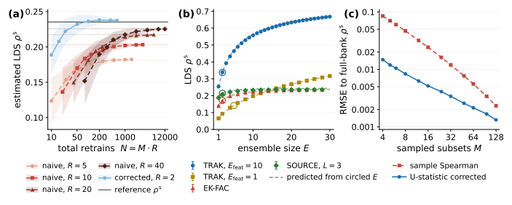
Figure 1 :Three ways to reduce LDS evaluation cost on CIFAR-10/ResNet-9. (a)Correcting for training variance approaches the Spearman reference computed from held-out retraining seeds with fewer retrainings, while naive seed averaging plateaus (EK-FAC). Curves show mean estimates±1 SD over random draws, see Section D for details.(b)The circled small attribution ensembles predict the LDS of larger ensembles (dashed lines).(c)Correcting finite-subset Spearman bias reduces RMSE against the 300-subset reference (TRAK).
Original paper · CC BY 4.0Subtracting training-noise attenuation
Training noise adds a seed-dependent term to each readout, and that term shrinks the observed Pearson correlation toward zero. With lambda the ratio of training-noise variance to signal variance and R the number of seeds averaged, the observed correlation equals the noise-free correlation divided by \(\sqrt{1+\lambda/R}\): \(\rho_p^{R,E}=\rho_p^{E}/\sqrt{1+\lambda/R}\).
Because the attenuation depends on R, averaging more seeds only partly removes it, and the naive estimate stops improving at a plateau.
The method runs R seeds on every subset and computes the sample variance across seeds for each subset. It averages those per-subset variances to get an estimate of the training-noise variance. It then subtracts that noise variance, divided by R, from the variance of the averaged readout, which gives the signal variance: \(\hat\sigma_F^2=\widehat{\mathrm{Var}}_M(\bar f_R)-\hat\sigma_\varepsilon^2/R\).
The Pearson correlation is then the corrected covariance divided by the product of the attribution and signal standard deviations, clipped to the range from minus one to one, and it returns zero when a variance isn't positive.
The method assumes the training seeds are independent of the attribution seeds, which is easy to arrange in practice by using different seeds for the two. Under this setup the correction's error shrinks at order N to the minus one-half in the total retraining budget N, for a fixed number of seeds R of at least 2. Naive averaging with the best seed count allocation only reaches order N to the minus one-third, so the correction changes the rate, not just the constant.
Does the correction cut retraining cost?
Naive seed averaging stalls at plateaus set by the attenuation, while the noise-corrected estimates keep improving as the budget grows. The paper's attenuation formula predicts these naive plateaus, so the gap shows up in the curves rather than in a single number. The median training-noise to signal ratios are 3.43 for CIFAR-10, 0.19 for QNLI and 0.39 for WikiText-2.
CIFAR-10 has the largest ratio, so the two-seed correction there removes bias that remains even with naive R= 20 averaging.
Reconstructing the five-seed Spearman target from k= 2 seeds per subset matches naive five-seed averaging with 2 to 5.2 times fewer retrainings. On WikiText-2 the reduction is 2.3 to 3.3 times, which the paper reads from the same comparison. Figure 2 plots these RMSE curves against total retrainings, so the cost gain is visible directly in the curves.
The biased finite-seed number can therefore be estimated more efficiently, even though its target is biased.
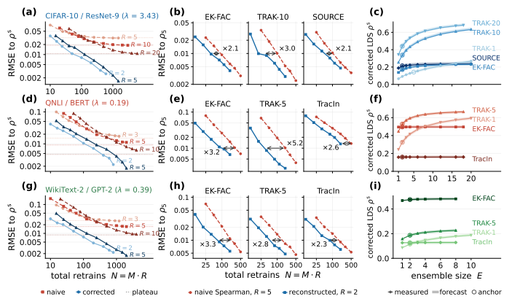
Figure 2 :Noise correction reduces the cost of LDS evaluation.Rows: CIFAR-10/ResNet-9, QNLI/BERT, WikiText-2/GPT-2.(a, d, g)RMSE to the noise-free Spearman LDS versus total retrainings, for naive R-seed averaging and the noise correction (EK-FAC); dotted: predicted naive plateaus.(b, e, h)Reconstructing the five-seed Spearman target ρ5 from two seeds matches naive averaging with 2.1–5.2× fewer retrainings.(c, f, i)Measured noise-corrected Spearman LDS and predictions from the circled small ensembles. The first two columns use E= 1 and disjoint retraining seeds for estimation and reference.
Original paper · CC BY 4.0 · Simon Vary, Alireza Mousavi-Hosseini, Roger Grosse · Efficient and Accurate Causal Validation of Training Data Attribution · Original paper figure · Extracted the figure area from page 6 of the original PDF.These comparisons use a single attribution member, E=1, with disjoint retraining seeds for estimation and for the reference. The 2.1 to 5.2 times range holds for that single-member setup. They didn't extend the range to larger ensembles in this part of the paper.
Forecasting ensembles and converting to Spearman
Attribution ensembling shrinks noise in the same way that retraining seeds do, so the authors estimate an attribution noise-to-signal ratio c. They use c to forecast the training-noise-free LDS of an E-member ensemble from K observed attribution members. The forecast takes the form ρ̂pred = ρ̂corr_{R,K,M} times the square root of (1 + ĉ/K) divided by (1 + ĉ/E), for E at least K and K at least 2.
On CIFAR-10 and QNLI, forecasts from K=2 members stay within 0.008 of the measured noise-corrected Spearman LDS. On WikiText-2, the forecasts stay within 0.005 of the measured value over the plotted ensemble sizes. TRAK-1 on CIFAR-10 needs K=5 instead, because its attribution scores have higher variance. Higher variance makes the noise-to-signal ratio harder for the authors to estimate reliably at K=2.
Reporting the corrected result in Spearman terms requires a joint Gaussian assumption on the attribution prediction and the averaged readout. Under that assumption, the population Spearman and Pearson correlations satisfy ρs = (6/π) arcsin(ρp/2). Across 220 tested settings, the Spearman minus Pearson LDS difference reaches about 0.02. The residual from the finite-M Gaussian expectation stays below 0.006, with the largest departures on WikiText-2.
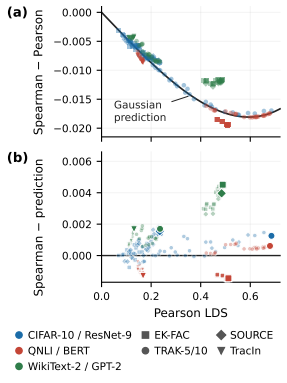
Figure 3 :Spearman versus Pearson LDS. (a)Spearman minus Pearson LDS; curve: Gaussian prediction.(b)Residual from the finite-MGaussian expectation. Large markers: full ensemble, all seeds.
Original paper · CC BY 4.0Removing finite-subset bias
Sample Spearman carries a systematic bias when LDS is estimated from a finite number of training subsets. Averaging over many queries shrinks sampling variance, but it leaves that systematic bias in place. The authors therefore turn to an unbiased U-statistic estimator from Hoeffding, even though it may cost some variance.
It combines the two statistics as (M+1) times the sample Spearman minus 3 times tau-a, divided by M minus 2. The construction needs at least 3 i.i.d. observations with continuous marginals, so ties don't occur.
The experiment samples subsets without replacement from a precomputed bank of 300 subsets, with 40 retraining seeds each. The reference is the Spearman LDS computed on all 300 subsets, measured against 3.2% relative RMSE. Figure 4 splits the squared error for TRAK on CIFAR-10 into squared bias and variance. Bias dominates the error of sample Spearman, and the unbiased estimator removes that large bias.
With the correction, 4 subsets reach 3.2% relative RMSE, while 32 subsets match ordinary Spearman at 96 subsets. Figure 8 in the appendix checks that bias stays the dominant term in these experiments.
Where the guarantees and empirical gains stop
The Gaussian conversion from Pearson to Spearman LDS is an approximation, and it rests on a joint Gaussian assumption for the attribution prediction and the readout. The authors found departures from Gaussianity that persist on QNLI and WikiText-2. On CIFAR-10, seed averaging with larger R improved agreement with the Gaussian reference. Figure 3 shows average discrepancies below 0.006 across 220 tested settings, so the conversion holds only as an approximation in those settings.
The proofs bound the error only up to an order of growth in the retraining budget N. The Pearson estimator's O(λ^1/3 N^-1/3) rate depends on a constant that the proposition leaves unstated. The corrected estimator's O(N^-1/2) bound holds for any fixed R≥2, but its constant can depend on R. Because the bounds are asymptotic in N, they don't give exact error values at small budgets.
The unbiased U-statistic estimator removes the finite-subset bias of sample Spearman at a cost in variance. The authors use it because bias dominates the estimation error in their CIFAR-10 experiments. They report the variance cost only qualitatively, so its size on other benchmarks is left open.
Paper info
- Authors
- Simon Vary, Alireza Mousavi-Hosseini, Roger Grosse
- Venue
- arXiv · Preprint
- First published
- 2026-11-14
- Added
- 2026-11-17
- Updated
- 2026-11-14
- Version
- v1
- arXiv
- 2611.19451
- Category
- cs.LG · stat.ME · stat.ML
- Original paper terms
- CC BY 4.0
- What we show
- Paper info, commentary and permitted figures from the original paper
AI commentary is a separate explanation from the original paper and may contain errors. The original paper and figures follow each source's terms of use and any rights noted separately.
Abstract
Causal validation of training data attribution (TDA) methods is costly, since evaluation involves retraining a model on many different subsets of the original training set. For example, the Linear Datamodeling Score (LDS), which has become a standard metric for evaluating TDA methods, measures the correlation between TDA predictions and expected retrained model outputs. In this paper, we reduce the amount of computation needed to estimate the LDS along three axes: the number of sampled training subsets, the number of retraining seeds per subset, and the number of models in the attribution ensemble. Each of these factors induces a form of bias in the LDS estimation, and removing these sources of bias significantly reduces the number of retrainings needed to match the same accuracy in LDS estimation. On ResNet-9/CIFAR-10, finite-subset debiasing achieves $3.2\%$ relative RMSE with as few as $4$ subsets, and $32$ subsets match the accuracy of ordinary Spearman using $96$ subsets, measured against a 300-subset reference. On ResNet-9/CIFAR-10, BERT/QNLI and GPT-2/WikiText-2, estimating the training-noise variance allows us to reproduce the standard five-seed LDS at the same accuracy with $2$--$5\times$ fewer retrainings.
Quote from the paper
Simon Vary, Alireza Mousavi-Hosseini, Roger Grosse (2026). Efficient and Accurate Causal Validation of Training Data Attribution. arXiv:2611.19451v1. https://arxiv.org/abs/2611.19451v1
BibTeX
@misc{vary2026efficient,
  title = {{Efficient and Accurate Causal Validation of Training Data Attribution}},
  author = {Simon Vary and Alireza Mousavi-Hosseini and Roger Grosse},
  year = {2026},
  eprint = {2611.19451},
  archivePrefix = {arXiv},
  url = {https://arxiv.org/abs/2611.19451v1}
}