논문 해설
Efficient and Accurate Causal Validation of Training Data Attribution
효율적이고 정확한 Training Data Attribution의 인과 검증
- 연구 문제 LDS는 TDA 평가의 표준 지표지만 재학습 비용이 커서, 같은 정확도를 더 적은 재학습으로 얻는 방법이 필요합니다.
- 연구 방법 학습 잡음 분산을 추정해 빼고, 유한 부분집합 편향을 U-통계량으로 제거하며, 작은 앙상블로 큰 앙상블 LDS를 예측합니다.
- 주요 결과 CIFAR-10에서 4개 부분집합으로 3.2% 상대 RMSE를 기록했고, 세 벤치마크에서 표준 다섯 시드 LDS를 2–5배 적은 재학습으로 재현했습니다.
LDS 평가의 재학습 비용 문제
Linear Datamodeling Score(LDS)는 TDA 방법의 인과 예측을 평가하는 표준 지표로 자리 잡았지만, 학습 데이터의 여러 부분집합마다 모델을 여러 번 재학습해야 하므로 비용이 큽니다. 이 논문은 이 비용을 부분집합 수 M, 부분집합당 재학습 시드 수 R, 어텐션 앙상블 멤버 수 E의 세 축에서 줄이는 방법을 다룹니다. 세 축 각각이 LDS 추정에 편향을 만들며, 이 편향을 제거하면 같은 정확도를 더 적은 재학습으로 얻을 수 있다고 주장합니다.
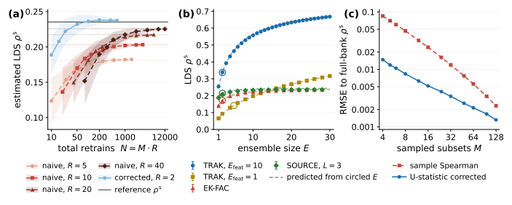
Figure 1 :Three ways to reduce LDS evaluation cost on CIFAR-10/ResNet-9. (a)Correcting for training variance approaches the Spearman reference computed from held-out retraining seeds with fewer retrainings, while naive seed averaging plateaus (EK-FAC). Curves show mean estimates±1 SD over random draws, see Section D for details.(b)The circled small attribution ensembles predict the LDS of larger ensembles (dashed lines).(c)Correcting finite-subset Spearman bias reduces RMSE against the 300-subset reference (TRAK).
원문 · CC BY 4.0 · Simon Vary, Alireza Mousavi-Hosseini, Roger Grosse · Efficient and Accurate Causal Validation of Training Data Attribution · 원문 그림 인용 · 원본 PDF 2쪽에서 그림 영역을 추출했습니다.학습 잡음 분산 보정
시드 평균을 취한 재학습 출력은 학습 잡음이 섞인 신호입니다. 논문은 같은 부분집합의 R개 시드 간 분산으로 학습 잡음 분산 σε²을 추정하고, 관측된 출력 분산에서 σε²/R을 빼서 신호 분산을 복원합니다. 이때 naive 시드 평균의 Pearson 상관은 ρpE/√(1+λ/R)로 감쇠되며, λ는 학습 잡음 대 신호 비율입니다. 보정 추정기는 이 감쇠를 제거하도록 설계되었습니다.
Pearson에서 Spearman으로의 변환
잡음 보정은 Pearson 상관의 공분산 형태에서 유도되지만, 표준 LDS는 Spearman 상관을 사용합니다. 논문은 (G(S), F(S))가 결합 가우시안이라고 가정하고 ρs = (6/π)arcsin(ρp/2)로 두 상관을 변환합니다. 이 변환은 가우시안 가정 아래에서의 관계이므로, 이 가정이 실제 데이터에서 얼마나 성립하는지가 중요합니다.
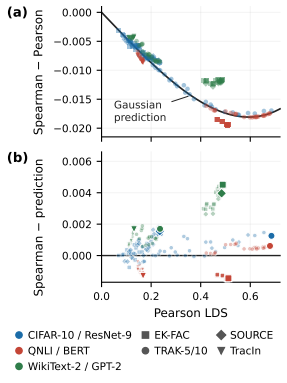
Figure 3 :Spearman versus Pearson LDS. (a)Spearman minus Pearson LDS; curve: Gaussian prediction.(b)Residual from the finite-MGaussian expectation. Large markers: full ensemble, all seeds.
원문 · CC BY 4.0 · Simon Vary, Alireza Mousavi-Hosseini, Roger Grosse · Efficient and Accurate Causal Validation of Training Data Attribution · 원문 그림 인용 · 원본 PDF 6쪽에서 그림 영역을 추출했습니다.유한 부분집합 편향 보정
표본 Spearman 추정기는 유한한 부분집합 수에서 편향을 가집니다. 논문은 기대값이 E[ρ̂s]=((m−2)ρs+3τ)/(m+1)임을 보이며, 편향이 3(τ−ρs)/(m+1)이라고 정리합니다. 이를 제거하기 위해 Kendall tau-a를 이용한 U-통계량 추정기 ρ̂s,unb=((m+1)ρ̂s−3τ̂)/(m−2)를 사용합니다. 이 추정기는 m≥3이고 주변분포가 연속인 경우의 비편향 추정입니다.
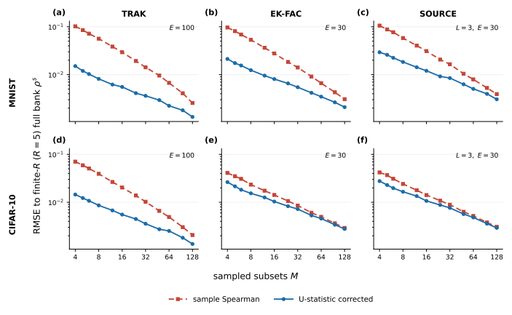
Figure 9 : Comparing RMSE in estimating the full-bank LDS using finite-sample Spearman and the finite-bank correction (18). All experiments useR= 5retraining seeds.
원문 · CC BY 4.0 · Simon Vary, Alireza Mousavi-Hosseini, Roger Grosse · Efficient and Accurate Causal Validation of Training Data Attribution · 원문 그림 인용 · 원본 PDF 20쪽에서 그림 영역을 추출했습니다.작은 앙상블로 큰 앙상블 LDS 예측
TDA 멤버들의 잡음 대 신호 비율 c를 추정하면, 작은 앙상블의 보정 상관을 바탕으로 더 큰 앙상블의 학습 잡음 없는 LDS를 예측할 수 있습니다. 실험에서 CIFAR-10과 QNLI의 K=2 멤버 예측은 측정된 보정 Spearman LDS와 0.008 이내로 맞았습니다. 다만 TRAK-1의 CIFAR-10 예측은 분산이 커서 K=2 대신 K=5를 사용했습니다.
재학습 비용 절감 결과
CIFAR-10/ResNet-9 실험에서 유한 부분집합 디바이싱은 4개 부분집합으로 3.2%의 상대 RMSE를 기록했습니다. 또한 ResNet-9/CIFAR-10, BERT/QNLI, GPT-2/WikiText-2에서 학습 잡음 분산 추정으로 표준 다섯 시드 LDS를 2–5배 적은 재학습으로 재현했습니다. 저자들은 학습 잡음이 큰 CIFAR-10에서 이득이 가장 크다고 해석합니다.
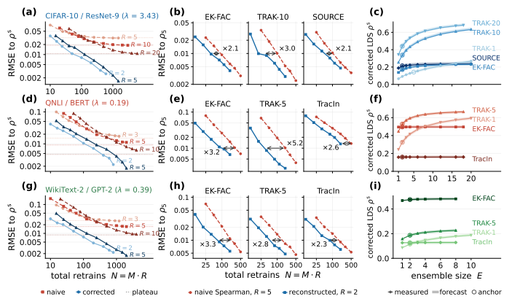
Figure 2 :Noise correction reduces the cost of LDS evaluation.Rows: CIFAR-10/ResNet-9, QNLI/BERT, WikiText-2/GPT-2.(a, d, g)RMSE to the noise-free Spearman LDS versus total retrainings, for naive R-seed averaging and the noise correction (EK-FAC); dotted: predicted naive plateaus.(b, e, h)Reconstructing the five-seed Spearman target ρ5 from two seeds matches naive averaging with 2.1–5.2× fewer retrainings.(c, f, i)Measured noise-corrected Spearman LDS and predictions from the circled small ensembles. The first two columns use E= 1 and disjoint retraining seeds for estimation and reference.
원문 · CC BY 4.0 · Simon Vary, Alireza Mousavi-Hosseini, Roger Grosse · Efficient and Accurate Causal Validation of Training Data Attribution · 원문 그림 인용 · 원본 PDF 6쪽에서 그림 영역을 추출했습니다.가우시안 가정과 편향 추정의 한계
QNLI와 WikiText-2에서는 시드 평균을 늘려도 가우시안 가정에서 벗어난 차이가 남았습니다. 또한 Spearman 변환 결과는 결합 가우시안 가정이 성립하지 않는 설정에서 보장되지 않으며, 보정된 분산이 너무 작을 때는 안정화 장치를 사용했습니다.
논문 정보
- 저자
- Simon Vary, Alireza Mousavi-Hosseini, Roger Grosse
- 학회·저널
- arXiv · 프리프린트
- 최초 공개일
- 2026년 11월 14일
- 등록일
- 2026년 11월 17일
- 수정일
- 2026년 11월 14일
- 버전
- v1
- arXiv
- 2611.19451
- 분류
- cs.LG · stat.ME · stat.ML
- 원문 이용 조건
- CC BY 4.0
- 제공 범위
- 논문 정보, 해설, 허용된 원문 그림
AI 해설은 논문 원문과 별개의 설명이며 오류가 있을 수 있습니다. 원문과 그림은 각 출처의 이용 조건과 따로 표시된 권리를 따릅니다.
초록
Causal validation of training data attribution (TDA) methods is costly, since evaluation involves retraining a model on many different subsets of the original training set. For example, the Linear Datamodeling Score (LDS), which has become a standard metric for evaluating TDA methods, measures the correlation between TDA predictions and expected retrained model outputs. In this paper, we reduce the amount of computation needed to estimate the LDS along three axes: the number of sampled training subsets, the number of retraining seeds per subset, and the number of models in the attribution ensemble. Each of these factors induces a form of bias in the LDS estimation, and removing these sources of bias significantly reduces the number of retrainings needed to match the same accuracy in LDS estimation. On ResNet-9/CIFAR-10, finite-subset debiasing achieves $3.2\%$ relative RMSE with as few as $4$ subsets, and $32$ subsets match the accuracy of ordinary Spearman using $96$ subsets, measured against a 300-subset reference. On ResNet-9/CIFAR-10, BERT/QNLI and GPT-2/WikiText-2, estimating the training-noise variance allows us to reproduce the standard five-seed LDS at the same accuracy with $2$--$5\times$ fewer retrainings.
원문 인용
Simon Vary, Alireza Mousavi-Hosseini, Roger Grosse (2026). Efficient and Accurate Causal Validation of Training Data Attribution. arXiv:2611.19451v1. https://arxiv.org/abs/2611.19451v1
BibTeX
@misc{vary2026efficient,
  title = {{Efficient and Accurate Causal Validation of Training Data Attribution}},
  author = {Simon Vary and Alireza Mousavi-Hosseini and Roger Grosse},
  year = {2026},
  eprint = {2611.19451},
  archivePrefix = {arXiv},
  url = {https://arxiv.org/abs/2611.19451v1}
}