Paper commentary
Opening the Black Box of Neural Auction Mechanisms
Sparse autoencoders reveal which hidden features in neural auctions track economic outcomes
- Problem Neural auctions set allocations and payments, but their hidden states give no readable account of why. Their features are dense and correlated, so they are hard to check against measurable auction outcomes.
- Method The authors split the frozen CITransNet's hidden states into sparse features with sparse autoencoders. They then test each feature against seven economic targets using activation prediction and causal interventions.
- Results Activation prediction reached pooled precision 0.630 and recall 0.672 on a balanced benchmark. The full prompt beat each control, which the authors take as evidence that explanations capture feature-specific activation conditions.
Why trained auctions resist inspection
Neural auction models parameterize allocation and payment rules with deep networks, and RegretNet and CITransNet reach strong revenue-regret tradeoffs. Classical mechanisms make their relationships explicit, but optimal design stays analytically intractable beyond structured settings. A learned rule that sets market outcomes without a readable account is hard to trust, because nobody can see how it prices and allocates.
The authors argue that opening this black box is an economic necessity once an algorithm sets market rules on its own.
Existing responses build trust at design time, through architectural constraints, menu representations, monotonicity enforcement, or certification procedures. The authors instead ask how an already trained auction can be audited without changing its architecture or optimization dynamics. Their framework stays strictly post-hoc, so it doesn't retrain the network or alter its training.
Sparse autoencoders split dense, polysemantic hidden states into interpretable sparse features without supervision. Neural auctions pose two obstacles for that route. First, an activation context is a dense, correlated auction profile, so a feature's meaning is hard to read from its top-activating examples. Second, a feature interpretation can only be falsifiably audited if it maps to measurable auction states or outcomes.
The authors respond by anchoring candidate features to the mechanism's native economic targets, not to open-ended discovery.
Tying features to economic targets
Anchoring features to the mechanism's own outcomes changes the reading from guessing at top-activating examples to checking each feature against a measurable quantity. Each auction instance gets seven economic targets, defined from the outputs of the audited CITransNet checkpoint. Revenue R sums the payments, and social welfare W sums the allocated valuations across bidders.
Bidder utility Ui subtracts payment from allocated value, while payment share Pi divides payment by allocated value when that value is positive. Allocation entropy H measures how uncertain the allocations are, and winner margin L measures how far apart the top two bidders sit on each item. The seventh target, the incentive score I, penalizes searched ex post regret across unilateral deviations, so it is counterfactual rather than a single forward pass.
For each feature, the auction-level activation is the maximum activation over all bidder–item pairs in that auction. An auction counts as active for a feature when that maximum is above zero. In active auctions, the focal bidder is the one whose pair gives the maximum activation, and bidder-level targets are read at that bidder. Before any explanation is written, the authors compute Spearman rank correlations between each feature's activation and each target.
These correlations are computed on disjoint generation and prediction partitions, so the explanation never sees the data used for testing. The explainer picks one target from the generation auctions and writes a description tied to it.
The sign of the generation-partition correlation sets the expected direction of each feature, and the authors fix that direction before any prediction or intervention. The first axis is prediction: a blinded predictor guesses activation on disjoint prediction auctions from the explanation alone. The second axis scales the feature's activation by a dose factor γ across bidder–item pairs.
Setting γ to 0 ablates the feature, and setting γ to 1 gives the SAE reconstruction baseline. Effects are read as paired contrasts against the γ=1 baseline, which isolates the scaling from the SAE reconstruction residual. The protocol is meant to split features with interventional influence from features that only correlate with outcomes.
How the audit runs step by step
The audit starts from the hidden states of the frozen CITransNet at its first fully connected layer, with one vector per bidder-item pair. Before the SAE sees each vector, the authors standardize every dimension with training-set moments. The encoder keeps only the s largest positive activations, so the TopK rule fixes the sparsity level directly.
With d = 64 and K = 8d = 512, the authors set s = 32, so at most 32 of the 512 features fire for any pair. They chose TopK over a regularization coefficient because it makes sparsity an explicit architectural choice.
The decoder rebuilds the standardized vector, and the reconstruction loss scores how close that rebuild lands. Low reconstruction error alone doesn't show that the auction still works, so the authors map each reconstruction back to the original scale. They then replace the frozen network's audited hidden states with these reconstructions, which yields a new mechanism they call M_SAE.
Allocation and payment L1 differences measure how far this swapped mechanism drifts from the original network. The mean allocation L1 difference is 0.003013, and the mean payment L1 difference is 0.000534 in the 2×5c setting. Downstream behavior barely moves, and the standardized reconstruction MSE of 4.44×10 −5 shows the SAE reconstructs closely.
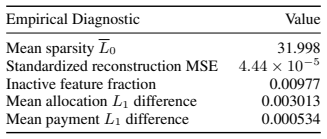
Table 1 : Representational and downstream output fidelity of the SAE in2×5c.
Original paper · CC BY 4.0An 80:20 split over bidder-item pairs separates SAE training from representational evaluation. A separate auction-level partition divides explanation generation from prediction sets, so the two stages don't share auctions. The authors run gpt-5.6-luna in separate contexts to write explanations and to predict binary activations on disjoint prediction auctions.
Explanations, targets and directional hypotheses are frozen beforehand, so the causal interventions on the independent test split can't adjust them.
Do explanations predict when features fire?
A feature's auction-level activation is the largest value across all bidder-item pairs in an auction. An auction counts as active for a feature when that maximum is above zero. The authors compute Spearman correlations between this activation and each economic target on separate generation and prediction partitions. Across all targets, the correlation vectors from the two partitions range from 0.872 to 0.999.
An explainer writes a description and picks one economic target from the generation auctions. A blinded predictor then guesses activation on disjoint prediction auctions without seeing the activations. The direction is set to the sign of the generation-partition correlation, and it stays fixed before any prediction runs. The predictions run as zero-shot simulations in separate contexts with gpt-5.6-luna, on a balanced benchmark with roughly equal active and inactive auctions.
Pooled precision divides correctly predicted active cases by all predicted actives, while recall divides them by all actual actives.
The full prompt reaches pooled precision of 0.630 and recall of 0.672 on this benchmark. Adding the explanation to a target-only prompt raises precision by 0.149 and recall by 0.206. Adding the target reference to an explanation-only prompt adds 0.038 in precision and 0.086 in recall. Shuffled explanations, frequency-matched text, random guessing and always-active guessing serve as the controls.
The full prompt beats each control, which the authors take as evidence that explanations capture feature-specific activation conditions.
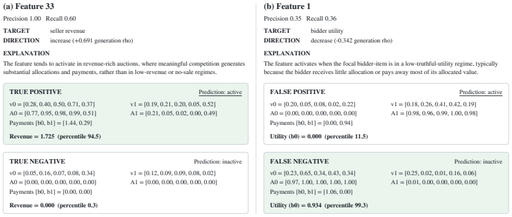
Figure 2 : Contrasting explanations: F33’s predictive revenue description and F1’s overbroad low-utility description. Each column shows the original text, selected target, preassigned direction, and two auctions in the prediction set with values, allocations, payments, and outcomes. Green marks actual positive SAE activation, and underlining marks predicted activation.
Original paper · CC BY 4.0F33's revenue explanation, with a generation-partition Spearman correlation of +0.691, identifies 15 of 25 active instances. It rejects all 25 inactive instances, giving precision 1.00 and recall 0.60. F1's bidder-utility description is overbroad, producing 17 false positives and 16 false negatives. Its precision of 0.35 and recall of 0.36 show the description is flawed, even though the target correlation is real.
Does scaling a feature move its target?
Scaling a feature's activation by a dose γ turns the audited layer into an edited mechanism, with γ=0 ablating the feature and γ=1 recovering the SAE baseline. Each auction gets an OLS dose-response slope over the grid Γ = {0, 0.5, 1, 2}, and the responses are compared with the γ=1 baseline. That baseline isolates the effect of scaling the feature from the SAE reconstruction residual.
A feature enters the strong-response set only when its BH-adjusted one-sided test is at most 0.05 and its target moves in the preassigned direction at every dose step. This filter keeps 165 features, and extending the grid to γ=8 retains 158 of them. For 163 of the 165 features, a linear fit of the mean target against dose reaches R² ≥ 0.95.
So the response is close to proportional, not a switch that flips only at ablation.
The paper reads utility gains as the focal bidder keeping more surplus. Payment-share reductions mean that a smaller fraction of allocated value goes to the seller. Features tied to the same target can point in opposite directions, with F173 reducing welfare while F189 increases it.
The authors then treat searched regret as a separate counterfactual check on these interventions, because regret is not a single forward-pass output. Section 4.4 applies that check to all 165 outcome-related features.
Regret sensitivity under reoptimized misreports
Empirical regret measures the bidder-averaged gain from the best unilateral deviation, approximated by numerical search. Regret isn't a single forward-pass output, so the authors recompute it by reoptimizing each bidder's report under each edited mechanism. They hold public contexts fixed and keep competing bids truthful while they do this.
Each auction's regret values are regressed on dose γ, which yields an auction-level regret slope across active instances. Two-sided t-tests check whether the mean regret slope differs from zero, with BH adjustment across the strong-response set.
At BH-adjusted q ≤ 0.05, 26 features increase regret and 17 reduce it. The 89 payment-share features include 17 regret-increasing and 11 regret-reducing features, so pricing representations push incentives in both directions. Doubling the activation of the utility feature F335 and the payment-share feature F364 raises mean empirical regret by 0.0331 and 0.0296 above the reconstruction baseline.
Those two features have the steepest positive regret slopes in their families, so the surplus features also push misreporting gains up.
Alignment with the Myerson oracle
The alignment check uses a two-bidder, single-item setting where valuations are independent and uniform on [0, v̄i]. Myerson's rule serves as the reference, giving the item to the bidder with the highest nonnegative virtual value. The authors split the oracle outcomes into three regions: no sale, Bidder 0 winning, and Bidder 1 winning. Each feature's continuous activations are scored by AUC, treating auctions inside one region as positives and the rest as negatives.
The evaluation covers 1,000 auctions, with 265 no-sale, 359 Bidder 0 win, and 376 Bidder 1 win cases.
F62 stays at zero or near zero in no-sale auctions and reaches higher values in both bidder-winning regions. That separation gives F62 an AUC of 0.9636 for no-sale outcomes. F62's explanation ties it to single-item auctions where a winner's allocation brings in substantial seller revenue. For winner identification, the authors read F73 and F421 per bidder, and they reach AUCs of 0.9129 for Bidder 0 and 0.9277 for Bidder 1.
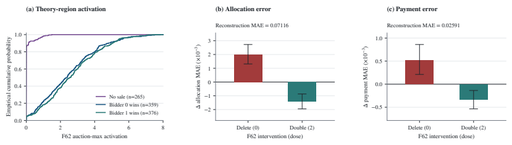
Figure 4 : Alignment with optimal-auction theory for feature F62 in the 2×1 c setting. (a) Empirical cumulative distribution of F62 auction-maximum activation across the three Myerson oracle regions on 1,000 evaluation auctions. (b, c) Paired changes in allocation and payment MAE relative to theγ= 1 reconstruction baseline when ablating at dose 0 or doubling at dose 2, with 95% auction-bootstrap confidence intervals. Negative values indicate closer agreement with the Myerson oracle.
Original paper · CC BY 4.0 · Li Kong, Zilong Liu, Haoyang Zhou, Hanbing Liu, Qi Qi · Opening the Black Box of Neural Auction Mechanisms · Original paper figure · Extracted the figure area from page 10 of the original PDF.The second test edits these features and measures allocation and payment MAE against the Myerson oracle, relative to the SAE reconstruction. So F62 appears to pull outputs toward the oracle, a pattern the paper reports only for the 2×1c setting.
Here the interpretability step grounds the Myerson benchmark in internal features, showing which theoretical states the mechanism represents.
Reading one auction at a time
The single-auction audit starts from two contrasting cases, each read in an unedited forward pass. In high-revenue auction 034928, F509 and F335 raise bidder utility. F419 and F428 lower payment share. F132 raises winner margin. F509 and F419 sit on each item's winning bidder, covering Bidder 0 on Item 1 and Bidder 1 on Items 0, 2, 3, and 4.
F132 and F428 mark the unallocated side of each item, so the surplus features sit with the recipients. Assigning each item to its higher-valuing bidder produces total welfare of 3.451. That layout gives seller revenue of 2.629.
Near-no-trade auction 010715 shows the opposite pattern, with its top activations marking severe trade suppression. F76 fires across all ten bidder-item positions, which points to an auction-wide no-trade regime. F173 is a welfare-reducing feature in this auction. F283 lies outside Sstrong, yet it joins F16 and F506 on allocations where payments take nearly all allocated value.
Allocations stay negligible in this auction.
Transaction scale collapses, so the payments have almost no volume to act on.
Limits of the audit
The audit rests on one CITransNet checkpoint family, so its findings are tied to that architecture. The main analysis covers the 2×5c setting, while 2×1c and 2×5d serve as auxiliary mechanisms. The authors don't test other neural auction architectures, so the reported behavior stays established only for CITransNet.
The Myerson comparison runs only in the single-item 2×1c setting, which the paper defines as a two-bidder, single-item auction. The bidder-winning AUCs of 0.9129 and 0.9277 come from that setting alone. The regret results for the 2×1c and 2×5d mechanisms sit in Appendix C rather than in the main analysis.
All explanations come from one language model, gpt-5.6-luna, run in separate contexts. On the balanced benchmark, the full prompt reaches pooled precision of 0.630 and recall of 0.672. The paper doesn't test whether these explanation scores hold under a different explainer model. Empirical regret is a counterfactual check, not a direct output of a single forward pass.
Whether these features steer mechanisms beyond the tested settings is not shown in the paper.
Paper info
- Authors
- Li Kong, Zilong Liu, Haoyang Zhou, Hanbing Liu, Qi Qi
- Venue
- arXiv · Preprint
- First published
- 2026-11-1
- Added
- 2026-11-6
- Updated
- 2026-11-1
- Version
- v1
- arXiv
- 2611.01981
- Category
- cs.AI
- Original paper terms
- CC BY 4.0
- What we show
- Paper info, commentary and permitted figures from the original paper
AI commentary is a separate explanation from the original paper and may contain errors. The original paper and figures follow each source's terms of use and any rights noted separately.
Abstract
Neural auction design has emerged as a powerful paradigm within automated mechanism design for modern Web platforms. Because these learned mechanisms directly dictate critical economic outcomes, their lack of internal transparency raises significant auditability and trust concerns. Opening this black box \textit{post-hoc} is therefore essential, yet presents two distinctive challenges: (1) activation contexts are dense, correlated numerical profiles devoid of explicit semantic structure, and (2) feature interpretations can only be falsifiably audited if they map to measurable auction states or outcomes. In this paper, we propose a post-hoc white-box auditing framework for unpacking trained neural auctions. Using CITransNet as a representative testbed, we first employ sparse autoencoders to decompose hidden representations while faithfully preserving downstream auction behavior. Anchoring feature interpretations to native economic targets, we validate them through activation prediction and causal interventions to isolate verified features from the reconstruction dictionary. Finally, applying this pipeline across varied auction settings, we show that the verified features can serve as analytical instruments to examine how internal representations modulate strategic misreporting incentives, align with Myerson's optimal auction, and support the diagnosis of individual auctions. Our work highlights the potential of white-box mechanism auditing to build the foundational trust necessary for neural auctions to be deployed as widely adopted Web technologies. To enhance research transparency and facilitate independent inspection, we publicly release the experimental results supporting our findings at https://github.com/Li-Beverly-Kong/opening-neural-auctions.git
Quote from the paper
Li Kong, Zilong Liu, Haoyang Zhou, Hanbing Liu, Qi Qi (2026). Opening the Black Box of Neural Auction Mechanisms. arXiv:2611.01981v1. https://arxiv.org/abs/2611.01981v1
BibTeX
@misc{kong2026opening,
  title = {{Opening the Black Box of Neural Auction Mechanisms}},
  author = {Li Kong and Zilong Liu and Haoyang Zhou and Hanbing Liu and Qi Qi},
  year = {2026},
  eprint = {2611.01981},
  archivePrefix = {arXiv},
  url = {https://arxiv.org/abs/2611.01981v1}
}