Paper commentary
AI Isn't Getting Dumber, We're Getting Pickier: Rising Standards in Human Evaluation of Large Language Models
Chatbot ratings fall over time because human judges grow pickier
- Problem Complaints that AI got worse cannot show whether models or judges changed.
- Method The authors track verdicts on Chatbot Arena for pairs of models whose versions are fixed, unlike earlier work that mixed in model updates. They use 1,260,967 blind votes from May 2023 to August 2024.
- Results Within frozen pairs, the share of "both are bad" votes rose 1.71 percentage points a month on a mean of 17.1%. The stronger model's share of decisive votes stayed flat.
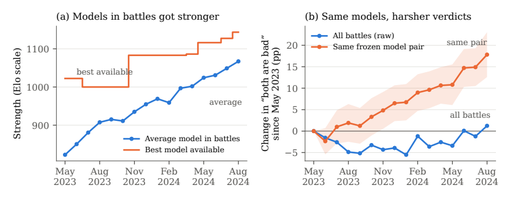
Figure 1 : Better models, steady verdicts. (a) Average Bradley–Terry rating (Elo scale) of the models in each month’s battles, and the rating of the best model with at least 500 battles that month. (b) Change since May 2023 in the share of “both are bad” votes: raw, across all battles (blue), and within the same frozen model pair (orange; calendar-month effects from a regression with pair fixed effects; shaded band is the 95% confidence interval, standard errors clustered by pair and week).
Original paper · CC BY 4.0 · Zihan Chen, Lei Nico Zheng, Di Zhu · AI Isn't Getting Dumber, We're Getting Pickier: Rising Standards in Human Evaluation of Large Language Models · Original paper figure · Extracted the figure area from page 8 of the original PDF.Why “got worse” complaints are hard to read
Complaints that an AI assistant got worse matter because they shape public debate and whether people keep paying for a service. A complaint, however, compares what a person received with what the person expected, so an unchanged answer can disappoint once expectations rise. This comparison sits at the core of expectation-confirmation theory (Oliver, 1980; Bhattacherjee, 2001), and adaptation-level theory makes the same point from psychology.
Adaptation-level theory says judgments are made against a reference that drifts toward recent experience (Helson, 1964; Brickman and Campbell, 1971; Frederick and Loewenstein, 1999). Generative AI is an extreme case for this drift, because better models arrived every few months between 2023 and 2024.
Each verdict also has to be recorded as it is made, so the record can't be rewritten later.
Labels collected in different periods also encode different standards if the evaluators' standard moves.
Existing theory gives competing accounts of where such a decline comes from. Adaptation-level theory predicts instead that each rater's reference rises with experience across a category (Helson, 1964). Chatbot Arena provides such a setting, so the paper uses it to ask whether unchanged systems draw harsher human verdicts over time (Zheng et al., 2023; Chiang et al., 2024).
Holding the models fixed to test the judges
The design keeps the models fixed and lets voters keep judging them, so any drift in verdicts must come from somewhere else. Chatbot Arena supplies this setting, because a visitor sees two anonymous answers, votes with one of four buttons, and only then sees the model names. Dated snapshots and fixed open-weight models don't change, so pairs of them met voters again and again.
The authors used 1,260,967 votes on such frozen pairs from May 2023 to August 2024.
The authors expected judges to move because the reference they judge against is set by the whole category, not by the focal model. Adaptation-level theory says a stimulus is judged against a reference that pools what a person has experienced. Generative AI improved quickly between 2023 and 2024, so a model that never changed would look worse against that reference.
The verdict model in Equation (1) makes this concrete: a vote is “both are bad” when both answers fall below the voter's threshold r. A higher threshold, or closer scrutiny that lowers perceived quality, raises the share of “both are bad” votes even when the answers stay the same.
Hypothesis 1 predicts that the “both are bad” share on the same unchanged pair rises over time. If voters became less attentive, the stronger model's share would move toward one half, and if the stronger model weakened, its share would fall. Hypothesis 3 separates two judge-side predictions, and a changing pool of raters predicts no change within a rater.
Adaptation instead predicts change within raters and across arrival cohorts, because newcomers already bring experience of better AI.
Within the same frozen pair, the “both are bad” share rose by 1.71 points a month on a mean of 17.1%. In 2024 the stronger model's share of decisive votes showed no trend, at 0.00 points a month with SE 0.13.
How the within-pair regression is set up
The data come from the public battle log that LMSYS released for its leaderboard, covering 1,799,991 battles from 24 April 2023 to 14 August 2024. Each record carries the two models, the vote, a hashed voter identifier, a timestamp and prompt-level fields, but no prompt or answer text. The “both are bad” button arrived on 29 April 2023, so the sample starts on 1 May 2023 and keeps 1,795,852 blind battles.
Of these, 1,260,967 battles pair two frozen models, and those votes form the analysis sample.
A model counts as frozen if it is a dated vendor snapshot or a fixed open-weight model, and the authors exclude aliases that can point to a changing model. The window holds 129 models: 33 dated API snapshots, 73 fixed open-weight models and 23 aliases, which yield 2,231 frozen pairs. Each model's strength comes from a Bradley–Terry rating, which the authors estimate once on the whole window.
Because each frozen model keeps one rating, the stronger model in a pair is defined once rather than per month.
The core estimate is a linear probability model with a fixed effect for each model pair, written as BothBad_ipt = α_p + β·Months_t + x_i′γ + ε_ipt. Months counts months since 1 May 2023, and x_i is an optional vector of prompt characteristics. The pair effect absorbs how good the two models are and how often their answers fall short, so β comes only from verdicts on the same two models changing over time.
The authors also swap the linear trend for a dummy per calendar month, with May 2023 as the reference, to trace the path.
Standard errors are clustered by pair and by calendar week, since clustering by pair alone gives 0.07 for the main estimate instead of 0.18. Judge identifiers come from the hashed network address of each vote, which lets the authors add identifier fixed effects and identifier-by-pair fixed effects. For the momentary test, the authors regress a verdict on the rating of the better model in the voter's previous battle, with pair, week and arrival-week fixed effects.
For re-anchoring, the authors estimate calendar-month effects from frozen pairs that do not involve a given model and subtract them from that model's own pairs before estimating the trend.
Testing the rise against rival explanations
The main estimate puts the rise in “both are bad” votes within frozen pairs at 1.71 percentage points a month, with an SE of 0.18. That rise sits on a mean of 17.1%, so the monthly climb is about a tenth of the level it starts from. Fourteen pairs judged often in both periods all rose, from 15.5% to 23.3%, which checks the regression without relying on it.
The authors don't rest the claim on the regression alone, since the pair-level comparison points the same way.
The stronger model's share of decisive votes doesn't move in 2024, so voters still prefer the better answer when they pick one. They more often reject both answers instead, and that is where the extra votes come from. Ties stay flat at −0.09 points a month, so the bar moves while the ranking holds.
Prompt-content controls leave the coefficient at +1.63, and easy single-turn English prompts give +1.30 (SE 0.17). Dated OpenAI and Anthropic snapshots give +1.41 (SE 0.20), while open-weight pairs give +2.12. Between major page changes the trend is +2.61, and between any page changes it falls to +1.03 (SE 0.31). Every one of these cuts stays positive, so no single control explains the drift.
Within the same judge identifier, the share rose 1.90 points a month across 24,508 identifiers seen over at least a month. On the same pair for the same identifier, the rise is +2.30 (SE 0.68), so the same voter grows harsher on a fixed matchup. Newcomers are also pickier, with +1.25 points per month of arrival date on their first recorded vote.
The authors read this as evidence against a changing pool of raters alone, because the same voters change too.
Seventeen of eighteen frequently judged frozen models rose on their own pairs, with an average of +1.40 points a month. After month effects from other models' pairs are subtracted, the average falls to +0.19 points a month.
Limitations of the Arena evidence
The log can't show what the voters' prompts looked like, because it holds no prompt or answer text. So the high-frequency subset doesn't hold the prompt mix fixed, and the authors name text releases as the fix.
The relative verdict is a pooled share, so offsetting changes inside individual pairs can stay hidden. Average model quality rose almost in step with calendar time, so other influences over the same months can't be ruled out. The vote also can't separate a higher threshold from closer scrutiny.
They didn't test a direct experiment, which would expose people to stronger or weaker AI on matched tasks.
The period ends in August 2024, so whether standards keep rising at the same pace is still open. A forced choice plus a separate acceptability judgment, with a delayed follow-up, would show the size and duration of the effect. New frozen models accumulating on evaluation platforms could track whether standards level off as improvement slows.
Paper info
- Authors
- Zihan Chen, Lei Nico Zheng, Di Zhu
- Venue
- arXiv · Preprint
- First published
- 2026-11-10
- Added
- 2026-11-12
- Updated
- 2026-11-10
- Version
- v1
- arXiv
- 2611.14333
- Category
- cs.HC · cs.AI · cs.CL · cs.CY
- Original paper terms
- CC BY 4.0
- What we show
- Paper info, commentary and permitted figures from the original paper
AI commentary is a separate explanation from the original paper and may contain errors. The original paper and figures follow each source's terms of use and any rights noted separately.
Abstract
Users often complain that AI assistants such as ChatGPT are getting worse. Some versions do change, but human evaluation leaves a second possibility untested: the people judging may change. We separate the two on Chatbot Arena, a public platform where people compare answers from two anonymous large language models (LLMs) and pick the better one or say both are bad. We study 1,260,967 blind votes cast from May 2023 to August 2024 on pairs of models whose versions are fixed: dated vendor snapshots and models with fixed open weights. For the same pair of unchanged models, the share of votes saying "both are bad" rises by 1.71 percentage points a month on a mean of 17.1%, and by 1.91 points a month in 2024. In fourteen pairs observed often in both 2023 and 2024, it rose in every one, from 15.5% to 23.3%. The ranking does not trend: in 2024, the stronger model's share of decisive votes is flat. The rise holds within the same voter and on the same pair, and across arrival cohorts from their first recorded vote. It holds with prompt controls, in every major language, for dated vendor snapshots, open-weight models and models with stable answer length, and between interface changes. The drift is shared across models: month effects estimated from other models' pairs remove it from each model's own pairs. Platform-wide, the average model would be expected to score 78% against the 2023 average, yet the share of "both are bad" votes ended near where it began. The pattern fits a standard that follows the category's progress, so a product that stands still is judged as declining. Absolute verdicts on AI drifted while relative comparisons held steady, an evaluation drift that matters for LLM leaderboards and for the human feedback used to train models.
Figures from the paper
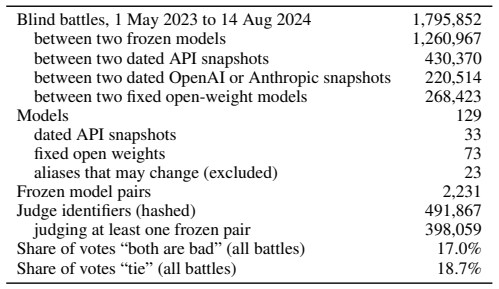
Table 1 : Sample
Original paper · CC BY 4.0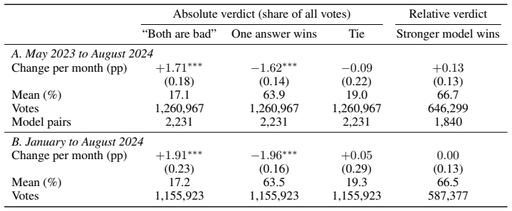
Table 2 : Verdicts on frozen model pairs over time: absolute and relative
Original paper · CC BY 4.0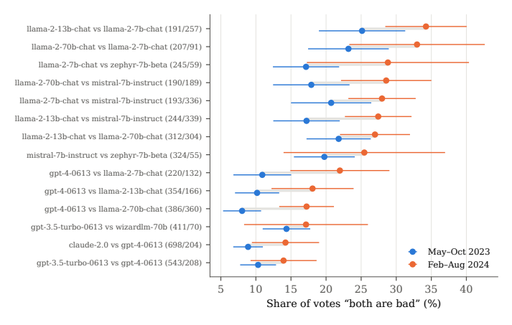
Figure 2 : Every pair judged often in both periods became “both are bad” more often. Frozen model pairs with at least 50 votes in May–October 2023 and in February–August 2024; vote counts in parentheses (early/late). Bars are 95% binomial confidence intervals.
Original paper · CC BY 4.0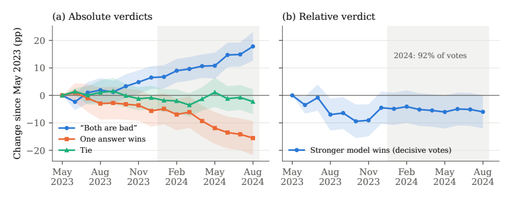
Figure 3 : Absolute verdicts drift; the relative verdict is flat from late 2023. Calendar-month effects (relative to May 2023) from regressions with model-pair fixed effects. (a) Shares of all votes on frozen pairs. (b) Share of decisive votes won by the higher-rated model, pairs whose ratings differ by at least 20 Elo points. Shaded bands are 95% confidence intervals, standard errors clustered by pair and week. The grey area marks 2024.
Original paper · CC BY 4.0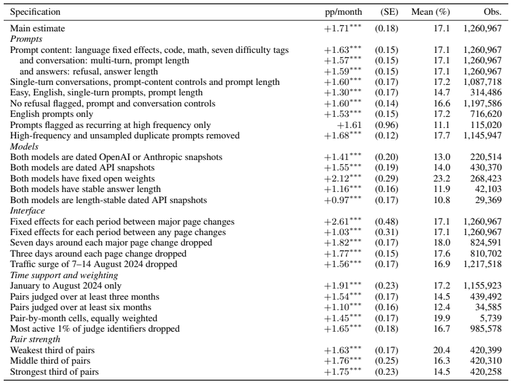
Table 3 : Robustness: change in “both are bad” per month within frozen model pairs
Original paper · CC BY 4.0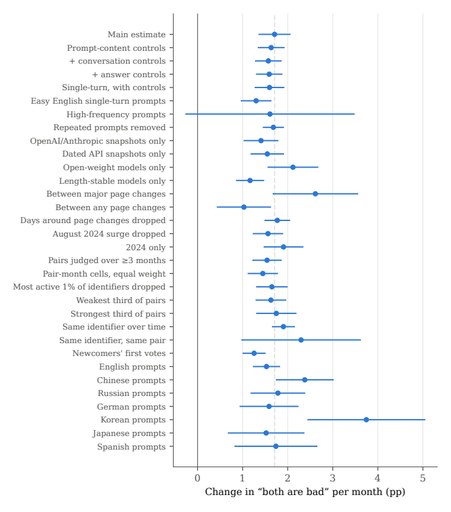
Figure 4 : One estimate, many cuts. Change in the share of “both are bad” votes per month within frozen model pairs, with 95% confidence intervals. The dashed line marks the main estimate.
Original paper · CC BY 4.0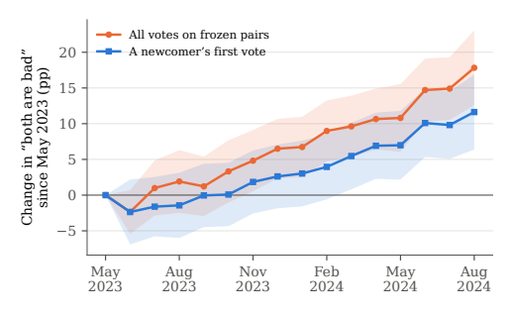
Figure 5 : Newcomers arrive pickier. Calendar-month effects (relative to May 2023) on “both are bad” within frozen model pairs, for all votes and for each judge identifier’s first recorded vote by month of arrival. Shaded bands are 95% confidence intervals, standard errors clustered by pair and week.
Original paper · CC BY 4.0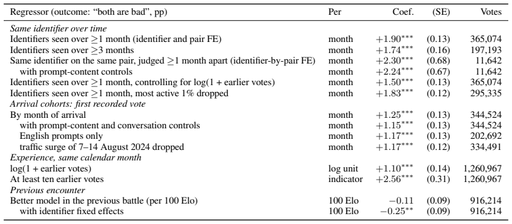
Table 4 : Who becomes pickier
Original paper · CC BY 4.0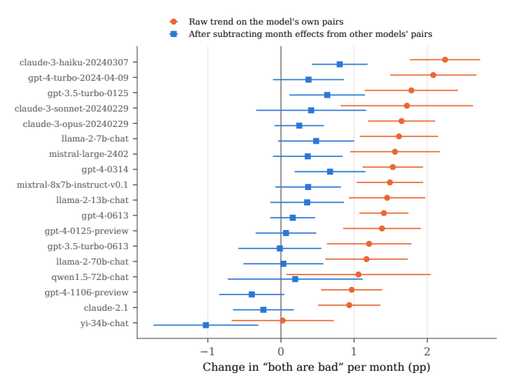
Figure 6 : A shared drift. For each frozen model with at least 10,000 votes over at least four months: the trend in “both are bad” on the model’s own pairs (orange) and the trend after subtracting calendar-month effects estimated only from frozen pairs that do not involve the model (blue). Pair fixed effects; 95% confidence intervals, standard errors clustered by pair and week.
Original paper · CC BY 4.0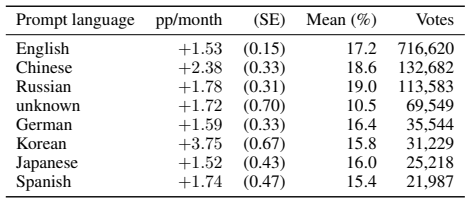
Table 7 : Change in “both are bad” per month within frozen pairs, by prompt language
Original paper · CC BY 4.0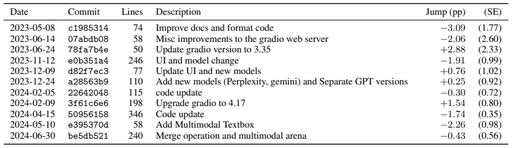
Table 8 : Jumps in “both are bad” at major changes to the anonymous battle page
Original paper · CC BY 4.0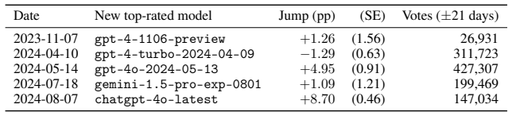
Table 9 : Jumps in “both are bad” at arrivals of a new top-rated model
Original paper · CC BY 4.0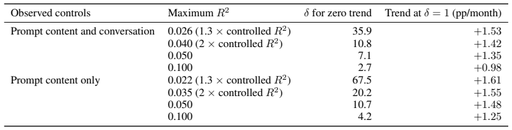
Table 10 : Coefficient-stability sensitivity for the main trend
Original paper · CC BY 4.0Quote from the paper
Zihan Chen, Lei Nico Zheng, Di Zhu (2026). AI Isn't Getting Dumber, We're Getting Pickier: Rising Standards in Human Evaluation of Large Language Models. arXiv:2611.14333v1. https://arxiv.org/abs/2611.14333v1
BibTeX
@misc{chen2026getting,
  title = {{AI Isn't Getting Dumber, We're Getting Pickier: Rising Standards in Human Evaluation of Large Language Models}},
  author = {Zihan Chen and Lei Nico Zheng and Di Zhu},
  year = {2026},
  eprint = {2611.14333},
  archivePrefix = {arXiv},
  url = {https://arxiv.org/abs/2611.14333v1}
}