Paper commentary
Parallel Broyden Methods for Efficiently Evaluating Nonlinear State Space Models
Parallel Broyden approximates Jacobians cheaply to speed up parallel state space evaluation
- Problem Exact parallel Newton needs expensive dense Jacobian blocks, and diagonal quasi-Newton methods converge slowly because they ignore coupling across state dimensions.
- Method Parallel Broyden builds diagonal-plus-low-rank block approximations from trajectory secants. It avoids automatic differentiation and compresses the scan to a fixed rank.
- Results On 50-step DDIM sampling with a DiT denoiser, Parallel Broyden averaged 14.9 iterations, compared to 16.8 for diagonal quasi-Newton.
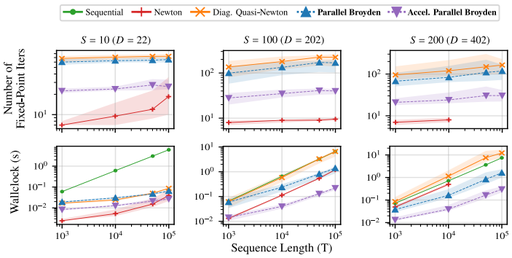
Figure 2 :Hierarchical Gibbs sampling.Across 32 problem instances, we report median iteration counts and runtimes with interquartile ranges as we vary trajectory length T and state dimension D= 2S+ 2 . Parallel Broyden variants require fewer iterations than diagonal quasi-Newton by capturing low-rank hierarchical coupling. Accelerated Parallel Broyden is the fastest approximate method in every setting, and the fastest overall except for small problems (small S or short T ). It also remains applicable at the largest settings, where exact Newton runs out of memory.
Original paper · CC BY 4.0 · Ian Christopher Tanoh, Scott W. Linderman · Parallel Broyden Methods for Efficiently Evaluating Nonlinear State Space Models · Original paper figure · Extracted the figure area from page 9 of the original PDF.Why exact Newton and diagonal methods stall
Nonlinear state space models are usually evaluated one step at a time, because each state depends on the previous one. The alternative treats the full trajectory as the unknown in a root-finding problem, with one residual per time step. Each residual is the difference between a state and the transition applied to the previous state, and the true trajectory makes all of them zero.
Newton's method on this residual gives a block lower bidiagonal Jacobian, so each update is a linear recurrence that a parallel scan can solve in logarithmic depth. The catch is that the Jacobian blocks are dense dynamics Jacobians, and forming and composing them is the expensive part.
Exact Newton must store and compose these dense blocks inside the scan, which costs O(TD^2) memory and O(TD^3) work. Diagonal quasi-Newton replaces each block with its diagonal, so the scan stays exact under that approximation. Memory and computation then scale linearly in D per block, since diagonal matrices are closed under multiplication.
The cost of estimating that diagonal remains, because these methods still need the diagonal of the Jacobian. Gonzalez et al. bound the convergence rate through the spectral-norm error of the block approximation, so a more accurate block should converge faster.
That leaves a gap: a block approximation that captures coupling but still costs O(TD) memory and work is what the field lacks. The authors ask whether richer block approximations can be built without automatic differentiation and still parallelized over time. Their answer is to base the approximation on Broyden's method and keep it in a low-rank form that the scan can handle.
Building low-rank blocks from secants
The core move is to start each block from a diagonal and let the trajectory iterates correct it through secants. For each transition the method forms a secant pair, with \(p^{(i)}_t = x^{(i+1)}_{t-1} - x^{(i)}_{t-1}\) and \(q^{(i)}_t = f_t(x^{(i+1)}_{t-1}) - f_t(x^{(i)}_{t-1})\). The updated approximation \(\tilde{A}^{(i+1)}_t\) must map \(p^{(i)}_t\) to \(q^{(i)}_t\), which is the secant condition and the multidimensional version of a finite difference.
Since Broyden updates are rank-one corrections, starting from a diagonal gives a diagonal-plus-low-rank block without autodiff. Table 1 puts this at \(O(TDm^2)\) work and \(O(TDm)\) memory for rank at most m, with no autodiff.
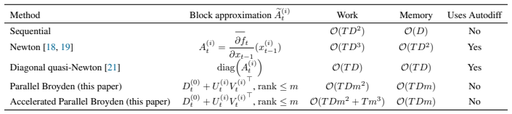
Table 1 : Comparison of trajectory evaluation methods. Sequential is the baseline. All other methods are parallel via parallel scan with O(logT) depth. Parallel Broyden and Accelerated Parallel Broyden (this work) use diagonal-plus-low-rank (DPLR) block approximations with rank at mostm.
Original paper · CC BY 4.0Accelerated Parallel Broyden goes further and fits several recent secants in one update, rather than adding one rank-one correction per iteration. Among corrections that satisfy the stored secants, it picks the one with minimum Frobenius norm. With ridge term \(\varepsilon\), the update reads \(\tilde{A}^{(i)}_t = D^{(i)}_t + (Q^{(i)}_t - D^{(i)}_t P^{(i)}_t)(P^{(i)\top}_t P^{(i)}_t + \varepsilon I)^{-1} P^{(i)\top}_t\).
The correction has rank at most m, so the update is diagonal-plus-low-rank directly, with no need to accumulate rank-one terms.
Large eigenvalues in the linearized dynamics can make parallel Newton steps unstable, so the authors add damping to the low-rank part only. With a parameter k in [0,1], the rank-one update becomes \(\tilde{A}^{(i+1)}_t = \tilde{A}^{(i)}_t + (1-k)\Delta^{(i)}_t\), so k = 0 is the standard Broyden step and k = 1 leaves the block unchanged. Too much damping weakens the secant information and drifts the block back toward its diagonal, so k is set as small as stability allows.
The diffusion experiment needed no damping.
Keeping the parallel scan low-rank
Compressing the scan matters because products of low-rank corrections gain rank at every merge of the scan tree. Each merged product is compressed back to rank m with a randomized compression, so the rank stays bounded. This keeps logarithmic parallel depth and linear scaling in state dimension for small rank. The trajectory update is read off the prefix results of the scan, so the parallel structure is kept.
The authors prove that the compressed scan still recovers the exact trajectory in a finite number of steps. That finite-step result explicitly covers compression, not only the exact scan. Convergence is analysed differently, using the block approximation error along the current trajectory error instead of the spectral norm. The authors back this claim with both theory and experiments.
The limits are stated plainly: the advantage shrinks when accurate approximations need a large rank. Scan and compression costs grow with rank, so a large rank erodes the benefit. The convergence analysis is local and conservative, which the authors flag as a limitation.
Low-rank RNN iteration counts
The authors test standard and MLP low-rank RNNs at state dimension D = 200, with rank m = R = 3 and 32 chains. Here the true Jacobian is exactly diagonal plus rank R, so the test sits inside the structure the method assumes. Accelerated Parallel Broyden needs fewer iterations than Parallel Broyden in every setting, and the gap is larger at Δt = 3.
At Δt = 3 and T = 10^3 on the standard model, the median was 30.5 iterations for Parallel Broyden, compared to 10 for Accelerated Parallel Broyden. At Δt = 0.5 the same comparison gave 12.5 compared to 10. So the multisecant fit pays off most where coupling is strongest, which fits the wider gap at Δt = 3. Non-converged chains were counted at the 1000-iteration cap, so these medians include them.
A full-rank DMF RNN tests the opposite case, with a dense Jacobian and no dominant diagonal. About 108 of its 128 normalized singular values exceed 1 percent of the largest, so no small rank represents it exactly.
The authors also report a run at T = 100K in a setting where exact Newton had run out of memory. The contribution list also cites speedups of up to 30 times over sequential evaluation.
DDIM sampling with a DiT denoiser: iterations and runtime without denoiser differentiation
Each local block has the form A_ℓ(x_{ℓ-1}) = c_x(t) I + c_ε(t) ∂ε_θ/∂x, so exact Newton would differentiate through the full DiT denoiser at every time step. That differentiation is prohibitively expensive at this scale, so the benchmark asks whether a good approximation is possible without differentiating the denoiser. The block is dominated by its diagonal, so a diagonal-plus-low-rank approximation is not expected to reduce iterations much here.
The authors compare against two parallel diffusion samplers: Picard iteration, which uses the identity as the local approximation, and ParaTAA, which approximates the full inverse residual Jacobian. Parallel Broyden approximates the local dynamics blocks used in the scan instead. Diagonal quasi-Newton requires slightly more, 16.8 iterations, which fits the view that the block is dominated by its diagonal.
Relative to Picard, Parallel Broyden reduces the mean iteration count by 1.21 times, and relative to ParaTAA by 1.68 times. This supports approximating the local dynamics blocks directly, rather than using the identity or the inverse residual Jacobian.
Diagonal quasi-Newton estimates each diagonal with a single Hutchinson probe. Picard iteration avoids differentiation but needs more iterations. Parallel Broyden runs 3.32 times faster than diagonal quasi-Newton, 1.12 times faster than Picard, and 1.53 times faster than ParaTAA. The authors attribute this speed mainly to avoiding automatic differentiation, not to a richer Jacobian approximation.
Even so, every parallel method stays slower than sequential DDIM on one H100 GPU, because the DiT denoiser cost becomes FLOP-bound.
These values mean the parallel images look perceptually indistinguishable from the sequential ones. The authors used the same stopping criterion for all methods, so iteration counts stay directly comparable.
Limits and open questions
Parallel Broyden works best when the dominant off-diagonal Jacobian structure can be captured by a small number of low-rank corrections. When accurate approximations need large rank, the advantage shrinks, because scan and compression costs grow with rank. The authors frame the compressed approximate scan as applicable to any DPLR block approximation, not only to Broyden-style ones.
The full-rank DMF RNN is the test case for this boundary, since its Jacobian is dense and has no dominant diagonal. No small rank m can represent that Jacobian exactly, so the experiment asks how the Broyden variants degrade as m decreases.
The authors describe the convergence analysis as local and conservative. Relating the block error along the current trajectory error to the secant updates is left as the next step. The experiments cover low-rank RNNs, a hierarchical Gibbs sampler, and DDIM sampling with a DiT denoiser.
The authors call these applications promising for future work, and they don't test them in this paper. The DDIM experiment doesn't show a richer approximation helping, because its advantage comes from avoiding automatic differentiation.
Paper info
- Authors
- Ian Christopher Tanoh, Scott W. Linderman
- Venue
- arXiv · Preprint
- First published
- 2026-11-10
- Added
- 2026-11-11
- Updated
- 2026-11-10
- Version
- v1
- arXiv
- 2611.13523
- Category
- cs.LG · math.NA
- Original paper terms
- CC BY 4.0
- What we show
- Paper info, commentary and permitted figures from the original paper
AI commentary is a separate explanation from the original paper and may contain errors. The original paper and figures follow each source's terms of use and any rights noted separately.
Abstract
Nonlinear state space models are typically evaluated sequentially, limiting their ability to exploit modern parallel hardware. Recent work has shown that state space models can be evaluated in parallel by reformulating evaluation as a root-finding problem, which can be solved with a parallel form of Newton's method. However, exact Newton methods require expensive multiplication of dense Jacobian matrices, and quasi-Newton methods based on diagonal approximations, while more scalable, are often slow to converge because they neglect interactions across state dimensions. We introduce a novel quasi-Newton approach based on Broyden's method, which captures coupling terms with diagonal-plus-low-rank approximations to blocks of the Jacobian. We construct the approximations from trajectory secants, avoiding automatic differentiation while retaining the favorable scaling of diagonal approximations and remaining compatible with parallel scan through rank compression. We prove finite-step recovery of the exact trajectory under the compressed scan, and show that convergence is tracked by the compression error and by the block approximation error along the current trajectory error, rather than in spectral norm. Empirically, we show that our method is advantageous when interactions are approximately low rank or when Jacobian evaluation is expensive: on low-rank RNNs, parallel MCMC algorithms, and denoising diffusion models, it converges in fewer iterations than other quasi-Newton methods and is the fastest parallel method when Jacobian evaluation is expensive or state dimensions are large.
Quote from the paper
Ian Christopher Tanoh, Scott W. Linderman (2026). Parallel Broyden Methods for Efficiently Evaluating Nonlinear State Space Models. arXiv:2611.13523v1. https://arxiv.org/abs/2611.13523v1
BibTeX
@misc{tanoh2026parallel,
  title = {{Parallel Broyden Methods for Efficiently Evaluating Nonlinear State Space Models}},
  author = {Ian Christopher Tanoh and Scott W. Linderman},
  year = {2026},
  eprint = {2611.13523},
  archivePrefix = {arXiv},
  url = {https://arxiv.org/abs/2611.13523v1}
}