Paper commentary
Closing the BF16-FP16 Convergence Speed Gap in RL Post-Training with Stochastic Rounding
Stochastic rounding closes the BF16 convergence gap in RL post-training
- Problem BF16 training converges more slowly than FP16 in RL post-training at low learning rates. Round-to-nearest quantization leaves BF16 weights unchanged for several optimizer steps, so small updates are delayed.
- Method Stochastic rounding replaces round-to-nearest when FP32 shadow weights are quantized to BF16. Small updates now shift the expected BF16 value, so the BF16 weights change sooner.
- Results BF16 with stochastic rounding matches FP16's convergence speed across the tested models and datasets. It also keeps the KL divergence from the reference model lower than BF16 at a larger learning rate.
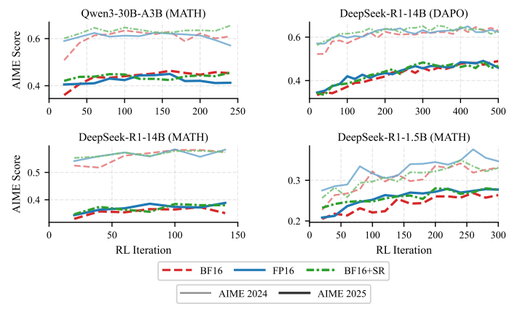
Figure 5 : AIME 2024 and AIME 2025 scores (mean@32). BF16 initially trails FP16 and BF16+SR on downstream task scores but usually closes the gap as training progresses.
Original paper · CC BY 4.0 · Mahdi Nazemi, Oleg Rybakov, Tijmen Blankevoort, Asit Mishra, Carlo del Mundo · Closing the BF16-FP16 Convergence Speed Gap in RL Post-Training with Stochastic Rounding · Original paper figure · Extracted the figure area from page 6 of the original PDF.Where BF16 falls behind FP16
So training-inference mismatch, as described by Qi et al. (2025), can't be the only cause.
In this paper's setup, the collapse occurs only when vLLM's TorchInductor compiler optimizations are enabled. They didn't test later releases, and they disabled TorchInductor in all remaining experiments.
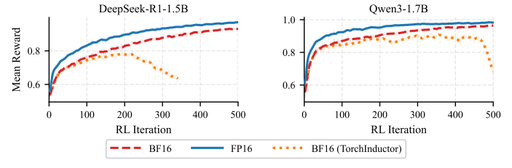
Figure 2 : Disabling TorchInductor compiler optimizations in vLLM prevents BF16 reward collapse.
Original paper · CC BY 4.0The mismatch explanation therefore leaves the gap unexplained, and the authors attribute it to weight sticking. Under round-to-nearest, small updates often leave the BF16 weights unchanged for several optimizer steps. Table 1 shows the share of weights still equal to their BF16 checkpoint values, with BF16 at 99.42% after the first optimizer step and FP16 at 95.35%.
Both thresholds sit above the Adam update of roughly η=10−6, so most weights stay unchanged in both formats. Raising the mantissa bits to 10 tracks FP16 closely, which points to limited mantissa precision as a contributor.
How round-to-nearest stalls a BF16 update
Mixed-precision training keeps FP32 shadow weights and applies optimizer updates to them. Those shadow weights are quantized to BF16 for the forward and backward passes. In RL post-training, the rollout backend also uses these low-precision weights, so quantization shapes the policy that generates the training data. Weight sticking happens when small updates leave the BF16 weights unchanged for several optimizer steps under round-to-nearest.
Round-to-nearest maps a shadow weight to the closer of its two neighbouring BF16 values. A stuck weight is one where a nonzero update leaves its quantized value unchanged. Starting from a BF16 checkpoint, the quantized value stays put while the net update is below half a ULP. BF16 keeps 7 mantissa bits and FP16 keeps 10, so the BF16 ULP is 8× the FP16 ULP for normal values.
The rounding error for a stuck weight equals minus the net update, so the quantized value cancels that update.
Stochastic rounding removes this systematic error in expectation by choosing a neighbour at random. The expected quantized value equals the shadow weight, so a small update still shifts the expected BF16 value. The price is a rounding error with zero mean but higher variance. The authors hypothesize that this added variance harms RLVR convergence less than the systematic error of round-to-nearest.
They hypothesize this even when rollout generation uses a single random realization of the quantized weights.
The authors test this hypothesis by applying stochastic rounding to the FP32 shadow weights while keeping the rest of the recipe fixed. Under this setup, BF16+SR matches FP16's convergence speed while avoiding FP16 loss scaling.
Measuring weight sticking and its mantissa cause
After the first optimizer step, 99.42% of BF16 weights still equal their checkpoint values, versus 95.35% for FP16. By the fourth step, the BF16 share falls only to 98.84%, while the FP16 share drops to 90.79%. Because FP16's half-ULP threshold is 8× smaller, FP16 changes roughly eight times as many weights by the end of the first RL iteration.
The measured shares were 9.21% for FP16 against 1.16% for BF16 by that point.
Equation (2) points to two levers: a smaller ULP from more mantissa bits, or a larger update from a higher LR. Figure 4a tests the mantissa lever with simulated formats that keep BF16's 8 exponent bits and use m = 8, 9, or 10 mantissa bits.
Figure 4b tests the update-size lever with learning rates from 10^-6 to 8×10^-6 for both formats. A higher learning rate speeds up both formats, but FP16 stays ahead of BF16 at every learning rate tested.
Does stochastic rounding close the gap?
The main test quantizes the shadow weights to BF16 with stochastic rounding and leaves the rest of the training recipe unchanged. In Figure 1, the FP16 and BF16+SR reward curves closely overlap across the tested models. The authors report this match for the 1.5B, 14B and 30B-A3B models, using two training datasets.
On AIME 2024 and AIME 2025, BF16 initially trails both FP16 and BF16+SR. BF16 usually closes that gap later in training, as the Figure 5 curves show. Figure 5 compares the three configurations on four model and dataset pairs.
Early in training, FP16 and BF16+SR give shorter responses than BF16 on every model and dataset. All three configurations later converge to similar response lengths, as Figure 6 shows. The authors leave that behavior to future work.
Applying SR only in the rollout backend, however, leaves the mean reward plateauing well below FP16's. The authors recommend applying SR once after each optimizer step and using those BF16 weights for all forward passes.
What the higher learning rate costs in drift
A higher BF16 learning rate can close the convergence gap, but the authors check what it does to the policy's drift from the reference model. Because a higher learning rate also changes the optimization dynamics, the authors measure drift with the k3 estimator of the KL divergence. BF16+SR at the default learning rate of 1×10⁻⁶ stays close to FP16 over the same reward range.
The drift result gives a trade-off: a higher learning rate closes the speed gap but pushes the policy further from the reference. Stochastic rounding gets the speed without that extra drift, because it keeps the default learning rate. Figure 7 shows the same pattern: BF16 with the higher learning rate has larger drift, while BF16+SR stays near FP16.
This matters because drift is commonly penalized in RL post-training and predicts how much a model forgets.
The authors also tested which stochastic rounding placement is needed, so the next step is a comparison of SR variants. They didn't test SR variants beyond the ones listed on DeepSeek-R1-1.5B and MATH-1460.
Which stochastic rounding variant to use
The authors compared several SR variants on DeepSeek-R1-1.5B and MATH-1460 to see where stochastic rounding has to act. So the rollout backend doesn't need its own fresh random draw to keep the speed-up.
Applying SR only in the rollout backend, however, wasn't enough. With SR limited to the rollout backend, the mean reward plateaus at a value well below FP16's.
The authors therefore recommend the simplest variant, which applies SR once after each optimizer step. Round-to-nearest stays in place for all other conversions, so the change is confined to the shadow-to-BF16 step.
The conclusions compare the three remedies, and SR is the one that keeps BF16's dynamic range with drift close to FP16's. Switching to FP16 works well for the models in this paper, but FP16 training overflowed frequently at a loss scale of 1,024 on Qwen3.5-397B-A17B.
Limits of the evidence
The BF16 reward collapse appeared only with TorchInductor enabled in vLLM. The authors observed this behavior with DeepSeek-R1-1.5B and Qwen3-1.7B on vLLM releases 0.12 to 0.17. They didn't test later releases, including the 0.33 release that was the latest at the time of writing. Because the main comparisons disable TorchInductor, they don't cover that setting.
Parity runs and weight sticking measurements run on 64 NVIDIA H100 GPUs, since parity lowers throughput. All other experiments run on 64 NVIDIA B200 GPUs, so the two groups of runs use different hardware.
The Qwen3.5-397B-A17B FP16 runs are preliminary and use an agentic software engineering task.
Paper info
- Authors
- Mahdi Nazemi, Oleg Rybakov, Tijmen Blankevoort, Asit Mishra, Carlo del Mundo
- Venue
- arXiv · Preprint
- First published
- 2026-11-10
- Added
- 2026-11-11
- Updated
- 2026-11-10
- Version
- v1
- arXiv
- 2611.13545
- Category
- cs.LG · stat.ML
- Original paper terms
- CC BY 4.0
- What we show
- Paper info, commentary and permitted figures from the original paper
AI commentary is a separate explanation from the original paper and may contain errors. The original paper and figures follow each source's terms of use and any rights noted separately.
Abstract
BF16 is widely used to pretrain large language models because it has the same dynamic range as FP32 and converges similarly to FP32 training. However, in reinforcement learning with verifiable rewards, where learning rates are typically low, we find that standard mixed-precision BF16 training converges more slowly than FP16 training at the same learning rate. We attribute this gap to weight sticking: when FP32 shadow weights are quantized to BF16 using round-to-nearest, small updates often leave the BF16 weights used for rollout generation and training unchanged. Consequently, several optimizer steps may be needed before updates to the shadow weights are reflected in the BF16 weights. Raising the BF16 learning rate reduces weight sticking and matches FP16's convergence speed, but it also increases the KL divergence from the reference model. We instead apply stochastic rounding when quantizing the FP32 shadow weights to BF16. This approach matches FP16's convergence speed across different models and datasets while reducing the KL divergence relative to BF16 training with a larger learning rate. Unlike FP16, it keeps BF16's wider dynamic range and needs no loss scaling.
Quote from the paper
Mahdi Nazemi, Oleg Rybakov, Tijmen Blankevoort, Asit Mishra, Carlo del Mundo (2026). Closing the BF16-FP16 Convergence Speed Gap in RL Post-Training with Stochastic Rounding. arXiv:2611.13545v1. https://arxiv.org/abs/2611.13545v1
BibTeX
@misc{nazemi2026closing,
  title = {{Closing the BF16-FP16 Convergence Speed Gap in RL Post-Training with Stochastic Rounding}},
  author = {Mahdi Nazemi and Oleg Rybakov and Tijmen Blankevoort and Asit Mishra and Carlo del Mundo},
  year = {2026},
  eprint = {2611.13545},
  archivePrefix = {arXiv},
  url = {https://arxiv.org/abs/2611.13545v1}
}