Paper commentary
Differentially Private Statistical Inference for Rankings from Pairwise Comparisons
Private rank inference from pairwise comparisons gives valid confidence sets
- Problem Releasing rankings of language models from human pairwise comparisons can expose individual preference records. Private ranking methods so far mostly targeted estimation, so valid inference under privacy has been thin.
- Method The authors perturb a ridge-regularized Bradley-Terry likelihood once with Laplace noise. Bias correction and Gaussian-Laplace calibration then build intervals from that single private release, so inference costs no extra privacy budget.
- Results Bias-corrected intervals reached coverage of 0.960 at privacy budget 1 for the boundary score, compared with 0.720 for the Wald interval.
Why human rankings need privacy
Data protection laws such as the General Data Protection Regulation in the European Union and the California Consumer Privacy Act add legal pressure to protect personal information during analysis. So the authors need ranking procedures that carry privacy guarantees and still support statistically valid inference.
Differential privacy handles this by adding randomness to the analysis, and that randomness has to be managed alongside ordinary sampling noise. Here the protected unit is an unordered pair of items together with its comparison, not a single record. Under edge adjacency, the guarantee covers both whether a comparison is observed and what its outcome is.
Earlier private ranking work mostly targeted estimation, so the inferential side has been thinner.
The closest prior work, Cai et al. (2026a), gives entrywise estimation bounds under edge and individual differential privacy. This paper goes further with a uniform asymptotic expansion that supports confidence intervals for individual scores and simultaneous confidence sets for ranks. The authors use objective perturbation with Laplace noise, following the construction of Cai et al.
(2026a).
A ridge-regularized estimate with one Laplace perturbation
The core move is to perturb the likelihood once, then treat all later inference as post-processing of that single release. Each item i has a latent score θ*i, and the probability that item i defeats item j is a logistic function of the score difference. The model uses π_ij = F(θ*i − θ*j), where F is the standard logistic distribution function.
The comparison graph is Erdős–Rényi, so each unordered pair enters independently with the public probability p. The authors draw independent Laplace(0, λ) entries for a vector w and minimize the negative log-likelihood plus a ridge term plus w⊤θ.
The ridge term makes the objective strongly convex, so the minimizer is unique and stable. The linear term w⊤θ masks how changing one comparison shifts the score equation, which is what protects the edge. Because the likelihood depends only on score differences, a common shift is not identified. Lemma 1 shows that the average noise only translates the whole estimate, so subtracting the mean is post-processing that keeps the privacy guarantee.
The tuning ties the budget to the constants, with λ = c_λ/ε and γ = c_γ/ε, where c_λ > 8 and c_γ > 1.
Every later quantity, including bias correction, plug-in standard errors and bootstrap draws, is built from this single release. The authors keep the centered estimator as the object of inference, while the private estimator carries the privacy guarantee. Proposition 1 states that this release is (ε, 0)-edge differentially private when λ > 8/ε and γ > 1/ε.
Inference built on this estimate needs no extra privacy budget, because the paper treats it as post-processing.
Correcting the score intervals for ridge bias and noise
A plain Wald interval splits the private error into three pieces: sampling variability, regularization bias, and centered privacy perturbation. Only the sampling term matches the leading fluctuation of the non-private MLE, so the other two terms are what a Wald interval can miss in finite samples. The Wald interval centers at the private score and adds and subtracts a normal quantile times the plug-in standard error for that score.
For a pair, the standard error combines the two item standard errors as the square root of the sum of their squares.
The bias correction starts from the leading regularization bias, which is minus β_γ,i, and adds a plug-in estimate of it to the center. It replaces each graph indicator A_ij by the public sampling probability p and evaluates the resulting matrix at the centered private estimate. Its diagonal uses the earlier g-hat values, because centering keeps score differences unchanged.
The bias-corrected estimate is the private estimate plus the estimated bias term, one coordinate per item.
The leftover privacy noise is handled by Gaussian–Laplace calibration, which draws a fresh standard normal Z and independent Laplace variables W. The calibration variable for a single score is Z plus the standard error times W, so the Laplace draw scales with the sampling error. Because both distributions are symmetric, the paper uses plus signs and takes the conditional quantiles of these draws as the interval half-widths.
Theorem 3 gives the asymptotic coverage of 1 minus α for these bias-corrected intervals.
Bias correction and calibration add no privacy cost, since they only post-process the private estimate and public quantities. The coverage guarantees assume negligible asymptotic privacy and regularization effects, so finite-sample performance is checked separately by simulation.
Bootstrap calibration for rank sets and top-K tests
The population rank of item i is one plus the count of items with strictly higher score. Choosing I = {i} targets one item's rank, while I = [n] gives simultaneous inference for all ranks. The bootstrap keeps the public sampling probability p fixed and draws a fresh graph for each replication. Given the private estimate, each simulated outcome is drawn from Bernoulli of F of the private score difference, so each replication follows the fitted model.
Within each replication, all contrasts use the same simulated graph and outcomes, which preserves their dependence. The original plug-in standard errors stay fixed across replications, so the bootstrap uses only the private estimator and simulation randomness.
For two-sided rank sets, the statistic is the maximum absolute standardized contrast error over all pairs in PI. Its bootstrap version takes the same maximum over the simulated S over g contrasts. The critical value is the empirical (1 minus alpha) quantile of the bootstrap statistics across the B replications. Each pairwise interval uses this critical value on both sides of the private contrast.
A pair whose lower endpoint is above zero certifies that item k ranks above item i. A pair whose upper endpoint is below zero certifies that item k ranks below item i. Counting these certified items gives the rank set, which runs from en1(i) plus 1 to n minus en2(i).
For top-K inference, the method keeps only one-sided lower bounds on the score differences. The one-sided statistic uses the signed contrast error, so its bootstrap analog drops the absolute value. The lower rank bound equals one plus the number of items certified above item i, and the test rejects when this bound exceeds K. Under the simultaneous coverage event, these tests hold their asymptotic simultaneous coverage over the pairs in PI.
If the comparison probability p were unknown, it would need its own differentially private estimate, and that estimate's privacy cost would have to be counted. The authors point to Ullman and Sealfon (2019) as one way to estimate p privately. The theorem that justifies these simultaneous guarantees is stated in the next section.
What the theorems guarantee and under which conditions
Proposition 1 gives the privacy guarantee: the estimator is (ε,0)-edge differentially private when λ > 8/ε and γ > 1/ε. The score intervals, pairwise intervals and rank confidence sets are also (ε,0)-edge differentially private, and so are the top-K testing decisions. The authors fix the tuning as λ = c_λ/ε and γ = c_γ/ε with c_λ > 8 and c_γ > 1, because privacy alone allows larger tuning parameters but accuracy needs these upper bounds.
Statistical probability statements account for the comparison graph, the outcomes, the privacy perturbation and any bootstrap simulation randomness.
Theorem 1 bounds the squared Euclidean error by C(1/p + log(n)^2/(np^2ε^2)) under p ≥ c_0 log(n)/n and ε ≥ c_0 log(n)^1.5/(np). Compared with Cai et al. (2026a), the sufficient lower bound on p is smaller by a factor of √log n at a fixed budget 0 < ε < 1. When np ≫ (log n)^2, the theorem permits smaller privacy budgets, including values where the privacy term dominates the entrywise statistical term.
This regime still includes sparse graphs, for example p = (log n)^3/n. The statistical term of the squared Euclidean bound is of order 1/p, compared with log(n)/p from converting the entrywise guarantee of Cai et al. (2026a).
Theorem 2 gives a uniform expansion of each centered score error as the leading term S_i/g_i plus remainders, under np ≫ (log n)^3/2 and np ε^2 ≫ (log n)^3. The authors adapt the leave-two-out argument of Gao et al. (2023) to the perturbed likelihood to control the remainder uniformly. Theorem 3 states that the Wald and bias-corrected intervals reach asymptotic marginal coverage 1−α for a fixed set of scores and pairwise differences.
These coverage guarantees assume negligible asymptotic privacy and regularization effects, so the authors assess finite-sample behaviour in Section 5.
Theorem 4 requires np ≫ (log n)^5 and np ε^2 ≫ (log n)^3, and it allows the set I to grow with n. The simultaneous contrast intervals reach asymptotic coverage 1−α, and the induced rank confidence sets can be conservative. Contrast coverage is sufficient for rank coverage, so the authors treat the rank sets as conservative rather than exact.
The empirical bootstrap needs B → ∞ and adds no privacy composition cost across the bootstrapped samples.
Score interval coverage under privacy
The simulation design fixes K at 10 and draws comparison graphs from G(n, p) with R at 500 replications. Each run sets α at 0.05 and varies the privacy budget ε over ∞, 5, 2.5 and 1. The authors study the boundary score θ*K and the boundary contrast θ*K − θ*K+1 at n in 500, 700 and 1000, with p at 0.4 and s at 0.5. They compare Wald intervals with bias-corrected (BC) intervals, which fold in a plug-in ridge-bias correction and Gaussian–Laplace quantiles.
The BC quantiles come from 50,000 Gaussian and Laplace reference draws, generated once and reused across replications.
As ε falls, Wald interval lengths barely change, but coverage drops sharply. At n=500 and ε=1, Wald coverage for the boundary score falls to 0.720, with mean length 0.663. The Wald contrast coverage falls to between 0.708 and 0.764 at ε=1 across the three sample sizes. The authors read this as the Wald calibration capturing only the leading sampling variation, while bias and privacy noise remain in finite samples.
The bias-corrected intervals stay between 0.926 and 0.960 at ε=1 for the boundary score. That coverage has a cost, since at n=500 and ε=1 the mean length grows from 0.663 to 1.551. For the BC procedure, the proportional length increase over the non-private benchmark shrinks at each fixed privacy level. The authors use the non-private benchmark for this comparison because the shorter private Wald intervals undercover.
Rank sets and top-K rejection rates in the simulations
At n=1400 and ε=1, the rank set for item 2 covered 0.966 of replications, and the non-private benchmark reached 1.000. The authors read this pattern as consistent with the gap between score-difference coverage and rank coverage in Theorem 4. Converting simultaneous score-difference intervals into rank sets can add conservativeness, so the coverage sits above the target.
Rank sets narrowed as n grew, and stronger privacy generally enlarged them.
For the top-K tests, the authors set n=400, p=0.6, and s=0.5, and rejected when the one-sided rank bound exceeded K. Each item was calibrated separately with B=7000 bootstrap draws. Figure 1 plots empirical rejection probabilities by true rank over R=500 replications, with K=10 and the non-private benchmark as a black curve. Rejection probability serves as type I error for items with rank at most K and as power for items with rank above K.
Empirical rejection probabilities for the ten null items stayed below the nominal level at every privacy budget. This is consistent with the asymptotic type I error control that Theorem 4 implies.
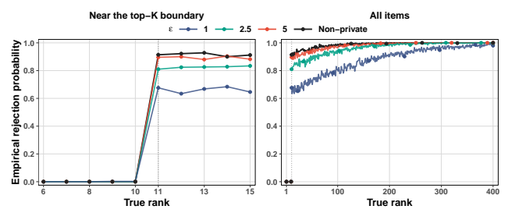
Figure 1 : Empirical rejection probabilities of the individual top-Kplacement tests overR= 500 replications, withn= 400,p= 0.6,K= 10,s= 0.5, andB= 7000 bootstrap draws per replication. The left panel shows ranks 6–15 and the right panel shows all items. Colored curves give results for finiteε; the black curve gives the non-private benchmark. Vertical dotted lines mark the first rank outside the top-Kgroup. Each item was calibrated separately.
Original paper · CC BY 4.0 · Xintao Xia, Jia Gu · Differentially Private Statistical Inference for Rankings from Pairwise Comparisons · Original paper figure · Extracted the figure area from page 27 of the original PDF.Stronger privacy caused larger losses, mainly for items near the top-K boundary. Power approached one farther from the boundary, even at the strongest privacy level considered, ε=1. The main cost of stronger privacy is therefore a weaker ability to exclude items near the boundary. Erroneous exclusions of true top-K items remained rare in this configuration.
Screening LLMs for creative writing with top-K inference
The authors apply the top-K screen to a real pool of 99 language models for a creative-writing task. They start from the October 15, 2026 snapshot of the Arena text leaderboard and keep 99 models with accessible APIs out of 402 listed models. Every pair of remaining models gets a comparison, with fresh responses generated for each pair independently of the others.
The authors draw R = 500 graphs from G(n, p) at each p in {0.6, 0.8}, and fit the model on each graph at each budget in {∞, 5, 2.5, 1}. Each finite budget gives one fit its own privacy budget, with fresh perturbations across repetitions. For K = 10 and α = 0.05, a model is excluded when its one-sided lower rank bound exceeds K. Each model is calibrated separately with I = {i} and B = 7000 bootstrap draws.
These repetitions measure how sensitive the individual rank inference is to comparison subsampling and privacy perturbation, given the observed judgments.
Table 3 reports the median and interquartile range of the lower rank bounds, along with the exclusion rate, for four selected models. Non-private summaries use only the 233 and 382 fits that give finite MLEs at p = 0.6 and p = 0.8, while private summaries use all 500 fits. GPT-5.5 and Claude Sonnet 4.6 were occasionally excluded under the strongest privacy, but their median lower bounds stayed at 1.
That rise came from the upper tail of the bounds, not from a shift in the typical bound past the top-10 threshold.
At ε = 1, its exclusion frequency rose from 44.0% to 60.4% as p increased from 0.6 to 0.8. The authors read this as extra comparisons offsetting part of the loss of exclusion evidence at a fixed privacy budget. The same four models were also screened on a story-beginning task from MT-Bench, which shows that evidence for exclusion can change across tasks.
Limitations and open settings
The simulations and the real-data study leave several regimes and settings outside what the paper tests. The authors flag coverage in stronger-privacy regimes, where regularization bias can dominate sampling variation, as future work. The paper doesn't test coverage in those regimes, so its finite-sample evidence covers only the moderate-privacy settings it reports.
The authors leave these extensions to future work.
Privacy protection in the paper covers individual comparison records, not all judgments from one participant. Extending protection to a participant's full set of judgments would require user-level differential privacy. That extension would need to control the influence of repeated evaluations of the same pair and the dependence among judgments.
The simulations use one true score configuration, with K set to 10 and s set to 0.5 or 2 depending on the experiment. The real-data study uses one automated judge on one creative-writing task. The authors also note that the proposed procedure accommodates human pairwise judgments, but they didn't test it on them.
Paper info
- Authors
- Xintao Xia, Jia Gu
- Venue
- arXiv · Preprint
- First published
- 2026-11-10
- Added
- 2026-11-11
- Updated
- 2026-11-10
- Version
- v1
- arXiv
- 2611.13485
- Category
- stat.ML · cs.LG · stat.ME
- Original paper terms
- CC BY 4.0
- What we show
- Paper info, commentary and permitted figures from the original paper
AI commentary is a separate explanation from the original paper and may contain errors. The original paper and figures follow each source's terms of use and any rights noted separately.
Abstract
Reliable inference for rankings of large language models based on human pairwise comparisons must preserve the privacy of individual preference records. To meet this need, we develop methods for score and rank inference under the Bradley-Terry model with edge differential privacy. For an objective-perturbed estimator, a new leave-one-out analysis establishes finite-sample bounds on Euclidean and entrywise estimation errors. For sufficiently dense comparison graphs, the error bounds extend to smaller privacy budgets, including regimes in which its privacy term dominates its statistical term. A uniform asymptotic expansion yields asymptotically valid confidence intervals for individual scores and pairwise score differences. To improve finite-sample performance, we account for both regularization bias and privacy-induced randomness by combining a plug-in ridge-bias correction with Gaussian-Laplace calibration. We further establish a bootstrap procedure for simultaneous rank inference, providing asymptotically valid confidence sets for individual ranks and tests of top-$K$ membership. When the comparison probability is public and known, all proposed inferential procedures require no additional privacy budget. We evaluate finite-sample performance through simulations and apply the proposed methods to rank large language models for creative writing.
Quote from the paper
Xintao Xia, Jia Gu (2026). Differentially Private Statistical Inference for Rankings from Pairwise Comparisons. arXiv:2611.13485v1. https://arxiv.org/abs/2611.13485v1
BibTeX
@misc{xia2026differentially,
  title = {{Differentially Private Statistical Inference for Rankings from Pairwise Comparisons}},
  author = {Xintao Xia and Jia Gu},
  year = {2026},
  eprint = {2611.13485},
  archivePrefix = {arXiv},
  url = {https://arxiv.org/abs/2611.13485v1}
}