Paper commentary
Identifying optimal cycles in quantum thermal machines with reinforcement-learning
Reinforcement learning finds power-maximizing cycles for quantum heat engines and refrigerators
- Problem Cycles in the literature have no guarantee of maximizing power, since they fix a cycle shape or a regime. Quantum effects make their optimality unclear.
- Method The authors train a soft actor-critic agent that picks each step's control and bath without assuming a cycle shape.
- Results On the oscillator engine, the agent's cycle beats the optimized Otto cycle in average power.
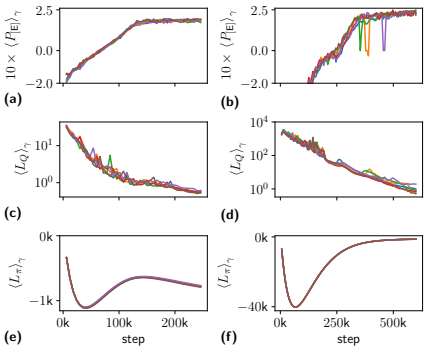
FIG. 7 . T raining curves. Training curves for 6 consecutive runs of the RL method in the harmonic oscillator heat engine. Panels (a), (c) and (e) correspond to the optimization carried out in the range considered in Figs. 5a and 5c, while panels (b), (d) and (f) correspond to the optimization carried out in Figs. 5b and 5d. The panels show, as a function of the training steps, the running average of the power [panels (a) and (b)], the running average of the loss function LQ [panels (c) and (d)], and the running average of the loss function Lπ [panels (e) and (f)]. Each curve corresponds to a separate training.
Original paper · CC BY 4.0 · Paolo Andrea Erdman, Frank Noé · Identifying optimal cycles in quantum thermal machines with reinforcement-learning · Original paper figure · Extracted the figure area from page 11 of the original PDF.Why fixed cycles leave power on the table
Modeling that regime requires the full dynamics of the quantum system, not just its equilibrium properties. The authors also point out that strategies are needed to identify optimally controlled cycles at all.
Most studies sidestep this by fixing a cycle shape, such as the Otto cycle, or by working in a specific regime. Slow-driving and fast-driving regimes have general strategies, but beyond them common work optimizes specific aspects of a chosen cycle. Shortcuts to adiabaticity and variational optimization have also been used, but they still rely on assumed structures.
There is no guarantee that these typical regimes and specific cycles are optimal for power maximization. Quantum effects complicate the picture, because studies report both quantum advantages and coherence-induced power losses.
The authors therefore aim for a search that doesn't rely on specific control sequences or assumptions. They propose a Reinforcement Learning based approach, using a generalization of Soft Actor-Critic for combined discrete and continuous actions.
Letting the agent choose the protocol
The agent acts on a continuous control u and a discrete bath choice d at each step. Time is discretized into steps of length Δt, and both u and d stay constant during each step. The action space combines a continuous set of controls U with the discrete set Hot, Cold and None. The authors chose the density matrix of the quantum system and the last chosen action as the state.
The environment, not the agent, evolves the state from ρ(t) to ρ(t + Δt) under the Markovian master equation. The agent therefore starts with no prior knowledge of quantum dynamics or of thermodynamic cycles.
The reward is the average power over one time step, ⟨P[ν]⟩Δt, computed by the environment. Plugging this reward into the discounted return makes the aim of the agent the maximization of the exponentially weighted average power. The relation between the two is γ̄ = −ln γ / Δt, so γ sets the timescale of the power averaging. The authors expected periodic driving to emerge on its own, since power extracted from the initial state is bounded.
Work extracted through repeated cycles, by contrast, scales with the number of performed cycles, that is with time. The method makes no assumption on the shape of the control cycle, so it starts from scratch.
Each step therefore gives the agent a state, an action and a reward, which it uses to update its policy. The policy π(a|s) acts as the actor, and the value function Q(s,a) acts as the critic that judges the actor's choices.
How the soft actor-critic agent learns
The learner is a soft actor-critic agent, in which the policy plays the actor and the value function plays the critic. Both are fully-connected neural networks with two hidden layers, and they are trained by minimizing loss functions with the ADAM optimizer. The entropy weight ε balances exploration and exploitation, and the authors replace the unknown state distribution with a replay buffer B of stored one-step transitions.
To handle mixed actions, the authors factorize the joint policy as πθ(u,d|s) = πθD(d|s)·πθU,d(u|d,s), so the discrete and continuous choices can stay correlated. The factorization matters because the decomposition captures correlations between the bath choice and the control, which the authors call crucial in their application. The continuous control is drawn from a squashed Gaussian that maps a sample into the range U = [ua, ub].
Two value functions Qφi are trained against a Bellman target that uses the minimum over two target networks. The target parameters are held fixed during backpropagation and updated by polyak averaging with ρpolyak. The expectation over the discrete action is computed as a full average, while the continuous action gets a single sampled value.
The policy is improved by minimizing a loss built from the Kullback-Leibler divergence to the exponentiated value function.
After an initial phase of random actions, the agent performs nupdates policy evaluation and improvement steps every nupdates environment steps. The entropy weight follows ε(nsteps) = ε0 exp(−nsteps/εdecay), so exploration fades as training goes on.
Two-level engine: recovering the known optimum
The two-level heat engine is the benchmark, with the Hamiltonian set by a single control parameter u(t) and a fixed energy scale E0. The authors ran the agent with rates Γ_H = Γ_C = 1, βH = 1, βC = 2, and a control range U = [0.3, 1]. The agent starts with no knowledge of the system, so its actions look random in the first steps. Those random actions dissipate work into the heat baths, so the running average of the power is negative.
As training goes on, the agent learns to control the engine, the power rises, and structure appears in the chosen actions. The policy then converges and the running average of the power saturates at a finite positive value.
The agent's final cycle matches this exact structure, with no time spent disconnected from the baths. The learned frequency is limited by the choice of Δt = 0.5, which the agent's cycle cannot exceed. The control values the agent found differ from the ones in Ref. 90 by about 0.05. Even so, the power nearly coincides with the upper bound, because the authors see a manifold of near-optimal solutions.
The authors measure the efficiency at maximum power, the ratio of extracted work to input heat at maximum power. They compare it with the Carnot efficiency ηc = 1 − βH/βC and the Curzon-Ahlborn efficiency ηca = 1 − sqrt(βH/βC). The Curzon-Ahlborn efficiency is not a fundamental upper bound, but it has been derived from linear irreversible thermodynamics.
The optimal cycle delivers an efficiency at maximum power equal to 100% of ηca, which is 59% of ηc.
Refrigerator: a cycle that uses coherence
The superconducting qubit refrigerator generates coherence while it is driven, because the Hamiltonian at different controls doesn't commute. Earlier work found that this coherence degrades the power of this setup, and a smoothed trapezoidal cycle was the best previous proposal. That trapezoidal cycle cools with a power of about 2.3×10⁻⁴ at its optimal period T, as reported in the earlier study.
The RL agent reached a cooling power of about 10.8×10⁻⁴ with the same system parameters, nearly fivefold higher.
The gain comes from an extra stretch near u≈0.13, where the qubit is nearly decoupled from the baths and evolves unitarily. That stretch takes about 1/4 of the total cycle time. The authors report that it extracts roughly the same heat per cycle as the trapezoidal cycle, but 5 times faster. The trapezoidal cycle run at the agent's speed yields negative power, so the authors read the gain as a mitigation of coherence-induced power loss.
To test this reading, the authors computed the time-average of the relative entropy of coherence for both cycles. The average is about 0.116 for the RL cycle and about 0.194 for the trapezoidal cycle at the same period. So the trapezoidal cycle generates almost twice as much coherence as the agent's cycle.
The authors also evaluate the coefficient of performance at maximum cooling power for the agent's cycle. That COP is 6% of the Carnot COP, which the authors call a rather low value. They argue it is acceptable because on-chip cooling usually aims to maximize cooling power regardless of efficiency.
Harmonic oscillator engine: an Otto-like cycle with extra features
The oscillator engine uses non-interacting particles in a harmonic potential, and the control u(t) changes the oscillator frequency. The agent chooses which bath, if any, couples to the oscillator, just as in the qubit engine. Because the Hamiltonian at different controls doesn't commute, this system also loses power at finite driving speed.
The baseline is an Otto cycle whose four stroke durations were tuned in Ref. 42, with u_H = 1 and u_C = 0.5. Ref. 42 reports only the optimized power, so the authors ran a grid search over the four durations and then a Newton refinement. The resulting power nicely matches Ref. 42.
With U = [0.5, 1], the agent's cycle outperforms the optimized Otto cycle in average power. The power is negative for small steps, because energy flows into the cold bath for roughly 20 time steps. The agent learns that this cold-bath step, required by the second law, is needed for power extraction in the long run.
The cycle still resembles the Otto cycle, since both are flat for some time at u = u_C and u = u_H. The authors attribute the gain to ramping the control during bath contact, which combines heat exchange and modulation. Those two processes happen in one stroke instead of two separate strokes, as in the Otto cycle.
The efficiency at maximum power is 60% and 78% of the Curzon-Ahlborn efficiency for the cycles in Fig. 5c and 5d. These values correspond to 46% and 59% of the Carnot efficiency.
Limitations of the experiments
The main-text case studies each come from a single training run, so run-to-run variability isn't shown there. The Methods include training curves for several runs, and they show the running average of the power, the loss LQ and the loss Lπ. Each curve in those panels corresponds to a separate training, so the main results don't rely on them.
The dynamics come from a Markovian master equation that assumes weak system-bath coupling. That equation is derived with the usual Born-Markov and secular approximations, and the Lamb-shift contribution is neglected. The strong system-bath coupling regime, which goes beyond a master-equation approach, isn't studied here. The authors list it as a future extension.
The RL agent produces piece-wise constant protocols, so the authors argue that master-equation inaccuracies under fast parameter driving don't affect them. That argument holds only provided that Δt isn't smaller than the bath timescale.
The time step Δt limits the frequency of the learned two-level cycle, as the authors note. The agent's values of u(t) differ from those predicted in Ref. [90] by about 0.05, yet the power nearly coincides with the upper bound. The authors don't test a smaller Δt, so its effect on the cycle beyond this point stays unmeasured.
Paper info
- Authors
- Paolo Andrea Erdman, Frank Noé
- Venue
- arXiv · Preprint
- First published
- 2021-8-30
- Added
- 2026-11-6
- Updated
- 2022-1-17
- Version
- v2
- arXiv
- 2108.13525
- DOI
- 10.1038/s41534-021-00512-0
- Category
- quant-ph · cond-mat.mes-hall · cs.LG
- Original paper terms
- CC BY 4.0
- What we show
- Paper info, commentary and permitted figures from the original paper
AI commentary is a separate explanation from the original paper and may contain errors. The original paper and figures follow each source's terms of use and any rights noted separately.
Abstract
The optimal control of open quantum systems is a challenging task but has a key role in improving existing quantum information processing technologies. We introduce a general framework based on Reinforcement Learning to discover optimal thermodynamic cycles that maximize the power of out-of-equilibrium quantum heat engines and refrigerators. We apply our method, based on the soft actor-critic algorithm, to three systems: a benchmark two-level system heat engine, where we find the optimal known cycle; an experimentally realistic refrigerator based on a superconducting qubit that generates coherence, where we find a non-intuitive control sequence that outperform previous cycles proposed in literature; a heat engine based on a quantum harmonic oscillator, where we find a cycle with an elaborate structure that outperforms the optimized Otto cycle. We then evaluate the corresponding efficiency at maximum power.
Figures from the paper
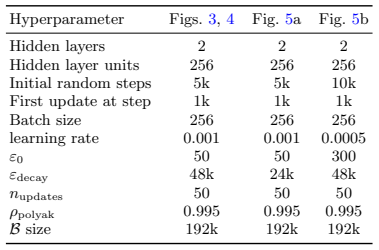
Figures from the paper TABLE I. Hyperparameters used in numerical calcu- lations that are not reported in the Figure captions.
Original paper · CC BY 4.0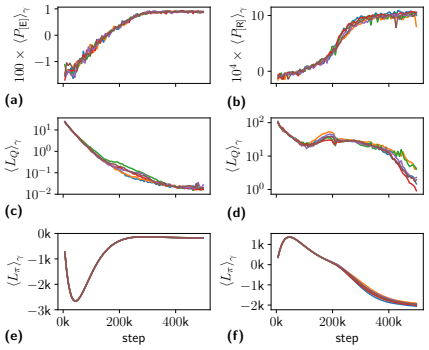
FIG. 6 . T raining curves. Training curves for 6 consecutive runs of the RL method in the two-level system heat engine case [panels (a), (c) and (e), corresponding to Fig. 3] and in the superconducting qubit refrigerator case [panels (b), (d) and (f), corresponding to Fig. 4]. The panels show, as a func- tion of the training steps, the running average of the power [panels (a) and (b)], the running average of the loss function LQ [panels (c) and (d)], and the running average of the loss functionLπ [panels (e) and (f)]. Each curve corresponds to a separate training.
Original paper · CC BY 4.0Quote from the paper
Paolo Andrea Erdman, Frank Noé (2021). Identifying optimal cycles in quantum thermal machines with reinforcement-learning. arXiv:2108.13525v2. https://doi.org/10.1038/s41534-021-00512-0
BibTeX
@article{erdman2021identifying,
  title = {{Identifying optimal cycles in quantum thermal machines with reinforcement-learning}},
  author = {Paolo Andrea Erdman and Frank Noé},
  year = {2021},
  eprint = {2108.13525},
  archivePrefix = {arXiv},
  doi = {10.1038/s41534-021-00512-0},
  url = {https://arxiv.org/abs/2108.13525v2}
}