Paper commentary
The Indic Token Tax in 2026: Measuring Tokenizer. Disparity and Its Cost for the Languages of India
Indian language text costs far more tokens than English on popular tokenizers
- Problem Tokenizers built mostly on English split Indian-language text into many more tokens, so users pay more per request and fit less text in a context window. Older studies predate newer large-vocabulary tokenizers and rarely measure romanized Hinglish.
- Method The authors encode the same FLORES-200 sentences in each Indian language and in English with nine public tokenizers. They compare token counts per language against the English count, and they price a hypothetical support bot with official list rates.
- Results On GPT-4o's tokenizer, Odia needs 5.01 times the English token count, while Hindi needs 1.57 times. Only Sarvam-30B/105B stays below 2.6 times on every language among third-party tokenizers.
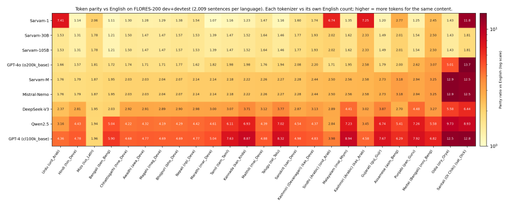
Fig. 2 . Parity ratio versus English on FLORES-200 for every tokenizer (rows, sorted by median) and language of India (columns, sorted by median), on a log color scale.
Original paper · CC BY 4.0 · Johin Johny Arimbur, Ankur Ashit Ghosh, Shervin Sam · The Indic Token Tax in 2026: Measuring Tokenizer. Disparity and Its Cost for the Languages of India · Original paper figure · Extracted the figure area from page 5 of the original PDF.Why tokenizer cost falls unevenly
Commercial language model APIs bill per token, and a context window holds only so many tokens. The tokenizer decides how many tokens a sentence becomes, and most tokenizers are built on text that is mostly English. Text in other languages therefore breaks into more and smaller pieces, which means higher bills, slower replies and less room in the window.
This effect was documented in 2023, but that work predates larger vocabularies such as OpenAI's o200k_base and the Indic models from Sarvam AI. Romanized Hinglish is a further gap, since many Indian users type that way and it is rarely measured.
The authors therefore ask how large the disparity is now and whether it depends on the script. They measure nine public tokenizers across every language of India in FLORES-200, including four Sarvam tokenizers released between 2024 and 2026. They also test romanized text against PHINC and Dakshina, work out a rupee cost example, and check morpheme boundary alignment for Hindi and Marathi.
They evaluate only publicly released tokenizers, while a companion paper proposes a tokenizer meant to reduce the tax.
How parity is measured
The method rests on parallel text, the same sentence in each language and in English, so token totals can be compared directly. The authors use the 2,009 FLORES-200 sentences per language, split into 997 dev and 1,012 devtest sentences. Each sentence is aligned with English, so a difference in token count reflects how a language is written rather than different content.
Bodo, Dogri and Konkani are absent from the release, so the study covers the other Indian languages present in it.
For a language L, the parity ratio P_L is the summed token count of its sentences divided by the summed token count of the aligned English sentences. Written out, \[ P_L = \frac{\sum_i T(x_{Li})}{\sum_i T(x_{en\,i})} \] where T is the token count and the two sentence sets are aligned. At equal per-token prices, \(P_L\) is the cost multiplier for the same content, and a context window holds \(1/P_L\) as much text.
The denominator is the tokenizer's own English count, so a tokenizer that compresses English poorly gets a flattering ratio. The authors therefore also compute a common-baseline ratio, dividing by GPT-4o's English count on the same sentences.
For the romanized sets the authors report tokens per word instead, since HingCorpus and MeCorpus are not parallel.
Hindi and Marathi with and without a common baseline
Older tokenizers carry the largest tax on Marathi and Hindi, measured against each tokenizer's own English count. On cl100k_base and Qwen2.5, Marathi lands between 4.6 and 5.0 times the English count. GPT-4o's o200k_base cuts the Marathi ratio from 5.04 to 1.82 and the Hindi ratio from 4.78 to 1.57. Full sentences still leave Marathi 82% above English, while one short sentence of 6 tokens looks nearly free.
Dividing by each tokenizer's own English count hides a second effect, because the English side changes between tokenizers. Sarvam-1's English needs 17% more tokens than GPT-4o's English, so its own-baseline ratios look better than they are. On GPT-4o's English count, Sarvam-30B and Sarvam-105B need 1.41 times the English tokens for Marathi and 1.33 times for Hindi.
Sarvam-1 needs 1.25 times for Marathi, against 1.41 for Sarvam-30B and Sarvam-105B, and it ties them on Hindi at 1.33. The 95% intervals come from 1,000 bootstrap resamples of sentences, so each ratio carries its own uncertainty.
Figure 1 plots each tokenizer's parity ratio with 95% bootstrap confidence intervals against a dashed line at parity. Even the best Indic-focused tokenizers still need 1.25 to 1.41 times the English tokens to write Marathi and Hindi. On GPT-4o's tokenizer, Hindi is the lowest Indian language at 1.57 times, and Odia reaches 5.01 times.
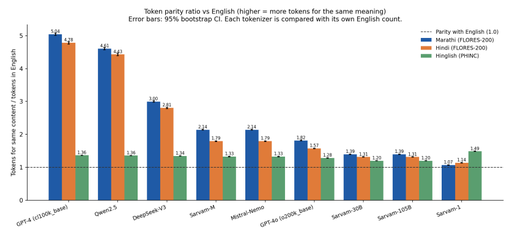
Fig. 1 . Parity ratio versus English for each tokenizer, with 95% bootstrap confidence intervals. The dashed line marks parity with English.
Original paper · CC BY 4.0Every FLORES-200 language and script pair
GPT-4o's tokenizer leaves no Indian language at parity with English on FLORES-200, and the cost depends heavily on script. Hindi is the lowest at 1.57, while Odia reaches 5.01 and Santali in Ol Chiki reaches 13.72. Odia costs almost three times what Bengali costs, at 1.72 on the same tokenizer. Eight of the 25 pairs sit at 2.0 or above, and Meitei in Bengali script reaches 3.07.
Santali in Ol Chiki is even worse on GPT-4o than on GPT-4, which gives 12.76.
The older tokenizers carry a much heavier tax across the full set of pairs. Those two tokenizers need 8.9 to 12.8 times on Odia and Santali. Figure 2 shows these ratios as a log-scaled colour grid, sorted by median.
Sarvam-30B/105B is the most even tokenizer, staying between 1.21 and 2.50 on every language. It is the only third-party tokenizer below 2.6 on every language, with a median of 1.53. Sarvam-1 has the lowest own-baseline ratio on 17 languages. Yet it needs 6.7 to 7.4 times on Urdu, Sindhi and Kashmiri in Arabic script, and 11.8 times on Santali.
Sarvam-1's own-baseline ratios look better partly because its English needs 17% more tokens than GPT-4o's. It trails Sarvam-30B on the other 17 languages, Bengali and Odia among them. Mizo, written in Latin script, sits between 1.8 and 2.1 on every tokenizer.
Romanized text on PHINC and Dakshina
PHINC gives the main romanized evidence because its Hinglish posts are paired with human English translations. On PHINC, GPT-4o needs 1.61 tokens per word for Hinglish, against 1.36 for the English side. GPT-4o's Hinglish parity ratio is 1.28, so Latin-script text stays close to English on that tokenizer. Latin-script Hinglish reuses English sub-words, which keeps the gap small.
Part of the remaining gap comes from the data, since PHINC Hinglish posts contain 8% more words than their English translations.
Sarvam-1 is the most efficient tokenizer on Devanagari but the least efficient on romanized text. On PHINC, Sarvam-1 needs 2.24 tokens per word for Hinglish, while Sarvam-30B/105B needs 1.53. The HingCorpus and MeCorpus figures in Table IV are secondary, because those posts are not parallel.
Dakshina gives a different comparison: the same Wikipedia strings appear in native script and as human romanizations. The ratio compares two spellings of one text rather than two languages. On Qwen2.5 the range is 0.28 to 0.75, so Latin letters avoid most of the penalty on these older tokenizers. GPT-4o stays close to even, at 0.90 to 1.10 for most languages, with Punjabi and Sinhala at 0.70.
Sarvam-30B/105B reverses the direction, needing 1.09 to 1.37 times the native-script tokens for ten of the eleven Indian languages. Sindhi is the exception at 0.92 on that tokenizer. Sarvam-1 needs 1.55 to 1.86 times for the nine Brahmic-script languages of India. Dakshina's romanizations are formal, so the authors don't assume casual messaging tokenizes the same way.
What the token tax costs in rupees at current list prices
We priced tokens with official list prices for the models whose tokenizers we measured, accessed on 5 November 2026. The prices are standard tier and exclude caching, batch and off-peak savings, so the estimate uses plain list rates. tiktoken 0.12.0 maps gpt-4o, gpt-4.1-mini, gpt-5 and gpt-5-mini to o200k_base, so those OpenAI models share one set of counts.
The authors compared DeepSeek-V4.1-Flash and V4-Pro with DeepSeek-V3 component by component, and all four encode a 1,400-sentence FLORES sample to identical token ids. Sarvam bills Sarvam 105B in rupees, and the authors assume its API uses the open Sarvam-105B tokenizer, which they didn't verify.
Qwen prices are left out, because the Qwen API models aren't the Qwen2.5 release that the authors measured. The worked example is a hypothetical support bot that handles 100,000 chats a month. Each chat holds 800 input and 400 output tokens of English conversation on that model's tokenizer.
On GPT-4o the bot costs INR 56,640 a month in English and INR 102,829 in Marathi, which is INR 46,190 more. Hindi comes to INR 89,145 and Odia reaches INR 283,601 on the same model. On deepseek-flash, Marathi costs INR 20,384 against INR 6,797 for English, three times as much. Model prices differ more than the tax does, since GPT-4o's English cost is 16 times Sarvam 105B's.
The tax therefore matters most when comparing languages on one model, and the figures don't measure answer quality. Table VII lists the full set of languages, and the released COST.CSV holds results for all models.
Do token splits follow morphemes?
The authors test morpheme alignment as a separate property, since tokens that follow morpheme boundaries may help models generalize. MorphTok supplies the gold reference, with word-level segmentations for Hindi and Marathi. The authors built those segmentations from affix lists with language experts, then had experts post-edit an existing segmenter's output.
That filtering leaves 59,676 Hindi words with 46,144 gold boundaries and 42,292 Marathi words with 39,083 boundaries.
Splits inside a single character, or from byte fallback, don't count toward the score. Precision, recall and F1 are micro-averaged, and splitting after every character gives recall of 1. That every-character reference reaches precision .14 in Hindi and .15 in Marathi, which matches the density of gold boundaries.
The cl100k_base tokenizer reaches precision of .13 in Hindi and .19 in Marathi, close to the every-character reference. Its high recall of .72 in Hindi comes from fragmentation rather than from morphology. Sarvam-30B/105B gives the best F1 on both languages, at .48, with precision .34 and recall .79 in Hindi. Sarvam-1 comes second, with F1 of .43 in Hindi and .46 in Marathi.
Sarvam-30B/105B matches the exact segmentation for 27% of Hindi words and 15% of Marathi words. No tokenizer goes above an F1 of 0.48, so alignment stays weak on every tokenizer tested. Fewer fragments and better alignment coincide in these results, but neither one implies the other. GPT-4o produces 3.37 tokens per Hindi word, against 2.78 for Sarvam-30B/105B.
Limits of the evidence
FLORES-200 is formal, Wikipedia-style text, so the measured disparity may not carry over to conversational use. IN22-Conv would test conversation, but its Hugging Face repository and BPCC archive returned HTTP 401, so conversational Devanagari text was never measured.
Bodo, Dogri and Konkani are absent from FLORES-200, so these scheduled languages stay unmeasured. The romanized and morphological measurements cover only Hindi and Marathi. MeCorpus tokens per word are therefore the only measurement of informal romanized Marathi in the study.
HingCorpus was read from a third-party Hugging Face mirror of the L3Cube release, not from the release itself. HingCorpus and MeCorpus are licensed CC BY-NC-SA 4.0, so the authors keep their measurements within research use.
Token counts exclude chat-template overhead, so the measurements cover raw text tokens only. Answer quality was not measured, and token counts say nothing about model quality. MorphTok segmentations are partly generated and partly post-edited, so words are scored out of context with sandhi entries dropped.
Paper info
- Authors
- Johin Johny Arimbur, Ankur Ashit Ghosh, Shervin Sam
- Venue
- arXiv · Preprint
- First published
- 2026-11-9
- Added
- 2026-11-11
- Updated
- 2026-11-9
- Version
- v1
- arXiv
- 2611.13058
- Category
- cs.CL · cs.AI
- Original paper terms
- CC BY 4.0
- What we show
- Paper info, commentary and permitted figures from the original paper
AI commentary is a separate explanation from the original paper and may contain errors. The original paper and figures follow each source's terms of use and any rights noted separately.
Abstract
Commercial language model APIs bill per token, so a tokenizer that needs more tokens for the same content in one language makes that language more expensive, slower, and able to fit less text in a fixed context window. We measure this disparity for nine public tokenizers, including those of GPT-4, GPT-4o, Qwen2.5, DeepSeek-V3, Mistral-Nemo and four Sarvam models, on all 25 languages of India available in FLORES-200 (2,009 professionally translated sentences aligned with English) and on 13,732 human-translated Hinglish-English social media pairs from PHINC. On GPT-4o's tokenizer the same content needs between 1.57 times (Hindi) and 5.01 times (Odia) the tokens of English, and 13.7 times for Santali in Ol Chiki script; GPT-4's tokenizer needs up to 12.8 times. Sarvam-30B/105B is the only third-party tokenizer that stays below 2.6 times on every language (median 1.53). In an illustrative scenario using official list prices accessed on 5 November 2026 and stated assumptions, a support bot handling 100,000 chats a month on GPT-4o would cost about INR 56,640 in English and INR 102,829 in Marathi; these are estimates, not measured production costs. Against an openly licensed Hindi and Marathi morphological segmentation set, no tokenizer places more than 35% of its word-internal boundaries on morpheme boundaries (boundary F1 at most 0.48). In a companion paper we present a tokenizer that reduces this tax. Code, pinned artifacts and raw token counts are available at https://github.com/HavonAI/indic-token-tax.
Quote from the paper
Johin Johny Arimbur, Ankur Ashit Ghosh, Shervin Sam (2026). The Indic Token Tax in 2026: Measuring Tokenizer. Disparity and Its Cost for the Languages of India. arXiv:2611.13058v1. https://arxiv.org/abs/2611.13058v1
BibTeX
@misc{arimbur2026indic,
  title = {{The Indic Token Tax in 2026: Measuring Tokenizer. Disparity and Its Cost for the Languages of India}},
  author = {Johin Johny Arimbur and Ankur Ashit Ghosh and Shervin Sam},
  year = {2026},
  eprint = {2611.13058},
  archivePrefix = {arXiv},
  url = {https://arxiv.org/abs/2611.13058v1}
}