Paper commentary
DSEC: A Stereo Event Camera Dataset for Driving Scenarios
DSEC adds a stereo event camera dataset for night and day driving
- Problem Stereo depth from event cameras lacked driving data. MVSEC's 10 cm baseline and 0.1 megapixel sensors are too small for stereo on real roads.
- Method DSEC pairs two event cameras with two color frame cameras on a wider baseline. It gets dense ground truth disparity by projecting filtered lidar points into the views.
- Results A retrained baseline reached a D1 error of 10.50 on Zurich City day sequences. Its error was 15.47 on night sequences.
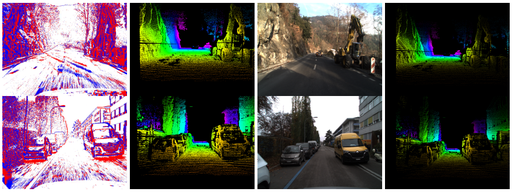
Fig. 7 : Examples of recorded event and image data with corresponding disparity groundtruth. From left to right: events with the corresponding disparity and image with corresponding disparity. The disparity image is colored to provide a sense of depth.
Original paper · CC BY 4.0 · Mathias Gehrig, Willem Aarents, Daniel Gehrig, Davide Scaramuzza · DSEC: A Stereo Event Camera Dataset for Driving Scenarios · Original paper figure · Extracted the figure area from page 6 of the original PDF.Why driving stereo with event cameras stalls
Event cameras suit driving because they offer high temporal resolution and high dynamic range, yet driving datasets with them remain rare. The closest prior work, MVSEC, is the only stereo event dataset for driving that the authors know of. Its DAVIS346 cameras give about 0.1 megapixels and sit 10 cm apart, far from the roughly 55 cm baselines and above 1 MP cameras of KITTI-style benchmarks.
Because the sensor was only recently commercialized, the authors argue that the community has had little time to collect large event datasets.
Stereo depth error grows roughly with the inverse of baseline times focal length, so a short baseline costs depth accuracy. Event-only stereo has a deeper problem: in a static scene under constant illumination, the event camera triggers no events. Dense depth can't be recovered in that case, and the authors note that a dynamic scene only gives depth for its moving part.
Most event-based stereo methods therefore give only sparse or semi-dense depth.
Fusing frames and events has helped in several prior works, but those methods assume both sensors share the same pixels. That assumption holds for older DAVIS cameras and fails for newer event sensors. The authors therefore add two high-resolution standard cameras next to the event cameras, so static scenes can still yield dense depth.
A rig that puts frames beside events
Each color frame camera sits next to its event camera, so the two stereo pairs stay close in parallax. Separating the sensors spatially keeps event and frame views nearly aligned, which lets fusion methods use both high-resolution sensors.
The two Prophesee Gen3.1 event cameras are monochrome sensors with 640 × 480 pixels and a 60 cm baseline. Two FLIR Blackfly S USB3 color cameras with 1440 × 1080 pixels sit next to them with a 51 cm baseline. The frame baseline is kept slightly shorter than the event baseline to offset the higher resolution of the Blackfly cameras. Each frame camera sits about 4.5 cm from its event camera, which introduces only a small parallax for fusion.
Compared to MVSEC, the event data has 3 times higher resolution and a larger baseline, which addresses MVSEC's main limitation.
Event cameras have no exposure setting, so the authors tune biases that control contrast sensitivity instead. In bright daylight they raise the sensitivity, which lowers the contrast threshold and reveals more detail. At dawn, dusk and night they raise the contrast threshold to reduce noisy events. The Blackfly cameras run in auto exposure at 20 Hz, prioritizing exposure time over analog gain to reduce noise.
The maximum exposure time of 15 ms is typically reached only at night, when the gain increases to minimize motion blur. A Velodyne VLP-16 lidar and an RTK GNSS receiver with 10 Hz updates complete the sensor suite.
What the 53 sequences cover
The authors kept 53 sequences after reviewing their raw recordings. They selected only sequences with good recording and calibration quality. The raw recordings exceed 4 TB and were captured in urban, suburban and rural parts of Switzerland. Together the 53 sequences add up to 3193 seconds, close to an hour of driving.
The training split holds 41 sequences that total 2634 seconds. Interlaken contributes 5 daytime sequences of 367 seconds, and Thun contributes 1 daytime sequence of 12 seconds. Zurich City adds 35 sequences of 2255 seconds, recorded in both day and night conditions. Zurich City makes up most of the training time, since its 2255 seconds far exceed the other two areas.
The test split holds 12 sequences that total 559 seconds. Interlaken supplies 3 sequences of 251 seconds, and Thun supplies 2 sequences of 64 seconds. Zurich City supplies 7 sequences of 244 seconds, spanning day and night. The test split keeps the same three areas as the training split, so both splits cover Interlaken, Thun and Zurich City.
Night sequences appear only in Zurich City in both splits. Interlaken and Thun contain daytime sequences only. Across the full dataset, the three areas cover day and night time, as the authors summarize.
Syncing and calibrating the rig
The sensors share one clock because a GPS receiver drives a microcontroller and the lidar with a pulse at the top of each second. The lidar takes these PPS pulses to update its internal timestamp, so lidar measurements are already in GPS timestamps. Each event camera records every pulse as a special event stamped with its own clock, while a frame camera starts exposing when a pulse arrives.
Frame and event timestamps are then expressed in the GPS clock.
Kalibr expects a checkerboard that event cameras don't show directly, so the authors reconstruct images from the event streams with E2VID. Instead of relying on blinking patterns, the reconstructions carry the checkerboard that Kalibr can use. Extrinsic calibration needs all frames captured or reconstructed at the same moment, so the authors reconstruct images at the middle of each frame's exposure time.
The hardware time synchronization makes these reconstruction instants possible for all cameras. Kalibr then detects corners in the reconstructed images to estimate the intrinsics and extrinsics.
The authors refine this estimate with ICP over N different views selected in a sequence of interest. For each view, they compute a local lidar pointcloud and a 3D pointcloud from SGM on the rectified image pair. A modified point-to-plane ICP aligns the stereo and lidar pointclouds and optimizes only for rotation. Translation isn't optimized because the CAD model gives it accurately.
Finally, the N rotation quaternions are averaged for a more robust extrinsic calibration, with N typically between 2 and 5.
The calibrated rig feeds the next step, where sparse lidar scans become dense ground truth depth. LIO-Mapping computes the pose for each lidar scan, so the authors can query several preceding and proceeding scans. Projecting this accumulated pointcloud directly ignores occlusions and moving objects, which is why a filter is needed.
Disparity labels from sparse lidar
A single lidar scan gives only very sparse depth, so the authors must densify the labels before projecting them. LIO-Mapping estimates the pose of every lidar scan, which lets the pipeline place scans in a common frame. For each view, the method queries several preceding and following scan poses and extracts their relative poses. It then accumulates a local lidar pointcloud from these neighboring scans for each view, as in the Figure 6 example.
Projecting that cloud straight into the camera frames is a problem, because occlusions and moving objects aren't modeled. The authors therefore adopt a filter similar to those used in the KITTI depth and DrivingStereo datasets. They compute a disparity map from the rectified image pair with SGM, which moving objects don't affect. A lidar point survives only if its disparity lies close to the SGM disparity at that pixel.
Points further than 50 meters are removed, which keeps the filtered map accurate.
After filtering, the cloud lands in the left event and frame views, yielding ground truth disparity at 10 Hz. The front car, roughly 40 meters from the camera, still has its erroneous points removed by the filter. The filter trades density for correctness, because lidar labels on moving objects become sparser. At night or under oversaturation, SGM gives sparser disparities, so the labels get sparser too.
How a retrained baseline performs
The authors score the baseline with D1 and D2, the share of disparity errors above 1 and 2 pixels, plus MAE and RMSE in pixels. The stereo method from Tulyakov et al. was first run on the test set with its released checkpoint and 0.5 seconds of events in the event queue. Its D1 error reached 85.9 percent and its MAE reached 13.0, which the authors read as a sign that the model doesn't generalize to DSEC.
Their implementation encodes events as a voxel grid over a 50 millisecond window, which they found comparable to event queues but much faster to train. After retraining, the D1 error on Zurich City day sequences was 10.50, while the night sequences reached 15.47. The night D1 error is about 50 percent higher than the day error, which the authors attribute to a lower signal to noise ratio in low light.
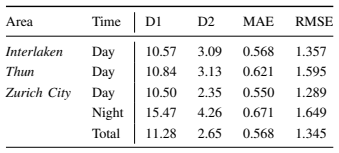
Figures from the paper TABLE IV: Baseline evaluation on the test set. We evaluate the method presented in [48] on a total of 12 sequences in 3 different areas within Switzerland. Here we report the average scores separated by city and day or night time as well as the total score. D N refers to the percentage of disparity errors higher than N pixels. MAE is mean absolute error and RMSE is the root-mean-square error.
Original paper · CC BY 4.0The error metrics are comparable across Interlaken, Thun and Zurich City, so the area alone doesn't drive the gap. The authors conclude that stereo methods trained on MVSEC must be retrained before they reach acceptable performance on DSEC. They evaluated only this one baseline, on 12 test sequences in 3 areas, and left better methods to future work.
Limits in sun, night and labels
Sun-facing sequences show that lens flare cuts contrast for both camera types. The authors tuned the event camera biases to the best of their knowledge, and contrast still dropped. They expect higher quality lenses and better lens coatings to reduce the flare in future hardware.
Night driving is hard for both sensors, so the dataset keeps night sequences on purpose. Standard cameras raise exposure time at night, and the resulting motion blur grows large. Event cameras produce more noise at night because the signal to noise ratio drops.
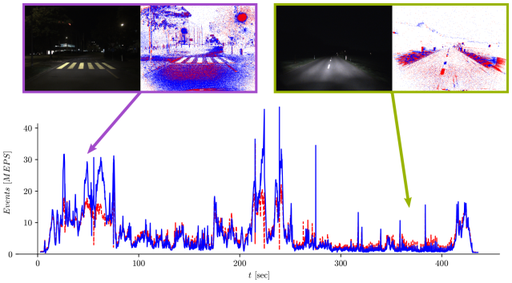
Fig. 9 : The event rate in millions per second (MEPS) during a night sequence. The red and blue curves correspond to negative and positive event polarity respectively. The upper left pair of RGB and event frame corresponds to a situation where a street lamp flashes and periodically triggers events for a large number of pixels. In contrast, the upper right pair of RGB and event frame depicts a scene without artifical light sources other than the car. In this scenario, the event rate is much lower due to the absence of periodically flashing light sources.
Original paper · CC BY 4.0Flashing street lamps trigger events over a large number of pixels, which is an often overlooked difficulty. Figure 9 compares a night sequence near a flashing lamp with one lit only by the car, where the event rate is much lower. Rarely, the event readout saturates and delays the events slightly. The D1 error at night reaches 15.47 percent, against 10.50 percent for the Zurich day sequences.
The authors note that the D1 error is approximately 50% higher at night, which they expect from the lower signal to noise ratio. The ground truth filter adds its own bias, because it leads to sparser disparity labels on moving objects. Since the filter runs SGM on the images, night and oversaturated images also yield sparser disparities.
Paper info
- Authors
- Mathias Gehrig, Willem Aarents, Daniel Gehrig, Davide Scaramuzza
- Venue
- arXiv · Preprint
- First published
- 2021-3-10
- Added
- 2026-11-6
- Updated
- 2021-3-10
- Version
- v1
- arXiv
- 2103.06011
- Category
- cs.CV · cs.RO
- Original paper terms
- CC BY 4.0
- What we show
- Paper info, commentary and permitted figures from the original paper
AI commentary is a separate explanation from the original paper and may contain errors. The original paper and figures follow each source's terms of use and any rights noted separately.
Abstract
Once an academic venture, autonomous driving has received unparalleled corporate funding in the last decade. Still, the operating conditions of current autonomous cars are mostly restricted to ideal scenarios. This means that driving in challenging illumination conditions such as night, sunrise, and sunset remains an open problem. In these cases, standard cameras are being pushed to their limits in terms of low light and high dynamic range performance. To address these challenges, we propose, DSEC, a new dataset that contains such demanding illumination conditions and provides a rich set of sensory data. DSEC offers data from a wide-baseline stereo setup of two color frame cameras and two high-resolution monochrome event cameras. In addition, we collect lidar data and RTK GPS measurements, both hardware synchronized with all camera data. One of the distinctive features of this dataset is the inclusion of high-resolution event cameras. Event cameras have received increasing attention for their high temporal resolution and high dynamic range performance. However, due to their novelty, event camera datasets in driving scenarios are rare. This work presents the first high-resolution, large-scale stereo dataset with event cameras. The dataset contains 53 sequences collected by driving in a variety of illumination conditions and provides ground truth disparity for the development and evaluation of event-based stereo algorithms.
Quote from the paper
Mathias Gehrig, Willem Aarents, Daniel Gehrig, Davide Scaramuzza (2021). DSEC: A Stereo Event Camera Dataset for Driving Scenarios. arXiv:2103.06011v1. https://arxiv.org/abs/2103.06011v1
BibTeX
@misc{gehrig2021dsec,
  title = {{DSEC: A Stereo Event Camera Dataset for Driving Scenarios}},
  author = {Mathias Gehrig and Willem Aarents and Daniel Gehrig and Davide Scaramuzza},
  year = {2021},
  eprint = {2103.06011},
  archivePrefix = {arXiv},
  url = {https://arxiv.org/abs/2103.06011v1}
}