Paper commentary
SWE-Lancer: Can Frontier LLMs Earn $1 Million from Real-World Freelance Software Engineering?
Frontier language models still fail most paid freelance software tasks
- Problem Coding benchmarks use isolated problems and unit tests, which miss bugs that appear only in full user workflows. Real freelance engineering work spans the whole stack, so these scores do not show what models could earn on it.
- Method SWE-Lancer is a benchmark of 1,400 Upwork tasks worth $1 million in payouts. Independent tasks are graded by browser end-to-end tests, and manager tasks are scored by matching the choice the hired engineering manager made.
- Results Claude 3.5 Sonnet earned $208,050 of the $500,800 possible on the Diamond set. Frontier models still solve most tasks.
Why unit-test benchmarks leave gaps
Most coding benchmarks test self-contained programs, such as program synthesis and competitive programming. SWE-Bench and SWE-Bench Verified come closer to real repositories, but they still center on isolated problems. Their data came from GitHub pull requests that had unit tests, so the sample leans toward problems that are easy to test.
The authors instead sampled a representative set of tasks from Upwork, so the selection wasn't driven by which problems volunteers chose to test. Real engineers, though, work across the whole stack and reason about tradeoffs between codebases.
Unit tests have a second weakness: the authors say they are highly susceptible to grader hacking. They also argue that unit tests are insufficient for evaluating full-stack engineering work. A unit test can confirm that each function works on its own, yet miss a bug that appears only in the full user workflow. In one $1,000 task, a bug left the avatar on the Share Code page different from the profile page, and an end-to-end test caught it.
SWE-Lancer's end-to-end tests, written by professional engineers, drive the application through a browser.
The benchmark asks how much of a $1,000,000 freelance payout pool a model can earn. Claude 3.5 Sonnet, the best model, earned $208,050 out of $500,800 possible on the SWE-Lancer Diamond set. That result shows that current models still leave most of the paid work unsolved.
Two task types and their grading
For an IC SWE task, the model receives the issue text, a checkpoint of the codebase from before the fix, and the goal of resolving the issue. The grader applies the model's patch and runs every associated end-to-end test with Playwright, an open-source browser testing library. Models can't read the end-to-end tests during the evaluation, so they can't tailor a patch to the grader.
The payout is earned only when all applicable tests pass, so a partial fix earns nothing.
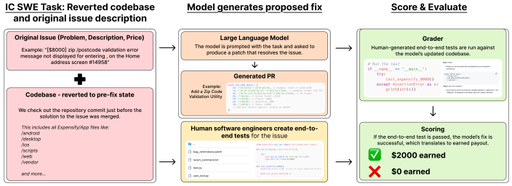
Figure 1 . Evaluation flow for IC SWE tasks; the model only earns the payout if all applicable tests pass.
Original paper · CC BY 4.0 · Samuel Miserendino, Michele Wang, Tejal Patwardhan, Johannes Heidecke · SWE-Lancer: Can Frontier LLMs Earn $1 Million from Real-World Freelance Software Engineering? · Original paper figure · Extracted the figure area from page 2 of the original PDF.The tests follow user flows, such as logging into the application and making financial transactions. In one $1,000 task, a bug left the avatar on the Share Code page different from the profile page. Unit tests might confirm each function alone, while this end-to-end test logs in, uploads a profile picture, and uses a second account to catch the mismatch.
Each test went through three rounds of engineer review, plus an automated check that it passes on the fixed state and fails on the broken one. Each IC SWE task also comes with a user tool, which runs a Playwright script that simulates the user action and writes a trajectory and screenshots.
SWE Manager tasks give the model several freelancer proposals, a snapshot of the codebase, and the goal of picking the best one. Several proposals are often technically correct, so the model has to use context from the whole repository to choose. A choice counts as correct when it matches the solution the original engineering manager picked.
An additional validation campaign with experienced engineers agreed with those original choices in 99% of cases.
The team generated each IC SWE task from a validated GitHub issue, using its title, description, and a codebase snapshot. An issue with at least two proposals also yielded a SWE Management task built from its description and proposal list. Three engineers reviewed each IC SWE task, and two reviewed each SWE Management task.
One attempt in a sandboxed repository
The authors also strip the GitHub remote and any future commits, so the model can't scrape code diffs or pull request details. Each agent gets a single attempt, pass@1, which mirrors the limits of typical online SWE freelancing platforms. The scaffold gives the model a way to inspect the local code, edit files, and run shell commands.
Each IC SWE task ships with its own user tool that the agent can call. When the agent invokes it, a Playwright script opens the browser and tries the action tied to the task. The tool gives no signal on success, but it writes a text trajectory and screenshots to the working directory. The agent can call the tool as often as it likes from the command line.
Running the tool often takes 90 to 120 seconds. The strongest models account for that delay, set timeouts, and review results when they appear. Weaker models such as GPT-4o sometimes give up on the tool altogether. The baseline runs keep the user tool switched on for gpt-4o-2024-08-06, o1 and Claude 3.5 Sonnet.
How far the models get on the Diamond split
The public Diamond split holds 502 tasks worth $500,800 in total, so these numbers cover only that subset. The authors keep the remaining tasks as a private holdout to avoid contamination via training or search. Claude 3.5 Sonnet is the best model here, earning $208,050 of the $500,800 possible. Diamond has 237 IC SWE tasks worth $236,300 and 265 SWE Manager tasks worth $264,500.
On IC SWE tasks in Diamond, Sonnet reaches a pass@1 of 26.2%, with $58k of $236k earned. It beats the next-best model, o1, by 9.7% on these IC SWE Diamond tasks. o1 at High reasoning effort scores 16.5% pass@1 on the same tasks. The authors call IC SWE results largely unsaturated, with pass@1 and earn rates below 30%.
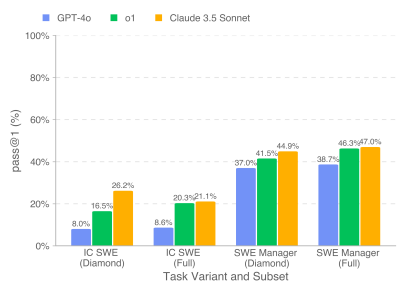
Figure 6 . Model pass@1 performance on IC SWE and SWE Man- ager in the Diamond set and the full set; Claude 3.5 Sonnet per- forms the best and earns $208K in total on the Diamond set and over $400K on the Full set.
Original paper · CC BY 4.0On SWE Manager tasks, Sonnet scores 44.9% pass@1 and earns $150k of $265k. It beats o1 by 3.4% on these Diamond manager tasks. Every model scores higher on SWE Manager tasks than on IC SWE tasks. Pass@1 on manager tasks is often more than double the IC SWE pass rate.
Sonnet's solutions on IC SWE tasks are mostly incorrect, which the authors read as a reliability gap. On the full set, Sonnet reaches 21.1% pass@1 on IC SWE tasks, with $89k of $415k earned. Across the full dataset, Sonnet earns over $400,000 out of $1,000,000 possible.
More attempts and more reasoning
The authors measure how the share of solved IC SWE tasks changes as the number of attempts grows. They estimate pass@k from n total samples and c correct samples, counting a task as solved when one of k attempts succeeds. They evaluated GPT-4o and o1 for k from 1 to 7, and Figure 7 plots these curves. For every model, more attempts produced a steady rise in pass rate.
The rise is most visible for o1, where six more attempts nearly triple the share of solved tasks. GPT-4o at pass@6 reaches the same score as o1 at pass@1, which is 16.5%.
Next, the authors varied o1's reasoning effort on IC SWE Diamond tasks with the user tool enabled. Raising the effort from Low to High lifted pass@1 from 9.3% to 16.5%. Earnings rose from $16K to $29K, and the earn rate rose from 6.8% to 12.1%. Breaking results down by task price, the authors suggest that more reasoning helps the most expensive tasks.
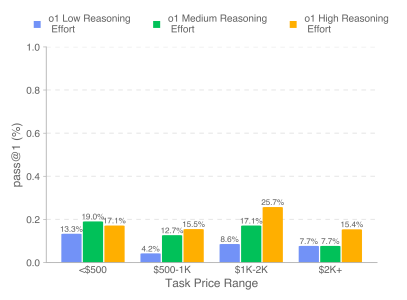
Figure 8 . o1 pass@1 performance on Diamond IC SWE tasks by price range of task. Higher reasoning effort improves overall pass@1 and improves performance on harder, more expensive tasks.
Original paper · CC BY 4.0Each pass@1 number rests on one sample, so run-to-run variance can be significant. The scaling trends across k and reasoning effort are therefore the main evidence here. Readers should weigh those trends against the spread between runs.
Cost against freelancer fallback
The authors asked whether letting a model try first, and paying a freelancer only for failed tasks, costs less than freelancers alone. They ran GPT-4o and o1 five times each on the 237 IC SWE Diamond tasks, which are worth $236,300 in total. Costs were measured with the OpenAI API and the open-source eval harness, since each task has a real payout to its freelancer.
On a single attempt, GPT-4o fails 90% of IC SWE tasks and o1 fails 80%, so most tasks still reach a freelancer.
The savings formula subtracts model costs plus freelancer costs on failed tasks from the freelancer cost of all tasks. Compared to the freelancer cost of all 237 tasks, GPT-4o with freelancer fallback is 8.84% cheaper. o1 with freelancer fallback is 13.26% cheaper under the same pass@1 setting. Giving each model 5 attempts before fallback raises savings to 18.6% for GPT-4o and 33.5% for o1.
The model contribution ratio is $0.10 per $1 for GPT-4o and $0.16 per $1 for o1, which is low because models fail most tasks.
The authors list several limits of this estimate, starting with its basis in API pricing rather than internal cost. Their API cost estimate includes retries and excludes batch API pricing, which would lower model cost and raise the contribution ratio. Historical bounties may differ from current rates, and cost varied across runs. The 95% confidence interval was $194.31 ± $17.31 for GPT-4o and $1,623.76 ± $56.68 for o1.
The pass@5 savings assume quick verification of correct solutions, which the authors say can take over 24 hours.
Tool use and failure modes
Removing the user tool lowers o1 at High effort from 16.5% to 13.1% pass@1 on IC SWE Diamond tasks. GPT-4o stays at 8.0% pass@1 whether the user tool is enabled or not. The authors call the ablation drop minimal overall, since removing the tool only minimally reduces pass@1 rates. They observe that stronger models use the tool more effectively, so they lose more performance when it is removed.
The user tool, in other words, matters most for the models that know how to use it.
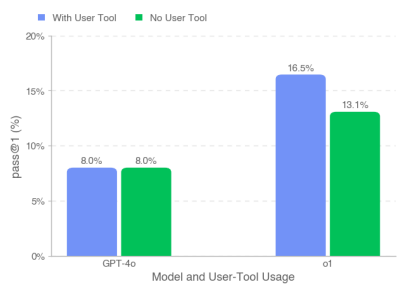
Figure 9 . Pass@1 performance on Diamond IC SWE tasks slightly decreases when the model cannot use the user tool.
Original paper · CC BY 4.0The user tool often takes 90 to 120 seconds to run, and that wait is the main friction for weaker models. Sonnet 3.5 outperforms o1 by nearly 15% on UI/UX tasks.
Agents pinpoint the source of an issue quickly with keyword searches across the whole repository. Because they miss the root cause, their solutions end up incorrect or insufficiently comprehensive. The authors rarely find agents that try to reproduce the issue or that fail by picking the wrong file to edit.
What the evaluation leaves out
Contamination is the first gap, because SWE-Lancer Diamond tasks come from public GitHub issues posted between 2023 and 2024. Depending on the model's cutoff date, its training data may already contain these tasks. The authors therefore advise disabling browsing or limiting the sites accessed, and ideally filtering post-hoc for cheating. Table 4 in Appendix A2 shows no clear performance improvement for tasks that predate the models' knowledge cutoffs, which suggests limited contamination impact for those tasks.
The benchmark is text-only, so the evaluation doesn't test how screenshots or videos could improve model performance. Most Expensify GitHub issues contain videos, and some contain screenshots, yet the current harness doesn't support multimodal inputs. The user tool saves screenshots that current models can't view, so the authors used text-based trajectories instead.
Models can't ask clarifying or follow-up questions, which real engineers can do.
Tasks come only from the Upwork platform and the Expensify repository, so the scope is narrow. Infrastructure engineering tasks, such as Kubernetes cluster work and debugging pod failures, are underrepresented in this iteration.
They remain cautious about extrapolating its economic impact beyond the benchmark itself.
Paper info
- Authors
- Samuel Miserendino, Michele Wang, Tejal Patwardhan, Johannes Heidecke
- Venue
- arXiv · Preprint
- First published
- 2025-2-17
- Added
- 2026-10-29
- Updated
- 2025-5-29
- Version
- v4
- arXiv
- 2502.12115
- Category
- cs.LG · cs.SE
- Original paper terms
- CC BY 4.0
- What we show
- Paper info, commentary and permitted figures from the original paper
AI commentary is a separate explanation from the original paper and may contain errors. The original paper and figures follow each source's terms of use and any rights noted separately.
Abstract
We introduce SWE-Lancer, a benchmark of over 1,400 freelance software engineering tasks from Upwork, valued at \$1 million USD total in real-world payouts. SWE-Lancer encompasses both independent engineering tasks--ranging from \$50 bug fixes to \$32,000 feature implementations--and managerial tasks, where models choose between technical implementation proposals. Independent tasks are graded with end-to-end tests triple-verified by experienced software engineers, while managerial decisions are assessed against the choices of the original hired engineering managers. We evaluate model performance and find that frontier models are still unable to solve the majority of tasks. To facilitate future research, we open-source a unified Docker image and a public evaluation split, SWE-Lancer Diamond (https://github.com/openai/SWELancer-Benchmark). By mapping model performance to monetary value, we hope SWE-Lancer enables greater research into the economic impact of AI model development.
Quote from the paper
Samuel Miserendino, Michele Wang, Tejal Patwardhan, Johannes Heidecke (2025). SWE-Lancer: Can Frontier LLMs Earn $1 Million from Real-World Freelance Software Engineering?. arXiv:2502.12115v4. https://arxiv.org/abs/2502.12115v4
BibTeX
@misc{miserendino2025lancer,
  title = {{SWE-Lancer: Can Frontier LLMs Earn $1 Million from Real-World Freelance Software Engineering?}},
  author = {Samuel Miserendino and Michele Wang and Tejal Patwardhan and Johannes Heidecke},
  year = {2025},
  eprint = {2502.12115},
  archivePrefix = {arXiv},
  url = {https://arxiv.org/abs/2502.12115v4}
}