Paper commentary
Delivered, Not Used: Evaluating Agent Memory at Its Point of Use
MemUse shows which delivered agent memories are actually used
- Problem Task success and resolve rates cannot show whether an agent read or used a delivered memory. Memory systems can match a no-memory baseline while most delivered entries go unused.
- Method MemUse judges each memory delivery against what the agent already saw, then follows the agent's later actions. An agentic judge rates each entry's relevance, accuracy, novelty, influence, and observed effect, and fixed rules turn those ratings into verdicts.
- Results On 8,000 SWE-bench Verified episodes from three memory systems, resolve rates stayed within 0.4 percentage points of a no-memory baseline. MemUse showed that most delivered entries were irrelevant.
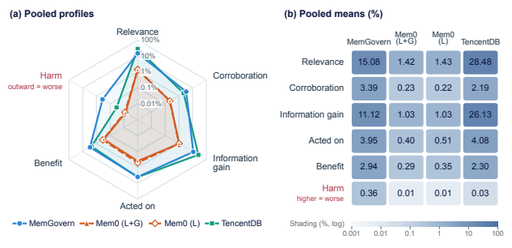
Figure 3 : Six-axis memory profiles, pooled over four runs per configuration, with each profiled span weighted equally. (a) The radar plot uses a common logarithmic radial scale from 0.001% at the center to 100% at the outer ring, with tenfold increases between adjacent rings. (b) Heatmap cells report the same means as percentages, with shading on the same logarithmic scale. Lower harm shares are better. Table 7 reports these shares alongside uncertainty and token efficiency.
Original paper · CC BY 4.0 · Changran Xu, Zeju Li, Qiang Xu · Delivered, Not Used: Evaluating Agent Memory at Its Point of Use · Original paper figure · Extracted the figure area from page 12 of the original PDF.Why outcome scores miss memory use
Coding agents now run long, multi-step tasks, and memory systems keep earlier experience for delivery during execution. Delivery alone doesn't show that the agent read the memory or benefited from it.
LongMemEval and LoCoMo score memory through question answering over conversation histories. They don't directly measure how retrieved content steers an agent's actions during task execution. VibeMemBench compares memory-equipped agents with a matched memory-off baseline, which shows overall task differences. That comparison doesn't show how each individual delivery influenced the agent's behavior.
In eleven of twelve VibeMemBench pairings, memory failed to beat the memory-off baseline. Outcomes also miss useful guidance in failed runs, and harmful guidance that gets corrected before success.
Finer diagnostics exist, but they depend on gold answers, reference operation traces, or annotated use targets. Some of them also need controlled memory interventions, so they demand extra executions beyond the original record. Reference-free trajectory evaluators such as TRACE avoid that requirement. Yet TRACE doesn't separate whether information was available from evidence that the agent used it.
Evaluating memory from execution records alone raises challenges, because one entry can appear in many forms and the agent may already see it. MemUse instead judges each delivery against what the agent already saw, then follows the agent's later actions.
Judging each delivery against prior context
MemUse judges one memory delivery at a time, using the text the agent received, the context it already held, and the later steps. MemUse evaluates each entry as the tuple c_d(m) = (q, B_d, ε_d(m), W_d(m), τ) in Eq. (1). Here q is the task, and τ is the trajectory of the episode that the agent ran.
Delivery d puts the ordered entries M_d into one model input, and its consuming step t_d is the first step whose input contains d. ε_d(m) marks the slice of entry m that is visible in that consuming input. Exposure is full when the consuming input holds the whole entry, and clipped when it holds only a prefix. When the recording verifies neither case, the exposure stays unknown and ε_d(m) remains undetermined.
In that case the judge doesn't receive the stored value, so it can't judge text the agent never saw.
The prior context B_d is the consuming input with the text of delivery d removed. Besides the text of d, B_d keeps earlier messages, tool results, and other memory deliveries the agent could read at that call. B_d serves as the reference for relevance and novelty, so the judge compares the entry against it. Read with earlier steps, B_d lets the judge tell memory use from behavior already explained by prior information or plans.
Type labels and confidence scores exist only in the annotations, so the judge doesn't see them.
The credit window W_d(m) lists the steps from t_d to T whose actions can be credited to entry m. The judge assesses three separate aspects: information, use, and consequence. Fixed rules then aggregate these per-entry assessments into a span verdict, which describes observed behavior rather than a counterfactual effect on task success.
Recording deliveries and building injection spans
MemUse first needs to know which input text came from memory, and the memory bridge handles that job. The memory bridge tags memory text through adapters for agent harnesses and memory systems. The pass-through trajectory recorder works at the model-API boundary, so it sees what the agent actually received. When that call completed an agent step, the step becomes the attributed consuming step of the delivery.
Repeated copies are grouped into an injection span, so a host that inserts the same entries before every call produces one judged unit. A new delivery joins an existing span only when it repeats the entries exactly, with the same order, placements, and exposure. It also needs an earlier copy that is still visible in its consuming input, because otherwise the delivery starts a new span.
The judge assesses each eligible span once. Later copies in a span are restatements, so they add no verdict but still count toward delivered text volume.
A window starts at the span's first consuming step and ends when a later entry of the same item takes over, or at the episode's end. A later copy that adds nothing to content still visible gets an empty window, and the earlier window continues.
The judge doesn't receive such a span, so no judge call happens for it. A failed recording check also matters, because it can turn the episode's spans into error spans.
From judge signals to span verdicts
An agentic judge rates each entry on five signals: relevance, accuracy, novelty, influence and observed effect. It inspects the evidence with two read-only tools, search evidence and read evidence, and must give a rationale for each value. The judge adapts Agent-as-a-Judge's agentic inspection to the problem of attributing behavior to one memory delivery.
Relevance requires more than a shared topic or file, since the entry must state a mechanism or a procedure that applies to the current situation. Accuracy asks whether recorded evidence from the described situation confirms or refutes the claim, and it is assessed apart from relevance.
An entry counts as acted on when its memory-specific content appears in an executed action, when the agent explicitly credits it, or when the agent switches direction as the entry specifies. A selected entry, where the agent only fetches a fuller version of the same item, gets no observed effect, because the fuller delivery is judged on its own.
Observed effect is assessed only for acted-on entries and is labeled improved, no effect, harmed, or undetermined.
Harm needs evidence linking the entry's guidance, through an action, to a harmful result, and the agent's own mistakes don't establish harm by themselves. Accuracy and observed effect are assessed separately, so a claim can be wrong and still help.
Programmatic checks accept an answer only when it has one assessment per entry, valid values and anchors within credit windows. Each cited step must be read in full, and search excerpts don't count as coverage. A rejected answer gets feedback and can be revised within a limit, and a span that never yields a valid answer becomes an error span and is left out of triage rates.
Fixed rules map influence and effect to usage labels, so acted-on entries become used, unproductive, misused, or unclear. A span's triage label follows a fixed precedence: negative if any entry is misused, then positive if any is used, then unresolved if any is unclear, and otherwise neutral. Harm takes precedence so that one beneficial entry can't hide a harmful one in the same span.
The entry-share profile measures composition: for each axis, the share is the entries that satisfy it divided by all delivered entries of the span. The aggregate score averages those shares over profiled spans with each span weighted equally, so a search that returns many entries can't dominate. Six axes cover relevance, corroboration, information gain, acted on, benefit and harm.
Resolve rates barely move
Task success barely separates the memory configurations from the no-memory baseline. MemUse ran on 8,000 recorded episodes, covering all 500 SWE-bench Verified tasks and four configurations of three memory systems. Each configuration and the no-memory baseline ran the same task sequence four times with the same agent model. The agent is mini-SWE-agent, and the SWE-bench harness evaluates its final patches.
Resolve rates range from 72.65% to 73.35%, against 72.95% without memory.
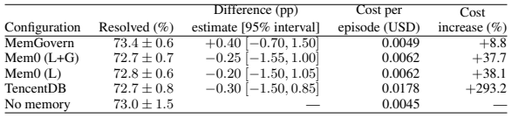
Table 2 : Task success and mean cost per episode. Resolve rates are mean±sample standard devia- tion across four runs. Differences from the no-memory baseline are in percentage points, with 95% confidence intervals from a paired bootstrap over tasks. Costs are computed from recorded agent and memory-system usage for retained executions.
Original paper · CC BY 4.0The baseline runs resolved 71.8% to 75.0% of the tasks. All 16 memory runs fall within this range, which the paper's Table 8 reports. Outcomes alone would therefore call the four configurations indistinguishable from no memory. Resolve-rate differences pair each task's four memory runs with its four baseline runs.
Cost separates the configurations even when resolve rates don't. Recorded episode costs rise by 8.8% for MemGovern and 293.2% for TencentDB. The no-memory baseline costs 0.0045 USD per episode, against 0.0178 USD for TencentDB. Because these costs come from recorded usage, they show what each configuration spends, not what it gains.
Resolve rate alone can't tell apart systems whose memory behaves very differently. MemUse separates the systems that the resolve rates lump together. Most delivered entries were irrelevant, and the agent acted on the relevant ones it saw far more often than it was misled.
Profiles separate systems that look the same
Resolve rates leave the three systems nearly tied, but the per-entry profiles pull them apart. MemGovern's mean relevance share is 15.08%, more than ten times the 1.42% to 1.43% of the two Mem0 configurations. TencentDB's relevance share is the highest at 28.48%, but its always-relevant persona block contributes 18.0 of those percentage points.
Without those persona spans, the remaining TencentDB spans average 15.9%, which stays close to MemGovern's share.
MemGovern delivers 50.50 beneficial entries per million delivered tokens, compared to 3.08 to 4.92 for the other configurations. MemGovern also has the highest harm share, at 0.36% against 0.01% to 0.03% for the others. These separations hold run by run: each MemGovern and TencentDB run exceeds every Mem0 run in relevance share. The two Mem0 configurations have nearly identical profiles, because the agent never requested the global scope.
Between 71.5% and 98.6% of a span's entries were irrelevant on average. Between 51.3% and 79.7% of the relevant entries remained unused within their credit windows. Novelty explains only part of this non-use, since many unused entries were novel, at 48% to 59% in MemGovern and Mem0 and 90% in TencentDB.
Of the 714 acted-on entries, 421 were beneficial and 16 were harmful, while 64 had no effect.
Task outcomes hide memory effects
Task outcomes and recorded memory effects disagree in both directions across the evaluated episodes. Of 383 episodes with beneficial use, 89 failed, which the paper gives as 23.2%. Of 16 episodes with harmful use, 5 still passed, or 31.3%. Figure 4 shows both patterns: a TencentDB skill misdirects a passed task, and a MemGovern card helps a failed one.
The memory labels come from the judge, while pass or fail comes from the SWE-bench harness.
Most beneficial use lands on tasks the baseline already solves reliably. 260 of the 383 episodes, or 67.9%, concern tasks that all four baseline runs resolved. The paper concludes that local progress can coexist with nearly unchanged resolve rates.
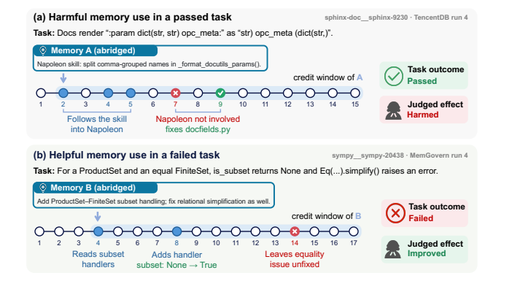
Figure 4 : Memory effects concealed by task outcomes. (a) A TencentDB skill for a different Napoleon bug directs the agent into the wrong component (steps 2–5). A reproduction rules out Napoleon at step 7, and the agent fixessphinx/util/docfields.pyat step 9; the task passes despite the detour. (b) A MemGovern card guides the agent to add a subset handler at step 8, chang- ing the reported subset check fromNonetoTrue. The equality error persists, and at step 14 the agent decides to leave it unfixed despite the card’s advice to repair it; the task fails. Timelines show complete episodes with steps numbered locally. Arrows mark first consumption, shading marks credit windows, and blue steps mark actions based on memory. Red and green annotations highlight problems and repairs. Memory effects are judge assessments; task outcomes come from the SWE- bench harness.
Original paper · CC BY 4.0Most changes in task outcome have no acted-on entry behind them in the record. Across configurations, memory runs gain 17.3 to 20.4 tasks and lose 15.3 to 21.4 tasks versus baseline runs on average. Baseline runs differ from each other by 18.1 tasks in each direction, a similar amount. Of 71 memory episodes that succeeded where all baseline runs failed, only 6 contained beneficial use.
Of 87 that failed where all baseline runs succeeded, only 1 contained harmful use. Among these, 64 of 71 gains and 80 of 87 losses had no acted-on entry.
The authors conclude that delivery-level evidence is needed to see how memory shaped a recorded run. Among 331 entries with known source-task outcomes, 73, or 22.1%, came from failed episodes. Only 3 of 16 harmful entries were contradicted by evidence, so accuracy and observed effect need separate assessments.
Where benefit and cost come from
Benefit sits in a small share of the delivered text, and Figure 5 breaks that share down by delivery form. Full MemGovern cards hold 96.4% of its beneficial entries while carrying only 12.5% of its delivered tokens. Mem0's task recall supplies 75.8% of its beneficial entries for 13.0% of its tokens. Full TencentDB skills supply 86.0% of its beneficial entries at a token share of 2.0%.
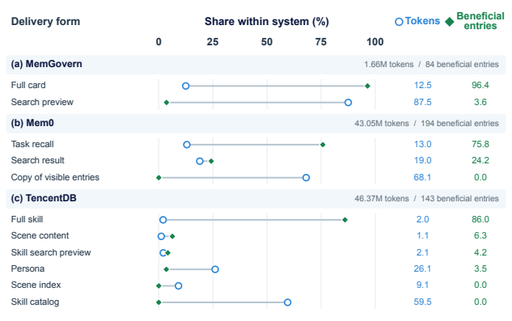
Figure 5 : Delivered-token and beneficial-entry shares by delivery form. Circles show each form’s share of estimated delivered tokens, including restatements, and diamonds show its share of bene- ficial entries. Values pool four runs per configuration, with both Mem0 configurations combined. Forms with no beneficial entries and less than 0.1% of tokens are omitted from the plot but retained in the token denominators. Full cards, task recall, and full skills supply most beneficial entries at small token shares. Table 11 gives the detailed breakdown.
Original paper · CC BY 4.0Previews and indexes contribute mainly by leading the agent to read fuller content. 709 MemGovern previews and 1,500 TencentDB catalog, index, or preview entries each led to such a read. The fuller read counts as its own delivery, so the preview entry itself receives a null observed effect. The authors read this gap between retrieval and useful memory action as a reason to filter and deduplicate recalled content.
Much of the remaining token volume comes from repeated delivery. TencentDB restates 88.4% of its deliveries, and Mem0 restates 78.2% of its deliveries. Excluding items delivered in at least 50 of the 500 episodes leaves 14.3% of episodes with a relevant entry.
All 194 beneficial Mem0 entries and 138 of TencentDB's 143 beneficial entries trace to such items.
What the evidence doesn't settle
For 29.8% of acted-on entries, 213 of 714, the observed effect stayed undetermined. Those 213 entries sit outside the benefit and harm counts, so the reported shares don't cover them. TencentDB accounts for 132 of its 321 acted-on entries in that undetermined group. The judge returns undetermined when incomplete reads prevent a decision or the evidence can't separate sources.
A span that gets no valid answer within the budget becomes an error span and leaves the triage rates.
Every judgment in this study comes from DeepSeek-V4.1-Flash-1017, and the authors didn't test another judge. The judge received each task's gold patch but never saw the harness outcome. Programmatic checks confirm that the judge read the cited evidence, but the judge still interprets that evidence. Effect labels therefore rest on the judge's interpretation rather than on a measured outcome.
The study covers one benchmark, SWE-bench Verified, with 500 tasks drawn from 12 Python repositories. Only one agent ran, mini-SWE-agent with gpt-6-luna, so other harnesses weren't tested. The agent never requested the global scope, so that scope's use was not exercised in these runs. Every run followed one fixed task order, and each memory system that writes memories started from an empty store.
Memory text volume is estimated from placement sizes, because recorded usage covers whole model calls. The token efficiency figures therefore depend on that estimate of delivered memory text. Repeated deliveries are counted in these estimates, so restatements add to the volume figures.
Paper info
- Authors
- Changran Xu, Zeju Li, Qiang Xu
- Venue
- arXiv · Preprint
- First published
- 2026-11-1
- Added
- 2026-11-3
- Updated
- 2026-11-1
- Version
- v1
- arXiv
- 2611.01718
- Category
- cs.AI
- Original paper terms
- CC BY 4.0
- What we show
- Paper info, commentary and permitted figures from the original paper
AI commentary is a separate explanation from the original paper and may contain errors. The original paper and figures follow each source's terms of use and any rights noted separately.
Abstract
Task success, retrieval quality, and cost do not show whether an LLM agent used a delivered memory or what followed from that use. We introduce MemUse, which evaluates memory at its point of use in recorded trajectories: each memory delivery is compared with what the agent could already see and followed through the agent's later actions and their consequences. An agentic judge rates each delivered entry's relevance, accuracy, novelty, influence, and observed effect; programmatic checks enforce complete reading of cited evidence, and fixed rules aggregate the ratings into verdicts linked to memory histories and delivery cost. On 8,000 SWE-bench Verified episodes from three memory systems, resolve rates stay within 0.4 percentage points of a no-memory baseline, yet MemUse shows that most delivered entries were irrelevant, most relevant entries went unused, and in two systems most deliveries restated content the agent could still see. It also surfaces effects that outcomes hide: 23.2\% of episodes with beneficial memory use still failed, and 5 of 16 with harmful use still succeeded.
Quote from the paper
Changran Xu, Zeju Li, Qiang Xu (2026). Delivered, Not Used: Evaluating Agent Memory at Its Point of Use. arXiv:2611.01718v1. https://arxiv.org/abs/2611.01718v1
BibTeX
@misc{xu2026delivered,
  title = {{Delivered, Not Used: Evaluating Agent Memory at Its Point of Use}},
  author = {Changran Xu and Zeju Li and Qiang Xu},
  year = {2026},
  eprint = {2611.01718},
  archivePrefix = {arXiv},
  url = {https://arxiv.org/abs/2611.01718v1}
}