Paper commentary
The Popular Get More Popular: Auditing Brand Bias in Generative Search
Generative search engines favor popular brands over unfamiliar ones
- Problem Generative search gives a few direct product recommendations, so small brand preferences can shape what people notice. Popularity bias is hard to separate from real product merit.
- Method The authors separate brand popularity from brand familiarity. They keep page content fixed and swap only the brand name, so any rank change comes from the name.
- Results Under its real brand, the target page gained 0.44 positions over an invented brand.
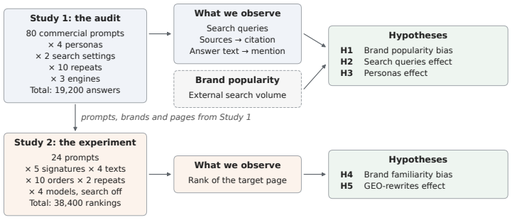
Fig. 1 . Study 1 is an audit of three deployed generative search engines on commercial prompts, with search-on and search-off, and with and without a persona context. Study 2 takes 24 of these prompts and manipulates two features of one product page, the brand that signs it and its text (GEO rewrites), while four models rank it among five pages withsearch-off.
Original paper · CC BY 4.0 · Giorgio Monaco, Jacopo Lenti, Francesco Pierri · The Popular Get More Popular: Auditing Brand Bias in Generative Search · Original paper figure · Extracted the figure area from page 5 of the original PDF.Why brand bias matters in generative search
Chatbots now answer product questions with a few synthesized recommendations instead of a ranked list of links. Because these systems run at a large scale, a small systematic preference can shift which brands people notice. LLMs trained on web corpora can inherit and amplify statistical skews, so a recommendation may reflect popularity rather than product merit.
Separating merit from bias is hard, because a model may favor a brand for real quality as well.
The authors split this concern into two questions. Brand familiarity bias is the edge a brand already encoded in a model's parametric memory holds over a new entrant when the content is the same.
Earlier audits covered gender, ethnicity and persona effects, but brand-level economic bias has received much less attention. Generative Engine Optimization (GEO) adds another angle, because rewriting page text aims to raise a page's chance of selection. The open question is whether surface rewriting can outweigh what a model already holds about a brand name.
Two studies that hold content fixed
The key move is to keep the content fixed and change only the names, so a rank difference can be credited to the name. The authors call this equal rank at equal content, and they apply it to both brand popularity and brand familiarity. Study 1 is an observational audit of three deployed engines, which the authors use to measure how popularity relates to mention share and citation share.
Study 2 is a controlled experiment that isolates the effect of a brand name swap and of a strategic rewrite on the rank of one page.
Study 1 runs 80 commercial prompts across 4 personas, 2 search settings, 10 repeats and 3 engines, which gives 19,200 answers. A brand's mention rate is the share of answers that name it in the text, and its citation rate is the share that cite its official site. Popularity is log10 of one plus the mean monthly Google searches for the brand name, and the popularity bias is the OLS slope of the rate on popularity.
A slope of 1 would mean one more answer in 100 for each tenfold rise in searches.
Four models rank the five pages with search off, in balanced orders, which gives 38,400 rankings. The rank of the target page is the outcome, and each intervention effect is the number of positions the target gains or loses.
The authors also write three GEO-style rewrites, Structure, Fluency and Authoritative, that keep every fact and change only the wording. A rewrite is kept only if its placeholders and numbers are unchanged and its length stays within 15% of the original. A separate check asks each model to recover the original brand from the page with names replaced, so the authors can test how much the text still reveals.
Popularity bias in Study 1
Mention share rises with brand popularity in Study 1, from below 1% in the least popular quintile to 1.2 to 5.3% in the most popular one. Spearman's rho reaches 0.47 at most, and the single exception is Perplexity in Travel with search-off, where rho is 0.08. Because the correlation is computed among brands the engines already mention, the authors read it as more popular brands being mentioned more often.
Figure 3 puts mention and citation on one relative scale, dividing each rate by its mean over the same engine and sector. Citation correlates significantly with popularity in 8 of the 12 engine-sector pairs after Benjamini-Hochberg correction, so H1b is only partially supported. For search-on versus search-off, the authors estimate that a tenfold rise in Google searches adds 0.87 answers per 100 with search-off and 0.89 with search-on.
The difference between the two slopes is +0.02 [−0.03, 0.07], so the search-off slope is not stronger, and the authors reject H1c. Web retrieval therefore leaves the popularity skew that the model already carries in place.
Search queries and buyer personas
Query similarity tests where the brands in an answer come from, by comparing pairs of answers to the same prompt. On GPT, the slope is 4.10 for sources, 3.57 for brands and 2.30 for text. The scale puts 0 at answers to different prompts and 1 at two repeats of the same prompt. Brand overlap still rises with query similarity after the authors strip brand names from the queries, which supports H2a.
The H2b prediction, that brand overlap stays flat, is not supported.
In Insurance the same share goes from 1% to 8%, a smaller but significant rise. When the engines search, 95.5% of GPT mentions appear in at least one returned source, against 60.9% on Gemini and 97.3% on Perplexity. On Gemini, 24.9% of mentions couldn't be verified, and 36.2% of checked mentions appear only on third-party pages.
The slope of mention share on popularity is 0.98 with no persona context. It falls to 0.80 with the Baseline persona (A) and to 0.85 with the Price variant (B), both significantly lower. The Profile variant (C) gives 0.89, which isn't significantly different from the no-persona slope. Across engines and sectors, only 12 of 36 differences from no persona survive the correction, and 11 of those slopes are lower with a persona.
With the Baseline or Profile persona, a price word appears in at least one query in 86 to 96% of calls in three sectors. Without a persona context, that share falls to 25 to 46% of calls. Answers to different personas share fewer sources, with Jaccard lower by 0.07 to 0.08 across the three engines. Adjusting for query similarity narrows that gap to 0.01 to 0.035, but it doesn't close it.
Brand names and page rank in Study 2
The figure plots mean rank, where 1 is first, so the arrangement shows how much each signature moves the page.
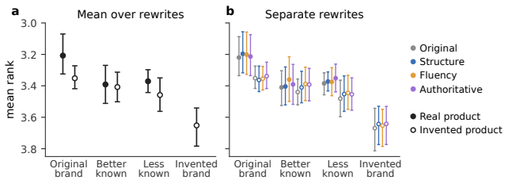
Fig. 7 . Study 2: mean rank of the target page (1 = ranked first; better ranks are higher in the plot) under each signature. The horizontal axis represents the manipulation on the brand that signs the page. Point style represents the manipulation on the product, filled points have a Real product name of the corresponding brand, and hollow points an Invented product name. (a) Mean over the original text and the three rewrites. (b) Colors encode the text rewriting strategy, includingOriginal,Structure,Fluency, andAuthoritative. Points: mean rank over the four models and over the questions in which each version exists (15 of the 24 forBetter known Real product andLess known Real product). Bars: 95% cluster bootstrap intervals over questions.
Original paper · CC BY 4.0With its true brand and real product, the target gains 0.44 positions over an invented brand, with interval [0.23, 0.69]. Keeping the true brand but inventing the product costs the page 0.14 positions [0.05, 0.27]. With the same invented product, the true brand still ranks the page 0.30 positions above the invented brand [0.13, 0.51], so the name alone carries part of the effect.
A more popular real brand with the same invented product doesn't rank the page higher than a less popular one, with a difference of +0.05 that is not significant after correction. Both real brands sit below the true brand, by 0.06 and 0.11 positions, and the authors read the shared drop of 0.08 as the cost of a text that doesn't match the brand that signs it.
Averaged over the three GEO rewrites, the change in rank is +0.022 positions, with interval [−0.001, 0.049], which is not significant. The original brand gains 0.42 positions more than rewriting does [0.22, 0.66]. When models tried to recover the original brand from placeholder-filled text, they guessed correctly in 38% of cases, which the authors use as a leak check.
Limitations of the audit and the experiment
The authors' limitations start with the time and place of the data, since black-box LLM outputs drift across time and geography. They fixed all prompts to one snapshot and one location, Italian queries from Rome, so cross-cultural or regional brand disparities fall outside the scope. Study 2 ran with live web retrieval disabled, so its rankings don't include live search reranking as it happens in the wild.
The trade-off buys total experimental control over the in-context page, which isolates brand bias.
Persona conditioning used three holistic multi-sentence templates, not an exhaustive factorial grid of user profiles. Those three personas capture only a subset of possible user profiles. All three personas lower the brand popularity bias in the same direction, and two of them do so significantly.
The GEO rewrites followed established strategies under an explicit fact-preserving constraint. The authors excluded deceptive or fabricated claims, such as fake statistics, so adversarial copy isn't tested. Whether adversarial copy can bypass parametric priors is left to future work. The evaluation covers only generative search, so it offers no direct baseline against traditional search engines.
The study quantifies brand visibility through mention and citation frequencies and doesn't perform sentiment analysis. Manual inspection found no unfavorable brand mentions or citations, and recommendations were uniformly positive or neutral. Testing brands founded after the training cutoff under search-on conditions could separate real emergence from synthetic entity penalties.
Open-weight architectures and multi-agent retrieval pipelines are left for later study to pinpoint where parametric priors override retrieved specifications.
Paper info
- Authors
- Giorgio Monaco, Jacopo Lenti, Francesco Pierri
- Venue
- arXiv · Preprint
- First published
- 2026-11-5
- Added
- 2026-11-6
- Updated
- 2026-11-5
- Version
- v1
- arXiv
- 2611.07614
- Category
- cs.CY · cs.AI · cs.SI
- Original paper terms
- CC BY 4.0
- What we show
- Paper info, commentary and permitted figures from the original paper
AI commentary is a separate explanation from the original paper and may contain errors. The original paper and figures follow each source's terms of use and any rights noted separately.
Abstract
The shift from traditional to generative search has fundamentally transformed online product discovery. Because conversational recommendations synthesize choices into a few direct answers, subtle systemic preferences toward specific providers can exert profound commercial impacts. In this work, we audit this phenomenon through two distinct dimensions: (i) brand popularity bias, the systematic preference for market-dominant entities over long-tail alternatives, and (ii) brand familiarity bias, the ranking advantage an entity encoded in an LLM's parametric memory holds over an unfamiliar competitor. First, evaluating commercial queries across major engines, we observe persistent brand popularity bias: dominant brands in the top quintile are cited 1.4x to 2.8x more frequently than the average brand within a sample of 1,176 top market players, already present in parametric memory that external web retrieval fails to mitigate. Second, through controlled in-context experiments holding product attributes constant, we find that substituting authentic brand signatures with unfamiliar ones significantly degrades recommendation rank. Conversely, fact-preserving content rewrites yield negligible ranking gains. Taken together, our findings demonstrate that generative search engines reinforce a ``rich-get-richer'' dynamic by favoring established market leaders and imposing a parametric barrier to entry that standard content optimization cannot overcome.
Quote from the paper
Giorgio Monaco, Jacopo Lenti, Francesco Pierri (2026). The Popular Get More Popular: Auditing Brand Bias in Generative Search. arXiv:2611.07614v1. https://arxiv.org/abs/2611.07614v1
BibTeX
@misc{monaco2026popular,
  title = {{The Popular Get More Popular: Auditing Brand Bias in Generative Search}},
  author = {Giorgio Monaco and Jacopo Lenti and Francesco Pierri},
  year = {2026},
  eprint = {2611.07614},
  archivePrefix = {arXiv},
  url = {https://arxiv.org/abs/2611.07614v1}
}