Paper commentary
Verifiable pXRD: Hill-climbing pXRD structure determination with LLM agents
- Problem Existing pXRD solvers recover few structures reliably, and agents need checks that can guide their search. Structure determination is verifiable in two ways, but those checks are used in different places.
- Method Wrap a frontier model in a coding-agent harness, add a learned skill and tool adapter, and select candidates by forward-simulated profile agreement, while scoring them against hidden references at evaluation time.
- Results Selected exact recovery on pXRD-Bench rose from 27.0% for tool-free GPT-5.6 Sol (high) to 69.0% for adapted-codex. On 15 measured patterns, mean verified Rwp fell from 7.90% for Baseline to 6.71% for Evolved v6.
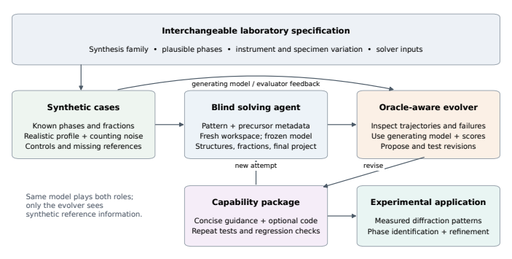
Figure 4 :Synthetic experience for experimental characterization.A laboratory specification defines the scientific setting and permitted synthetic variation. Fresh solver workspaces receive only public measurements and metadata. A persistent evolver can inspect trajectories and use synthetic reference information to diagnose failures, revise a capability package, and test it on further solves. The frozen package is subsequently applied to measured patterns. Ground-truth access is confined to synthetic research and evaluation; experimental fits retain the solving agent’s own model and calibration.
Original paper · CC BY 4.0 · Samuel Chen, Jiaru Bai, Austin Henry Cheng, Varinia Bernales, Alán Aspuru-Guzik · Verifiable pXRD: Hill-climbing pXRD structure determination with LLM agents · Original paper figure · Extracted the figure area from page 10 of the original PDF.Why pXRD structure determination can be verified
Self-driving laboratories need an automated way to recover atomic structure from the diffraction data they collect. The task is an inverse problem: given a chemical composition, an X-ray wavelength and a measured intensity profile, the solver must return a periodic crystal structure written as a CIF. The authors identify two separate senses in which this task can be verified, and the rest of the study builds on both.
At inference time, a candidate is tested by forward-simulating its diffraction pattern and comparing it with the measurement. The forward model is written as \( y_i = F(s^\star, \eta^\star;\lambda)(2\theta_i) + \epsilon_i \), where \( s^\star \) is the true structure, \( \eta^\star \) collects experimental and profile nuisance parameters, and \( \epsilon_i \) is measurement noise.
At evaluation time the reference structure is known, so a proposed structure is scored by pymatgen's StructureMatcher. It removes differences in cell choice, basis and origin, and then checks lattice-length, lattice-angle and maximum normalized site-displacement tolerances. The study uses this structure match as its primary success metric, so that its benchmark results can be compared with existing baselines.
Agent adaptation on pXRD-Bench
pXRD-Bench contains 200 single-phase problems, divided equally between pXRD-100 and pXRD-ood, and each solver receives the reduced composition, the wavelength and the simulated profile. The ladder keeps the same underlying model and changes only the harness. It moves from a tool-free condition to matsci-codex, which adds a Python environment and crystallographic database access, then to pxrd-codex, which adds GSAS-II and DICVOL14, and finally to adapted-codex, which adds a capability package.
Selected exact recovery rises from 27.0% for tool-free GPT-5.6 Sol (high) to 52.0% with matsci-codex, 57.0% with pxrd-codex and 69.0% with adapted-codex.
The step from tool-free prompting to matsci-codex gives a gain of 25 percentage points. That gain is expensive in computation: completed matsci-codex rollouts used a mean of 6.09 million input-plus-output tokens over 25.3 minutes, while single tool-free GPT-5.6 Sol (high) calls used 161,293 tokens and 6.94 minutes.
Adding GSAS-II and DICVOL14 through pxrd-codex raises overall recovery from 52.0% to 57.0%. Most of that change sits in pXRD-ood, where recovery goes from 44% to 56%. pXRD-100 moves from 60% to 58%, which the authors treat as within stochastic variance.
The adapted-codex trainer runs a pxrd-codex trainee on a disjoint 50-problem curriculum drawn from the same distribution as pXRD-Bench, then revises a capability package over repeated runs. The trainer could see the ground-truth structures and the structure-matcher verifier, so evaluation-time verifiability acted as the learning signal. The resulting package has two parts: a 139-word skill and a DICVOL adapter that handles raw DICVOL input.
Its selected structures reach 69.0% exact matches on pXRD-Bench.
The authors attribute a large share of this gain to trainer-written guidance about the task and the verifier, which pushes agent behaviour toward what the verifier scores. They also report that a limited package surface worked better than a larger package that tried to correct every observed mistake. The ladder compares whole packages, and the units give no separate score for the skill or the DICVOL adapter on its own.
What the two pXRD-Bench halves test and how baselines compare
pXRD-100 contains ordered Materials Project structures from the frozen MP-20 training split, each with at most 20 sites in its primitive cell.
Table 2 places the specialist methods beside GPT-5.6 Sol. PXRDGen reaches 32.0% at pass@1 overall and 55.0% at pass@8, while Ab-PXRD-Solver reaches 31.0% and RealPXRD-Solver 30.5%. PXRDGen and RealPXRD-Solver receive the known primitive-cell Z, so the authors treat their numbers as oracle-input comparisons. Tool-free GPT-5.6 Sol reaches 27.0% overall and 24% on pXRD-ood at pass@1, using a simple prompt, no tools and no oracle Z.
Ab-PXRD-Solver and DiffractGPT have no pass@8 values, because the former emits one final candidate and the latter decodes greedily. The authors read the GPT-5.6 Sol result as evidence that frontier LLMs carry strong crystallographic knowledge.
Every case is simulated with GSAS-II using monochromatic Cu Kα1 radiation at λ = 1.5406Å over 5° to 90° in 2θ at 0.01° intervals, which gives 8,501 intensity values. Submitted structures are scored with StructureMatcher using ltol = 0.2, θtol = 5°, and stol = 0.3, with lattice rescaling disabled so that the unit-cell dimensions must be recovered.
Repeated sampling and profile-based selection
Inference-time scaling allocates more computation to each problem without changing the model or its persistent capabilities. Independent rollouts are sampled and then aggregated or ranked after generation. The study applies this to pXRD-Bench-20, a 20-problem representative subset that the authors store as inference-scaling-20.
Panels (a) to (c) of the figure show candidate-set exact StructureMatcher recovery for pxrd-codex with Sol, pxrd-codex with Luna and adapted-codex with Sol. Each colored square marks a candidate that matches the reference. Panel (d) plots expected oracle matches against the number of independent rollouts k.
Repeated adapted-agent solves supply an exact candidate for 18 of the 20 problems, and profile-based selection recovers all 18. The candidate-set count uses the hidden reference through StructureMatcher, whereas the selection step relies only on the profile residual computed from the input pattern.
How synthetic problems drive the evolver
The evolver is a persistent agent. It starts from six curated problems, runs three baseline attempts on each, and reads the scripts, projects, trajectories and verifier diagnostics. Both the evolver and the solver use GPT-5.6 Sol at maximum reasoning effort.
Each package revision gets one solve per active case in the first screen. A promising package is then evaluated with three solves per case, because rollout variability was observed.
What the evolution changed and whether it transferred
On the six development problems, the mean composite score rose from 50.04 to 74.07 over three attempts per problem. Every case mean improved, and the full generating phase inventory was recovered in 17 of 18 attempts.
Two later batches each added two new synthetic cases. The mean score moved from 58.79 to 72.44 in the first batch and from 43.02 to 68.97 in the second, under the unchanged Baseline and Evolved v6 conditions. Further revisions after v6 produced local gains and regressions, and none replaced v6.
Transfer to measured divalent-tungstate patterns
A deposited PG solution for each measurement was withheld from both agents and is used only as a comparison.
The evaluator reopens each GSAS-II project and recomputes its profile without further refinement, then scores it against the measured counts over 10.1° to 99.9° in 2θ, using \[ w_i = \frac{1}{\max(y_i, 1)} \] as the weight in Rwp. The deposited models give a useful baseline but no structural ground truth, so this comparison concerns profile agreement only.
Mean Rwp falls from 7.90% for Baseline to 6.71% for Evolved v6, a relative reduction of 15.1%. The measurement-level mean improves on 10 of the 15 scans, and the largest gains occur on Sr and Zn.
Mean wall time per attempt rises from 27.0 minutes to 50.2 minutes, so the package changes how much computation the agent spends as well as the analysis.
On a measured mixture whose Sr2WO5 structure is missing from the supplied library, the transferred analogue-substitution procedure recovers that phase.
Limitations
pXRD-100 is intentionally in-distribution, so its scores do not test novelty.
The authors also note that a structure the measurement cannot distinguish may be penalized by a score based only on the generating model.
The evolution results are a repeated development evaluation, and evolution was neither monotonic nor uniformly reliable. The measured-pattern study covers 15 patterns from one sample family, and the synthetic framework itself is restricted to the laboratory scope set by its specification. Lower mean Rwp is achieved at a much longer wall time, and the comparison does not test whether the gain holds at a lower time budget.
Paper info
- Authors
- Samuel Chen, Jiaru Bai, Austin Henry Cheng, Varinia Bernales, Alán Aspuru-Guzik
- Venue
- arXiv · Preprint
- First published
- 2026-11-12
- Added
- 2026-11-16
- Updated
- 2026-11-12
- Version
- v1
- arXiv
- 2611.17539
- Category
- cs.AI
- Original paper terms
- CC BY 4.0
- What we show
- Paper info, commentary and permitted figures from the original paper
AI commentary is a separate explanation from the original paper and may contain errors. The original paper and figures follow each source's terms of use and any rights noted separately.
Abstract
Autonomous crystal-structure determination from powder X-ray diffraction (pXRD) remains a key bottleneck for self-driving materials laboratories. We formulate the task of pXRD structure determination as a verifiable agentic search problem: candidate structures can be assessed during inference through forward-simulated profile agreement and during evaluation through structural matching to a known reference. To benchmark progress, we introduce pXRD-Bench, a suite of 200 simulated single-phase problems spanning in-distribution structure determination, challenging and polymorphic structures, and controlled compositional and topological distribution shifts. Agent adaptation raises selected structural recovery from 27% to 69%, with further gains from repeated sampling and verifier-guided inference-time scaling. We extend this approach to experimental multiphase pXRD through a reflexive evolution framework that learns from self-generated synthetic problems. A replaceable laboratory specification defines the sample family and measurement conditions. An evolver agent uses the known generating structures and measurement parameters to diagnose solver failures and develop persistent guidance and executable tools, which are then provided to agents on measured patterns. This supplies verifiable training experience without requiring a collection of solved experimental measurements. On 15 measured patterns from solid-state synthesis, the evolved package improves average profile agreement and transfers an analogue-substitution procedure that recovers a phase whose structure is absent from the supplied reference library. These results demonstrate how learning from verifiable synthetic experience can improve agentic characterization of experimental samples whose structures are not known in advance.
Quote from the paper
Samuel Chen, Jiaru Bai, Austin Henry Cheng, Varinia Bernales, Alán Aspuru-Guzik (2026). Verifiable pXRD: Hill-climbing pXRD structure determination with LLM agents. arXiv:2611.17539v1. https://arxiv.org/abs/2611.17539v1
BibTeX
@misc{chen2026verifiable,
  title = {{Verifiable pXRD: Hill-climbing pXRD structure determination with LLM agents}},
  author = {Samuel Chen and Jiaru Bai and Austin Henry Cheng and Varinia Bernales and Alán Aspuru-Guzik},
  year = {2026},
  eprint = {2611.17539},
  archivePrefix = {arXiv},
  url = {https://arxiv.org/abs/2611.17539v1}
}