Paper commentary
PAC-NeRF: Physics Augmented Continuum Neural Radiance Fields for Geometry-Agnostic System Identification
PAC-NeRF estimates object geometry and physical properties from multi-view videos
- Problem Video-based system identification estimates physical properties only when the object's geometry is already known. Most real scenes have complex or unknown geometry, so those methods rarely apply.
- Method PAC-NeRF couples a neural radiance field with a differentiable continuum physics simulator. Its density and color grids are moved by Lagrangian particles through the material point method, so geometry and physical parameters are fit together from the videos.
- Results PAC-NeRF gave the best mean absolute error in 14 of 17 property categories, excluding the Oracle. The Oracle uses ground-truth point clouds, so this is a strong baseline comparison.

Figure 5 : We test PAC-NeRF on a set of real-world multiview videos. Our reconstructed scene qualitatively matches the target videos, which validates that the rendering loss is effectively minimized.
Original paper · CC0 1.0 · Xuan Li, Yi-Ling Qiao, Peter Yichen Chen, Krishna Murthy Jatavallabhula, Ming Lin, Chenfanfu Jiang, Chuang Gan · PAC-NeRF: Physics Augmented Continuum Neural Radiance Fields for Geometry-Agnostic System Identification · Original paper figure · Extracted the figure area from page 8 of the original PDF.Why geometry-known system identification stalls
Video-based system identification estimates physical properties such as mass, friction or viscosity from how an object moves. Those methods assume the object's geometry is already known, and some also assume the rendering configuration is known. That assumption limits where they can be used, because most real scenes have complex or unknown geometry.
The authors ask whether both the geometric structure and the physical properties can be recovered from multi-view video sequences.
Neural radiance fields (NeRF) recover the geometry of dynamic objects better than the physics-based methods, but they don't model physics. Variants such as D-NeRF, Tretschk et al. and Park et al. learn object dynamics from scratch. Learning motion this way needs a large amount of data, and the learned dynamics are uninterpretable. The authors instead use a differentiable physics simulator as a more prescriptive, data-efficient and generalizable dynamics model.
That choice lets parameters be estimated solely from videos, without assuming anything about the geometric structure.
PAC-NeRF augments a NeRF with a differentiable continuum dynamics model, so one model estimates geometry and physical properties together. The NeRF holds a volume density field and a color field, coupled with a velocity field v. The velocity field admits the continuum conservation law, which lets the method advect geometry and appearance to every frame.
That advection makes it possible to measure a reconstruction error in image space.
The key idea: a radiance field that moves like a continuum
PAC-NeRF makes the radiance field itself behave like a continuous material, so its density and color move with the material's motion. The model pairs a NeRF's volume density field and color field with a velocity field v that admits the continuum conservation law. Because the rendering error is computed on images, gradients from the pixels can flow back through the simulator to the physical parameters.
The error term is minimized by gradient-based optimization, which uses the differentiability of the entire computation graph.
The authors enforce that the density and color fields have zero material derivative, so they are transported by the velocity field. The material derivative is written as Dφ/Dt = ∂φ/∂t + v·∇φ for an arbitrary time-dependent field φ(x,t). The velocity itself must obey momentum conservation, ρ Dv/Dt = ∇·T + ρg, where T is the internal Cauchy stress tensor and g is gravity.
The authors evolve this momentum balance with the differentiable Material Point Method, which they take from Hu et al. (2020).
A grid suits rendering, but advecting material is easier with particles, so the authors keep both views. Grid-to-particle conversion is called G2P and particle-to-grid conversion is called P2G. Both conversions rely on trilinear shape-function weights, so one field can move with the simulator and return to the grid for rendering. The authors initialize a voxel field on the first frame, advect it with the initial guess of physical parameters, and map it back with P2G.
The density is a softplus of an interpolated scalar grid, and the color is an MLP applied to an interpolated vector grid. Advection moves the grids first, and the interpolation and MLP are evaluated afterward.
How the pipeline runs, phase by phase
The pipeline starts with video matting, which removes static background and leaves a foreground mask of the object of interest. The authors assume static cameras with known intrinsics and extrinsics, and they run the video matting framework in Lin et al. (2021) for this step. Geometry seeding then fits a static voxel NeRF to that mask, using a coarse-to-fine strategy that makes the optimization easier.
Each pixel color comes from the volume rendering integral, and the squared difference to the ground truth video frame forms the rendering loss. The rendering loss averages over N frames and over the rays in each frame, so the NeRF is trained to match every frame of the video.
A surface regularizer is added to the rendering loss, and it sums clamped particle densities scaled by squared voxel spacing. The regularizer minimizes the total surface area, which makes the reconstructed point cloud more compact and fits the ground truth boundary more closely. Figure 2 shows that the surface regularizer produces a tight-fit shape to the segmentation mask.
At the first frame, the voxel fields are converted to particles with G2P, and the authors randomly sample 8 particles within each voxel grid. Running G2P and then P2G means every frame, including the first, is rendered from the same particles, which gives consistent correspondences across time.
After geometry seeding converges, the geometry is frozen at the initial time step t0. The first two or three frames are then used to estimate the initial velocities of the observed particles, so unobservable variables are less likely. The physical parameters are then optimized frame by frame, and the optimizer is warm-started after the first collision events.
Initial velocity estimation uses L-BFGS, which the authors found better than Adam for this sub-task, while the other parameters are updated with Adam. The simulation advects the particles with the material point method, and the advected field is mapped back to the grid with P2G for rendering.
The authors report that one simulation plus rendering step of a frame takes about 1 s, compared with about 10 min for Chen et al. (2022). Training the whole pipeline takes about 1.5 hours on a single Nvidia 3090 GPU. Synthetic experiments then run this pipeline on 9 problem instances, with qualitative results in Figure 4 and quantitative results in Table 1.
Synthetic and real-data results
On the nine synthetic problem instances, PAC-NeRF starts from a rough initial guess and lands close to the ground truth for every parameter. Table 1 lists the initial guess, the optimized values and the ground truth for each object, so the agreement can be checked row by row. For the Trophy, the friction angle θfric moves from 10° to 36.1° against a ground truth of 40°.
So the optimizer moved the estimate by roughly an order of magnitude and landed close to the true value.
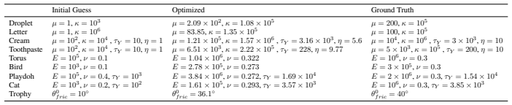
Table 1 : PAC-NeRF estimates physical parameters very accurately.
Original paper · CC0 1.0The real-world test uses a capture system of four synchronized Intel RealSense D455 cameras. Each camera streams RGB images at 640 × 480 and 60 frames per second. The authors use no depth data from these cameras, so the fit depends only on the color videos.
With only four views, the reconstructed surface geometry shows slight errors. The authors expect that capturing from more views would reduce these errors. They didn't report a quantitative error for the real-data reconstruction, so the match stays a qualitative claim.
Comparison with learned and simulation baselines
No prior method estimates both geometry and material from videos, so the authors built best-effort combinations of existing methods for each sub-task. Each material type has 10 problem instances that vary object orientations, initial velocities and physical parameters. Table 2 reports the mean absolute error and its standard deviation for each property, with a random-sampling baseline and an Oracle as reference points.
PAC-NeRF achieves the best result in 14 of the 17 categories, excluding the Oracle. The 17 categories cover Newtonian, non-Newtonian, elasticity, plasticine and sand properties. The Oracle knows the ground-truth point clouds and uses Chamfer distance supervision, and it was run on only 4 of the 10 instances per material type.
The multi-view LSTM uses a pre-trained ResNet feature extractor and a 2-layer LSTM, and it relies on training video sequences as privileged information. D-NeRF plus DiffSim, adapted from VEO, produced very noisy deformation in the authors' experiments. Because of these instabilities, the authors ran this baseline on only one scenario per material type.
∇Sim supports only FEM simulation for elastic materials, so the baseline ran on only a small subset of the scenarios. It needs tens of thousands of substeps to stabilize the symplectic FEM and contact model over a full sequence. The authors credit PAC-NeRF's Eulerian-Lagrangian representation with tolerating larger deformations and permitting larger time step sizes than a symplectic FEM integrator.
Surprisingly, a pixel-wise color loss outperformed the Chamfer distance supervision of the Oracle in several scenarios.
Photorealistic dataset and runtime
The synthetic dataset is rendered with a photo-realistic simulation engine under varying environment lighting and ground textures. It covers Newtonian fluids such as Droplet and Letter, non-Newtonian fluids such as Cream and Toothpaste, granular Trophy, elastic Torus and Bird, and plasticine Cat and Playdoh. In every scene, the objects freely fall under gravity and undergo self and external collisions.
All ground truth simulation data come from the MLS-MPM framework of Hu et al. (2018b).
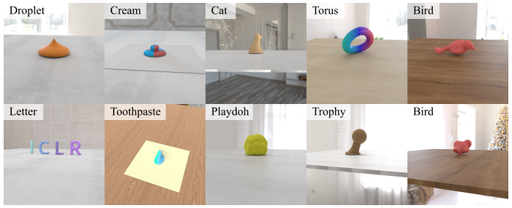
Figure 3 : The photorealistic dataset used to evaluate system identification and geometry estimation. The dataset includes a variety of continuum materials, including Newtonian fluids (Droplet, Letter), non-Newtonian fluids (Cream, Toothpaste), granular media (Trophy), deformable solids (Torus, Bird), and plasticine (Cat, Playdoh). All objects freely fall under the influence of gravity, undergoing collisions. Objects are rendered under complex environmental lighting conditions for photorealism.
Original paper · CC0 1.0The differentiable MPM implementation supports five material models: elasticity, plasticine, granular media, Newtonian fluids and non-Newtonian fluids. Elasticity is parameterized by Young's modulus E for stiffness and Poisson's ratio ν for volume preservation under deformation. Sand is parameterized by a friction angle θfric, which sets the slope of a sand pile.
Newtonian fluids use viscosity µ and bulk modulus κ, while non-Newtonian fluids add a yield stress τY and plasticity viscosity η.
Training takes about 1.5 hours on a single Nvidia 3090 GPU. Simulation plus rendering of one frame takes about 1 s, compared with about 10 min for Chen et al. (2022). The speed-up comes from the voxel grid, which the authors say renders at least two orders of magnitude (100×) faster than an MLP-based NeRF. The rendering density σ and color c are read from trilinear interpolation of voxel grids, so the MLP only runs on the interpolated color features.
Limitations
The authors list the requirements their approach places on the input data and on the physics model. PAC-NeRF needs a set of synchronized and accurately calibrated cameras so that NeRF gives a good-quality reconstruction. It also needs scenes that are easily amenable to video matting for background removal, or scenes with foreground masks.
The method assumes the underlying physical phenomenon follows continuum mechanics. It cannot automatically distinguish between different materials, so the material type must be supplied.
The real-world test used only four synchronized RealSense D455 cameras, and the authors don't report a larger view count. With only four views, the reconstructed surface geometry showed slight errors, which the authors expect more views to mitigate. The D-NeRF+DiffSim baseline was run on one scenario per material type, because its learned deformation was too noisy to evaluate across the full set.
The NeRF+∇Sim baseline ran only on a small subset of scenarios, since it supports FEM simulation for elastic materials only. Future work includes extending MPM beyond volumetric continuum materials, such as thin-shell objects like cloth. Implicit MPM for stiff materials and integrating articulated body simulators are also left as future avenues.
Interactions with rigid bodies, which could enable manipulation tasks on NeRF-represented soft bodies, are also left for future work.
Paper info
- Authors
- Xuan Li, Yi-Ling Qiao, Peter Yichen Chen, Krishna Murthy Jatavallabhula, Ming Lin, Chenfanfu Jiang, Chuang Gan
- Venue
- arXiv · Preprint
- First published
- 2023-3-9
- Added
- 2026-11-5
- Updated
- 2023-3-9
- Version
- v1
- arXiv
- 2303.05512
- Category
- cs.CV · cs.AI · cs.GR · cs.LG · cs.RO
- Original paper terms
- CC0 1.0
- What we show
- Paper info, commentary and permitted figures from the original paper
AI commentary is a separate explanation from the original paper and may contain errors. The original paper and figures follow each source's terms of use and any rights noted separately.
Abstract
Existing approaches to system identification (estimating the physical parameters of an object) from videos assume known object geometries. This precludes their applicability in a vast majority of scenes where object geometries are complex or unknown. In this work, we aim to identify parameters characterizing a physical system from a set of multi-view videos without any assumption on object geometry or topology. To this end, we propose "Physics Augmented Continuum Neural Radiance Fields" (PAC-NeRF), to estimate both the unknown geometry and physical parameters of highly dynamic objects from multi-view videos. We design PAC-NeRF to only ever produce physically plausible states by enforcing the neural radiance field to follow the conservation laws of continuum mechanics. For this, we design a hybrid Eulerian-Lagrangian representation of the neural radiance field, i.e., we use the Eulerian grid representation for NeRF density and color fields, while advecting the neural radiance fields via Lagrangian particles. This hybrid Eulerian-Lagrangian representation seamlessly blends efficient neural rendering with the material point method (MPM) for robust differentiable physics simulation. We validate the effectiveness of our proposed framework on geometry and physical parameter estimation over a vast range of materials, including elastic bodies, plasticine, sand, Newtonian and non-Newtonian fluids, and demonstrate significant performance gain on most tasks.
Quote from the paper
Xuan Li, Yi-Ling Qiao, Peter Yichen Chen, Krishna Murthy Jatavallabhula, Ming Lin, Chenfanfu Jiang, Chuang Gan (2023). PAC-NeRF: Physics Augmented Continuum Neural Radiance Fields for Geometry-Agnostic System Identification. arXiv:2303.05512v1. https://arxiv.org/abs/2303.05512v1
BibTeX
@misc{li2023nerf,
  title = {{PAC-NeRF: Physics Augmented Continuum Neural Radiance Fields for Geometry-Agnostic System Identification}},
  author = {Xuan Li and Yi-Ling Qiao and Peter Yichen Chen and Krishna Murthy Jatavallabhula and Ming Lin and Chenfanfu Jiang and Chuang Gan},
  year = {2023},
  eprint = {2303.05512},
  archivePrefix = {arXiv},
  url = {https://arxiv.org/abs/2303.05512v1}
}