Paper commentary
Deep Partial Multi-View Learning
- Problem Samples with different view-missing patterns are hard to compare in one space, and existing completion and grouping strategies either need paired training data or scale poorly as the number of views grows.
- Method Encodes each sample's observed views into one latent vector by reconstructing those views, adds a clustering-like class loss with a re-tuning step before testing, and uses per-view adversarial training to impute missing views in the unsupervised variant.
- Results Reached 89.48% accuracy on CUB, against 86.27% for LMNN, in the reported missing-rate comparison.
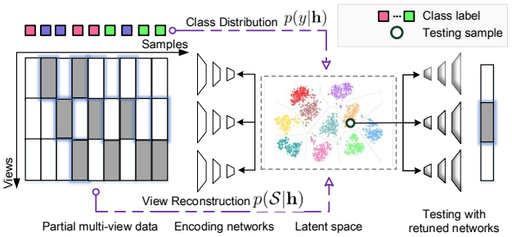
Fig. 1 : Illustration of Cross Partial Multi-View Networks for classification. Given multi-view data with missing views (black blocks), the encoding 1networks degrade the complete latent representation into the available views (white blocks). Learning multi-view representation according to the distributions of observations and classes has the promising potential to encode complementary information, as well as provides accurate predictions.
Original paper · CC BY 4.0 · Changqing Zhang, Yajie Cui, Zongbo Han, Joey Tianyi Zhou, Huazhu Fu, Qinghua Hu · Deep Partial Multi-View Learning · Original paper figure · Extracted the figure area from page 3 of the original PDF.Why view-missing samples resist shared representations
Multi-view data often arrive with some views absent for some samples, as when a medical subject lacks one kind of examination or a web page carries only text. Most multi-view methods assume each sample has the same set of observed views, so view-missing data breaks the premise they rely on. Two common workarounds have limits: completing the missing views before applying standard methods, or grouping samples by their view pattern and fusing separate models late.
Pairwise predictors of a missing modality need training samples that carry both modalities, and grouping by view pattern becomes inflexible when there are many views. Low-rank completion does not fit this setting because the missing views are blockwise.
The aim here is a representation that is complete and flexible: it should use whatever views a sample has and work for any view-missing pattern. The task is partial multi-view classification, where the classifier is trained on samples with missing views and must classify a new sample with any pattern. This leads to three subproblems: placing samples with any pattern in one comparable latent space, making that space reflect class structure, and keeping test-time encodings consistent with training.
Encoding observed views into one latent vector
CPM-Nets treats each sample's latent vector as the source and generates each view from it, which is a backward encoding rather than an encoder-decoder pair. Each view has its own reconstruction network, so one mapping per view is learned from the shared vector. Figure 1 shows the overall setup: the networks degrade a complete latent representation into the views that are available.
For sample n, the encoding loss sums squared reconstruction errors only over the views that sample has. \[ \ell_r(S_n,h_n)=\sum_{v=1}^{V} s_{nv}\,\lVert f_v(h_n;\Theta_r^{(v)})-x_n^{(v)}\rVert^2 \] Here s_{nv} is 1 when view v is available for sample n and 0 otherwise, f_v is the reconstruction network for view v, and Θ_r^{(v)} are its parameters.
Because one vector h_n must reconstruct every view the sample has, samples with different missing patterns land in a common space and can be compared. A multi-view representation is complete when each observed view can be recovered from it through a mapping. That completeness rests on the assumption that the views are conditionally independent given the shared representation.
The authors contrast this with mapping each view into its own latent vector and forcing the vectors of different views to match. They judge that alternative poorly suited to views that are highly independent of one another, and they argue the shared-latent design fits the case where views originate from one latent representation.
Structuring the latent space for classification
Training minimizes one objective that adds the encoding loss and a classification term, weighted by λ > 0. \[ \min_{\{h_n\},\Theta_r}\frac{1}{N}\sum_{n=1}^{N}\bigl(\ell_r(S_n,h_n;\Theta_r)+\lambda\,\ell_c(y_n,y,h_n)\bigr) \] The weight λ sets how strongly the class structure is balanced against completeness across views.
The class term is nonparametric: each class is represented by the set T(y) of latent vectors of its training samples, and the predicted class maximizes the similarity to that set. The similarity F is an inner product of the latent features, and the authors set the feature map to the identity for simplicity. \[ \ell_c(y_n,y,h_n)=\max\bigl(0,\Delta(y_n,y)+E_{h\sim T(y)}F(h,h_n)-E_{h\sim T(y_n)}F(h,h_n)\bigr) \] Here Δ(y_n,y) is 0 for the true class and 1 for a wrong class, so a wrong class is penalized unless the true class beats it in similarity by at least that margin.
The authors argue that a jointly learned parametric classifier can fit the training data without reflecting the underlying patterns. The nonparametric form reduces parameter tuning and suits small-sample problems, according to the authors.
Training uses labels to shape the latent vectors, but a test sample has no label, which opens a gap between training and testing. To close it, the per-view networks are re-optimized on the encoding loss alone, using the training samples and their latent vectors. A test sample with observed views is then encoded by minimizing its encoding loss with the re-tuned networks, and it is assigned the class with the highest similarity.
Adversarial imputation of missing views
Without labels, the unsupervised setting depends more on the observed views, so better imputation of the missing views should improve the representation. CPM-GAN uses degradation networks as generators, one per view, together with a discriminator for each view, so that generated views resemble the observed data. Figure 2 illustrates this unsupervised setting, where latent learning and imputation are run together.
The adversarial loss is computed over samples and views that are missing: the observed data of a view count as real examples, and the generated values for that view's missing entries count as fake. The generated views are updated iteratively toward the distribution of the observed data. The latent vectors are treated as variables that are optimized together with the missing views rather than as fixed inputs.
The full unsupervised objective combines the adversarial term with a reconstruction term that uses only observed views. \[ \mathcal{L}_{rec}=\sum_{n=1}^{N}\sum_{v=1}^{V} s_{nv}\Bigl\lVert G_v(h_n;\Theta_g^{(v)})-x_n^{(v)}\Bigr\rVert^2 \] Algorithm 2 alternates updates of the discriminators, the generators and the latent vectors, so the missing views and the latent vectors improve each other.
The generator inputs are optimized latent vectors rather than fixed samples from a prior, which separates this setting from a standard GAN.
What the encoding loss guarantees
Versatility means that for any feature computed from one view, some mapping on the shared vector recovers that feature. The authors argue that a shared vector should be more versatile than any single view, because it carries the content of all of them.
Proposition 2.1 states that a solution of the encoding loss exists that holds versatility. The argument is short: if each view equals a mapping f_v of h, then \(\psi(\cdot)=\phi(f_v(\cdot))\) gives the required mapping.
Exact versatility is hard to guarantee in practice, so the authors bound the error instead. If ϕ is Lipschitz continuous with constant K, the versatility error \(e_y\) is bounded by \(K\,e_r\), where \(e_r\) is the reconstruction error of the encoding objective. The proof covers the case where all views are available, and the extension to view-missing cases is argued as intuitive rather than proven.
Supervised results under missing rates
Missing views are removed at random, with each sample keeping at least one view, so the data show diverse missing patterns. The missing rate is \(\eta=\sum_v M_v/(V\times N)\), where \(M_v\) is the number of samples without view v. Baselines fill missing views with average values taken from the available samples of the same class.
Without missing views, CPM-Nets is described as very competitive on all datasets, which the authors read as evidence of stability on complete data. As η grows, the performance of the compared methods falls much more than that of CPM-Nets. On CUB the text gives 89.48% for CPM-Nets and 86.27% for LMNN, and says the gap widens as the missing rate rises, without naming one η for both values.
On Handwritten, the accuracy drop for CPM-Nets stays under 5% as η goes from 0.0 to 0.3. The authors attribute this robustness to CPM-Nets performing well in heavily missing cases.
A second comparison fills missing views with CRA, which needs part of the samples to have complete views for training. Half of the samples are treated as complete-view samples, and η is 0.5. Filling with CRA is generally better than filling with average values, which the authors attribute to CRA capturing correlations among views. Figure 4 shows this view-completion comparison on the datasets.
On the multi-modal datasets CUB, 3Sources-complete, Football and Politics, CPM-Nets is reported as best, ahead of the second-best method by 2.5%, 10.2%, 36.7% and 6.6% respectively. The text also gives an average advantage of 3.9%, but the sentence ends before naming the method it is measured against. These margins come from the comparison at η = 0.5, so they apply to that setting only.
The Animal standard deviations are below 0.01, which the authors attribute to that dataset being larger than the others.
The fine-tuning evaluation compares performance with and without the re-tuning step on Handwritten and CUB. The authors report that performance with fine-tuning improves on performance without it in most cases.
Unsupervised imputation and clustering
The unsupervised comparison uses Average, SVD, CRA and CPM-without-GAN as baselines. The fully connected networks of CPM-Nets serve as generators, and the discriminators use the same structure with a sigmoid layer on the output. Each method is run 10 times, and CPM-GAN and CPM-without-GAN share the same experimental settings.
Imputation is measured by NRMSE, with views removed at random at several missing rates. The imputation performance of every method declines as the ratio of missing views increases. CPM-GAN outperforms the comparison methods at all missing rates on all six datasets, and since NRMSE is an error, a lower value is better.
Clustering is evaluated with accuracy and NMI on the learned representations across six datasets, with missing rates varied in each panel. The text gives these clustering results only as plotted curves, not as numbers. The two real-world datasets, ADNI and 3Sources-partial, have views missing naturally, and their clustering curves are shown separately.
Limits of the evidence
The versatility guarantee covers the case where all views are observed, and the missing-view case is argued intuitively. Proposition 2.1 is an existence statement about a solution of the encoding loss.
The 3.9% average advantage is not tied to a named reference method in the text. CRA is trained on a subset of samples with complete views, a condition the average-value baseline does not have. For the CCA-based baselines, two views were selected for each method to get the best performance.
Hyperparameters were tuned with five-fold cross validation, and the latent dimensionality K was chosen from 64, 128 and 256. The fine-tuning gain is reported for most cases rather than for all cases. The real-world missing rates are 0.26 for ADNI and 0.24 for 3Sources-partial.
Paper info
- Authors
- Changqing Zhang, Yajie Cui, Zongbo Han, Joey Tianyi Zhou, Huazhu Fu, Qinghua Hu
- Venue
- arXiv · Preprint
- First published
- 2020-11-12
- Added
- 2026-11-6
- Updated
- 2020-11-12
- Version
- v1
- arXiv
- 2011.06170
- Category
- cs.LG
- Original paper terms
- CC BY 4.0
- What we show
- Paper info, commentary and permitted figures from the original paper
AI commentary is a separate explanation from the original paper and may contain errors. The original paper and figures follow each source's terms of use and any rights noted separately.
Abstract
Although multi-view learning has made signifificant progress over the past few decades, it is still challenging due to the diffificulty in modeling complex correlations among different views, especially under the context of view missing. To address the challenge, we propose a novel framework termed Cross Partial Multi-View Networks (CPM-Nets), which aims to fully and flflexibly take advantage of multiple partial views. We fifirst provide a formal defifinition of completeness and versatility for multi-view representation and then theoretically prove the versatility of the learned latent representations. For completeness, the task of learning latent multi-view representation is specififically translated to a degradation process by mimicking data transmission, such that the optimal tradeoff between consistency and complementarity across different views can be implicitly achieved. Equipped with adversarial strategy, our model stably imputes missing views, encoding information from all views for each sample to be encoded into latent representation to further enhance the completeness. Furthermore, a nonparametric classifification loss is introduced to produce structured representations and prevent overfifitting, which endows the algorithm with promising generalization under view-missing cases. Extensive experimental results validate the effectiveness of our algorithm over existing state of the arts for classifification, representation learning and data imputation.
Quote from the paper
Changqing Zhang, Yajie Cui, Zongbo Han, Joey Tianyi Zhou, Huazhu Fu, Qinghua Hu (2020). Deep Partial Multi-View Learning. arXiv:2011.06170v1. https://arxiv.org/abs/2011.06170v1
BibTeX
@misc{zhang2020deep,
  title = {{Deep Partial Multi-View Learning}},
  author = {Changqing Zhang and Yajie Cui and Zongbo Han and Joey Tianyi Zhou and Huazhu Fu and Qinghua Hu},
  year = {2020},
  eprint = {2011.06170},
  archivePrefix = {arXiv},
  url = {https://arxiv.org/abs/2011.06170v1}
}