Paper commentary
Hinted Scaling Laws
Hint-based scaling laws forecast accuracy on benchmarks where small models score near zero
- Problem Scaling laws fail for downstream accuracy when small models score near zero, because the fit has no trend to extrapolate. Standard fits then under-forecast large models by 12 to 13 points on GSM8K.
- Method Hinted scaling laws make a benchmark easier with a hint level H, so small models score above zero. A joint law over scale and H then carries signal from small models to the unhinted case.
- Results Hinted forecasts reach a median error of 4.3 percentage points on GSM8K, AIME and HLE, compared to 21 for a standard scaling law.
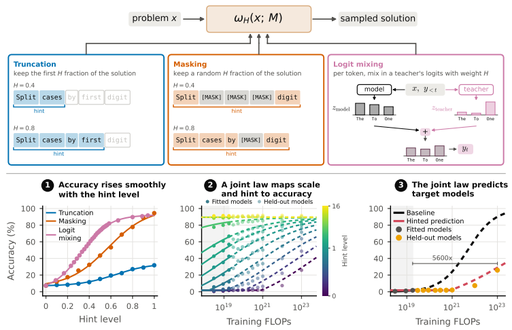
Figure 1 :Hinted scaling laws. Top:Benchmark hinting turns a benchmark into a continuous sequence of easier versions indexed by a hint level H, converting an answer sampling protocol ω into a hinted protocolω H by truncation, masking, or logit mixing.Bottom:results for the Delphi pretraining ladder on GSM8K.(1)Accuracy of the 10 22 FLOPs model rises smoothly with H, where H= 0 is the original benchmark.(2)A single joint law in model scale and hint level (Eq. (2)) is fit to the three smallest models at every H of logit mixing and extrapolates to the held-out larger models.(3)The same law, whosefitted modelshave 5600x less compute than the largest and score near zero at H= 0, is evaluated at H= 0 to give ahinted predictionthat forecasts theheld-out larger models. Abaselinescaling law fit to the same models’ unhinted accuracy alone overshoots.
Original paper · CC BY 4.0 · Suze van Adrichem, Luke Bailey, Rohith Kuditipudi, Christine Ye, Neil Band, Ahmed Ahmed, John Duchi, Percy Liang, Tatsunori Hashimoto · Hinted Scaling Laws · Original paper figure · Extracted the figure area from page 2 of the original PDF.Where accuracy scaling laws stall
Scaling laws extrapolate from small, cheap runs to an expensive target, which works well for pretraining loss because loss varies predictably with scale. Downstream accuracy does not follow that pattern, since small models land near zero on hard benchmarks and leave the fit with no slope to follow. Fitting a law to accuracy directly has been found unreliable, because the fit is unconstrained when the small models sit at chance.
Pretraining loss is also an imperfect stand-in for the capabilities that developers care about.
Reliable accuracy forecasts would let developers tune recipes for the downstream task, and let safety teams estimate the scale at which dangerous capabilities appear.
Hints as a continuous second variable
The key idea is to treat how much help a model receives as a second variable next to its scale. Given a benchmark, the authors build easier versions indexed by a hint level H, where H=0 is the original benchmark and larger H gives the model more privileged help. The easier versions still score above zero for small models, so those models carry usable signal for extrapolation.
A joint law over scale and H then passes information from the smaller models to the H=0 slice that predicts a larger model.
The authors use three ways to reveal help, and each builds on privileged information such as a reference solution. Masking keeps the reference solution in context but hides a random 1 − H fraction of its words with [MASK], so at H=0 the hint is dropped. Logit mixing needs a stronger teacher that shares the model's vocabulary, while truncation and masking need only reference solutions.
For logit mixing, the evaluated model's logits at each answer position are summed with the teacher's logits scaled by H. The mixed logits are written as follows. \[ s_H(x,y_{<t})_j = z_{model}(x,y_{<t})_j + H\, z_{teacher}(x,y_{<t})_j, \qquad H\in[0,\infty) \] The next token is drawn from \(\mathrm{softmax}(s_H/T)\), and it is appended to both models' contexts.
At H=0 the evaluated model decodes alone, and as H grows the teacher's logits dominate.
The joint law is a floored sigmoid over scale C and hint level H. \[ L(C,H)=\max\Big(F,\; L+(A-L)\,\sigma(\beta_1 C+\beta_2 H+\beta_3)\Big), \qquad \sigma(z)=\frac{1}{1+e^{-z}} \] Here C is log10 FLOPs for the pretraining ladder or log10 parameter count for the post-trained families, and F, L, A and the β terms are fitted. The upper asymptote A lets accuracy saturate below 1, while F and L keep accuracy flat until an emergence point.
Above the floor, the law gives iso-accuracy contours with slope −β1/β2, and some family and method pairs match that slope better than others.
Does accuracy move smoothly with hint and scale?
Accuracy rises smoothly with the hint level for each model, even when the model scores near zero at H=0. The authors checked this on the Delphi ladder for GSM8K and on the Qwen3.5 family for HLE, under masking and truncation. Larger models stay above smaller ones at every hint level, so the family ordering holds as H increases.
Each H was sampled with 10 rollouts per problem on AIME and HLE, and with 32 per seed on GSM8K at H>0. On GSM8K the authors used 64 rollouts per seed at H=0, which gives a stable estimate of the near-floor accuracy. Raising H therefore moves accuracy down to smaller models, which makes hinted measurements usable for small-scale fits.
Accuracy also varies smoothly with model scale at each fixed hint level, and a higher H shifts the curve left. The curves rarely cross, so hint level and scale act on accuracy in a consistent way. The iso-accuracy contours of Fig. 3 run as roughly parallel diagonals for masking and truncation on both families. So hint level trades roughly linearly for model scale at every accuracy, which is the simple structure the law assumes.
Forecasting unhinted accuracy of larger models with the hinting ensemble
The hinting ensemble forecasts the H=0 accuracy of the largest models by fitting a joint law to the smallest models of each family. The ensemble averages the masking and truncation forecasts at H=0, so one forecast combines two separately fitted laws. Over all families and benchmarks, its median absolute error is 4.3 percentage points, compared to 21 for a standard scaling law.
The baseline is a two-parameter sigmoid fit to the unhinted accuracy of the same smallest models. The baseline fails when the smallest members sit near zero on the unhinted benchmark, because the fitted sigmoid is then nearly unconstrained.
The authors also compare against pass@k as a hinting method and a trivial hinting baseline that gives the correct answer with probability H. The joint law has six parameters per family, while fitting every slice on its own needs 4|M|+2|H| parameters, between 42 and 102 here. The joint fit uses between 36 and 96 fewer parameters, and its extra error is at most 1.7 percentage points.
Using a stronger teacher to forecast the Delphi ladder
Logit mixing is the headline Delphi method, because masking and truncation can only reveal as much of the solution as the model can use. Logit mixing adds the teacher's logits to the evaluated model's logits with weight H, so at H equal to 0 only the evaluated model decodes. The authors sweep H between 0 and 16, and the teacher's logits dominate as H grows.
The upper asymptote A of Eq. (2) captures that shared ceiling directly.
Contours under masking and truncation in Fig. 3 are less simple than these lines. Fitted to every model and hint level, the joint law reaches a mean absolute error of 1.7 percentage points.
Averaged over all nine training sets, the forecasting error is 3.3 points. The largest error, 6.6 points, occurs when the law extrapolates from 0.03% of the target compute budget.
They average hinted accuracies over all available seeds before fitting the joint law, and they find this averaging important.
For the post-trained families, the authors don't have a strong external teacher with the same tokenizer. They prompted a model from within each family, the largest model in its training set, with the solution as the teacher. These teachers reach high benchmark accuracy, but they produce unnatural solutions that explicitly reference the hint, and their forecasts are poor.
They didn't explore other teacher instantiations, such as prompting or finetuning for more natural solutions.
Ranking near-identical models with fewer rollouts
Here the target is the true order of models whose accuracies differ by tiny gaps near zero, where an unhinted ranking needs many rollouts. The authors build seven near-zero models for AIME and another set for HLE, with unhinted accuracies from 0.06% to 0.81% on AIME and 1.7% to 3.0% on HLE. Ground truth comes from 4,096 unhinted rollouts per problem on AIME and 1,024 on HLE, drawn separately from the ranking rollouts.
A ranking is scored by Kendall's τ against that ground truth, where 1 means perfect agreement and 0 means chance.
The avg@k baseline averages k unhinted rollouts, while the log-loss baseline ranks by teacher-forced log loss on the reference solutions with no rollouts. \[ \hat{s}(M,k) = (1-\alpha_k)\, z\!\left[d\mathrm{Acc}_1(M,\bar H)\right] + \alpha_k\, z\!\left[d\mathrm{Acc}_{k-1}(M,0)\right], \qquad \alpha_k=\frac{k-1}{k-1+\lambda} \] As k grows, the weight moves toward the unhinted score, and λ=8 means the hinted score counts as eight unhinted rollouts per problem.
At one rollout per problem, the hint-prior ranking improves Kendall's τ over avg@k by 0.33 on AIME and 0.27 on HLE. The log-loss baseline reaches 0.33 on AIME, but −0.05 on HLE, which is below chance.
The best single hint level depends on the benchmark, since Kendall's τ peaks at H=0.7 on AIME and drops sharply at H=1. The hint-prior ranking avoids choosing H by using all hint levels. On HLE, pass@k disagrees with the average ranking, and agreement falls from 0.62 at k=5 to 0.05 at k=50. That disagreement may partly explain why the ranking methods do worse on HLE than on AIME.
Limits of the evidence
The forecasting study rests on one open scaling ladder, Delphi, so its errors can't be cleanly separated from artifacts of the model families.
For the post-trained families, the teacher is the family's largest model prompted with the solution in its context. These teachers reach high benchmark accuracy, but they produce somewhat unnatural solutions that explicitly reference the hint, and they yield poor forecasts. The authors didn't meaningfully explore other teacher instantiations, such as prompting or finetuning teachers for more natural solutions.
Logit mixing variants that don't require a shared tokenizer were not meaningfully explored, and the authors treat them as future work. The capability slices for logit mixing need not be monotonic, because a weak model with a near-uniform output can beat stronger models at a high enough hint level. This effect shows up most with an overly confident teacher, such as one that overfits to the in-context solution.
The ranking experiments use two benchmarks with seven near-zero models each, AIME and HLE. All ranking experiments use single-turn benchmarks, so hinting for agentic tasks remains untested. The ranking gains also depend on the metric, because the target ranking itself is unclear for near-zero models. On HLE, pass@k agreement with the average ranking falls from 0.62 at k of 5 to 0.05 at k of 50, which may explain weaker ranking gains there.
Paper info
- Authors
- Suze van Adrichem, Luke Bailey, Rohith Kuditipudi, Christine Ye, Neil Band, Ahmed Ahmed, John Duchi, Percy Liang, Tatsunori Hashimoto
- Venue
- arXiv · Preprint
- First published
- 2026-11-1
- Added
- 2026-11-4
- Updated
- 2026-11-1
- Version
- v1
- arXiv
- 2611.02270
- Category
- cs.LG · cs.AI · cs.CL
- Original paper terms
- CC BY 4.0
- What we show
- Paper info, commentary and permitted figures from the original paper
AI commentary is a separate explanation from the original paper and may contain errors. The original paper and figures follow each source's terms of use and any rights noted separately.
Abstract
Scaling laws predict the outcome of large, expensive training runs by extrapolating trends from smaller, cheaper runs. On downstream accuracy evaluations, these predictions fail when the weaker models produced by the cheaper runs score near zero accuracy, because these scores give no trend to extrapolate to larger scales. We introduce hinted scaling laws, which use privileged information to turn a benchmark into a continuum of easier versions so that even the small models score above zero. We find that accuracy rises smoothly and predictably with the hint level, enabling new types of scaling laws that operate below the noise threshold. On the Delphi pretraining ladder, a hinted scaling law fit on models trained with at most $10^{20}$ FLOPs forecasts the GSM8K accuracy of a $10^{23}$ FLOP model (25.9%) to within 3 percentage points; a standard scaling law under-forecasts it by 13 percentage points when fit on the same models and by 12 even with models up to $10^{22}$ FLOPs in the fit. Across both this pretraining ladder and a collection of post-trained model families, hinted scaling laws reduce the median forecasting error on GSM8K, AIME and HLE from 21 percentage points to 4.3. Hinting also reduces the number of test examples needed to tell whether one model is better than another by widening the accuracy gaps between models while approximately preserving their order: a single hinted rollout per problem ranks nearly indistinguishable models as accurately as five unhinted rollouts. Our results suggest that hinting is a general primitive for improving the accuracy and cost of downstream scaling laws and other prediction tasks in model development.
Figures from the paper
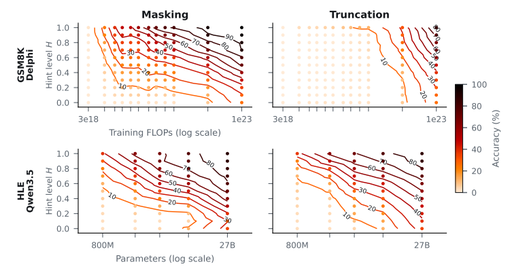
Figure 3 :Iso-accuracy contours in the scale and hint level plane.Rows are the Delphi ladder on GSM8K and the Qwen3.5 family on HLE, columns masking and truncation. Each dot is one measured cell, colored by accuracy. Lines are contours of constant accuracy at 10% to 90%, interpolated linearly between the cells. The slope of a contour is the exchange rate between scale and hint level at that accuracy.
Original paper · CC BY 4.0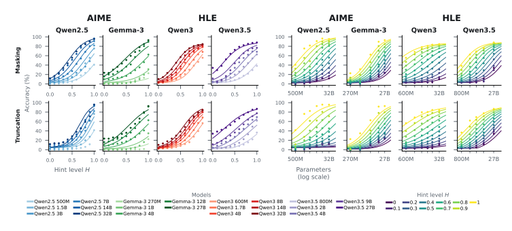
Figure 4 :Benchmark hinting leads to scaling laws with low fit error.Joint laws in C and H fit to the post-trained model families. Rows are the two benchmark hinting methods, masking and truncation, columns the model family and benchmark. For each family and method we fit asingle joint law, Eq. (2), to the accuracy of every model in the family at all eleven hint levels.Left:the hint slices (fixing model scale and letting hint level vary) of each joint law.Right:the capability slices (fixing hint level and letting model scale vary) of each joint law.
Original paper · CC BY 4.0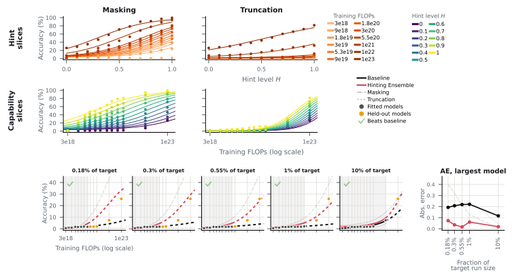
Figure 5 :Benchmark hinting on the Delphi ladder (GSM8K). Top:for each hinting method (masking and truncation) we fit one joint law (Eq. (2)) over all models and hint levels, with C the log10 pretraining FLOPs.Bottom:the same law is refitted on only the n smallest models and its unhinted (H=0) slice is evaluated at the larger, held-out models. Theblack curveis the baseline which fits a sigmoid to unhinted accuracies alone. Each individual method’s forecast is shown in faint grey, with thered curvebeing the hinting ensemble forecast, the average of the masking and truncation forecasts. A ✓marks panels in which the hinting ensemble forecast beats the baseline forecast on the largest ladder model. The right-most panel reports the absolute error (AE) on the 0–1 accuracy scale against the size of the largest training model.
Original paper · CC BY 4.0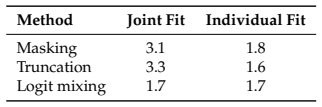
Table 1 : Mean absolute error in percentage points of the fitted laws over the families of Figs. 4, 5 and 7. The joint law has six parame- ters per family, the individual fit averages the errors of each cell’s hint- and capability-slice fits (4|M|+ 2|H| parameters). Logit mixing is Delphi only.
Original paper · CC BY 4.0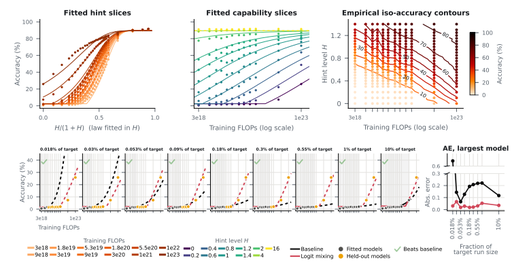
Figure 7 :Logit mixing with a shared teacher on the Delphi ladder (GSM8K). Top left and middle:Joint law fit over all models and hint levels, with C the log10 pretraining FLOPs.Top right:empirical iso-accuracy contours of the same measurements for H≤ 1.4, as in Fig. 3.Bottom: the same law is refitted on only the n smallest models and its unhinted (H=0) slice is evaluated at the larger, held-out models. Theblack curveis the baseline which fits a sigmoid to unhinted accuracies alone. Thered curveshows our prediction.
Original paper · CC BY 4.0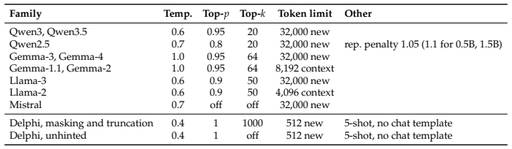
Table 2 : Sampling settings per model family. Gemma-1.1, Gemma-2 and Llama-2 generate up to their shorter context windows.
Original paper · CC BY 4.0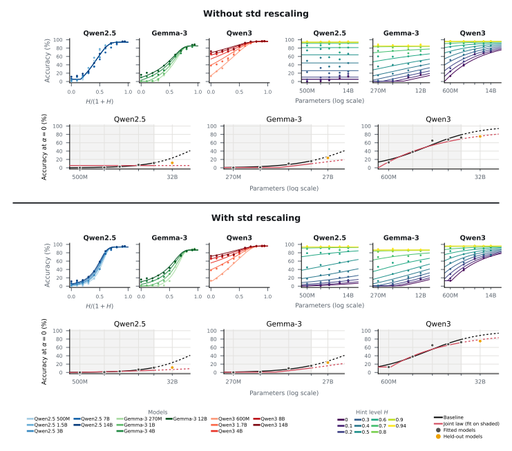
Figure 9 :Logit mixing on post-trained families on AIME.The top half uses the raw rule (Eq. (1)), and the bottom half rescales the teacher’s logits to the evaluated model’s standard deviation at each step (Eq. (4)). Each half shows the hint and capability marginals of the joint law fitted to every model except the largest, and its forecast of the largest model atH=0.
Original paper · CC BY 4.0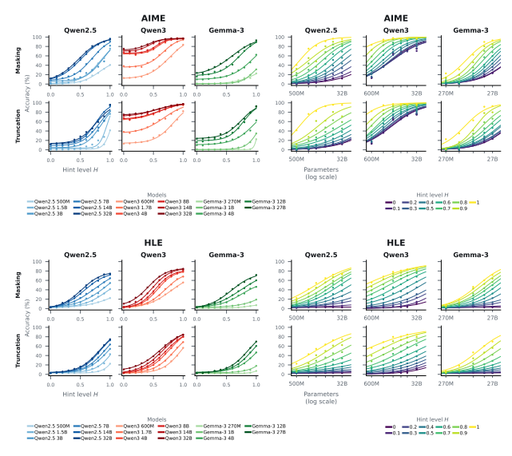
Figure 10 :Hint and capability slices for the remaining families.As Fig. 2, for Qwen2.5, Qwen3 and Gemma-3 on AIME (top) and HLE (bottom). Rows are masking and truncation.Left:accuracy against hint level H, one curve per model, darker is larger.Right:accuracy against model scale, one curve per hint level. Each curve is a sigmoid fitted to that model or that level alone, with free asymptotes inHand asymptotes pinned to 0 and 1 in scale.
Original paper · CC BY 4.0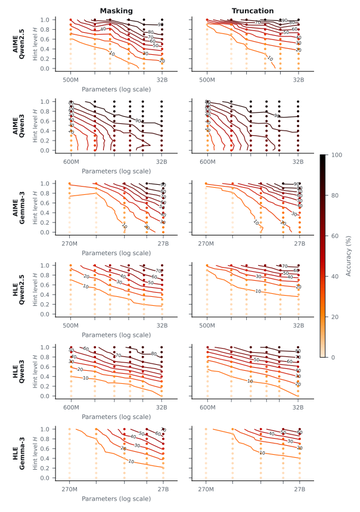
Figure 11 :Iso-accuracy contours for the remaining families.As Fig. 3, for Qwen2.5, Qwen3 and Gemma-3 on AIME and HLE. Columns are masking and truncation.
Original paper · CC BY 4.0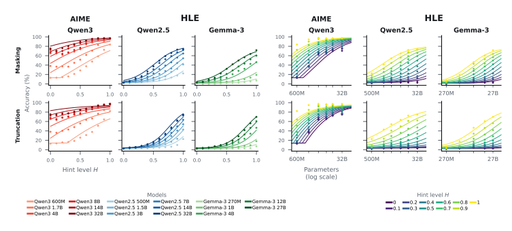
Figure 12 : As Fig. 4, for Qwen3 on AIME and Qwen2.5 and Gemma-3 on HLE.
Original paper · CC BY 4.0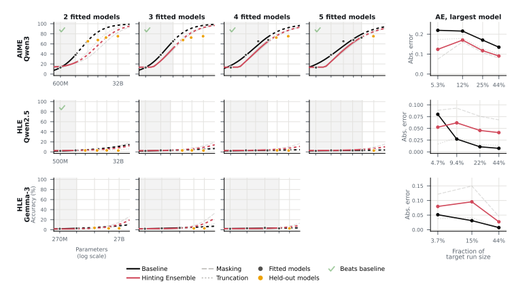
Figure 13 : As Fig. 6, for Qwen3 on AIME and Qwen2.5 and Gemma-3 on HLE.
Original paper · CC BY 4.0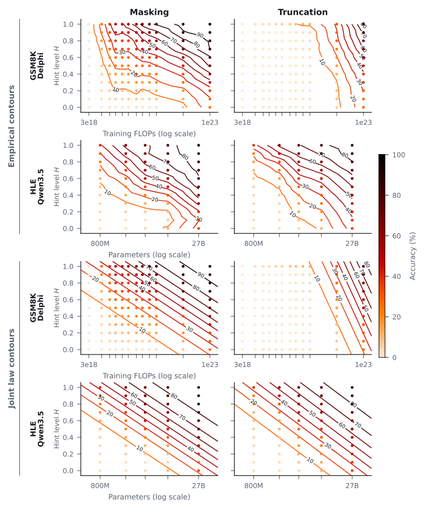
Figure 14 :Empirical against joint-law iso-accuracy contours. Top two rows:Fig. 3, the Delphi ladder on GSM8K and the Qwen3.5 family on HLE with contours interpolated from the measured cells.Bottom two rows:the same cells with the contours of the joint law of Eq. (2) fitted to each panel, which above the law’s floor are straight parallel lines of slope −β1/β2. Columns are masking and truncation. Each dot is one measured cell colored by accuracy.
Original paper · CC BY 4.0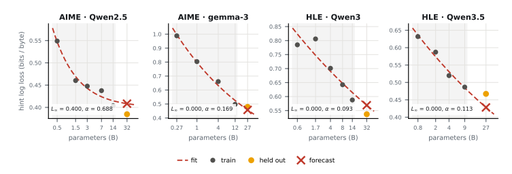
Figure 15 :Bits-per-byte against parameter count on the post-trained families.Each panel holds out the largest model and fits Eq. (5) to the rest (theshadedregion), then reads the fit at the held-out model’s parameter count. • are fitted models, • the held-out model andcrossesthe forecast. Fitted L∞ and α are annotated per panel; L∞ reaches its lower bound of zero in three of the four families, indicating the floor is not identified at this number of points.
Original paper · CC BY 4.0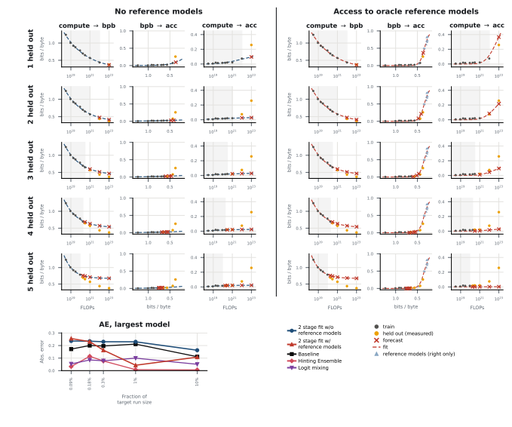
Figure 16 :Two-stage scaling law forecasts on the Delphi ladder (GSM8K).Each row is fitted on the smallest models only (theshadedregion) and forecasts the held-out larger ones.Columns within a block:the compute-to- BPB power law of Eq. (5); the BPB-to-accuracy sigmoid of Eq. (6), with the x axis running high to low so the curve rises left to right; and the two composed, giving accuracy implied at any compute. • are fitted models and • held-out models;crossesare forecasts, which use only the held-out model’s compute.Left block:the sigmoid is fitted on the fitted models alone.Right block:the eleven external reference models of Held [2026] (triangles) are added to its fitting data.Bottom:absolute error for the largest model on the 0–1 accuracy scale against the size of the largest fitted model as a fraction of the target’s, with the unhinted baseline, the hinting ensemble of Fig. 5 and logit mixing (§4.2) for reference, all refitted on the same ten models.
Original paper · CC BY 4.0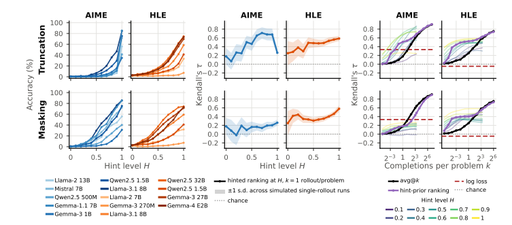
Figure 20 :Fig. 8 for truncation and masking.Rows are hinting methods, columns benchmarks; left, middle and right panels as in Fig. 8.
Original paper · CC BY 4.0Quote from the paper
Suze van Adrichem, Luke Bailey, Rohith Kuditipudi, Christine Ye, Neil Band, Ahmed Ahmed, John Duchi, Percy Liang, Tatsunori Hashimoto (2026). Hinted Scaling Laws. arXiv:2611.02270v1. https://arxiv.org/abs/2611.02270v1
BibTeX
@misc{adrichem2026hinted,
  title = {{Hinted Scaling Laws}},
  author = {Suze van Adrichem and Luke Bailey and Rohith Kuditipudi and Christine Ye and Neil Band and Ahmed Ahmed and John Duchi and Percy Liang and Tatsunori Hashimoto},
  year = {2026},
  eprint = {2611.02270},
  archivePrefix = {arXiv},
  url = {https://arxiv.org/abs/2611.02270v1}
}