Paper commentary
PredRNN: A Recurrent Neural Network for Spatiotemporal Predictive Learning
- Problem Future-frame prediction needs both fine spatial detail and longer-range dynamics, but in stacked ConvLSTM the memory cell of each layer changes only along time, so layers exchange little memory.
- Method A training-only decoupling loss separates the two cells, and Reverse Scheduled Sampling changes the encoder inputs during training.
- Results On Moving MNIST with a fixed training set, per-frame MSE falls from 103.3 for ConvLSTM to 48.4 for PredRNN-V2 averaged over 10 prediction timesteps. On KTH averaged over 20 future timesteps, LPIPS falls from 0.204 for PredRNN to 0.139 for PredRNN-V2.
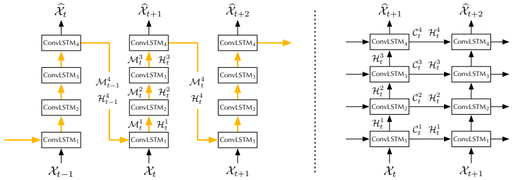
Fig. 1 : Left: the spatiotemporal memory flow architecture that uses ConvLSTM as the building block. The orange arrows show the deep-in-time path of memory state transitions. Right: the original ConvLSTM network proposed by Shi et al. [1].
Original paper · CC BY 4.0 · Yunbo Wang, Haixu Wu, Jianjin Zhang, Zhifeng Gao, Jianmin Wang, Philip S. Yu, Mingsheng Long · PredRNN: A Recurrent Neural Network for Spatiotemporal Predictive Learning · Original paper figure · Extracted the figure area from page 4 of the original PDF.Why stacked ConvLSTM memories fall short for future frames
Predicting future frames means generating a block of K frames after T observed frames, and the observed frames are spatial grids of measurements over time. Stacked ConvLSTM networks pass hidden states upward through the layers, but each layer's memory cell only evolves along the time axis, so the first layer at a timestep has little access to what the top layer remembered earlier.
The authors argue that the LSTM memory pathway was designed for tasks such as language modeling and action recognition, where high-level semantics are enough and fine detail matters less. Frame prediction needs both low-level appearance and high-level motion to be preserved, because the inputs and the outputs share the same data space.
Table 1 places the recurrent units and training schemes of earlier convolutional video predictors side by side, from ConvLSTM to Conv-TT-LSTM, and the proposed model is listed with its own memory flow, ST-LSTM and Reverse Scheduled Sampling.
How memory is routed across layers and time
PredRNN keeps the ConvLSTM layer as its starting block but moves the memory along a different path. In the original design the memory stays inside one layer and moves forward in time, whereas here the memory leaves each layer upward to the next, and the top layer's memory returns to the bottom layer at the following timestep.
With ConvLSTM as the block, the memory update reads the previous layer's memory and hidden state: the forget gate and input gate act on \(M^{l-1}_t\), and the new memory is \(M^l_t = f_t \odot M^{l-1}_t + i_t \odot g_t\), with output \(H^l_t = o_t \odot \tanh(M^l_t)\). The bottom layer reads the top layer's memory from the previous timestep, so the memory forms a loop through all layers.
Convolutions replace the Hadamard products in computing the gates, which lets the same model run on inputs of different spatial resolutions.
The authors justify the design by pointing to the deeper transition path between adjacent nodes, which gives more nonlinear gated steps for short-term motion without wider kernels. They also relate the flow to memory networks, where the layer-wise gates act as read and write operations on a shared memory.
What the two memory cells of ST-LSTM compute
ST-LSTM keeps the original LSTM cell C for the horizontal, timestep-to-timestep path and adds a second memory M that comes up from the lower layer at the same timestep. The M path has its own input gate \(i^{0}_t\), forget gate \(f^{0}_t\) and input modulation gate \(g^{0}_t\), computed from \(X_t\) and \(M^{l-1}_t\), and the new memory is \(M^l_t = f^{0}_t \odot M^{l-1}_t + i^{0}_t \odot g^{0}_t\).
The Hadamard terms on the cell C were removed from the input and forget gates, which the authors chose for empirical performance and model efficiency.
The hidden state is obtained by concatenating C and M, applying a 1×1 convolution, and gating the result with an output gate that sees both memories, which is written as \(H^l_t = o_t \odot \tanh(W_{1\times1} * [C^l_t, M^l_t])\). The authors intend M to form a deeper, faster path for short-term change, and C to form a shorter gradient path for long-term dependence.
Memory decoupling during training
The authors found that the increments of the two memory cells were tangled when visualized with t-SNE on KTH, so the two cells did not separate on their own. The decoupling loss is added to make the two cells learn different aspects of the change.
Each memory increment is computed with a shared 1×1 convolution \(W_{decouple}\) applied to the gated input: \(\Delta C^l_t = W_{decouple} * (i_t \odot g_t)\) and \(\Delta M^l_t = W_{decouple} * (i'_t \odot g'_t)\). The loss is \(L_{decouple} = \sum_t \sum_l \sum_c \frac{|\langle \Delta C^l_t, \Delta M^l_t\rangle_c|}{\|\Delta C^l_t\|_c \cdot \|\Delta M^l_t\|_c}\), where the dot product and the l2 norm are taken over the flattened feature maps of each channel c.
Because it is an absolute cosine similarity, minimizing it drives the increments toward orthogonality in each channel, and the loss sums over timesteps, layers and channels.
The training objective adds this term to the frame reconstruction error: \(L_{final} = \sum_{t=2}^{T+K} \|\hat X_t - X_t\|_2^2 + L_{decouple}\). The decoupling parameters exist only during training and are removed at inference, so the model size matches the earlier ST-LSTM version.
Fig. 11 compares models under sudden step changes and under slow, long-term changes of pixel intensity. The authors report that the memory-decoupled ST-LSTM responds faster to sudden changes and tracks changes at several timescales.
Reverse Scheduled Sampling
In standard sequence-to-sequence training the encoder always sees real observations, so the forecaster is not forced to rely on earlier context frames. Reverse Scheduled Sampling instead replaces some encoder inputs with the model's own predictions. Each real frame is kept with probability \(1-\epsilon_k\), so the chance of hiding it grows with the iteration count k.
The authors give three increasing forms for \(\epsilon_k\), which rise from \(\epsilon_s\) to \(\epsilon_e\): linear, \(\epsilon_k = \min\{\epsilon_s + \alpha_l \times k, \epsilon_e\}\); exponential, \(\epsilon_k = \epsilon_e - (\epsilon_e - \epsilon_s)\exp(-k/\alpha_e)\); and sigmoid, \(\epsilon_k = \epsilon_s + (\epsilon_e - \epsilon_s)/(1+\exp((\beta_s - k)/\alpha_s))\).
Scheduled sampling with probability \(\eta_k\) is used in the forecasting stage, and \(\eta_k\) decays linearly in the experiments, while the two strategies differ in how close the sampling ranges of encoder and forecaster are early in training. The second strategy performs slightly better, and the authors suggest the same training can be applied to most sequence-to-sequence models beyond PredRNN.
Action conditioning inside ST-LSTM
The action-conditioned version fuses the previous hidden state with the previous action inside each layer, and the fused value \(V^l_t = (W_{hv} * H^l_{t-1}) \odot (W_{av} * A_{t-1})\) is fed into ST-LSTM together with \(X_t\), \(C^l_{t-1}\) and \(M^{l-1}_t\). The actions are continuous values that are transformed to the same spatial resolution as the hidden state, so the fusion operates pixel-wise.
The authors use this variant on the BAIR dataset, a robot dataset with 64×64 RGB frames and commanded gripper actions.
Moving MNIST with a fixed training set
Models are trained to predict the next ten frames from the first ten, on a fixed training set of 10,000 sequences, and tested on 5,000 sequences whose digits come from a different subset of MNIST. Metrics are averaged over 10 prediction timesteps, with MSE, SSIM and LPIPS reported.
Moving the memory onto the spatiotemporal flow lowers MSE from 103.3 to 74.0, and replacing ConvLSTM units with ST-LSTM lowers it to 56.8. Adding memory decoupling and Reverse Scheduled Sampling together gives a 14.8% lower MSE, from 56.8 to 48.4. The two training changes are reported together here, so this row does not separate their effects.
ConvLSTM* has MSE 62.8 and 320.8 in the FLOPS column, while PredRNN (Conf.) has MSE 56.8 and 115.9, so the authors' efficiency claim rests on this pair. Fig. 8 shows prediction examples for the same Moving MNIST test set.
Moving MNIST with dynamically generated data
In this setup, the training data are generated dynamically with two or three flying digits, following the CrevNet protocol.
For two digits, PredRNN-V2 reaches MSE 13.4 and SSIM 0.958, against 22.3 and 0.949 for CrevNet with ST-LSTM. For three digits, PredRNN-V2 reaches MSE 24.7, against 40.6 for CrevNet with ST-LSTM, and SSIM 0.928 against 0.916.
KTH action prediction
All models are trained on the six KTH action categories to predict 10 future frames from 10 observations, and at test time the horizon is extended to 20 timesteps. PSNR, SSIM and LPIPS are averaged over 20 future timesteps.
In Table 7, PredRNN-V2 has PSNR 28.37, SSIM 0.838 and LPIPS 0.139, while PredRNN has PSNR 27.55, SSIM 0.839 and LPIPS 0.204. Conv-TT-LSTM reaches PSNR 27.62 and LPIPS 0.196, so PredRNN-V2 is higher on PSNR and lower on LPIPS, while PredRNN has the slightly higher SSIM. The authors interpret the large LPIPS drop as a sign of more perceptually convincing frames, since LPIPS follows human judgement more closely.
Precipitation forecasting from radar echoes
Each radar sequence has 10 input frames and 10 output frames, and the dataset holds 7,800 training sequences and 1,800 test sequences. CSI is computed at 30, 40 and 50 dBZ thresholds from hits, misses and false alarms.
In Table 8, PredRNN-V2 reaches MSE 36.4, against 39.1 for PredRNN and 39.3 for MIM, with TrajGRU at 68.3 and ConvLSTM at 63.7. PredRNN-V2 has CSI 0.462, 0.425 and 0.378 at the three thresholds, against 0.455, 0.417 and 0.358 for PredRNN.
Traffic4Cast and the reach of the training changes
The U-Net decoder contains four ST-LSTM layers, and CrevNet is also run with either ConvLSTM or ST-LSTM as its recurrent unit.
The authors also report that PredRNN++ gains only about 3% from the same ideas, and that memory decoupling and Reverse Scheduled Sampling add a negligible number of parameters.
Action-conditioned BAIR results
BAIR models are trained with a prediction horizon of 10 and evaluated with a horizon of 28, on 822,016 training sequences and 4,864 test sequences.
The action-free rows report PredRNN at SSIM 0.536 and PSNR 16.21, and PredRNN-V2 at 0.577 and 16.80, which are different input settings and should not be compared with the action-conditioned rows.
Limitations
Some Moving MNIST and radar comparisons rely on numbers from other works or on single rows of a table, and the CrevNet figures come from the CrevNet paper.
The second scheduled sampling strategy is only slightly better than the first, according to the authors' Table 6 comparison. The Traffic4Cast study uses only the Berlin data, and the reverse scheduled sampling experiments are reported on CrevNet and a U-Net-based PredRNN. The authors suggest Reverse Scheduled Sampling could serve other sequence-to-sequence models, but those models were not tested in this work.
Paper info
- Authors
- Yunbo Wang, Haixu Wu, Jianjin Zhang, Zhifeng Gao, Jianmin Wang, Philip S. Yu, Mingsheng Long
- Venue
- arXiv · Preprint
- First published
- 2021-3-17
- Added
- 2026-11-6
- Updated
- 2022-4-9
- Version
- v4
- arXiv
- 2103.09504
- Category
- cs.LG · cs.CV
- Original paper terms
- CC BY 4.0
- What we show
- Paper info, commentary and permitted figures from the original paper
AI commentary is a separate explanation from the original paper and may contain errors. The original paper and figures follow each source's terms of use and any rights noted separately.
Abstract
The predictive learning of spatiotemporal sequences aims to generate future images by learning from the historical context, where the visual dynamics are believed to have modular structures that can be learned with compositional subsystems. This paper models these structures by presenting PredRNN, a new recurrent network, in which a pair of memory cells are explicitly decoupled, operate in nearly independent transition manners, and finally form unified representations of the complex environment. Concretely, besides the original memory cell of LSTM, this network is featured by a zigzag memory flow that propagates in both bottom-up and top-down directions across all layers, enabling the learned visual dynamics at different levels of RNNs to communicate. It also leverages a memory decoupling loss to keep the memory cells from learning redundant features. We further propose a new curriculum learning strategy to force PredRNN to learn long-term dynamics from context frames, which can be generalized to most sequence-to-sequence models. We provide detailed ablation studies to verify the effectiveness of each component. Our approach is shown to obtain highly competitive results on five datasets for both action-free and action-conditioned predictive learning scenarios.
Quote from the paper
Yunbo Wang, Haixu Wu, Jianjin Zhang, Zhifeng Gao, Jianmin Wang, Philip S. Yu, Mingsheng Long (2021). PredRNN: A Recurrent Neural Network for Spatiotemporal Predictive Learning. arXiv:2103.09504v4. https://arxiv.org/abs/2103.09504v4
BibTeX
@misc{wang2021predrnn,
  title = {{PredRNN: A Recurrent Neural Network for Spatiotemporal Predictive Learning}},
  author = {Yunbo Wang and Haixu Wu and Jianjin Zhang and Zhifeng Gao and Jianmin Wang and Philip S. Yu and Mingsheng Long},
  year = {2021},
  eprint = {2103.09504},
  archivePrefix = {arXiv},
  url = {https://arxiv.org/abs/2103.09504v4}
}