Paper commentary
A Cost-Sensitive Deep Belief Network for Imbalanced Classification
- Problem A conventional DBN treats every misclassification as equally costly, so on skewed data its predictions tend to favour the majority class, and the costs that would correct this are hard to set without domain knowledge.
- Method Uses adaptive differential evolution to search class-dependent misclassification costs, scored by the training G-mean, then fixes the best costs in the output layer of a pre-trained DBN.
- Results Across 58 KEEL datasets, ECS-DBN was strongest in test accuracy on 34 datasets and in G-mean on 52. On the gun drilling dataset it reached a G-mean of 0.9946 ± 0.0011, against 0.9830 ± 0.0027 for plain DBN.
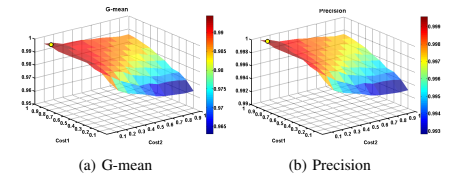
Fig. 8 : Illustration of the comparison between the performance of the proposed ECS-DBN and grid search of misclassification costs on DBN in terms of G-mean and Precision. Note that the solid yellow circle represents the performance of ECS-DBN. This example indicates the proposed ECS-DBN can obtain better performance by finding suitable misclassification costs.
Original paper · CC BY 4.0 · Chong Zhang, Kay Chen Tan, Haizhou Li, Geok Soon Hong · A Cost-Sensitive Deep Belief Network for Imbalanced Classification · Original paper figure · Extracted the figure area from page 11 of the original PDF.Why equal costs fail on skewed data
A conventional DBN is trained as if every misclassification cost the same, so when one class is rare, its predictions tend to drift toward the majority class. Cost-sensitive learning counters this by penalising some errors more than others, but the costs are seldom known in advance and are often picked by trial and error. Few studies have applied cost-sensitive learning to deep belief networks, so how costs should be chosen for a DBN has been largely unexplored.
Resampling is the usual data-level alternative, but oversampling or undersampling changes the original class distribution and can add computation. Working at the algorithm level, by changing the costs rather than the data, avoids that distortion.
The study asks whether an evolutionary search can find misclassification costs that help a DBN, and whether the resulting model beats DBN variants that use resampling on imbalanced benchmarks.
How the cost vector is evolved and applied
ECS-DBN has two phases: a DBN is pre-trained greedily from the bottom layer upward, and then an evolutionary search fits the misclassification costs on top of that trained network. The pipeline is summarised in a table of the training steps.
Each candidate in the population is a vector with one cost per class, and each value lies in the range from 0 to 1. The cost of a correct decision is zero, and the costs of errors are non-negative. The starting population is drawn uniformly between the lower and upper bounds of the cost range.
A candidate is scored by applying its costs to the outputs of the trained DBN and computing the G-mean on the training data. The G-mean is \(\sqrt{\frac{TP}{TP+FN}\times\frac{TN}{TN+FP}}\), so it rewards accuracy on both the minority and majority classes. The cost enters the decision by scaling each class posterior, giving \(P_\xi(y=j\mid x)=P(y=j\mid x)\cdot(1-C_{i,j})\), and the predicted class is the one with the largest scaled value.
Each generation, every parent gets a mutant built from three population members, using the difference of two of them scaled by its mutation factor, \(c_i'=c_i+F_i\,(c_j-c_k)\). A binomial crossover then mixes the mutant with the parent, and the parent is kept unless the trial scores higher on G-mean.
Each individual draws its own crossover probability from a normal distribution with standard deviation 0.1, and its own mutation factor from a Cauchy distribution with scale 0.1. The centre values are updated each generation as a weighted mix of the old value and the mean of the values that produced successful trials, with weight β = 0.5.
Evolution stops at the maximum number of generations, or earlier once the best fitness has stayed unchanged for 30 generations. The best individual from the final generation is written into the output layer as the misclassification costs, and the resulting ECS-DBN is then tested on the test data.
The cost-sensitive part acts only on the output layer, while the lower layers follow the usual pre-training and fine-tuning procedure.
KEEL benchmark results
The benchmark uses 58 binary-class imbalanced datasets from the KEEL repository, all known to have high imbalance ratios. The imbalance ratio is the number of majority samples divided by the number of minority samples, \(IR=\frac{\#majority}{\#minority}\).
Every method is run with 5-fold cross validation repeated over 10 trials. The DBN uses a learning rate of 0.01, 100 pre-training iterations and 300 fine-tuning iterations, and its hidden-neuron count is drawn from the range 5 to 50. The resampling baselines use the default settings of the code they were taken from.
Seven settings are compared: plain DBN, ADASYN-DBN, SMOTE-DBN, SMOTE-borderline1-DBN, SMOTE-borderline2-DBN, SMOTE-SVM-DBN and ECS-DBN.
ECS-DBN excels in test accuracy on 34 of the 58 datasets. The G-mean result is stronger, with ECS-DBN outperforming the compared DBN variants on 52 of the 58 datasets. The authors argue that accuracy alone can be high for a classifier biased toward the majority class, which is why G-mean carries more weight here. They attribute the G-mean advantage to the evolutionary search using G-mean as its objective.
Pairwise Wilcoxon paired signed-rank tests were run for each dataset at the 5% significance level, and average ranks were computed across datasets. A Holm post-hoc test with ECS-DBN as the control is reported to show statistically significant differences in favour of ECS-DBN over the other methods on all 58 datasets. The Wilcoxon win-lose-draw counts and the Holm p-values sit in the annex tables, which are not part of the text read here.
The authors read the gap to plain DBN as evidence that cost-sensitive learning is needed.
Run-time cost on KEEL and gun drilling
On the KEEL datasets, average computational time is 26.64 ± 1.50 s for ECS-DBN and 8.41 ± 1.28 s for DBN. Excluding DBN training time, ECS-DBN takes 18.23 s on average.
The resampling-based variants take between 22.97 ± 3.95 s and 25.81 ± 3.10 s in total. The authors note that the resampling methods are slightly faster than ECS-DBN on these small datasets, and attribute ECS-DBN's higher cost mainly to its evolutionary algorithm.
On the gun drilling dataset, the text reports that ECS-DBN takes less average computational time than the other competing methods. The underlying times are in a table that is not part of the selected text, so the size of that gap is not given here.
Gun drilling fault diagnosis
A sample is healthy when maximum flank wear is below 300 µm and faulty at 300 µm or above, with an imbalance ratio of 10. The dataset holds 19,712,414 samples, split into 13,798,690 for training and 5,913,724 for testing. Besides accuracy and G-mean, precision, F1-score and AUC are reported, with F1 focused on the faulty class.
Among the conventional models in Table VII, DBN has the highest mean accuracy, 0.9954 ± 0.0006, and a G-mean of 0.9830 ± 0.0027. SVM reaches an accuracy of 0.9894 ± 0.0103 in the same table. DBN is therefore chosen as the base classifier for the real-world task.
In Table VIII, ECS-DBN has the highest G-mean, 0.9946 ± 0.0011, ahead of CSDBN with random costs at 0.9916 ± 0.0026 and of plain DBN at 0.9830 ± 0.0027. WELM reaches a G-mean of 0.7532 ± 0.0170 and ECO-ensemble 0.9713 ± 0.0133 in the same comparison.
ECS-DBN's precision is 0.9996 ± 0.0002, while its accuracy of 0.9960 ± 0.0002 is slightly below ADASYN-DBN at 0.9964 ± 0.0004. The authors describe ECS-DBN as comparable on accuracy and F1-score rather than better.
The authors also compare ECS-DBN with a grid search of misclassification costs applied to DBN, in terms of G-mean and precision. In that comparison, ECS-DBN, marked by a solid yellow circle, is read as showing that evolved costs give better results than the grid-searched ones. Fig. 9 is described as showing that the evolved costs raise minority-class accuracy, while the effect on the majority class depends on how the objective is defined.
Limitations
All benchmark experiments use binary-class datasets, while the paper states that the approach can also handle multiclass problems.
The real-world evidence is one gun drilling dataset, and for that reason only the Wilcoxon paired signed-rank test is used there.
ECS-DBN takes about 18.23 s more than DBN on KEEL once DBN training is removed, and its total time is above that of the resampling variants.
ECS-DBN is not the most accurate model on the gun drilling dataset, since ADASYN-DBN is marginally higher, and on KEEL it is best in accuracy on 34 of 58 datasets rather than all of them.
The DE parameters were set empirically to make DE converge, and no sensitivity analysis of these settings appears in the text read here.
Paper info
- Authors
- Chong Zhang, Kay Chen Tan, Haizhou Li, Geok Soon Hong
- Venue
- arXiv · Preprint
- First published
- 2018-4-28
- Added
- 2026-11-6
- Updated
- 2018-5-5
- Version
- v2
- arXiv
- 1804.10801
- Category
- cs.LG · stat.ML
- Original paper terms
- CC BY 4.0
- What we show
- Paper info, commentary and permitted figures from the original paper
AI commentary is a separate explanation from the original paper and may contain errors. The original paper and figures follow each source's terms of use and any rights noted separately.
Abstract
Imbalanced data with a skewed class distribution are common in many real-world applications. Deep Belief Network (DBN) is a machine learning technique that is effective in classification tasks. However, conventional DBN does not work well for imbalanced data classification because it assumes equal costs for each class. To deal with this problem, cost-sensitive approaches assign different misclassification costs for different classes without disrupting the true data sample distributions. However, due to lack of prior knowledge, the misclassification costs are usually unknown and hard to choose in practice. Moreover, it has not been well studied as to how cost-sensitive learning could improve DBN performance on imbalanced data problems. This paper proposes an evolutionary cost-sensitive deep belief network (ECS-DBN) for imbalanced classification. ECS-DBN uses adaptive differential evolution to optimize the misclassification costs based on training data, that presents an effective approach to incorporating the evaluation measure (i.e. G-mean) into the objective function. We first optimize the misclassification costs, then apply them to deep belief network. Adaptive differential evolution optimization is implemented as the optimization algorithm that automatically updates its corresponding parameters without the need of prior domain knowledge. The experiments have shown that the proposed approach consistently outperforms the state-of-the-art on both benchmark datasets and real-world dataset for fault diagnosis in tool condition monitoring.
Quote from the paper
Chong Zhang, Kay Chen Tan, Haizhou Li, Geok Soon Hong (2018). A Cost-Sensitive Deep Belief Network for Imbalanced Classification. arXiv:1804.10801v2. https://arxiv.org/abs/1804.10801v2
BibTeX
@misc{zhang2018cost,
  title = {{A Cost-Sensitive Deep Belief Network for Imbalanced Classification}},
  author = {Chong Zhang and Kay Chen Tan and Haizhou Li and Geok Soon Hong},
  year = {2018},
  eprint = {1804.10801},
  archivePrefix = {arXiv},
  url = {https://arxiv.org/abs/1804.10801v2}
}