Paper commentary
ISLA: A Coordinate-Free, Measure-Weighted Transformer for Boundary-Driven PDEs
ISLA keeps aerodynamics surrogates accurate when the same car is rotated or resampled
- Problem Top aerodynamics surrogates give different predictions when the same car is rotated or its boundary is resampled. Their coordinates enter as features, and their sums ignore how much area each point represents.
- Method ISLA is a slice-attention transformer that feeds the network only distances and relative angles to learned anchors. Each boundary cell is a token weighted by its surface measure, so mesh changes affect predictions only through quadrature error.
- Results On AeroZoo, ISLA's mean velocity and pressure errors are at least 3.1 and 3.3 times lower than any baseline's.
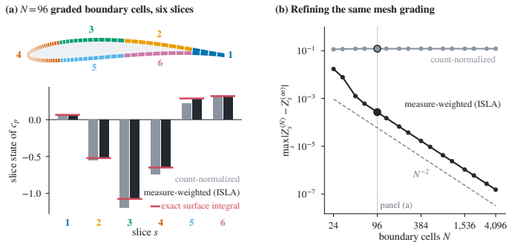
Figure 5 .Measure-weighted slice pooling converges under mesh refinement; count-normalized pooling does not. (a)A Joukowski airfoil in potential flow, discretized into N= 96 boundary cells that are about nine times shorter at the leading edge, with six soft slices. Bars show the slice states of the exact cp pooled by soft counts (gray) and by cell measure (charcoal, ISLA) beside the exact ratio of surface integrals (crimson ticks).(b)Largest error across the six slice states as the same grading law is refined from N= 24 to 4,096: count-normalized pooling stays near 0.12, its mesh-density-weighted limit, whereas ISLA’s measure-weighted pooling falls by five decades asN −2.
Original paper · CC BY 4.0 · Peter Sharpe · ISLA: A Coordinate-Free, Measure-Weighted Transformer for Boundary-Driven PDEs · Original paper figure · Extracted the figure area from page 17 of the original PDF.Why surrogates depend on how a problem is written
A boundary-value problem has physical content that is separate from how it is written down. The paper calls the origin, axes, units, mesh, kept cells and query points the presentation of the problem. A computer needs these choices, yet the solution shouldn't depend on them. The strongest surrogates on today's benchmarks do depend on them, because coordinates enter as features.
Their sums over points also ignore the area each point represents, so a large cell counts the same as a small one. Anchor-based cross-attention models such as AB-UPT avoid this coupling, according to the paper.
The effect is large even in simple tests on DrivAerML. Tuned Transolver and GeoTransolver networks were trained on DrivAerML as stored, with every car pointing along +x, in meters, from one mesher. When their validation PDE problems were rotated at random, the surface-pressure error rose from 4% to more than 100%, which is worse than predicting zero.
Uniform area sampling raised the same error to about 30%. Figure 1 shows the same effect on one DrivAerML case, where GeoTransolver's error grows while ISLA's stays near 4%.
A training set fixes one convention, so a model that leans on it fails when the problem arrives in another frame. Rotation augmentation only multiplies the stored-case errors of Transolver and GeoTransolver by 1.04 and 1.03. On AeroZoo, every case has its own pose, size, speed and boundary conditions, so the convention can't be fixed in advance.
Three rules that remove the convention
ISLA starts from a linear model problem, where the field at an interior point is a boundary integral that depends on relative positions and the surface measure. ISLA keeps those three features without assuming linearity, so every boundary point can still influence every field point. It also keeps the slice idea, in which every token exchanges information with every other at linear cost.
The architecture must ignore the choices of presentation, and the three rules map onto the three parts of that presentation. Under the first rule, no learned operation receives a coordinate, so each slice gets an anchor made from the measure-weighted mean position and mean normal of its tokens. A token's position then enters only as distances and relative angles to those anchors.
Lengths come from a unit computed from the boundary, and vectors at the output are built from directions that rotate with the body.
The second rule makes every sum over the boundary a quadrature, so cell measures weight every attention over boundary tokens. Under this rule a change of mesh alters a prediction only through quadrature error. The third rule makes interior points read-only, which gives query independence. Because the point contributes to no sum, its prediction depends only on the point and the boundary.
Proposition 1 covers the invariance side: if problems are closed under rigid motions, reflections and unit changes, the solution operator must be covariant and rescale outputs with units. Its dependence on the boundary is that of an oriented surface, not of how the surface is meshed or sampled, the order of its cells, or the other query points.
The authors call a surrogate presentation-independent when it meets these parts exactly, and consistent when its mesh dependence vanishes under refinement. ISLA is both, and the paper proves this in Section 4.
From boundary cells to slices and queries
An ISLA pass starts by turning each boundary cell into a token that carries its centroid, unit normal, measure and any data its condition prescribes. A token's first state comes from invariants only, such as the cosines between its normal and the global directions, computed by a per-condition layer. Each token's weight is the surface measure it stands for, so a cell kept with probability πi gets the Horvitz–Thompson weight ai/πi.
Interior tasks draw the sample along a space-filling curve with πi proportional to ai, while surface tasks draw cells uniformly. In training the start u0 is uniform on [0,1), and in evaluation u0 = 1/2, so inference is deterministic. Large cells are kept with certainty, so the tokens of a finely meshed region don't crowd out the rest of the boundary.
Each block holds learned base prototypes that the case adapts through one measure-weighted attention, with the summaries centered over the slices. Tokens route to the slices through a cosine-similarity score that is bounded, so routing can't sharpen without limit as the weights grow. Boundary data of rank one and two enter through contractions with the frame vectors, so the channels remain true vectors and tensors.
The sign comes from the generalized winding number, and at points with several closest features the least-norm point of the tied directions is taken.
A query reads the boundary through a learned kernel over a binary radix tree of boundary nodes, each node storing summed weights and measure-weighted means. With randomly initialized weights in float64, the θ = 1 read deviates from the exact boundary read by 1.4 to 3.5%.
AeroZoo: every case in a different presentation
AeroZoo changes geometry, size, speed, pose and boundary layout from case to case, so it tests whether ISLA's invariances hold on a mixed set of flows. The benchmark contains 2,816 flows, the subset of 3,815 time-averaged RANS solutions whose averages are converged.
As released, Transolver and GeoTransolver have no input for the inlet conditions. In SI units their velocity errors sit within 2% of predicting zero, with rU = 0.999 and 0.981. Adding both per-case scales and boundary-condition tokens brings GeoTransolver's mean εU to 0.294, with rU = 0.257. That version beats the reference on 82% of the cases.
ISLA reaches εU = 0.082 with rU = 0.112, and εp = 0.298 with rp = 0.315. The baselines are single seeds from earlier work, while ISLA averages four seeds. To check whether size explains the margin, the authors trained a 28.2 M ISLA with half the boundary tokens on the same step schedule. That smaller model has mean εU 3% above a 67.5 M ISLA.
Supervising boundary targets as well costs 1.46 times the step time and lowers εp to 0.171, with εU at 0.078.
Per enclosure configuration, ISLA's median velocity error is 1.3 to 7.8 times below the best baseline's. The gap holds across all eight configurations, so one setup doesn't drive the result. The matching references reach 0.099 and 0.138. Presentation independence doesn't extrapolate to unseen topologies, since with non-box enclosures held out ISLA exceeds the reference's error.
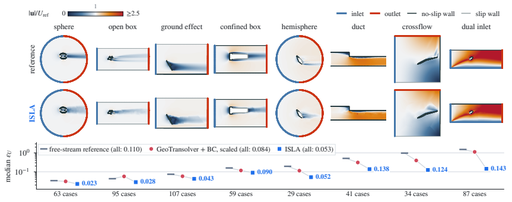
Figure 4 .On AeroZoo, ISLA has the lowest velocity error in every enclosure configuration.Top:one median-error test case per configuration: reference velocity magnitude on a plane through the body and one ISLA model’s prediction (duct: around its contraction). Bottom:medianε U by configuration on in-distribution test cases; ISLA’s is 1.3–7.8×below the best baseline’s.
Original paper · CC BY 4.0Rotating and re-sampling the same problem
The rotation and re-sampling tests ask whether a model's error stays put when the same problem is presented differently. For tuned Transolver and GeoTransolver networks trained on DrivAerML as stored, random rotation of the validation PDE problems raised the surface-pressure error from 4% to more than 100%. Uniform area sampling raised the same error to about 30%, so the baselines depend on how the boundary is written down.
The authors trained every model without augmentation, so these tests isolate invariance rather than what augmentation can learn.
In the re-sampling test, the surface cells a model receives are drawn with probability proportional to their area, instead of following the mesher's refinement pattern. ISLA's error changed by at most 1.1% of its value in every test.
On DrivAerML's 34 validation cases, rotating the full PDE problem multiplied the surface-pressure errors of tuned Transolver and GeoTransolver networks by 26 to 31. ISLA's surface-pressure error changed by at most 0.2% in the same test. Augmentation covers only its trained subgroup, so vertical-axis augmentation left SO(3) errors at 23 times.
Uniform SO(3) augmentation kept rotation changes within 0.2% and multiplied stored-case errors by 1.04 and 1.03, which shows that augmentation trades invariance for coverage of the group it was trained on.
AirfRANS: second only to GLOBE
On AirfRANS, GLOBE, a boundary-integral model, has the lowest error in every field. GLOBE uses learned boundary kernels, which is why its error sits below ISLA's on each field in Table 2. ISLA's errors are 1.0 to 2.0 times GLOBE's, so ISLA is second only to GLOBE on this benchmark. Across fields, ISLA's errors are at least 1.6 times below those of Transolver and GeoTransolver.
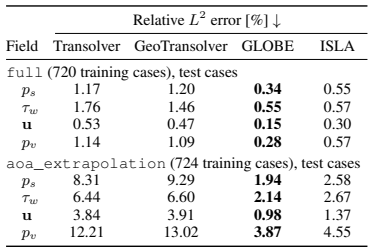
Table 2 .AirfRANStest cases: relative L2 error in percent (ps, τw: surface pressure and wall shear; u, pv: volume velocity and pres- sure; bold: lowest in row; Section C).
Original paper · CC BY 4.0Table 2 reports relative L2 error in percent on the full split with 720 training cases. The Table 2 entries are ensembles on FluidsBench's splits, so each family is compared on the same data.
On the aoa_extrapolation split, the test angles lie outside the training range, so the models must extrapolate. Every family's errors grow by 4 to 15 times from validation to test on this split. ISLA's errors stay at least 2.4 times below Transolver's and GeoTransolver's on this split. The gap to the slice baselines is wider on aoa_extrapolation than on the full split, and the table shows the same pattern.
Automotive datasets: ISLA against near-saturated baselines
On the automotive datasets, existing architectures already score close to saturation, so ISLA's gains there are small. They report these full-split errors anyway, for direct comparison with prior work.
Its volume errors lie 7% below to 28% above that lowest other family's, as Table 14 reports. With 67 training cases on DrivAerML and AhmedML, errors lie 4% below to 13% above the lowest other family's. With 11 DrivAerML training cases, ISLA's errors are 8% to 13% below the lowest other family's in all four fields. That last comparison used 50,000 steps per network for Transolver, GeoTransolver, and ISLA, and the schedule check sits in Section D.3.
What each rule buys in the ablations
The authors removed one design rule at a time and retrained the reference configuration with nothing else changed. Counts in place of measures give each cell of a boundary condition the condition's mean measure, so sums over tokens weight cells equally. The loss and the metric still use the true measures, so only the token sums change. On cells re-sampled by area, the surface-pressure error is 43%, which is 11 times the reference's.
So the measure weights matter once the sampling changes, not on the stored cells.
Coordinates as inputs add the three centered and scaled centroid coordinates of each cell to its token input. On stored cases this variant's error is 3.6% lower than the reference's across 3 seeds, a gap close to the reference's seed spread. On rotated cases the same variant reaches 83%, and the body reports 21 times higher error on rotated cases.
The two figures disagree, so the rotated-case ratio should be read with care.
Removing the relational invariants of Equation (5) sets them to zero in every block, which strips all positional information from the boundary tokens. The error is 71% in every presentation, a figure the excerpt doesn't express relative to the reference. On AirfRANS, dropping the boundary read raises velocity error by 10% and lowers eddy-viscosity error by 8%.
Both seeds of the variant fall outside that spread in velocity and eddy viscosity, but not in pressure.
Where ISLA's invariance stops being exact, and where its tests stop
The invariance holds exactly in exact arithmetic, but float32 rounding can move cells across grid lines of the ordering curve. The Morton order is built in the frame of the boundary's measure-weighted principal axes, so a rigid motion should keep the same cells.
With randomly initialized weights in float64, its outputs at θ = 1 deviate from the exact boundary read by 1.4 to 3.5% on a sphere and a random point cloud. Trained models depend on the angle more strongly, so AirfRANS models trained at θ = 1 have 2.0 to 5.1 times their error when evaluated with the exact boundary read.
Presentation independence doesn't extend to unseen topologies: with non-box enclosures held out, ISLA's error exceeds the reference's. The model accepts only global scalars and unit directions, so a problem with a rank-2 material tensor or a pseudovector can't be posed to it in full.
The AeroZoo baselines are single seeds from Sharpe et al. (2026), while ISLA averages 4 seeds. On the automotive splits, ISLA's errors sit above the lowest other family's in several fields, such as 5% above on the full splits. Those automotive datasets are already near saturation for existing architectures, so the margins there are small.
They didn't test a rotation-augmented ISLA on those splits, so the margin under augmentation is unknown.
Paper info
- Authors
- Peter Sharpe
- Venue
- arXiv · Preprint
- First published
- 2026-11-12
- Added
- 2026-11-14
- Updated
- 2026-11-12
- Version
- v1
- arXiv
- 2611.17141
- Category
- cs.LG · cs.CE · math-ph · physics.flu-dyn
- Original paper terms
- CC BY 4.0
- What we show
- Paper info, commentary and permitted figures from the original paper
AI commentary is a separate explanation from the original paper and may contain errors. The original paper and figures follow each source's terms of use and any rights noted separately.
Abstract
A foundational principle of physics is that all coordinate systems are equally valid: the behavior of a PDE-governed system does not depend on the origin or orientation of the frame, nor on the units or mesh used to write it down, and neither should a surrogate model. Yet the neural surrogates with the lowest errors on today's aerodynamics benchmarks lack these invariances and fail under simple transformations of the same problem: for models trained on PDEs of cars in one pose (i.e., translation and rotation) and from one mesher, rotating the full PDE raises the surface-pressure error from 4% to more than 100%, and re-sampling its boundary raises it to about 30%. We introduce ISLA (Invariant Slice Attention), a slice-attention transformer for steady, boundary-driven PDEs in which no learned operation receives a coordinate and every sum over the boundary is a quadrature. Positions enter only as distances and relative angles to learned slice anchors, lengths are measured in a unit computed from the boundary, and interior points query the boundary through a tree-accelerated learned kernel without influencing one another. With every boundary cell a token and an exact boundary read, ISLA is equivariant to rigid motions and reflections, invariant to the units of its declared data, and consistent under mesh refinement, while at every setting each query is independent of all other queries. On AeroZoo, 2,816 flows that vary in shape, size, speed, and boundary conditions, its mean reference-scaled velocity and pressure errors are at least 3.1 and 3.3 times lower than any baseline's. On AirfRANS its errors are second only to those of a boundary-integral model (GLOBE) and at least 1.6 times lower than those of Transolver and GeoTransolver.
Quote from the paper
Peter Sharpe (2026). ISLA: A Coordinate-Free, Measure-Weighted Transformer for Boundary-Driven PDEs. arXiv:2611.17141v1. https://arxiv.org/abs/2611.17141v1
BibTeX
@misc{sharpe2026isla,
  title = {{ISLA: A Coordinate-Free, Measure-Weighted Transformer for Boundary-Driven PDEs}},
  author = {Peter Sharpe},
  year = {2026},
  eprint = {2611.17141},
  archivePrefix = {arXiv},
  url = {https://arxiv.org/abs/2611.17141v1}
}