Paper commentary
Joint Null-Space Projection for Data-Free Model Merging
JNSP merges fine-tuned CLIP experts by removing the directions other tasks claim
- Problem Entrywise merge rules ignore how tasks overlap in their input directions, so merged models interfere.
- Method JNSP removes each task's update along other tasks' input directions, then sums the rest.
- Results On eight CLIP ViT-B/16 tasks, JNSP reaches 89.45% average accuracy without any images, compared with 77.57% for TIES-Merging. The gain also holds on the independently trained TALL checkpoints.
Why entrywise merging stalls
Serving several fine-tuned checkpoints means one copy per task plus routing at inference, so merging them into one parameter vector is attractive. The direct route adds the task vectors, and it gets worse as the number of tasks grows because the updates conflict. Existing fixes treat this conflict entry by entry, through trimming and sign voting, random dropping, or outlier sparsification.
Because such rules act on each coordinate independently, they ignore how the entries of a delta relate to one another.
The authors argue that a task vector has structure that a per-entry rule cannot see. For a weight matrix that reads an n-dimensional hidden state, what matters is the row space, the set of input directions the update amplifies. Permuting the columns of a delta changes its right singular subspace completely, so two deltas with identical entrywise statistics can interfere in very different ways.
Random subspaces would overlap only at r/n, so these tasks claim far more shared input directions than chance would give. This is the gap the paper sets out to close, since merge rules that act per weight never see the shared directions.
Merging inside each task's input subspace
The core idea is to merge each task only in the input subspace where it acts, instead of coordinate by coordinate. For each tensor, a task's top-r right singular vectors name the input directions along which it moves the hidden state most. The joint null space of a task is the orthogonal complement of the union of the other tasks' subspaces, so it holds what no neighbour claims.
The projection removes only the component of the delta lying inside another task's subspace, so disjoint subspaces leave the delta untouched.
The authors expected this to help because two tasks that claim the same input direction spend the same capacity there. When both tasks move the same input direction, their contributions can add or cancel, and cancellation erases the smaller one. The authors also say that overlap only measures geometric redundancy, not the sign of the interaction, so the conflict reading is a proxy.
AlphaMerging is the closest prior method, since it also projects each delta off its peers' singular subspaces. AlphaMerging uses output-side vectors and compresses them, whereas JNSP uses input-side vectors and keeps the union uncompressed. So the contribution lies in this specific construction and in the controlled comparison, not in projection off peers as such.
JNSP applies the leave-one-out projection jointly, while NUFILT accumulates its filtering basis along the merge order.
How the projection and sum run
Only two-dimensional tensors whose smaller dimension is at least 64 are merged, which gives 53 tensors for ViT-B/16. Layer norms, biases and each task's classification head stay at their pretrained or task-specific values. The rank r is the only hyperparameter, and it is fixed at 16 everywhere.
First, an SVD of each task delta gives the top-16 right singular vectors that span its input subspace. Second, the other seven tasks' bases are stacked and orthonormalized with QR into one peer basis, at most 7r = 112 directions in a 768-wide tensor. Third, each delta is projected onto the complement of that peer basis, using the operator below, where the peer basis is the orthonormal matrix U_cup.
\( \tilde{\tau}_i = \tau_i\,(I - P_i), \quad P_i = U_\cup U_\cup^\top \) Summing the projected deltas onto the pretrained weights gives the merged tensor: \[ \theta_{\mathrm{merge}} = \theta_0 + \sum_{i=1}^{N} \tilde{\tau}_i \] Nothing in this chain uses data, a forward pass or an optimizer.
Figure 2 follows one Cars test image through these steps. The merge takes about 61 seconds on CPU for the 53 tensors with N=8.
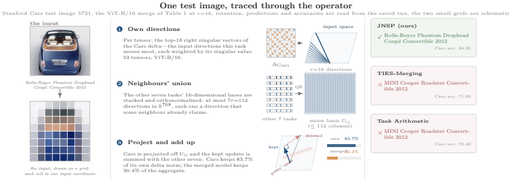
Figure 2 . One merged prediction, traced through the operator.Image 5721 of the Stanford Cars test split, predicted by the same merged checkpoints as the Cars column of Table 1. Left: the test image, and the same input drawn as a cell grid. Middle: the three steps of JNSP for this task, with schematic graphics for the delta and the basis (no checkpoint is stored for rendering them). The two retention figures are averages over tensors and come from ourr=16run: Cars keeps 83.7% of its own delta norm, and the merged model keeps 30.4% of the aggregate norm. Right: predictions of JNSP, TIES-Merging and Task Arithmetic on this image, with each method’s Cars accuracy. JNSP is correct; both entrywise baselines predict the same wrong class. The sample is one of 962 Cars test images on which JNSP is correct and both baselines err (of 8,040). WUDI is not shown because its per-sample predictions were not saved.
Original paper · CC BY 4.0 · Tian Xia · Joint Null-Space Projection for Data-Free Model Merging · Original paper figure · Extracted the figure area from page 3 of the original PDF.Does JNSP beat the baselines on the same ViT-B/16 checkpoints?
JNSP reaches 89.45% average accuracy on the eight ViT-B/16 tasks, which is 11.88 points above TIES-Merging. Task Arithmetic reaches 75.23%, so the gap to it is 14.22 points. Against WUDI's consensus subtraction at 88.47%, JNSP leads by 0.98 points. WUDI merges 48 of the 53 tensors, so its comparison isolates the merge rule only approximately.
The margin is widest on the visually diverse tasks, where entrywise rules lose the most. TIES-Merging scored 57.98 on DTD, 71.09 on Cars and 66.70 on SUN397. JNSP scored 77.23, 84.25 and 74.97 on the same three tasks. TIES is competitive on MNIST at 98.71, so its weakness is concentrated on these tasks.
Against the re-implemented subspace baselines on the same checkpoint, JNSP leads by 2.23 to 2.86 points. Iso-C and Iso-CTS are stronger on SUN397, at 75.3 to 75.4, but fall below JNSP on SVHN and DTD. The published TSV-M and AlphaMerging numbers are 89.01 and 89.9. The authors' re-implementations reach 87.22 for both methods, below those published figures.
So the comparison here runs on one checkpoint and one evaluator, not against the published figures.
Does the lead hold on other backbones and an independent release?
The independently trained TALL release tests whether the lead depends on the authors' own checkpoints. On ViT-B/16, JNSP reaches 89.20% against 78.36% for TIES-Merging, a 10.84-point lead. On the authors' own checkpoints the same gap is 11.88 points, so the lead shrinks but stays large. The authors read this as a property of independently fine-tuned CLIP experts rather than of one set of hyperparameters.
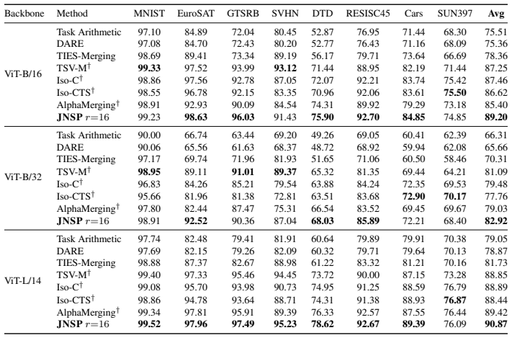
Table 2 . Scaling across backboneson the independently trained TALL release; every number is on that release, so cross-row comparisons are apples-to-apples. JNSP usesr=16throughout, untuned per backbone. †Re-implementation (Section 4.3). All methods are data-free and training-free.
Original paper · CC BY 4.0The authors also ran the same comparison on ViT-B/32 and ViT-L/14 from the TALL release. On ViT-B/32, JNSP reaches 82.92% versus 70.31% for TIES-Merging, a gain of 12.61 points. On ViT-L/14, JNSP scores 90.87% against 81.73% for TIES-Merging, a gain of 9.14 points. The best subspace baseline changes across backbones, with Iso-C on ViT-B/16, TSV-M on ViT-B/32 and AlphaMerging on ViT-L/14.
JNSP still places first on every backbone, and its margin over the subspace family is 1.45 to 1.83 points. That margin is much narrower than the margin over TIES-Merging, and it is narrowest on the largest model.
The authors report a stratified bootstrap rather than seed variance, because JNSP is deterministic for fixed checkpoints and rank.
Which parts of the design carry the gain
The rank r is the only hyperparameter, and the authors swept it from 8 to 32 on ViT-B/16. The plateau from 12 to 20 is flat, with its endpoints differing by 0.08 points. Rank 16 was chosen once and never retuned per backbone or dataset. Rank 8 keeps more norm yet still scores below rank 16, so retained norm alone doesn't explain the low-rank tail.
The most direct control swaps the per-task peer bases for one shared subspace, the top-r right singular vectors of the summed deltas. A shared basis has no notion of which task conflicts with which, so the gap points toward pairwise structure. The control doesn't isolate that cause, and the authors say so. Even so, the shared control recovers about three quarters of the margin over TIES, 8.94 of the 11.88 points.
Merging sequentially, with each task projected against earlier tasks only, is the order-dependent alternative the authors checked. That sequential variant collapses to 69.6% average accuracy. An order-dependent filter that accumulates its basis along the merge order differs from the joint construction by 18.4 points. This fits the joint construction being order-free, because permuting the task list leaves the merge unchanged.
The merge is deterministic, so the uncertainty the authors report comes only from the evaluation sets. A stratified bootstrap gives 89.45% with an interval of [89.17, 89.75] on the authors' checkpoints. Per-tensor rank allocation gave 89.66, which is 0.21 above the uniform rank and inside that interval. The authors kept the uniform rank because the non-uniform allocation at a fixed budget buys little.
Limitations and open questions
The clearest boundary of the evidence is language models, where JNSP doesn't transfer to RoBERTa-large on GLUE. On RoBERTa-large the same projection underperforms plain task arithmetic, and the authors report that result rather than hide it. So overlap alone doesn't explain the difference, and the authors diagnose the language failure without fully explaining it.
The method treats overlap between task subspaces as a conflict proxy, which is an assumption rather than a measured fact. Two tasks can both move along the same direction without contesting it, and overlap alone doesn't show which case holds. The authors also state that equations (1) to (3) can't separate a low-energy function-carrying direction from a genuinely shared one.
Generative objectives were not tested, so the results cover only the image classification and GLUE-style settings studied here. The subspace control shows a per-task pattern, with its deficit largest on SVHN and Cars, and the authors didn't test what predicts it. Published TSV-M and AlphaMerging numbers come from other checkpoints and pipelines, so the reported gaps are relative to re-implementations.
Re-running TSV-M, Iso-C and Iso-CTS on the TALL checkpoint moved them by at most 0.31 points, while AlphaMerging dropped to 85.40 without re-sweeping.
Paper info
- Authors
- Tian Xia
- Venue
- arXiv · Preprint
- First published
- 2026-11-12
- Added
- 2026-11-14
- Updated
- 2026-11-12
- Version
- v1
- arXiv
- 2611.17103
- Category
- cs.CV · cs.LG
- Original paper terms
- CC BY 4.0
- What we show
- Paper info, commentary and permitted figures from the original paper
AI commentary is a separate explanation from the original paper and may contain errors. The original paper and figures follow each source's terms of use and any rights noted separately.
Abstract
Merging independently fine-tuned checkpoints into a single multi-task model requires no data, no labels, and no gradient steps. In practice the task vectors of different tasks interfere, and the standard remedies--averaging, magnitude pruning, sign election--operate entry by entry, ignoring that each delta induces a low-dimensional update on the hidden features it acts upon. We recast merging as a subspace interference problem. For every two-dimensional weight tensor we take the top-r right-singular subspace of each task's delta--the input directions along which that task moves the representation most--and remove from each task vector the component lying in the union of the other tasks' subspaces. The resulting Joint Null-Space Projection (JNSP) is closed-form and order-independent, needs no forward pass, and is defined entirely by the checkpoint set. On eight CLIP image-classification tasks JNSP merges ViT-B/16 experts to 89.45% average accuracy without using a single image, 11.88 points above the strongest parameter-wise training-free baseline (TIES-Merging, 77.57%), 14.22 above Task Arithmetic, and 0.98 above WUDI's data-free consensus merge (88.47%). The gain holds across three backbones on the independently trained TALL release (+10.8, +12.6, +9.1 over TIES for ViT-B/16, ViT-B/32, ViT-L/14) and replicates there at 89.20%; controls confirm the source--a single shared subspace instead of per-task ones loses 2.9 points, and a sequential variant collapses to 69.6%. On RoBERTa-large the same projection underperforms plain task arithmetic, which we report rather than hide. Code is available at https://github.com.
Quote from the paper
Tian Xia (2026). Joint Null-Space Projection for Data-Free Model Merging. arXiv:2611.17103v1. https://arxiv.org/abs/2611.17103v1
BibTeX
@misc{xia2026joint,
  title = {{Joint Null-Space Projection for Data-Free Model Merging}},
  author = {Tian Xia},
  year = {2026},
  eprint = {2611.17103},
  archivePrefix = {arXiv},
  url = {https://arxiv.org/abs/2611.17103v1}
}