Paper commentary
The Neighbour's Label: Opposite Subgroup Effects of Same-Dialogue Exposure in Next-Act Evaluation
Neighbour labels leak into next-act evaluation with opposite effects on subgroups
- Problem Row-level splits and similarity retrieval can put a test target's labelled predecessor into training. A model can copy that label, which helps on continuations and hurts on transitions, so one aggregate score hides the effect.
- Method The authors randomly include the predecessor's row in training and compare continuation and transition scores. They also purge the adjacent rows to see how much of the gain goes away.
- Results On AMI, the lexical classifier's lag-1 effect was +0.2209 nats on continuations and −0.0722 nats on transitions.
Why a neighbouring label can leak
Next-act models read a window of preceding turns and predict the act of the turn that follows. Consecutive windows from one dialogue overlap heavily, so one window's target label becomes the previous act of the next window's target. A row-level split often puts the window just before a test target into training. Similarity retrieval over a pool of windows often returns that same window, so the test dialogue's gold label can reach the model without any training.
Whether this counts as leakage depends on the claim the evaluation makes. Under Setting A, the lag-1 row therefore counts as leakage. For prospective evaluation within a dialogue (Setting B), earlier acts are admissible only when they are known before the prediction, such as a system's own executed actions. Unlabelled earlier text of the test dialogue isn't gold-label leakage in either setting, and repeating the previous act is a legitimate baseline in Setting B.
The predecessor p(t) is the previous labelled target of the same dialogue, and in SGD it lies two utterances back. The leaked item is the neighbour's label, not the target's own label. Its effect changes sign with the target: copying the predecessor's label is correct for a continuation and wrong for a transition.
The paper calls a target a continuation when its act exactly equals the predecessor's act, and a transition otherwise. Dialogue-initial targets have no predecessor, so they belong to neither cell. Because the two cells pull in opposite directions, a copying model's natural aggregate can rise, fall or stay flat while its behaviour has changed.
One leaked label, two opposite effects
A single copied label helps one subgroup of targets and hurts the other, so one aggregate can average them away. When the target repeats the previous act, the neighbour's label is the correct answer. When the target changes act, that same label is wrong. The natural-weight aggregate, Δnat, is πC times ΔC plus (1 minus πC) times ΔT, with πC at 0.135 on SGD, 0.099 on STAR and 0.232 on AMI.
The authors also say that a lower aggregate than a published one doesn't show a cleaner protocol. A higher aggregate doesn't show leakage either. Under a naive row-level split, the lexical classifier's aggregate change is negative on SGD at −0.0094 [−0.0104, −0.0085] LRAP and on STAR at −0.0312 [−0.0346, −0.0281] nats.
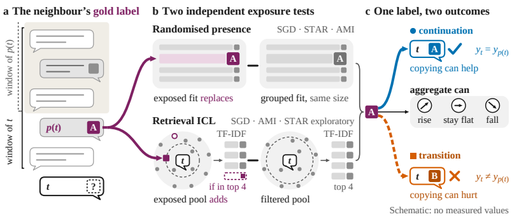
Figure 1 : Graphical overview (schematic, not measured values). (a) The labelled predecessor p(t) can expose its gold label; earlier unlabelled dialogue text is not itself gold-label leakage. (b) Independent tests: randomly controlled, equal-size training-set replacement (SGD, STAR, AMI), and TF-IDF top-four retrieval from exposed versus filtered demonstration pools (SGD, AMI; exploratory STAR). (c) Copying yp(t) can help continuations, hurt transitions, and mask subgroup effects in the aggregate. All exposure is induced on officially clean splits; the dense retriever was used for prevalence only.
Original paper · CC BY 4.0 · Ali Amini, Masoumeh Chapariniya, Rytis Maskeliunas, Robertas Damaševičius · The Neighbour's Label: Opposite Subgroup Effects of Same-Dialogue Exposure in Next-Act Evaluation · Original paper figure · Extracted the figure area from page 2 of the original PDF.On AMI the same split gives a positive aggregate change of +0.0411 [+0.0325, +0.0499]. The continuation and transition cells move in opposite directions in every corpus, so the sign of the aggregate reflects the mix.
Mistral on SGD shows −0.038 [−0.062, −0.013], while the AMI changes are +0.036 [+0.017, +0.055] for Qwen and +0.020 [+0.004, +0.035] for Mistral. Those small aggregate moves sit on top of much larger cell effects, such as a pooled continuation gain of +2.58 [+2.17, +3.01] nats for Qwen on AMI. The authors conclude that comparing aggregates with and without exposure can't serve as a leakage test.
Reporting continuation and transition cells next to the aggregate is therefore the check they recommend.
Randomising the predecessor's row
The randomised presence design varies exposure at random, so the lag-1 row's presence doesn't follow dialogue membership. Because of this matching, whether a target's lag-1 row sits in its exposed training set is randomised within dialogue.
The effect is estimated per cell with a within-target regression, where the outcome is the exposed-minus-grouped score Dtr. The indicator Ltr marks whether the row of p(t) is in the exposed training set, and L′tr does the same for the next labelled target. The count Ntr covers the other same-dialogue rows present, and the target fixed effects αt absorb differences between targets.
The lag-1 effect is the coefficient βc, fitted over the targets whose lag-1 presence varies across repeats.
Purge fits drop the two adjacent rows, or instead drop as many label-matched non-adjacent rows, in eight groups. A label permutation within dialogue and a naive row-level five-fold split complete the controls. The primary learner is a TF-IDF (1–2-gram) logistic regression, with a fine-tuned RoBERTa-base as the secondary learner. A TF-IDF k-nearest-neighbour classifier serves as an exploratory third learner, added after the primary results.
For the TF-IDF classifier, the lag-1 coefficient is +0.0285 [+0.0201, +0.0364] LRAP on continuations on SGD, against −0.0129 on transitions. On AMI, the same coefficient is +0.2209 nats on continuations and −0.0722 nats on transitions. A non-overlapping placebo row shows no detectable effect on continuations, but it does show a small negative effect on AMI transitions, −0.0110 nats.
The adjacent row drives the lexical effect
On SGD the values are +0.0285 [+0.0201, +0.0364] and −0.0129 [−0.0161, −0.0095] LRAP. On AMI they are +0.2209 [+0.1910, +0.2648] and −0.0722 [−0.0781, −0.0660] nats. The prespecified decision was met in all three corpora, so the continuation gain held everywhere it was tested. The continuation gain was positive in all five repeats, which means the sign didn't depend on one random split.
The section asks whether the adjacent row itself produces the asymmetry, or whether dialogue membership does. A non-overlapping placebo row from the same dialogue shows no detectable continuation effect. The placebo row does show a small negative effect on AMI transitions, −0.0110 [−0.0174, −0.0055] nats. Purging as many label-matched other rows removes only −2% to +1%, so the gain is tied to adjacency.
Permuting the exposure rows' labels within dialogue removes the positive effect on SGD and AMI. On STAR, a permuted label keeps about a quarter of the effect, because templated wizard turns often make the labels coincide. So the effect depends on the neighbour's label, not only on the presence of its text. The predicted benefit of the following row on transitions was not observed.
The fine-tuned RoBERTa-base shows no detectable adjacency effect in any corpus. The authors read this as inconclusive rather than as evidence of no effect, and the SGD encoder is near ceiling. Its unbounded log scores aren't comparable, and the paper doesn't identify which learner property makes it copy.
Retrieved demonstrations show the same asymmetry
The language model scores every label string of the fixed inventory by its summed log probability, without length normalisation. The cell effect is the mean difference between the exposed and filtered pools, computed as the gold string's log score in nats. Here s is the log of the gold string's probability renormalised over the inventory, and h marks whether the gold string ranks first.
The natural-weight aggregate reweights the stratified queries to the corpus's πC, so it follows Equation (1) applied to the top-1 cell changes.
Qwen and Mistral were both run on TF-IDF-retrieved demonstrations from exposed and filtered pools, so each arm compares the same queries under two pools. Pooled over both samples, the continuation gain on SGD is +0.46 nats for Qwen, against +0.55 nats for Mistral. The transition loss on SGD is −0.63 nats for Qwen, and −0.76 nats for Mistral.
On AMI the continuation gain is +2.58 nats for Qwen and +2.40 nats for Mistral, far larger than on SGD. The continuation–transition interaction excludes zero in all eight arms, yet four of the sixteen single-cell intervals include zero.
For SGD with Qwen under the primary order A, the first-sample continuation gain of +0.33 has an interval of [−0.20, +0.87], which includes zero. The fresh-sample transition loss under order A is −0.39, with an interval that also includes zero, so that decision stays partial. Under the alternative seeded slot order B, the fresh-sample transition loss grows to −1.00 nats, with an interval of [−1.50, −0.53].
That sensitivity result doesn't change the primary-order replication decision, which is the one the paper fixed before scoring. Mistral met its decisions on SGD and on both AMI arms in both samples, although its fresh SGD continuation gain missed.
Aggregates point the wrong way
Under a naive row-level split, the lexical classifier's aggregate change falls on SGD and STAR and rises on AMI. On SGD the change is −0.0094 LRAP, with interval [−0.0104, −0.0085], and on STAR it is −0.0312 nats. On AMI the same change is +0.0411, with interval [+0.0325, +0.0499], so the sign flips across corpora. Continuation and transition cells move in opposite directions in every corpus, so the aggregate hides the cell-level response.
The k-nearest-neighbour learner also shows a falling aggregate on SGD and STAR under the row split, which makes a strong leak look like a shortfall.
On AMI the changes are +0.036 for Qwen and +0.020 for Mistral, with intervals [+0.017, +0.055] and [+0.004, +0.035]. AMI continuation accuracy improves under exposure, yet the transition cell pulls the aggregate back toward zero.
The weights come from the corpus mix, where πC is 0.135 on SGD, 0.099 on STAR and 0.232 on AMI. On AMI the weighted contributions cancel partly, since the fresh-sample Mistral interval includes zero. The authors therefore treat aggregate comparisons, with and without exposure, as unable to detect leakage.
How often retrieval exposes the test dialogue
With the TF-IDF pipeline, the test dialogue's previous window lands among the four demonstrations for most queries. It is in the top four for 97.6% of SGD queries and 99.3% of AMI queries in the first sample. Those hits usually sit in the slot nearest the query, which matters for how the model reads the demonstrations. So the retrieval pipeline, not the corpus alone, decides how often the predecessor reaches the model.
On the same queries and pool, the dense encoder retrieves the lag-1 window for 83.9% of AMI queries. It reaches only 43.2% of SGD queries and 27.2% of STAR queries. Every paired difference between the two pipelines is negative, so the lexical pipeline always exposes more. The two pipelines differ in representation as well as model, so this compares two concrete pipelines, not dense and lexical retrieval in general.
Exposure frequency also shows up in the transition queries, where predicting the previous act is always wrong. Under TF-IDF retrieval, the previous-act rate on AMI rises from 0.102 to 0.336 for Qwen in the first sample. On SGD the change is at most 0.05, and the rate stays below the zero-shot rate. The rate measures how often the model copies the predecessor's act instead of answering from the query.
The authors read the rate against a zero-shot reference, because a high rate alone does not reveal a leak.
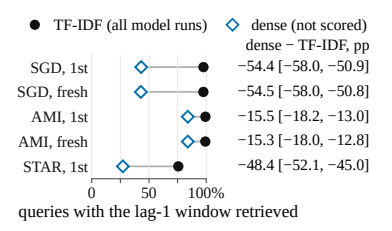
Figure 6 : Previous-act copying on transition queries, where predicting the previous act is always incorrect. The left panel shows copy rates under zero-shot, filtered, and exposed retrieval; the right panel shows the paired exposed-minus-filtered difference with its 95% cluster- bootstrap interval. Each sample contains 450 transition queries. Numerical results are reported in Table 13.
Original paper · CC BY 4.0Cost of excluding the test dialogue from demonstrations
On SGD, the filtered pool keeps the test dialogue's own windows out of the demonstrations. Qwen reaches 0.516 top-1 accuracy with filtered retrieval on the first sample, against 0.261 zero-shot. Random demonstrations give Qwen 0.346 on that sample, so filtered retrieval outperforms random ones here. Filtering lowered accuracy detectably in no SGD arm, yet that doesn't make it free.
On AMI, Qwen's filtered retrieval shows no detectable gap from zero-shot. Mistral's filtered retrieval falls below zero-shot by −0.074, with an interval of [−0.101, −0.046]. Repeating the previous act scores 0.232, and every retrieval condition of both models lands under that bar. AMI top-1 accuracy under random, filtered or exposed demonstrations sits between 0.090 and 0.163.
The authors call that previous-act baseline legitimate in prospective evaluation, where these models still don't beat it.
For the row-split diagnostic, the continuation effect from test scores alone is +0.0316 on SGD. The randomised continuation effect on SGD is +0.0285, so the observational reading agrees in sign and size. On AMI, exposure raises the share of transition queries predicted as the previous act from 0.102 to 0.336 for Qwen on the first sample. On SGD that share shifts by no more than 0.05 and remains under the zero-shot rate.
Label placement versus window text in the continuation gain
The continuation gain could come from the predecessor's label, from the window's text, or from both. Label placement by itself reproduces the continuation gain in this comparison. On SGD, the same-dialogue window is less useful than that replacement, detectably in three of four arms. On AMI, the same-dialogue window adds 1.45 to 2.60 nats beyond that replacement.
That AMI increment has no common support in similarity, because none of the 598 pooled continuation queries has a close replacement. The increment grows with the similarity gap, so it reflects the contrast that natural retrieval produces. An exploratory control kept the same-dialogue window but removed its label.
On SGD the shared part reached +0.23 [−0.15, +0.59] nats, with an interval that covers zero.
The follow-up found no shift toward the previous act, so the persistence-cue reading isn't confirmed. In Setting A, only the label channel counts as gold-label leakage, while the unlabelled text is earlier history.
What these results do not establish
That range sits below the previous-act reference accuracy of 0.232, so weak task competence may amplify sensitivity to copied labels. The effect magnitudes shouldn't be assumed to generalise to stronger models.
Both SGD decisions for Qwen are partial, and four of the sixteen single-cell intervals include zero. The primary-order replication decision for SGD/Qwen doesn't change under the alternative order B.
Pre-training contamination of the public corpora can't be excluded. Contamination can't create a within-query contrast between pools, but it may interact with one. Absolute accuracies therefore aren't capability estimates. The corpora are English task-oriented and meeting dialogues, so counselling and clinical corpora aren't represented. Label strings were scored by summed token log probabilities without length normalisation, and the authors didn't test that choice.
The authors couldn't independently evaluate the closest published row-split system, Tanaka et al. (2019), because its implementation and split indices weren't available. They report only the exposure rates implied by that system's published protocol. The work identifies behavioural dependencies only, not mechanisms inside the models.
Paper info
- Authors
- Ali Amini, Masoumeh Chapariniya, Rytis Maskeliunas, Robertas Damaševičius
- Venue
- arXiv · Preprint
- First published
- 2026-11-11
- Added
- 2026-11-13
- Updated
- 2026-11-11
- Version
- v1
- arXiv
- 2611.15194
- Category
- cs.CV · cs.CL
- Original paper terms
- CC BY 4.0
- What we show
- Paper info, commentary and permitted figures from the original paper
AI commentary is a separate explanation from the original paper and may contain errors. The original paper and figures follow each source's terms of use and any rights noted separately.
Abstract
Window-based next-act evaluation often aims to measure generalisation across dialogues, yet overlapping windows and similarity retrieval can expose labelled examples from the test dialogue. The nearest such example is the target's labelled predecessor, whose act is correct when the target continues it and wrong when the target changes act; a model that copies it can gain and lose in two subgroups that one aggregate averages. We induce this exposure under controlled designs on SGD, STAR and AMI, whose official splits are clean. Randomly including the predecessor's row in training raises a lexical classifier's continuation scores and lowers its transition scores in all three corpora, and purging the adjacent rows removes most of the gain. With TF-IDF-retrieved demonstrations, two 7B instruction-tuned models show the same opposite pattern in all eight model-corpus-sample arms (some single-cell intervals include zero; one replication is partial), while natural-weight accuracy changes by only -0.05 to +0.04. Exposure frequency depends on the retrieval pipeline. We evaluate two diagnostic comparisons without model retraining and find that excluding the test dialogue does not detectably reduce accuracy on SGD. All exposure is induced; no published system was re-evaluated.
Quote from the paper
Ali Amini, Masoumeh Chapariniya, Rytis Maskeliunas, Robertas Damaševičius (2026). The Neighbour's Label: Opposite Subgroup Effects of Same-Dialogue Exposure in Next-Act Evaluation. arXiv:2611.15194v1. https://arxiv.org/abs/2611.15194v1
BibTeX
@misc{amini2026neighbour,
  title = {{The Neighbour's Label: Opposite Subgroup Effects of Same-Dialogue Exposure in Next-Act Evaluation}},
  author = {Ali Amini and Masoumeh Chapariniya and Rytis Maskeliunas and Robertas Damaševičius},
  year = {2026},
  eprint = {2611.15194},
  archivePrefix = {arXiv},
  url = {https://arxiv.org/abs/2611.15194v1}
}