Paper commentary
SO-Arena: Benchmarking the Capability Spectrum and Reliability of System One Models
SO-Arena shows System One models can be reliable only when scored on consistency
- Problem Accuracy alone can't show whether System One models stay consistent when the answer options change. A model can score well on a fixed set yet flip its answer after the options are reordered.
- Method SO-Arena is a benchmark of 2,919 tasks across 11 domains. Unlike accuracy-only tests, it adds option-reordering and missing-option tests to measure decision reliability.
- Results GLiDE trails GPT-6 Luna by about ten points on overall performance. JevAny-27B reaches the highest reliability among System One models while ranking eleventh in capability.
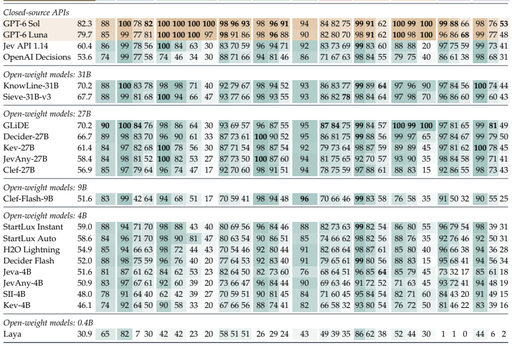
Table 2 :Scores by domain and difficulty tier.E, M, H, and V denote the easy, medium, hard, and very hard tiers; All marks untiered domains. Score is the leaderboard score (Equation (4)). Rows are grouped by access and size and sorted by Score within each group; the two System Two references are shaded orange. Darker is higher; bold is the best in each column. Tiers are not calibrated across domains.
Original paper · CC BY 4.0 · Lichen Li, Ziping Dong, Sicheng Feng, Qi Li, Xinchao Wang · SO-Arena: Benchmarking the Capability Spectrum and Reliability of System One Models · Original paper figure · Extracted the figure area from page 9 of the original PDF.Why accuracy alone falls short for System One models
System One models answer in a single forward pass, so their value depends on consistent decisions as well as speed. A model can score well on a fixed accuracy set while changing its answer after the options are reordered. The authors call this gap decision reliability, which conventional accuracy metrics often overlook.
The authors argue that a benchmark for these models should provide trustworthy reference labels backed by model-visible evidence. It should also separate performance across increasing task complexity and judge models both as actors and as verifiers. Finally, it should assess decision reliability when the available options change.
SO-Arena covers 2,919 tasks across 11 domains and five capability families. The authors keep evaluation references separate from model inputs and manually verify that labels are supported by the information the model sees. Nine domains are organized into difficulty tiers, so the benchmark can separate models on demanding tasks. The reliability test checks whether models keep consistent decisions when options are reordered.
It also checks whether models recognize that no valid answer exists when the correct option is removed.
The two reliability components are combined into a separate reliability score, so strong capability can be checked against reliable decisions. Among the 21 models evaluated, JevAny-27B reaches the highest reliability among System One models while ranking eleventh in capability. Each decision model returns a probability distribution over admissible outcomes, which downstream software can read directly.
Such an output space makes it possible to test whether the same decision survives a change in option order.
How the tasks were sourced, checked and formatted
Representative sources include GoEmotions for emotion understanding, MATH500 for mathematics and GPQA Diamond for scientific reasoning. Some tasks are new derivations, such as completion checks on BrowseComp-Plus search runs and VirtualHome trajectories. The authors keep source labels as references, so the benchmark doesn't invent answers of its own.
They review the labels manually and with LLMs, and they exclude items with questionable references. Each task records its source, version and original identifier, and model-derived references are flagged in the metadata.
Every static task is cast into one of three output formats: choice, noul or score. For choice, the predicted outcome is the alternative with the highest probability, so the model picks one option. For noul, the model returns the probability assigned to the affirmative outcome, which is a yes/no judgment. Multi-label tasks become one yes/no question per candidate label, so each label gets its own probability.
A score item keeps the source's native ordinal scale, but the authors give credit only for adjacent levels. They do this because the gaps between levels aren't assumed equal, so a wrong grade one level away still earns partial credit.
Static tasks need some adaptation, because open-answer math problems have no options at all. Environment-based tasks differ because each decision changes the state that the next decision sees. Tool-use episodes run through the BFCL or ToolSandbox simulator, which executes each selected action and returns the next observation. Each episode is scored with the success criteria of its benchmark.
The final benchmark holds 2,919 tasks, with 2,300 static tasks and 619 environment-based tasks. The environment-based part includes 337 web tasks and 282 interactive tool-use episodes. Nine of the 11 domains carry difficulty tiers, which are defined relative to each domain. Sentiment & Emotion Understanding and Knowledge & Commonsense stay untiered, because their tasks offer little room to vary complexity.
Capability scores then weight each domain equally, using only the hardest tier of each domain.
How capability and reliability are scored
Each task gives a model a credit between 0 and 1, and the capability score uses only the hardest tier of each domain. Within each domain the authors average those credits, then average the domains with equal weight, and scale the result by 100. \[ C(m) = \frac{100}{D}\sum_{d=1}^{D}\frac{1}{|T_d|}\sum_{i\in T_d} c_i(m) \] Here D is the number of domains, T_d is the hardest-tier set of domain d, and c_i(m) is model m's credit on task i.
Option order stability asks whether a model keeps the same answer when the options are shuffled. Each item is shown in its original order and in 12 reorderings, and the answer is matched by its content rather than its position. The share A(m) of reorderings that keep the original answer is then rescaled. \[ S(m) = \frac{A(m)-p_e}{1-p_e} \] Here p_e is the chance agreement averaged over the K_i options of each item, so random picks score 0 and full agreement scores 1.
S measures consistency, not correctness.
Null discrimination asks whether a model gives a higher null probability to items whose correct option has been removed. Each item appears twice, once intact and once without its correct option, and the null probability is 1 minus the estimated chance that a correct option is included. \[ N(m) = 2\,\mathrm{AUC}(m) - 1 \] Here AUC(m) is the probability that a copy without a correct option outranks a copy with one, with ties counted as half, so N is 0 at chance.
The reliability score combines the two components with a geometric mean. It is positive only when both S(m) and N(m) exceed chance, and it is set to zero otherwise. \[ R(m) = \sqrt{S(m)\,N(m)} \]
Capability and latency across 21 models
The authors evaluated 21 models, including 16 open-weight System One models from 0.4B to 31B. The set also includes StartLux Auto, which switches between System One and System Two. It adds two closed decision APIs, Jev API 1.14 and OpenAI Decisions. Each model runs in the settings its developer documented.
GPT-6 Sol and GPT-6 Luna outperform every System One model on overall performance. Both System Two references sit at the top of the capability ranking. Among System One models, GLiDE and KnowLine-31B are the strongest. GLiDE and KnowLine-31B trail Luna by about ten points.
System One models are much faster than the System Two references. Each open-weight System One model finishes a task in 0.3 seconds or less, on one H100 GPU. That speed is tens of times faster than GPT-6 Sol and Luna. The authors ran open-weight models one task at a time, with one H100 GPU for each model. They timed closed APIs end to end over the network, so their figures include network time.
Speed doesn't track reliability, because JevAny-27B reaches the highest reliability among System One models. JevAny-27B ranks only eleventh in capability, so its reliability isn't explained by its score. Figure 5 therefore shows speed and performance together, while reliability is measured separately.
Where the gap to System Two lies
The gap to GPT-6 Luna depends on the domain, so the authors compare Luna with two System One models of different sizes. They compare Luna with StartLux Instant at 4B and with GLiDE at 27B. The authors sort the domains into three groups: direct semantic judgment, fine-grained grounded decision and multi-step derivation. To explain each group, they measure a gain from backbone capability and a gain from thinking in StartLux Auto.
The backbone gain pairs each smaller model with the larger model of its family, and the larger models build on the newer Qwen3.8-27B.
In Knowledge & Commonsense, Sentiment & Emotion Understanding and Retrieval & Reranking, System One models perform comparably to Luna. A stronger backbone or thinking doesn't add much in these domains.
In Intent & Routing, Safety, Task Completion Verification, Tool & API Use and Web Interaction, GLiDE comes within 4 points of Luna. StartLux Instant trails Luna by up to 29 points in the same five domains.
In Math, Scientific Reasoning and Code Understanding, both System One models trail Luna significantly. Thinking helps most in Math and Scientific Reasoning, so it narrows the gap there. In Math, enabling thinking always lifts StartLux Auto from 50.8 to 92.5, close to Luna.
Reliability: order stability and null discrimination
Most models keep their answer when only the option order changes. 14 of the 18 System One models reach S above 0.8, and these lie between 0.83 and 0.94. Laya is at 0.35, and SII-4B, Kev-4B and OpenAI Decisions fall between 0.68 and 0.72. Jeva-4B reaches S = 1, which follows from how it was constructed rather than from measured stability.
Null discrimination varies much more, from near chance to about 0.8. Within families released in two sizes, the larger model scores higher, yet some 4B models beat some 9B and 27B models. So null discrimination doesn't track model size, and it follows performance only loosely.
JevAny-27B has the highest reliability among System One models, although it ranks eleventh in capability. It ranks eighth in performance among the 18 models, and Jev API 1.14 ranks sixth. Reliability therefore doesn't simply repeat the capability ordering.
Order stability largely tracks performance, and answers flip mostly on items the model gets wrong. The authors conclude that performance says much about order stability but little about whether a model notices a missing answer.
Where the evidence is narrow
Order stability only measures consistency, so a model can stay stable across reorderings and still be wrong. Each item is shown in its original order and in 12 reorderings, so the stability estimate rests on that fixed set of permutations. Null discrimination depends on copies where the correct option is removed, so it reflects that particular construction.
Jeva-4B reaches S = 1 by construction rather than by measurement, so its stability value tells us nothing about its behaviour.
The capability score keeps only the hardest tier of each domain, so results on easier tiers don't enter the leaderboard. Math counts both its hard and very hard tiers toward the score. Nine of the eleven domains have difficulty tiers, and the other two are untiered. Difficulty tiers are defined inside each domain and aren't calibrated across domains.
The benchmark draws on 40 public datasets, benchmarks, and environments, so its coverage depends on those sources. Source labels were kept as references after manual and LLM review, and questionable items were excluded. Some references are model-derived, and the metadata flags them. The environment-based part has 619 tasks, including 337 web tasks and 282 interactive tool-use episodes.
The backbone comparison covers only the model families released in both sizes. Those pairs compare Qwen3.5 backbones with the newer Qwen3.8-27B backbone. The thinking gain is measured on one model, StartLux Auto, against its own never-thinking setting. Null discrimination isn't predicted by the performance score, so it has to be measured directly.
Paper info
- Authors
- Lichen Li, Ziping Dong, Sicheng Feng, Qi Li, Xinchao Wang
- Venue
- arXiv · Preprint
- First published
- 2026-11-11
- Added
- 2026-11-13
- Updated
- 2026-11-11
- Version
- v1
- arXiv
- 2611.15777
- Category
- cs.CL · cs.AI · cs.LG
- Original paper terms
- CC BY 4.0
- What we show
- Paper info, commentary and permitted figures from the original paper
AI commentary is a separate explanation from the original paper and may contain errors. The original paper and figures follow each source's terms of use and any rights noted separately.
Abstract
System One models promise fast, general-purpose decision-making without lengthy token generation. However, understanding their capability spectrum and decision reliability requires more than aggregate performance on current benchmarks. Existing evaluations often provide limited insight into the breadth of model capabilities and the reliability of their decisions. We introduce SO-Arena, a benchmark characterizing the capability spectrum and decision reliability of System One models across 11 domains and five capability families. For the capability spectrum, SO-Arena offers evidence-grounded evaluation through reliable sources and manual verification of reference labels against model-visible inputs; fine-grained capability assessment through domain-specific difficulty criteria; and realistic interactive evaluation, where models iteratively execute actions in sandboxes. Reasoning-intensive tasks further enable system one-two comparison. Beyond accuracy, SO-Arena assesses decision reliability through two complementary measures: decision stability under controlled option-set changes and missing-answer recognition when no valid option is available. Evaluations across 21 models reveal that the benefits of scaling and additional reasoning vary substantially across domains. More importantly, strong overall performance does not necessarily imply reliable decision-making: the best-performing System One model ranks only seventh in reliability. Together, these findings highlight the need to characterize capability spectrum and decision reliability as complementary dimensions, providing a systematic view of the strengths and limitations of System One models.
Figures from the paper
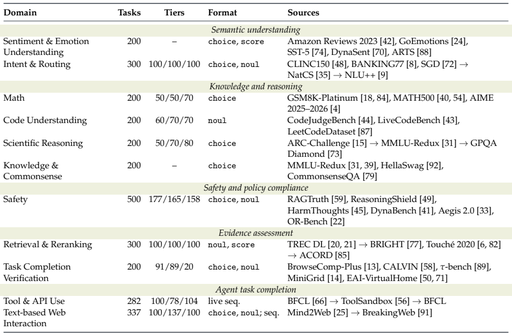
Table 3 :Composition of SO-Arena.Counts are natural tasks. Tiers give easy/medium/hard counts; Math addition- ally has 30 very hard AIME problems, and “–” marks domains without tiers. Where tiers draw on different sources, sources are listed from easy to hard, separated by→. “Seq.” denotes a sequence ofchoicerequests.
Original paper · CC BY 4.0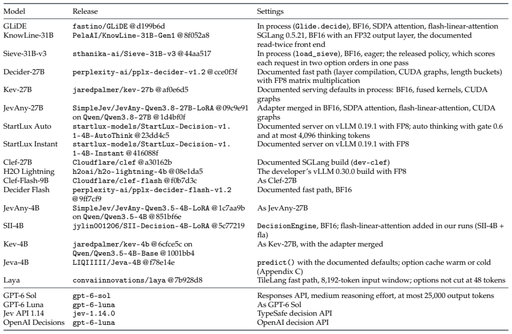
Table 4 :Releases and settings.Open-weight models: the Hugging Face repository at the revision used, and the inference path of our latency and reliability runs, which follows each developer’s documented fast path. APIs: the model identifier and settings of the evaluation runs.
Original paper · CC BY 4.0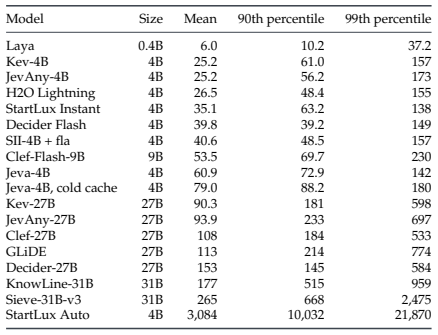
Table 5 :Latency per task (ms)on the 1,109 timed tasks: mean, 90th and 99th percentiles over tasks. Jeva-4B is timed with a warm and a cold option cache.
Original paper · CC BY 4.0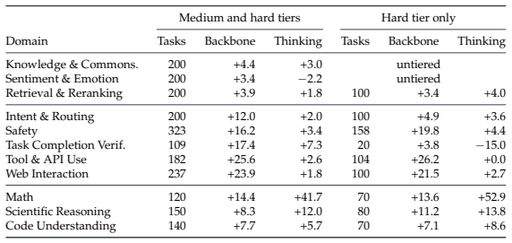
Table 7 :Backbone and thinking gains on the medium and hard tiers and on the hard tier alone.Gains as in Figure 7b and c (thinking:alwaysminusnever). The untiered domains are identical in both selections.
Original paper · CC BY 4.0Quote from the paper
Lichen Li, Ziping Dong, Sicheng Feng, Qi Li, Xinchao Wang (2026). SO-Arena: Benchmarking the Capability Spectrum and Reliability of System One Models. arXiv:2611.15777v1. https://arxiv.org/abs/2611.15777v1
BibTeX
@misc{li2026arena,
  title = {{SO-Arena: Benchmarking the Capability Spectrum and Reliability of System One Models}},
  author = {Lichen Li and Ziping Dong and Sicheng Feng and Qi Li and Xinchao Wang},
  year = {2026},
  eprint = {2611.15777},
  archivePrefix = {arXiv},
  url = {https://arxiv.org/abs/2611.15777v1}
}