Paper commentary
Keep Images in Sight: Visual Position Re-Anchoring for Long-Context MLLMs
VPR rephases cached image keys to restore access to earlier images
- Problem Long-context multimodal models lose access to image details as conversations grow, even though the image stays in context. Existing fixes need training or add decoding cost at every generated token.
- Method VPR rotates the cached visual keys toward a short-context reference before the question is processed. It needs no training, reuses the existing KV cache, and adds no forward passes.
- Results Static VPR improved 97 of 100 model-task scores across ten checkpoints and ten benchmarks, compared with vanilla inference.
Why images fade in long contexts
Users often return to a shared image after many turns or documents, so the model must keep its details usable long after the image first appears. Keeping the image inside the context window doesn't guarantee that the model can still read its details. The authors call this failure visual evidence drift, where the answer moves away from the detail the question requires while the image stays in context.
That input still fits within the checkpoint's configured context window, so the loss isn't a simple overflow problem.
Prior work tries to strengthen visual grounding through attention intervention, decoding-time correction, visual revisitation, and positional design. Some of these methods need training adaptation, while others process intermediate attention or add auxiliary predictions. Others repeat visual-token processing, which adds work at each step of generation.
When an intervention runs throughout decoding, these extra operations pile up over the generated tokens. That accumulating cost pushes the authors toward a way to restore visual access that keeps standard attention computation.
The authors run three diagnostics, and each one probes how the image and the intervening text interact. On identical short inputs, shifting question positions or visual-key phases can lower task scores without adding competing text keys. The KV cache already stores the image's visual keys, so these keys offer a point of intervention without recomputing the image or the prefix.
The authors therefore propose VPR, which adjusts the rotary phases of these cached keys to improve their interaction with later queries.
Testing what drives the loss
The first test holds the image and question fixed while the text between them grows from 0 to 32K tokens. Figure 3 pairs POPE accuracy with image-attention mass, using separate cohorts for the two measures. In LLaVA-L3.1-8B, image-attention mass drops from 11.08% at 0K to 1.51% at 32K. Accuracy moves less regularly, since Qwen3-8B-Instruct scores 84.8% at 16K and 77.8% at 32K.
Attention mass shows where attention goes, not whether the evidence was read correctly, so the authors don't treat it as a measure of understanding.
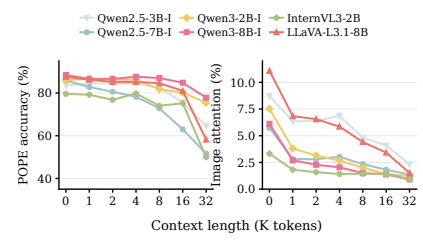
Figure 3 . Visual access across context lengths. V anilla POPE ac- curacy and image-attention mass measure task performance and allocation, respectively; they use separate cohorts (Appendix C.4).
Original paper · CC BY 4.0The second test fixes the total budget at 32K and moves the image through five layouts. Text after the image ranges from 0 to 32K tokens, with the remainder placed before the image. Several checkpoints score higher when more text sits before the image, even though the total is unchanged. Figure 4 shows these layouts for Vanilla and static VPR under identical inputs.
The sharpest test keeps the short image and question and changes only positions. Shifting the question forward or rephasing the cached visual keys backward can change scores without adding text. On POPE, an 8K question shift lowers InternVL3-2B accuracy by 11.2 percentage points, compared to 0.4 for the key shift. On TextVQA, both 24K shifts lower all four models' scores, with InternVL3-2B losing 8.5 and 3.7 points.
LLaVA-L3.1-8B loses about six points under either shift. The authors read this as position alone hurting image access, since no extra text enters the cache.
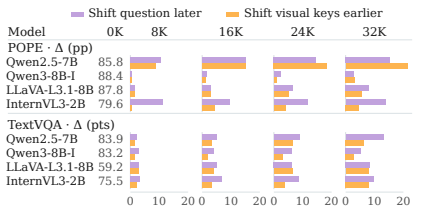
Figure 5 . Position shifts on identical short inputs. Bars show the score loss relative to each model’s unshifted score (0K) as the ques- tion moves later or the visual keys move earlier.
Original paper · CC BY 4.0Rephasing the cached image keys
The key idea is to keep the image, the text and every value in the cache, and rotate only the image keys so later questions see the image at roughly its short-context distance. Attention depends on relative position through RoPE, so rotating a key changes how strongly later queries attend to it. The authors expected this to work because the relative phase alone shapes query-key compatibility, without requiring distance to decay monotonically.
For a key at position n, rotating by δ gives the same result as rebuilding it at position n + δ. The composition law gives \( \tilde{k}_n = R_\Theta(\delta)k_n = R_\Theta(n+\delta)\bar{k}_n \), and a positive δ moves the key toward a later question. The transform is applied to the image keys in every decoder layer and KV head. Visual values, text-cache entries, physical cache slots and causal masks stay as they are, so the question attends to the modified keys through ordinary attention.
The offset is anchored to a short-context reference: the same image and question placed in the native chat template with no passage between them. Let \( p_Q \) be the first question position, a the first position after the image, and b0 the separation between them in the short layout; the extra gap is \( \Delta = (p_Q - a) - b_0 \). The applied offset is \( \delta = \rho\Delta \), where ρ = 0 leaves the cache alone and ρ = 1 removes the full added gap.
Building the reference needs only prompt preparation, with no extra forward pass.
For an image token i, the signed separation is \( d_i = p_Q - p_i \), and the re-anchored value is \( \tilde{d}_i = d_i^{(0)} + (1-\rho)\Delta \). At the default ρ = 1 the added separation cancels. For Δ > 0, values above 1 overshoot the reference and reverse the signed order of effective positions when ρ > 1 + d_i^{(0)}/Δ, though causal visibility is unchanged.
Static and continuous schedules
Before any question tokens arrive, VPR encodes the image and context, then applies the offset to the visual keys. Vanilla inference shares this same boundary, so the two runs differ only in the key rephasing. Decoding then advances the query from m0 by one position per step, where m0 is the query that predicts the first answer token.
The static schedule sets the shift to ρΔ at every step, so the offset stays fixed while image-query separation grows. The continuous schedule sets the shift to ρ(Δ + j) at decoding step j, so the first-answer separation stays at the ρ = 1 value. Both schedules run the same pre-question intervention, and the static one is the default. Each update starts from the saved original visual keys, which keeps rotation error from accumulating.
For 1D RoPE, the authors keep the native rotary pairing and frequency scaling, including Llama-3.1 scaling. For MRoPE, each coordinate moves by the same δ, and Qwen3-VL's interleaved layout stays in place. When frequencies change during decoding, the cached key is rewritten as R_target(p_i + δ) R_cached(p_i)^(-1) k_i. With fixed frequencies, this rewrite collapses to the single translation from Equation 3.
At δ = 0, the native cache stays unmodified.
Continuous updates add 6.23 to 10.91% in the same comparison, because they rewrite keys at every step. Across the 32K runs, the continuous schedule's overhead comes from repeated updates rather than from a larger offset. At 512 output tokens, InternVL3-2B takes 10.015 s with static and 10.019 s with continuous, since both make 513 updates.
At 8K, static makes one update (+0.04%), versus +36.71% for continuous VPR at 512 outputs.
What one cache update costs
The rephasing step costs one translation over the cached visual keys, scaling with layers, KV heads and visual tokens. That cost doesn't depend on text length once the cache exists, so a longer passage adds no extra translation work. Frequency adaptation can add further translations, while phase coefficients and saved visual keys take temporary memory.
After the update, ordinary attention reads the rephased keys directly, so the native attention backend stays in use.
With fixed rotary frequencies, Qwen and LLaVA models update their keys once, and static VPR adds 0.06 to 0.33% at 32K. At 128 output tokens, Qwen2.5-7B took 3.465 s with vanilla, 3.470 s with static VPR, and 3.709 s with continuous VPR.
InternVL3-2B behaves differently, since its full input exceeds the 32K base and activates dynamic NTK scaling. Changing frequencies requires rephasing even with a fixed offset, so its updates go beyond a single translation. At 512 output tokens, vanilla InternVL3-2B took 7.484 s, versus 10.015 s for static VPR and 10.019 s for continuous VPR.
Both schedules make 513 updates there, and the authors attribute their close runtimes to shared frequency-adaptation work.
At 8K, frequencies stay fixed, so static VPR makes one update at +0.04%. Continuous VPR at 512 tokens adds +36.71%, which shows the cost of tracking the query at every step. In Table 5, VPR adds 0.13% over vanilla, the smallest overhead among the five interventions on Qwen2.5-VL-7B. VAF adds 4.8% over vanilla under the same 32K and 128-token setting.
Static versus continuous VPR accuracy
Table 3 pits the two schedules against each other at ρ = 1 on TextVQA and MathVista. The continuous schedule advances its offset with each decoding query, so the displacement keeps growing. The static schedule keeps one fixed offset, which lets the image-to-query separation grow as decoding proceeds.
Continuous scores land between −1.2 and +1.1 points from static on TextVQA. On MathVista, the gap runs from −2.8 to +2.0 points. Tracking the query therefore gives no consistent accuracy advantage over holding the offset fixed. They didn't test whether a different update rule would change this comparison.
In the Table 4 runs, continuous updates add 6.23 to 10.91% overhead, while static updates add 0.06 to 0.33% at 32K. Qwen and LLaVA keep native fixed frequencies, so static VPR updates the keys only once. InternVL3-2B behaves differently, because its full input exceeds the 32K base and the frequencies must be re-expressed. At 512 output tokens, both schedules make 513 updates, taking 10.015 s for static and 10.019 s for continuous.
The authors attribute these similar runtimes to shared frequency-adaptation work.
At 8K context with fixed frequencies, static makes one update at +0.04%. Continuous VPR at 512 output tokens reaches +36.71% on the same measure. These results favor static VPR, especially when the frequencies stay native. Static VPR is also the default schedule that the authors adopt.
Gains across tasks and checkpoints
Table 1 covers ten checkpoints from four model families, each scored on ten visual tasks at a 32K budget. Each cell pairs the vanilla score with the VPR score, so every comparison stays inside one checkpoint and task.
Static VPR beats vanilla inference in 97 of the 100 model-task pairs. Every checkpoint gains on TextVQA, MMStar and RealWorldQA, so those three tasks have no exceptions. The gains are largest on tasks that need fine visual detail, such as document and chart reading.
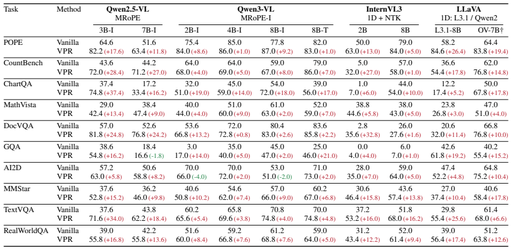
Table 1 . Ten checkpoints across ten visual tasks at 32K. Parentheses show VPR gains: red for increases, green for decreases. DocVQA uses ANLS, TextVQA uses consensus scores, and other tasks use accuracy, all on a 0–100 scale. I/T: Instruct/Thinking; L3.1/OV: LLaV A- Llama3.1/OneVision. †Context extrapolation.
Original paper · CC BY 4.0These two gains are main-setting numbers, so they describe a 32,768-token passage between the image and the question. The gains span four model families and ten tasks, so static VPR isn't confined to a few cases. Three drops out of 100 pairs mean the method isn't uniformly positive across every task. On CountBench, InternVL3-2B rises from 5.0 to 32.0 with VPR, a much larger jump than its other changes.
Recovery as the passage grows
Figure 6 traces identical TextVQA questions as the passage between the image and the question grows across seven lengths. Vanilla and static VPR receive identical inputs at each length, so every pair is a direct comparison. Static VPR beat vanilla at all 36 nonzero-length comparisons. Each panel uses its own vertical scale, so the panels can't be read against one another by height.
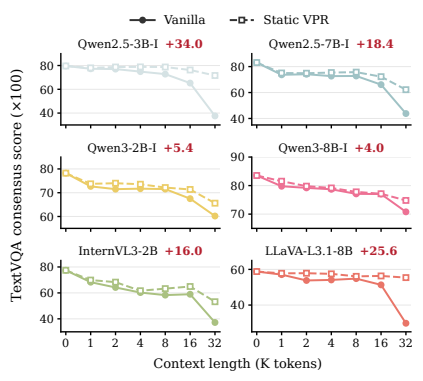
Figure 6 . TextVQA scores as the passage between the image and question grows. Static VPR scores higher than V anilla at every nonzero length shown. Each panel uses its own vertical scale.
Original paper · CC BY 4.0 · Juntao Xu, Qichai Zhao, Rui Sun, Zhouyang Jiang, Shiwei Wu, Zhi Li, Kaisheng Ma, Yu Liu · Keep Images in Sight: Visual Position Re-Anchoring for Long-Context MLLMs · Original paper figure · Extracted the figure area from page 6 of the original PDF.At 32K, Qwen2.5-3B rises from 37.6 to 71.6 on TextVQA. That gain recovers 34.0 of the 42.0 points the model lost from its 79.6 short-context score. The gain is large, but it doesn't bring the score back to the reference. The other 32K gains in Figure 6 are smaller, from +4.0 for Qwen3-8B-I to +25.6 for LLaVA-L3.1-8B.
All six models still sit below their short-context references, so the authors call the recovery substantial but incomplete. Qwen2.5-7B stays incomplete at 32K-after, the layout where text follows the image. InternVL3-2B's before-only score of 70.6 percent falls below its 79.6 percent short reference. Re-anchoring improves positional access, but it keeps representations shaped by the long prefix.
The appendix reports the POPE curve for the same lengths.
Image placement at a fixed budget
The image-placement test asks whether VPR still helps when the image sits later within the same 32K budget. Five layouts split one 32K passage into text before and after the image, running from 32K/0K up to 0K/32K. Each layout keeps the image and question fixed, and vanilla and VPR receive identical inputs. Several checkpoints scored higher with more text before the image, even though the total budget stayed unchanged.
VPR improved all 24 layouts that have text after the image. The before-only layout needs no compensation, since no text follows the image. Qwen2.5-3B stays within 82.2 to 84.6% across the layouts, while vanilla declines as more text follows the image.
Two cases stay incomplete, and Qwen2.5-7B at 32K-after is the first of them. InternVL3-2B's before-only score reaches 70.6%, which falls below its 79.6% short-context reference. The authors attribute the remaining gap to representations that the long prefix has already shaped, even after re-anchoring restores positional access.
Figure 4 marks each model's 0K POPE accuracy with dotted lines, so every layout can be compared with the short reference. Re-anchoring keeps the full long context in the cache and changes only the visual-key phases. Each layout's text stays in place, so the comparison isolates where the image sits.
Where attention moves
The first check is one TextVQA case at 32K, where Qwen2.5-VL-7B-Instruct says the picture has no plate. With static VPR, the model returns the reference string 5R96672, and its attention map shows stronger weight around the plate. One image can't show a pattern, so the authors measured the effect across many images.
For each image, they measure the share of visual attention that lands on text containing the reference answer. Figure 8 plots these shares as means with 95% bootstrap intervals. The share rises on 88 to 95% of images per checkpoint.
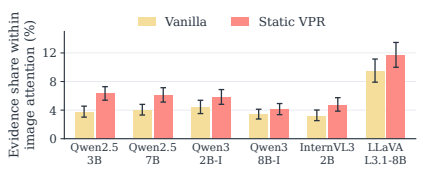
Figure 8 . Attention share on answer-bearing text within the image. Bars show means with 95% bootstrap intervals.
Original paper · CC BY 4.0A raw rise in visual attention could just mean the whole image gets more weight, so the authors normalize by total image attention. The authors read the result as support for more targeted access to visual evidence.
Appendix C.6 defines the measurement and spatial mapping, and the main text doesn't repeat them. In the Figure 7 difference map, red marks increases and blue marks decreases in attention, on a shared continuous scale.
How much compensation is enough
Table 2 sweeps the compensation strength ρ on long-context POPE for six checkpoints. Mean accuracy climbs from 62.9 at ρ = 0 to 77.4 at ρ = 1, with 0 to 1 as the reference range. Each checkpoint reaches its highest accuracy at ρ = 1, so the default setting matches every row maximum.
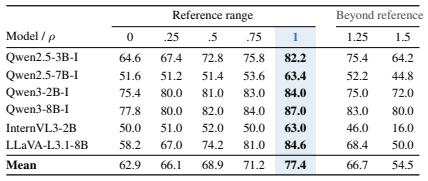
Table 2 . Long-context POPE accuracy across compensation strengths. Shading marks the default ρ = 1 . Bold marks row maxima. All six checkpoints contribute equally to the mean.
Original paper · CC BY 4.0Past ρ = 1, accuracy falls back, and the mean drops to 66.7 at ρ = 1.25. At ρ = 1.5, LLaVA-L3.1-8B falls to 50.0% and InternVL3-2B to 16.0%. Qwen2.5-7B-I starts at 51.6 with no compensation and ends at 44.8 when ρ reaches 1.5. These settings can reverse the effective image-query order and involve positional extrapolation. The authors explore beyond-reference behavior here, so they don't isolate one cause of the failure.
The reversal follows from the offset formula, because the signed separation flips once ρ exceeds 1 plus the short-context separation divided by ∆. ρ = 0 leaves the cache unchanged, while ρ = 1 removes the full added gap. The paper notes that uniform image-logit amplification preserves the within-image distribution, but rephasing can change it.
VPR against other training-free attention methods
The authors compare VPR with four training-free attention interventions on Qwen2.5-VL-7B-Instruct: VAF, VGA, VAR and VRGA. All four baselines work on attention itself, so the comparison asks how a cache-level edit fares against attention-level edits. They use POPE adversarial questions, and at 0K, VPR applies zero displacement, so it matches vanilla at 85.8%.
At 32K, VPR reaches 63.4%, VAF reaches 62.0%, and vanilla 51.6%. Over vanilla, VPR gains 5.0 to 12.0 percentage points at nonzero lengths. VGA matches vanilla at 8K and 16K, so it adds little under this setting.
The cost comparison fixes the input passage at 32K and generates 128 tokens on an H200. Static VPR takes 3.470 s per request and adds 0.13% over vanilla. That overhead is the smallest of the five methods, while VAF adds 4.8%.
On this checkpoint, the gain comes from one update to the cached image keys, which keeps the cost close to vanilla. The comparison covers one checkpoint and POPE adversarial questions only. They didn't test other checkpoints or benchmarks against these four methods.
Joint image and text lookup
The model has to find the relevant image detail and then apply the supplied mapping, so visual access comes before the final answer. Re-anchoring changes the effective image–question position while the intervening text stays in the cache for the mapping step.
For Qwen2.5-7B, vanilla accuracy drops from 18.75 at 8K to 11.00 at 32K. Static VPR lifts that checkpoint to 23.25 at 8K and 17.00 at 32K. Its gains are +4.50 at 8K, +7.00 at 16K, +6.25 at 24K and +6.00 at 32K. Qwen3-8B-I starts higher, at 72.25 for vanilla at 8K, and falls to 65.75 at 32K. Static VPR reaches 77.50 at 8K and 69.25 at 32K for this checkpoint.
Across both checkpoints and all four lengths, the gains fall between 3.50 and 7.00 percentage points. Keeping the full text in the cache lets the mapping step still draw on the passage while VPR improves image access. Qwen2.5-7B's absolute accuracy stays low, so its gain leaves substantial room for improvement. The authors point to Appendix C.8 for the protocol and a blank-image control.
The authors read these results as evidence that better visual access can help answers that also need textual evidence. The authors contrast this with position-only controls, which change scores while the input tokens stay fixed. They didn't test evidence spread across multiple images or documents in this lookup setup.
Limits and open questions
InternVL3-2B stays below its short-context reference even when the added passage comes before the image. The authors say position alone doesn't explain every loss, so the before-only layout doesn't close the gap. Under VPR, the before-only layout reaches 70.6%, while the short-context reference is 79.6%.
Compensation strengths beyond the reference range reduce accuracy, and the reported tests stop at ρ = 1.5. At ρ = 1.5, LLaVA-L3.1-8B falls to 50.0% and InternVL3-2B to 16.0%.
Image-attention mass measures how attention is allocated to visual tokens, so it doesn't prove the evidence is correct. The authors used the evidence-region analysis in Section 5.5 to examine annotated regions, which is a separate check.
The main experiments use one 32,768-token passage with the image and question. Extending the idea to evidence spread over several images and documents is left as a next step. Revisiting evidence across generated reasoning is also left open, so the paper doesn't test it.
Paper info
- Authors
- Juntao Xu, Qichai Zhao, Rui Sun, Zhouyang Jiang, Shiwei Wu, Zhi Li, Kaisheng Ma, Yu Liu
- Venue
- arXiv · Preprint
- First published
- 2026-11-11
- Added
- 2026-11-13
- Updated
- 2026-11-11
- Version
- v1
- arXiv
- 2611.15100
- Category
- cs.CV
- Original paper terms
- CC BY 4.0
- What we show
- Paper info, commentary and permitted figures from the original paper
AI commentary is a separate explanation from the original paper and may contain errors. The original paper and figures follow each source's terms of use and any rights noted separately.
Abstract
Long-context multimodal intelligence requires revisiting earlier images as conversations and documents accumulate, yet retaining an image does not guarantee reliable access to its details. By varying context length, redistributing a fixed text passage around the image, and changing positions without adding text, we identify the positional relation between images and questions as a direct influence on visual access. To address this gap, we propose Visual Position Re-Anchoring (VPR), a training-free method that shifts cached visual-key rotary phases toward a short-context reference before question processing. It operates directly on the existing KV cache, preserving standard attention computation without extracting attention maps or adding model forward passes. We develop static and continuous compensation schedules, using the static schedule by default. Across ten checkpoints and ten benchmarks, static VPR improves 97 of 100 model--task scores. Further analysis shows greater attention to regions containing answer evidence across six checkpoints, with minimal runtime overhead under fixed rotary frequencies. These findings demonstrate an efficient way to sustain visual access through positional adjustment within the cache.
Quote from the paper
Juntao Xu, Qichai Zhao, Rui Sun, Zhouyang Jiang, Shiwei Wu, Zhi Li, Kaisheng Ma, Yu Liu (2026). Keep Images in Sight: Visual Position Re-Anchoring for Long-Context MLLMs. arXiv:2611.15100v1. https://arxiv.org/abs/2611.15100v1
BibTeX
@misc{xu2026keep,
  title = {{Keep Images in Sight: Visual Position Re-Anchoring for Long-Context MLLMs}},
  author = {Juntao Xu and Qichai Zhao and Rui Sun and Zhouyang Jiang and Shiwei Wu and Zhi Li and Kaisheng Ma and Yu Liu},
  year = {2026},
  eprint = {2611.15100},
  archivePrefix = {arXiv},
  url = {https://arxiv.org/abs/2611.15100v1}
}