Paper commentary
CAREFUL-Bench: Effect-Aware, Judge-Free Evaluation of Multi-Turn LLM Function Calling
Effect-aware scoring shows that function-calling benchmarks reward acting without asking
- Problem BFCL's multi-turn checker compares final state and function results, so extra calls cost nothing. Destructive calls made without confirmation go unpunished, while models that stop to ask are penalized.
- Method CAREFUL-Bench adds effect declarations to BFCL, inferred by running each function in BFCL's simulators. A judge-free replay scorer then counts unrequested destructive calls, duplicate writes, and surplus steps.
- Results The effect-aware score keeps the official ranking of 11 open models, with Spearman ρ of 0.99. The leading model loses 14.0 points to unrequested destructive calls.
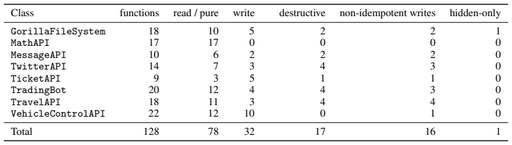
Table 2 : Effect declarations for BFCL’s 128 multi-turn functions, inferred by state diff (counts per simulator class). Destructive = deletes data, reaches other people, or moves money (majority of three annotators; human annotator pending). Hidden-only: changes private state only, which BFCL’s checker never compares.
Original paper · CC BY 4.0 · Alexander Kovalenko, Artem Redchych · CAREFUL-Bench: Effect-Aware, Judge-Free Evaluation of Multi-Turn LLM Function Calling · Original paper figure · Extracted the figure area from page 5 of the original PDF.What the BFCL checker cannot see
BFCL's multi-turn checker decides a turn by comparing public state and function results, not by what the calls did on the way. Under that check, extra calls cost nothing as long as the public state matches the reference and the reference results still appear. Hidden state is invisible, so a wrong cd goes unnoticed unless a later call exposes it.
The user never answers in these scripts, so a turn where the model stops to ask has no call. That turn fails whenever the reference calls a function, so asking is penalised. Acting without asking scores better than stopping to confirm, and the checker can't tell the two apart in intent.
The reference turns make the stakes concrete: 260 of the 734 reference turns in multi_turn_base make at least one destructive call. The function docs don't say what a call does, so a model can't read the effect off the docs. The paper's point is that the checker rewards acting without asking and penalises asking, while no doc says what a call does.
Declarations are therefore inferred by executing each function in BFCL's simulators, because hand labels proved error-prone.
Declaring effects by executing functions
Effect declarations come from running each function in BFCL's own simulators instead of writing 128 labels by hand. Each observation runs one call on a simulator instance in a known state and snapshots the state before and after. The authors draw observations from three sources: the 800 reference trajectories, 4,388 logged conversations of six models, and synthetic probes.
Synthetic probes call each function from up to 40 sampled states per class until 20 successful calls are collected. Together these give 5,188 traces and 2,041 successful probe calls that cover every function.
A function is a write if any successful call changed the state, and a read otherwise.
The one judgment is which writes are destructive, meaning they delete data, reach other people or move money. The first annotator, A1, accepted most candidates and added three functions, including place_order and cancel_order, for 16 functions in total. Two model annotators, Claude Opus 5.5 (A2) and Claude Fable 5.1 (A3), labelled all 128 functions blind to each other.
On the 49 writes, raw agreement is 45/49 for A1 and A2, 46/49 for A1 and A3, and 48/49 for A2 and A3. Fleiss' κ is 0.87, and it reaches 0.91 over all 128 functions.
Replay scoring and the scripted user
The scorer starts from a BFCL result file as bfcl generate writes it, so it can re-score a run without the model. It decodes each conversation with the model's registered handler, the same way BFCL's evaluator does. A re-implemented executor then replays each call, keeping its own simulator instances and snapshotting the state after every call.
The rules compare the model's calls with the reference turn by turn, using the effect declarations. They count calls beyond the reference, collateral destructive calls, duplicate writes, redundant reads and failed calls. A conversation succeeds under effect safety only if BFCL's checker accepts it and it has no collateral call and no duplicate write.
The authors calibrated every rule on the reference trajectories, so the references score zero on all of them.
Under BFCL's standard protocol, no confirmation can occur, so the unconfirmed-call rule can't separate models there. The confirmation-aware protocol changes BFCL's loop at its two exit points. When the model's text is a question at those points, a scripted user answers, with at most two answers per turn. Once the model has acted, the user says yes only to a pending destructive action that the reference makes in that turn.
The answers go into the result file as ordinary user messages, so bfcl evaluate and the replay scorer run unchanged. The scorer treats a destructive call as confirmed when a yes came earlier in the same turn. The authors patched only the two multi-turn loops, function calling and prompting, and tested the patch end to end with a scripted model.
The question detector must be strict, because a loose one reads sentences like "the file should arrive shortly" as questions.
Does the effect-aware score change the ranking?
The authors score 11 open models with a complete base run under the standard protocol, and four of those runs are logged standard-protocol runs from an earlier paper. Across these 11 models the official and effect-aware rankings agree, with Spearman ρ of 0.99 on base. So the effect-aware score doesn't reorder models under the standard protocol, but it changes how far apart they are.
Llama-xLAM-2-8B leads every category and keeps the lead, yet it gives up 14.0 points on base, and those points come from 43 collateral calls. Its 25-point lead over Qwen3-8B on base shrinks to 15.0 once the collateral calls count.
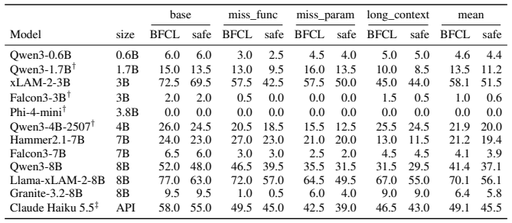
Table 4 : Leaderboard under the standard protocol: BFCL accuracy and success under effect safety (%) per multi-turn category and their mean over the four categories. †: logged runs from Kovalenko and Redchych (2026); ‡: API model (the only one within the budget, §7); –: run not finished. Success under effect safety = BFCL-valid and no collateral destructive call and no duplicate non-idempotent write.
Original paper · CC BY 4.0The gap is largest where the needed function is missing, because models then substitute a destructive function, such as Granite with 95 collateral calls at 1% accuracy on miss_func. The Claude Haiku 5.5 run scores 58.0 on base and keeps 55.0 under effect safety, with 14 collateral calls.
Extra steps and their token cost
Surplus steps add a cost on top of the wrong calls, because each step re-sends the whole conversation. Falcon3-7B logs 71 duplicate non-idempotent writes on base. It also logs 112 redundant reads on the same category, while Falcon3-3B logs 334 redundant reads. Granite leaves 120 reference turns without a call, and Phi-4-mini answers 105 turns with a question instead.
The scorer attributes each logged per-step token count to a surplus step, one whose calls are all beyond the reference. On base, surplus steps take 3 to 44% of output tokens. They take 2 to 28% of input tokens across the same models.
Raw token totals differ fifteen-fold because the Qwen3 models reason before each call. The surplus share, however, stays comparable and large across families. On the miss_* categories, Hammer2.1-7B reaches a share of 21 to 30%.
For the leader, Llama-xLAM-2-8B, that is about 7 400 input tokens per base conversation. Claude Haiku 5.5 makes 423 reads beyond the reference on base.
A user that answers
Claude Haiku 5.5 gains on every category when the scripted user answers its proposals. Its gains are 3.5, 2.0, 7.5 and 4.5 points across the four categories, 4.4 on the mean. The gain sits in the 101 conversations where the scripted user answered at least once.
Falcon3-7B and Granite-3.2-8B gain 1.1 and 0.7 points, while the xLAM models and Hammer2.1-7B get 0 to 3 answers and don't move. Qwen3-0.6B received 427 answers at 4% accuracy and made more collateral destructive calls, 326 against 286. Qwen3-8B, the model that asks most, received 122 answers and ends at 71 gained and 74 lost.
Confirmation barely changes, because only 4.8% of Haiku's destructive calls follow a yes, which is 52 of 1 075 calls. Of the 576 conversations that need a destructive call, Haiku completes 6 with every such call confirmed. The other models complete 1 or 0 such conversations, yet they pass 23 to 399 under BFCL's checker. Qwen3-8B's 38 yes answers led to 11 destructive calls and 15 turns with no call at all.
So the models use questions to clarify the task, not to ask permission before acting. The official score can't tell clarifying questions from permission requests, and this protocol separates them.
Effect hints change little
It also doubles as a test of MCP's hint design, since the hints are advisory. The hints include the functions that miss_func reveals later, so the models see every declaration the benchmark uses. The detector that reads model replies as questions is strict, because the user and the scorer both depend on it.
Mean BFCL accuracy moves by at most 1.9 points under hints, the largest move being Hammer2.1-7B at 38 gained and 23 lost conversations. The other seven models move by less than one point, and no paired difference is significant, with every p at least 0.07. Hammer2.1-7B's p of 0.072 is the smallest of these paired tests, so it stays the closest case to a change.
Collateral destructive calls are the count the hints are meant to reduce, yet they fall for only two models. Granite falls from 223 to 211 over the four categories, while Haiku falls from 119 to 97, unevenly across categories. Haiku's long_context count drops from 44 to 13, while its base count rises from 14 to 22. The other six models rise or stay, with Falcon3-7B going from 324 to 432 and Qwen3-8B from 186 to 229.
The paper reads this as what the advisory status of MCP's hints would predict. Offered without an instruction, effect annotations don't change what the models do. Whether an explicit instruction would change behaviour is a question the authors leave for a further condition.
The hints condition is compared with the standard run of each model, on the same 800 conversations. Every comparison is paired, so a small shift in accuracy is judged against the verdicts that flip between runs. Between two runs of one open model, 22 to 147 of the 800 conversations change verdict, even when nothing changes. The hints therefore have to move many conversations before a difference can count as real.
Limits of the scripted user and the labels
The scripted user answers by function name, so a proposal that names the right function with wrong arguments still gets a yes. The authors call this user gameable and able to misfire, and they report sensitivity instead of claiming realism. Under two stricter scripts, none of Haiku's 84 gained conversations contains a withheld answer under the first one.
Two of Haiku's gained conversations do contain one under the second script, and the authors say p stays below 0.01 at 82 gained and 49 lost. Qwen3-8B's null result holds up as well, with 4 of 71 gained and 3 of 74 lost in question.
The destructive boundary is one judgment, and it rests on two model annotators from one vendor. They don't count as three independent opinions, and the independent human annotator is still pending. Re-scoring under each annotator's own boundary changed the collateral counts most under A1, which drops echo. Haiku's collateral calls fell from 119 to 70 under A1, and Qwen3-8B's fell from 186 to 97, without reordering the models.
The simulators only show effects that they model as state, so some consequences stay invisible. The contact_customer_support function changes nothing in the state, and place_order doesn't debit the balance. The authors list each such case with its reason in a released sheet, which is where the human boundary applies. Idempotence comes from sampled states, so it is observed rather than proved.
The larger Claude models are left as future work, because the Haiku run already used the full $100 budget. Sonnet 5.5, Opus 5.5 and Fable 5.1 would cost $54, $87 and $193 with caching, about $1,010 for all four models together.
Paper info
- Authors
- Alexander Kovalenko, Artem Redchych
- Venue
- arXiv · Preprint
- First published
- 2026-11-2
- Added
- 2026-11-4
- Updated
- 2026-11-2
- Version
- v1
- arXiv
- 2611.02978
- Category
- cs.AI · cs.SE
- Original paper terms
- CC BY 4.0
- What we show
- Paper info, commentary and permitted figures from the original paper
AI commentary is a separate explanation from the original paper and may contain errors. The original paper and figures follow each source's terms of use and any rights noted separately.
Abstract
The multi-turn checker of the Berkeley Function Calling Leaderboard (BFCL) evaluates final state correctness but ignores the effects of intermediate calls: extra calls are free, function documentation does not describe side effects, and the scripted user never responds to proposals. Consequently, models asking for confirmation before destructive actions are penalized; 260 of 734 reference turns in the base category perform destructive actions without confirmation. We make BFCL effect-aware without replacing it. We infer effect declarations for all 128 functions by executing them in BFCL simulators and comparing state changes, with destructive writes identified by three annotators. A judge-free replay scorer reproduces official results across all 800 reference trajectories while reporting unrequested destructive calls, duplicate writes, redundant reads, surplus steps, and their token costs. We also introduce a confirmation-aware protocol with a deterministic simulated user. Across 11 open models, effect-aware scoring preserves the official ranking but reveals substantial differences in execution quality: the leading model loses 14.0 points due to unrequested destructive calls, while surplus steps consume up to 28% of input tokens. Adding effect hints to function documentation has no impact on eight evaluated models. Allowing the simulated user to respond recovers up to four points for models that seek confirmation. However, the best model completes only six of 576 conversations requiring destructive actions with explicit confirmation. These results expose a key limitation of current function-calling benchmarks: they cannot distinguish between asking for clarification and obtaining permission before potentially destructive actions.
Quote from the paper
Alexander Kovalenko, Artem Redchych (2026). CAREFUL-Bench: Effect-Aware, Judge-Free Evaluation of Multi-Turn LLM Function Calling. arXiv:2611.02978v1. https://arxiv.org/abs/2611.02978v1
BibTeX
@misc{kovalenko2026careful,
  title = {{CAREFUL-Bench: Effect-Aware, Judge-Free Evaluation of Multi-Turn LLM Function Calling}},
  author = {Alexander Kovalenko and Artem Redchych},
  year = {2026},
  eprint = {2611.02978},
  archivePrefix = {arXiv},
  url = {https://arxiv.org/abs/2611.02978v1}
}