Paper commentary
ELEVATER: A Benchmark and Toolkit for Evaluating Language-Augmented Visual Models
Benchmark and toolkit show how language-augmented visual models transfer across tasks
- Problem Language-augmented visual models such as CLIP are hard to compare, because each study uses its own downstream tasks and adaptation process is often not public. Researchers cannot tell whether a gain comes from the model or from the evaluation setup.
- Method ELEVATER is a public benchmark and toolkit with 20 image classification and 35 object detection datasets. It scores adaptation on sample efficiency and parameter efficiency, from zero-shot to full-shot and from linear probing to full fine-tuning.
- Results The paper reports a common evaluation setup for comparing these models on task-level transfer. Its baselines include CLIP ViT-B32, where the zero-shot score across 20 classification datasets is 56.64.
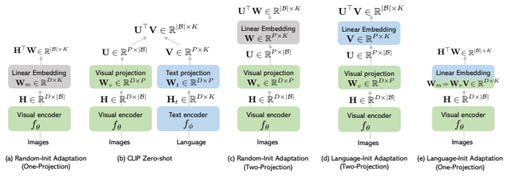
Figure 5 : Illustrative comparison of different model evaluation and adaption methods.
Original paper · CC BY 4.0 · Chunyuan Li, Haotian Liu, Liunian Harold Li, Pengchuan Zhang, Jyoti Aneja, Jianwei Yang, Ping Jin, Houdong Hu, Zicheng Liu, Yong Jae Lee, Jianfeng Gao · ELEVATER: A Benchmark and Toolkit for Evaluating Language-Augmented Visual Models · Original paper figure · Extracted the figure area from page 6 of the original PDF.Why task-level transfer lacked a shared yardstick
Language-augmented visual models such as CLIP and ALIGN have shown strong transfer to many downstream tasks. Each study, however, tends to rely on its own downstream tasks, and the process of adapting the models to those tasks is often not public. Researchers therefore can't tell whether a reported gain comes from the model or from the evaluation setup.
Comparing models fairly and building on other people's work becomes extremely difficult under these conditions.
Earlier zero-shot benchmarks test generalization to unseen categories inside one domain, using a manual split of categories into disjoint training and test sets. For object detection, COCO and LVIS compare methods within a single domain, while UODB is a multi-domain OD benchmark. The task-level setting, which asks for transfer to unseen datasets, had no public benchmark to standardize it.
VTAB studies task transfer with an emphasis on few training examples, but it uses vision backbones only and involves no language modality. The authors' benchmark shares VTAB's spirit of task-level transfer, yet it adds language to the picture.
The authors therefore build a public benchmark and toolkit, ELEVATER, to make task-level transfer comparisons more reproducible. Their goal is to make the research results, such as a model's task-level transferability, more rigorous and reproducible.
Datasets and external knowledge in ELEVATER
ELEVATER pairs 20 image classification datasets and 35 object detection datasets with external knowledge for every class name. The benchmark covers two challenges, Image Classification in the Wild (ICinW) and Object Detection in the Wild (ODinW). The task definition of each downstream recognition dataset is usually given by its category names.
The authors use three general knowledge sources: WordNet hierarchy paths, WordNet definitions and Wiktionary definitions. Those three sources don't return valid knowledge for every query, so the authors add GPT3 to reach full coverage. GPT3 gets prompts built from pairs of class names and their Wiktionary definitions, using in-context learning.
The authors generate five GPT3 knowledge sequences per class name, each from different context prompts with randomly sampled pairs. WordNet has relatively rich and precise knowledge but low coverage, while GPT3 covers the full set but its quality is hard to assess. Figure 3 (b) shows examples of the collected knowledge for the concepts risotto and starfish.
The pre-training data is split into two tracks that limit scale in different ways, because large corpora are a barrier for university labs. The Academic track restricts pre-training to established public datasets: ImageNet-21K, GCC3M, 12M and YFCC15M. Benchmark images can't be used in Industry track pre-training when reporting zero-shot or few-shot results.
Table 2 lists the pre-trained checkpoints the authors evaluate as baselines on ELEVATER.
Starting the linear head from text features
The key idea is to start the classifier head from text features the model already has, instead of from random weights. The authors argue that random initialization leaves the language side of these models unused. Language-free models, such as supervised and self-supervised ones, can't be used for zero-shot transfer and need added weights for adaptation.
A language-free visual model encodes each image x as a feature vector h, and one randomly initialized projection Wm serves as the classifier. A language-augmented model adds a text encoder, and the projections Wv and Wt map image and text features into a joint space of dimension P. For zero-shot prediction, the mean text feature v is computed for each category by averaging its prompts, and the image takes the category with the highest u^T v.
Two-Projection places the linear head W on the projection space and initializes it with V, with bias terms set to zero. One-Projection puts the head on the backbone before the visual projection and initializes it as the product WvV. This keeps the number of trainable parameters the same as in language-free adaptation, which the authors use for a fair comparison.
Because D is 768 and P is 512, the one-projection head has fewer parameters, which the authors use to explain its small edge.
Knowledge is joined to each prompt with a semicolon, and the encoded embeddings of all prompt and knowledge pairs are averaged for the concept. Random initialization has no way to use this knowledge source. Two-Projection with language-initialized weights is the default in the ensuing experiments, so the trainable count matches CLIP's random head.
In Figure 6, language-based initialization significantly outperforms random initialization under both LP and FT, and even 2-shot results beat the zero-shot CLIP.
How sample and parameter cost are measured
ELEVATER scores adaptation on two axes, sample efficiency and parameter efficiency, and each axis spans a range of settings. Sample efficiency runs from zero-shot to few-shot to full-shot, so the cost of labeled data is varied directly. Parameter efficiency runs from linear probing to full model fine-tuning, which fixes how many weights get updated.
Figure 4 places these two axes on a 2D chart, where the bottom-left corner is the most inexpensive strategy and the top-right corner is the most expensive. Because the axes are orthogonal, one can interpolate between them and build intermediate adaptation methods with different costs.
Few-shot evaluation exists because annotating data is costly, so transferable models should perform well in data-limited scenarios. For IC, the training size per category N is 0, 5, 20 or 50, while for OD it is 0, 1, 3, 5 or 10. For OD, N-shot means providing at least N images per category. Three random seeds each select a subset of samples in a deterministic manner, so the few-shot splits can be repeated.
The authors also fix the indices of the training samples once the seed is given, which supports reproducible research.
Linear probing is the minimum-cost option for parameter efficiency, since it updates the fewest weights. Fine-tuning updates the entire weights of the backbone and the linear head, which makes it the most expensive adaptation. For GLIP, prompt tuning updates only the language input, which was initialized from V.
The paper explains that a large number of dataset-specific parameters is hard to maintain, because each downstream application would need its own copy of a large checkpoint. This maintenance cost is why the authors treat parameter count as a separate axis from sample count. Prompt tuning in GLIP sits between these two extremes, since it changes the language input rather than the whole model.
Language initialization on image classification
Language initialization is the paper's main answer to whether text features help the linear head on image classification, and the comparison uses CLIP ViT-B32 as the checkpoint. The zero-shot CLIP ViT-B32 score across the 20 IC datasets is 56.64, and that single value is shared by every row of the table. Under both linear probing (LP) and fine-tuning (FT), the paper reports that language-based initialization significantly outperforms random initialization across the shot counts in Figure 6.
At 5 shots, Language-2P linear probing scored 65.35, compared to 58.09 for Random-2P linear probing. Even with about 2 shots per category, the authors show that both LP and FT with language initialization outperform zero-shot CLIP.
Random-initialized fine-tuning scored 29.75 at 5 shots, far below its zero-shot starting point of 56.64. The paper finds that random fine-tuning performs significantly worse than linear probing under few-shot settings. With language initialization, fine-tuning starts to outperform linear probing only with more than 20 shots. Language-2P fine-tuning scored 63.29 at 5 shots, which is still above its random-initialized counterpart.
At full shot, Language-2P fine-tuning reached 80.35, compared to 77.77 for Random-2P fine-tuning. Under the same CLIP checkpoint, the one-projection variant Language-1P gave 65.88 at 5 shots with linear probing. The paper uses the two-projection language-initialized scheme as the default in later experiments, because it keeps the number of trainable parameters the same as random initialization.
The authors also report that CLIP beats supervised ViT by a 5 to 10% gain at 5 shots.
Object detection and parameter cost
On the 35 OD datasets, GLIP with linear probing scored 35.2 at full shot, compared to 31.4 for DyHead. At 1 shot the gap is wider, with GLIP scoring 22.2 against DyHead's 15.2 under linear probing. GLIP's zero-shot score is 19.7, so the language-augmented detector starts well above the language-free one only after adaptation begins. The authors summarize that the language-augmented GLIP is more sample-efficient than DyHead under either LP or FT.
Fine-tuning beats linear probing at every OD shot count, which differs from the IC pattern. The authors suggest this is because OD images carry many boxes, which makes overfitting less likely than in IC. Full-shot fine-tuning scored 63.2 for GLIP, against 35.2 for its linear probing. For parameter cost, the authors observe that more trainable parameters lead to better performance across the curves they plot.
They also note that LP and FT give the lower and upper bounds in both parameters and performance.
Prompt tuning gives a cheap alternative to linear probing for detection, and the authors call it an effective parameter-efficient approach. Prompting is better than linear probing in GLIP, as the authors report from the Fig. 7 (d) results. Prompt-tuned GLIP beats fine-tuned DyHead in the 1-shot setting, while the former has less than 0.1% of the latter's parameters.
In IC, by contrast, the 5-shot CLIP curve dips slightly when full fine-tuning replaces the probe, so the authors call data-limited adaptation a more meaningful playground.
What external knowledge adds to zero-shot transfer
External knowledge lifts zero-shot scores on the image classification benchmark, even for checkpoints pre-trained without it. The knowledge-free UniCL starts at 27.15 zero-shot when it uses only the class name. With Wiktionary definitions, UniCL reaches 29.92, and the WordNet definitions raise it to 30.68. Across the knowledge sources, UniCL ranges from 29.92 to 33.93 in the zero-shot setting.
GLIP-A moves from 11.53 to between 11.70 and 13.30 mAP on object detection. The authors used K-LITE for this test because its pre-training already includes knowledge.
More GPT-3 knowledge items help the image classification score, rising from 33.00 to 34.00 as the count grows from 1 to 5. On object detection, the same growth in GPT-3 items does not give a consistent gain. Combining GPT-3 knowledge with Wiktionary knowledge adds a further boost, reaching 33.95 for UniCL. The authors also tested whether the knowledge helps knowledge-free models such as CLIP during adaptation, and they report it in the appendix.
In few-shot and full-shot transfer, the auto-tuning stage picks whether to use external knowledge. This selective choice gives a consistent improvement or a tie on 15+ of 20 datasets. Initializing the linear head with knowledge-encoded features is an effective way to use the knowledge, especially at fewer shots.
Where the results stop
The detection tables cover only GLIP and DyHead, both built on Swin-Tiny backbones. The authors didn't put the language-free models MoCov3, MAE, ViT and DeiT in the main comparison, so those results sit in the appendix.
The knowledge gains were measured for UniCL and GLIP-A in zero-shot transfer. The knowledge-free CLIP check appears only in the appendix, while external knowledge improved the baseline on four datasets. GPT3 knowledge has full coverage, but the authors note that its quality is hard to assess.
Few-shot numbers are averages over three random seeds, and each seed fixes a deterministic subset of samples. Some spreads are wide, such as the random-initialized fine-tuning row at 29.75 ± 6.64 for 5 shots. The authors claim that few-shot results always beat zero-shot results for their language-initialized methods. Supervised ViT rows have no zero-shot entries, since language-free models can't transfer zero-shot.
For OD, N-shot means providing at least N images per category, which gives fewer labels than the IC sweep. DyHead's linear probing row has no zero-shot entry, so it can't be compared at zero shots.
Paper info
- Authors
- Chunyuan Li, Haotian Liu, Liunian Harold Li, Pengchuan Zhang, Jyoti Aneja, Jianwei Yang, Ping Jin, Houdong Hu, Zicheng Liu, Yong Jae Lee, Jianfeng Gao
- Venue
- arXiv · Preprint
- First published
- 2022-4-19
- Added
- 2026-11-5
- Updated
- 2022-10-13
- Version
- v6
- arXiv
- 2204.08790
- Category
- cs.CV · cs.CL · cs.LG
- Original paper terms
- CC BY 4.0
- What we show
- Paper info, commentary and permitted figures from the original paper
AI commentary is a separate explanation from the original paper and may contain errors. The original paper and figures follow each source's terms of use and any rights noted separately.
Abstract
Learning visual representations from natural language supervision has recently shown great promise in a number of pioneering works. In general, these language-augmented visual models demonstrate strong transferability to a variety of datasets and tasks. However, it remains challenging to evaluate the transferablity of these models due to the lack of easy-to-use evaluation toolkits and public benchmarks. To tackle this, we build ELEVATER (Evaluation of Language-augmented Visual Task-level Transfer), the first benchmark and toolkit for evaluating(pre-trained) language-augmented visual models. ELEVATER is composed of three components. (i) Datasets. As downstream evaluation suites, it consists of 20 image classification datasets and 35 object detection datasets, each of which is augmented with external knowledge. (ii) Toolkit. An automatic hyper-parameter tuning toolkit is developed to facilitate model evaluation on downstream tasks. (iii) Metrics. A variety of evaluation metrics are used to measure sample-efficiency (zero-shot and few-shot) and parameter-efficiency (linear probing and full model fine-tuning). ELEVATER is a platform for Computer Vision in the Wild (CVinW), and is publicly released at at https://computer-vision-in-the-wild.github.io/ELEVATER/
Figures from the paper
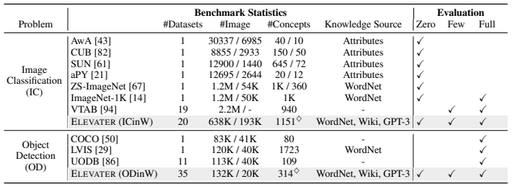
Table 1 : Comparison of dataset statistics and evaluation settings. For existing zero-shot datasets in IC, the number of images and concepts are reported for development / evaluation stages separately.♦ represents the total number of concepts in the benchmark to evaluate task-level transfer, and there is no train-evaluation category split as in class-level transfer.
Original paper · CC BY 4.0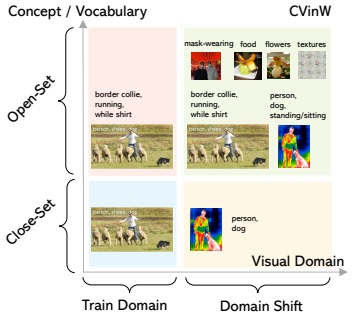
Figure 2 : Illustration of CVinW in comparison with close-set, open-set and domain shift.
Original paper · CC BY 4.0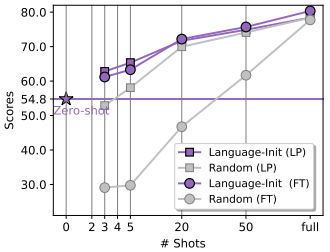
Figure 6 : Comparison of random- and language- initialized adaptation.
Original paper · CC BY 4.0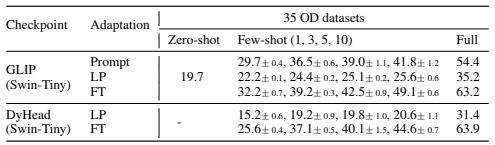
Table 4 : Averaged results on 35 OD datasets.
Original paper · CC BY 4.0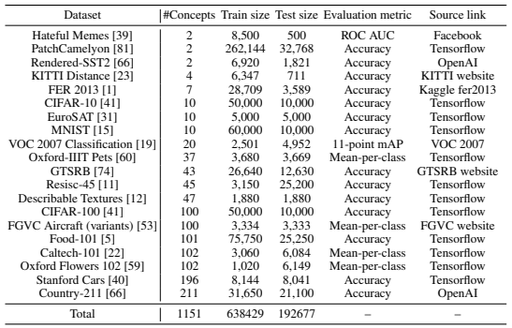
Table 5 : Statistics of 20 datasets used in image classification.
Original paper · CC BY 4.0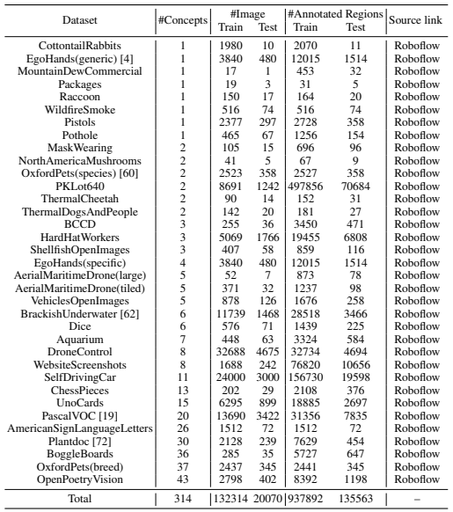
Table 6 : Statistics of 35 datasets used in object detection. Box mAP is used as the evaluation metric. Datasets are downloaded from Roboflow. For the datasets without a citation, we refer to Roboflow links for the original sources.
Original paper · CC BY 4.0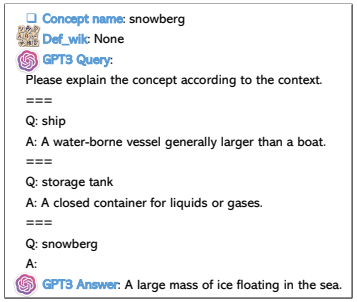
Figure 10 : Example of generating external knowledge with GPT3 using in-context learning even when Wiktionary knowledge is missing.
Original paper · CC BY 4.0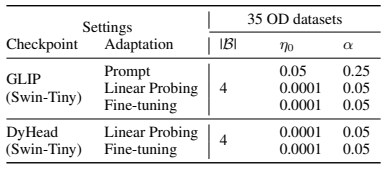
Table 8 : Pre-selected hyperparameters for OD datasets.
Original paper · CC BY 4.0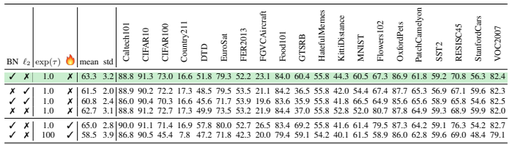
Table 9 : Effect of the normalization and temperature with 5-shot finetuning CLIP (ViT/B-32). The linear head is initialized with the proposed language-initialization adaptation strategy.
Original paper · CC BY 4.0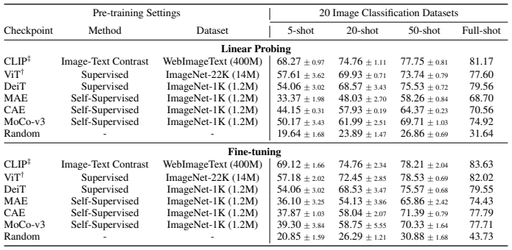
Table 11 : Averaged scores on 20 IC datasets with the ViT-B16 network architecture. ‡ CLIP is adapted using the proposed language-augmented initialization.† ViT checkpoint is pre-trained on ImageNet-22K, then fine-tuned on ImageNet-1K. The zero-shot performance of CLIP is 59.96%.
Original paper · CC BY 4.0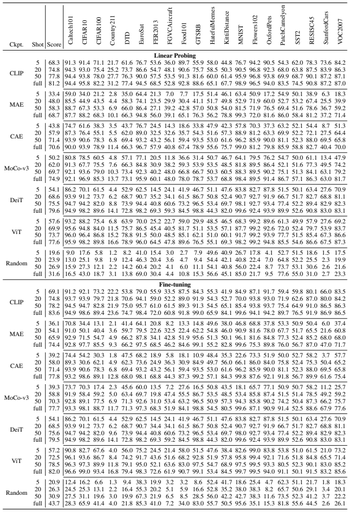
Table 12 : Breakdown results of ViT-B16checkpoints in Table 11.
Original paper · CC BY 4.0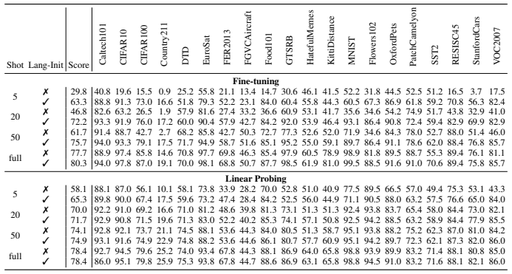
Table 13 : Comparison of random and language-augmented initialization on CLIP (ViT-B32).
Original paper · CC BY 4.0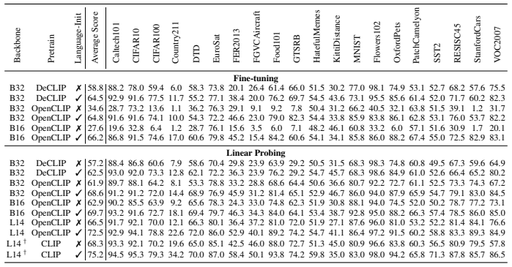
Table 14 : Comparisons of random and language-augmented initialization for language-image model adaptation with more checkpoints under 5-shot settings.† Input image size 336×336 .
Original paper · CC BY 4.0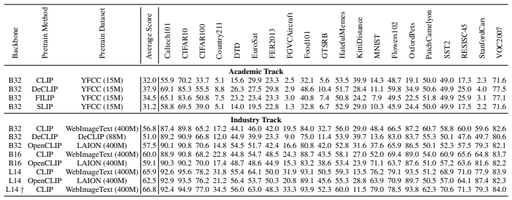
Table 15 : Zero-shot results of more checkpoints in Academic and Industry Tracks.† Input image size 336×336.
Original paper · CC BY 4.0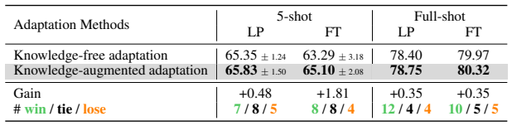
Table 16 : Benefits of adapting CLIP with external knowledge.
Original paper · CC BY 4.0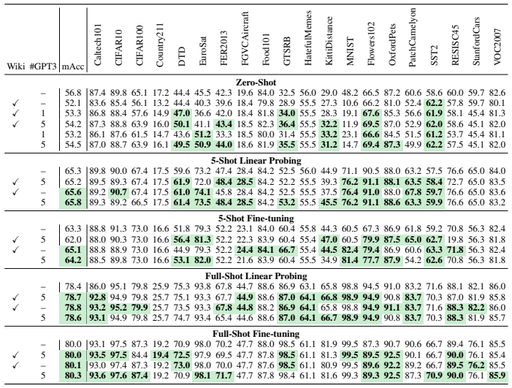
Table 17 : Benefit of external knowledge for CLIP. For adaptation with linear probing and fine-tuning, we make use of the external knowledge when it has a higher validation accuracy.
Original paper · CC BY 4.0Quote from the paper
Chunyuan Li, Haotian Liu, Liunian Harold Li, Pengchuan Zhang, Jyoti Aneja, Jianwei Yang, Ping Jin, Houdong Hu, Zicheng Liu, Yong Jae Lee, Jianfeng Gao (2022). ELEVATER: A Benchmark and Toolkit for Evaluating Language-Augmented Visual Models. arXiv:2204.08790v6. https://arxiv.org/abs/2204.08790v6
BibTeX
@misc{li2022elevater,
  title = {{ELEVATER: A Benchmark and Toolkit for Evaluating Language-Augmented Visual Models}},
  author = {Chunyuan Li and Haotian Liu and Liunian Harold Li and Pengchuan Zhang and Jyoti Aneja and Jianwei Yang and Ping Jin and Houdong Hu and Zicheng Liu and Yong Jae Lee and Jianfeng Gao},
  year = {2022},
  eprint = {2204.08790},
  archivePrefix = {arXiv},
  url = {https://arxiv.org/abs/2204.08790v6}
}