Paper commentary
Language Defaults Before Content: A Causal Layer Map of Multilingual Generation
Multilingual models pick the output language after they settle the content
- Problem Output-only evaluations cannot show where a multilingual LLM picks content and language.
- Method The authors patch the last-token residual state from a successful translation run into a failing one, layer by layer. They compare the matched donor against shuffled, mean, and steering-vector controls to separate content from language.
- Results Matched donors beat shuffled donors by 4.43 chrF++ at L17, compared with 0.43 at L16. The English default appears first, then content, then the target language in three LLMs.
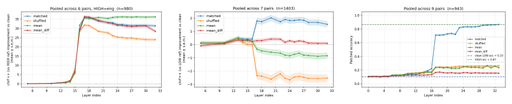
Figure 1 : Per-layer effect of last-token patching in gemma-3-4b-pt, pooled over instances and read per donor condition.Left:∆ HIGH (chrF++ against the HIGH target’s gold translation) for the six different-target pairs whose HIGH direction targets English (n=980). All four donors rise together at L15–16; only at L17 doesmatchedseparate. Middle: ∆LOW for the seven same-target pairs (n=1403), where no language flip is possible; thematched–shuffled gap opens at L17.Right: Belebele accuracy for nine language contrasts ( n=943); the clean baseline is 0.10 and the HIGH pass scores0.87. xCOMET-XL versions of the two MT panels are in Appendix F.
Original paper · CC BY 4.0 · Shenbin Qian, Yves Scherrer · Language Defaults Before Content: A Causal Layer Map of Multilingual Generation · Original paper figure · Extracted the figure area from page 5 of the original PDF.Why output alone can't settle the question
A multilingual model has to settle two things when it generates text: what to say and in which language to say it. Those decisions are entangled in the final output, so behavioral evaluations alone cannot show where in the network each one arises or the order in which they are resolved. Holding the content fixed while the language varies is what makes the two commitments visible in the activations.
Each contrastive instance pairs one parallel segment translated in a direction the model handles well (HIGH) with the same segment translated in a direction it handles poorly (LOW). When the targets coincide, no language switch is possible, so any quality gain against the LOW reference reflects content.
A successful HIGH-to-LOW patch doesn't reveal what kind of information moved. The donor state may carry content-specific information, or content-independent signals such as the intended output language. The authors set the matched HIGH donor against three controls: a shuffled HIGH state, the mean HIGH state, and the additive mean_diff steering vector.
Because their relative effects differ, the comparison can separate information tied to a particular content from information shared across successful generations. Donor-controlled patching is the method the paper builds on to separate content-specific and content-independent components of a patch.
What each donor condition isolates
The donor conditions separate content from language by changing only where the patched vector comes from. A gain under a replacement patch is ambiguous, because the donor may supply the segment's content or only a content-free signal about executing the task. The matched donor is the HIGH activation of the same instance, serving as the positive control that replicates a standard cross-lingual patch.
The shuffled donor is the HIGH activation of a different instance, picked by a seeded derangement, so no gain there can come from the segment's content. Only the matched donor sees the test segment, which is why the other three donors serve as controls.
The mean donor averages all N HIGH activations at a layer and rescales the result to the average per-instance norm. Because the mean donor is identical for every instance, it carries no instance-specific content by construction. The mean_diff condition is the only additive one: it keeps each instance's own LOW state and adds the steering direction.
That steering direction is the average HIGH state minus the average LOW state, so mean_diff tests whether a single linear direction carries the effect.
Each donor is applied with the same patch site and sweep, so differences between donors reflect only what the donor carries. The authors read the effects as quality change and as the fraction of outputs in the target language, measured against the LOW and HIGH references. Comparing matched against shuffled and mean therefore shows which part of the effect depends on the particular content.
Mean and mean_diff, which carry no instance's content, show what is shared across successful multilingual generations.
How a patch is written and scored
A patch edits one residual vector, the state at a single layer and at the last token of the LOW prompt. Every other state in the forward pass is computed normally, so the write stays confined to that one position. A replacement patch overwrites the LOW state with a donor vector taken from HIGH forward passes. An additive patch keeps the LOW state and shifts it along a steering direction, with alpha set to 1 unless stated otherwise.
Each layer is patched independently, so a layer curve reports that layer's marginal causal contribution.
Translation quality is read as a change in chrF++ and xCOMET-XL, with Delta LOW measured against the LOW reference. Delta HIGH is measured against the HIGH direction's gold translation for different-target pairs. Output language comes from fastText lid.176, which the authors don't treat as reliable on short outputs in closely related languages.
To cover that gap, the authors count target-exclusive characters, using exclusive letters for same-script siblings and Unicode script membership for different-script targets. An instance counts as flipped at the first layer from L8 on where the HIGH-target exclusive share reaches 0.5, and the median of these layers gives the onset layer.
Contrastive instances are kept when the LOW xCOMET-XL score falls below its threshold and the HIGH score meets its threshold. Each pair needs a margin of at least 0.10 between the two thresholds and at least 50 surviving instances. Belebele is scored by accuracy difference and by whether the patched answer matches the HIGH pass's own prediction.
The three-stage layer map: where each signal appears
At L15 and L16 the English switch appears in all four donor conditions, so the donor's identity barely matters for it. On the six English-target pairs, the matched donor's ∆HIGH rises from 8.0 to 28.5 chrF++ between L15 and L16. The shuffled donor moves from 7.8 to 28.5, the mean donor from 5.8 to 31.8, and mean_diff from 6.7 to 29.4. The matched minus shuffled difference is 0.15 chrF++ at L15 and -0.02 at L16, so the donor's source makes no measurable difference.
The authors read this jump as one instance-independent additive direction, not as the test segment's content.
Content transfer shows up one layer later, on the same-target pairs where a language flip cannot happen. At L17 the matched donor reaches +1.79 chrF++, while the shuffled donor falls to -2.35 and the mean donor to -0.34. The matched minus shuffled gap is 0.43 chrF++ at L16 and 4.43 at L17, and it persists to L32. xCOMET-XL reproduces the onset and the ordering, at 0.05 for matched against -0.01 for shuffled at L17.
Belebele gives the same onset without any surface metric. Matched accuracy rises from 0.22 at L16 to 0.71 at L17, while shuffled and mean stay at 0.26 and 0.24, near the four-way chance level. The authors argue that two unrelated task formats placing the onset at L17 points to a property of the model, not of translation.
After the language flip is complete at L16, the matched donor separates from the shuffled donor at exactly L17. The scores there are 36.1 for matched against 31.8 for shuffled, with p below 10 to the power of -3. From L20 on, the mean donor overtakes matched on ∆HIGH, at 36.3 against 31.5 at L32. xCOMET-XL doesn't reproduce that order, so the authors treat this as a surface-form effect that changes wording without reducing adequacy.
Why sister targets resolve late
When the HIGH direction targets something other than English, the flip onset moves to L22 to L24 in the paper's flip-onset atlas. The flip fraction tracks how far apart the two targets are: 0.44 for khm to cmn and 0.42 for khm to hin, both cross-script. Those values sit against only 0.12 for the nno/swe pair and 0.08 for the ukr/rus pair, which are sister targets.
Sister targets sit at L24 with near-zero flip fractions, so English and high-resource Latin targets form a separate cluster. The atlas leaves out eng→kas vs. eng→hin, because its discriminator is saturated at baseline, with 91.8% of clean eng→kas outputs already identified as Hindi.
The logit lens needs no intervention, and Llama-free probing here runs on the same prompts as the patching sweeps. Cyrillic mass for eng→rus stays at 0.05 to 0.10 through L23, reaching 0.38 at L24 and 0.97 at L33.
The logit lens therefore reproduces the patching onset map from the previous section, with Latin and English rising at L16. The atlas and the logit lens agree, and Zeng et al. (2025) reports similar results for the logit lens.
Sparse features and causal effect
Reconstruction is faithful, with mean relative L2 fidelity moving from 0.96 at L13 to 0.90 at L28, and roughly 100 to 150 active features per vector. They fit the flip direction r, the difference between the mean HIGH and mean LOW residuals, by least squares on the top-k decoder directions. The resulting cumulative R2k measures the share of r's variance captured by the linear subspace of those k directions.
The English flip direction isn't sparse, with R2 at top-50 at 0.80 at L13 and 0.48 at L15. R2 then reaches 0.54 at L16 and recovers to 0.76 at L17, so the dip sits exactly where the English flip is causal. The authors read this as the English-flip direction being represented least sparsely at this layer.
Feature steering works because decoder directions live in the model's own residual space, so they can be added to or subtracted from an activation. The ablate operation removes the currently active LOW-associated features, while add injects the selected HIGH-associated features. The both operation applies the two together, and the intervened state is h plus the change.
Each feature set is checked by hand on the max-activating-feature dashboard before patching, which leaves 3 to 7 features per layer. On English-HIGH pairs, matched, mean and mean_diff move 76 to 97% of outputs into English at the onset layer. The sparse interventions stay at the clean baseline of 0 to 5%, and the negative result holds for both SAE widths, for k up to 100, and at alpha values of 1 and 4.
For sister targets the picture reverses, because R2 at L24 to L25 is 0.91 to 0.95, so the separating direction is sparsely represented. Yet no identified feature flips the language, since matched flips only 6 to 7% of instances against a clean baseline of 0 to 3%.
The authors caution that a failed SAE test doesn't prove that no sparse representation exists. They didn't claim that the sparse negative results generalise beyond the three pretrained models studied.
Instance-specific features become load-bearing at L17
The authors split each HIGH vector's active features into shared features, active in at least 90% of a pair's instances, and instance-specific features. To test whether this instance-specific part matters, they patch the HIGH vector with its instance-specific feature reconstruction subtracted, called matched_denoised. This removes the instance-specific noise from the donor while leaving the shared features in place.
Matched_denoised is compared with two controls, matched_denoised_renorm and random_ablate. matched_denoised_renorm rescales the subtracted vector back to the norm of h, because subtraction also shrinks the vector. At L16, matched_denoised beats the full HIGH vector matched by 4.60 chrF++ (p < 10−3, n=1055) and mean by 1.60 (p < 10−3). It also keeps the language flip, with the HIGH-language fraction at 0.60/0.84/0.79/0.91/0.89/0.86 across six pairs, against 0.60/0.39/0.78/0.91/0.88/0.57 for matched.
Random_ablate drops those fractions to 0.49/0.56/0.54/0.68/0.79/0.10, so removing mass at random doesn't preserve the flip.
From L17 the ordering reverses, and matched_denoised falls below matched by 3.58 at L17 and by 18.48 at L28. Renormalising changes nothing at any layer, with +0.15 at L16, +0.03 at L17 and −0.10 at L20, so the collapse isn't caused by lost norm. The authors conclude that the identity of the removed features carries the effect, and L17 is where instance-specific features become load-bearing.
Does the three-stage ordering hold in Qwen and Llama
Qwen3.5-9B-Base and Llama-3.1-8B both have 32 layers, whereas gemma-3-4b-pt has 34. Qwen has a hybrid attention design with interleaved linear-attention layers, while Llama uses uniform full attention. The SAEs for these models are TopK autoencoders, which keep only the k largest features rather than using a JumpReLU threshold. The three-stage pattern reappears in both models, although the depth at which each stage happens changes.
For Qwen, the English flip starts two layers later than Gemma, at L18, and content onset follows at L19. At the flip layer the paired matched minus shuffled difference is not significant, at +0.95 with p = 0.12. The late-layer mean-over-matched effect is larger in Qwen, reaching 8.36 chrF++ at L28 with p below 10 to the power of -3.
For Llama the English flip switches on at L13, three layers earlier than Gemma's L16. The donor's identity makes a small difference at the Llama flip layer, with matched minus shuffled at +0.74 chrF++. Llama's language transitions are ramps over L10 to L13 rather than steps, so the two stages are less cleanly separated. The authors read this as confirming the transfer ordering while treating the sharpness of the transition as model-specific.
Fidelity is 0.45 to 0.73 for Qwen-Scope and 0.26 to 0.55 for Llama-Scope, against 0.90 to 0.96 for Gemma Scope 2. On Qwen the sparse interventions fail to flip the output into English, and the denoised vector is dominated by reconstruction errors. The authors didn't report the sparse-flip test or the denoised sweep for Llama, because its fidelity is too low.
The patching-level account, which needs no autoencoder, transfers across all three models.
Limitations
The interventions patch a single residual vector at the last token, one layer at a time. A negative result therefore doesn't show that a signal is absent, since it could sit at other token positions, across components, or require interventions at several layers.
SAE null results depend on the learned dictionary, its reconstruction fidelity and the feature-selection procedure, which matters most for poorly reconstructed layers. Contrastive instances are selected with xCOMET-XL, which may inherit biases toward higher-resource settings.
The authors don't claim that exact layer locations or effect sizes generalise, and instruction-tuned checkpoints and larger models were not tested.
Paper info
- Authors
- Shenbin Qian, Yves Scherrer
- Venue
- arXiv · Preprint
- First published
- 2026-11-5
- Added
- 2026-11-10
- Updated
- 2026-11-5
- Version
- v1
- arXiv
- 2611.12538
- Category
- cs.CL
- Original paper terms
- CC BY 4.0
- What we show
- Paper info, commentary and permitted figures from the original paper
AI commentary is a separate explanation from the original paper and may contain errors. The original paper and figures follow each source's terms of use and any rights noted separately.
Abstract
Multilingual generation requires large language models (LLMs) to determine both what to say and in what language to say it, yet these two commitments are difficult to disentangle from model outputs alone. We use translation as a controlled probe: for multi-parallel segments that a model translates well in one language direction but poorly in another, content is held fixed while language varies. Using activation patching, we write residual-stream states from successful runs into failing ones and compare content-matched states with content-independent controls, allowing us to trace content-specific and language-related signals across layers. Across three LLMs of different scales and architectures, we find a consistent three-stage pattern of multilingual generation. Intermediate layers first express a default English signal; content information becomes causally available one layer later; and the final target language is resolved only at later layers. The ordering of the English default before content also appears in a reading-comprehension task. Our sparse autoencoder analyses reveal a further dissociation: the intermediate language signal is only weakly represented by sparse features, whereas a later language distinction is clearly sparse, but resists intervention at the patched position. These results provide a mechanistic account of how language selection and content information emerge and interact during multilingual generation.
Figures from the paper
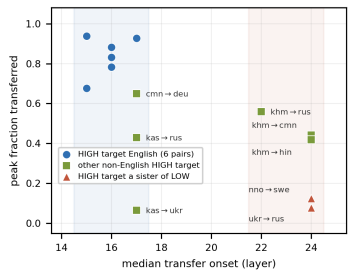
Figure 2 : Target-flip onset atlas over all 15 different- target pairs undermatchedpatching. The horizontal axis is the medianonset layer, computed from the target- exclusive-character discriminator, and the vertical axis is the peakfractionof instances whose output fastText identifies as the HIGH target language. Pairs whose HIGH target is high-resource Latin form one cluster (onset L15–17, .68–.94 flipped); sister targets sit at L24 and near zero; other non-English targets fall between. One pair, eng→kas vs. eng→hin, is omitted because its discriminator is saturated at baseline: 91.8% of clean
Original paper · CC BY 4.0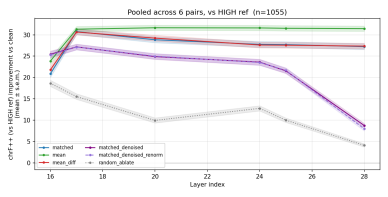
Figure 3 : ∆HIGH when patching the denoised vectors and their two controls ( n=1055), pooled over the six different-target pairs with English as HIGH target.
Original paper · CC BY 4.0Quote from the paper
Shenbin Qian, Yves Scherrer (2026). Language Defaults Before Content: A Causal Layer Map of Multilingual Generation. arXiv:2611.12538v1. https://arxiv.org/abs/2611.12538v1
BibTeX
@misc{qian2026language,
  title = {{Language Defaults Before Content: A Causal Layer Map of Multilingual Generation}},
  author = {Shenbin Qian and Yves Scherrer},
  year = {2026},
  eprint = {2611.12538},
  archivePrefix = {arXiv},
  url = {https://arxiv.org/abs/2611.12538v1}
}