Paper commentary
What Makes a VLA Reactive? A Study of Execution Strategies for Dynamic Manipulation
Study finds execution pipeline matters as much as the VLA policy for dynamic manipulation
- Problem Action chunks from vision-language-action models go stale when objects move before the chunk finishes executing. Shorter execution horizons help but raise inference cost and create seams between chunks.
- Method The authors vary the prediction and execution horizons of pi0.5 and compare synchronous and asynchronous inference. They also test FASTER, DynamicVLA, RTC, ABPolicy, PUMA, DSRL and AAC on dynamic belt tasks.
- Results The best prediction horizon is about one second, and the best execution horizon depends on the checkpoint. On the conveyor task, changing the execution horizon gained as much as adapting the policy.
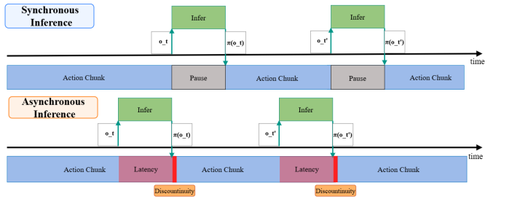
Figure 5 : Synchronous execution introduces waiting periods, while asynchronous execution overlaps inference with motion but may cause inter-chunk discontinuities.
Original paper · CC BY 4.0 · Zhuoyue Li, Zhendong Han, Pankhuri Vanjani, Wenting Li, Rudolf Lioutikov · What Makes a VLA Reactive? A Study of Execution Strategies for Dynamic Manipulation · Original paper figure · Extracted the figure area from page 7 of the original PDF.Why predicted chunks go stale
A VLA policy predicts a block of future actions, called an action chunk, from one observation rather than one action per step. That design saves inference calls, but the block is planned from a scene that may have changed by the time its later actions run. When objects move during inference and execution, the old plan keeps steering the arm toward where the object used to be.
A chunk fixed at one moment can't reflect later object motion, so its predictions become stale.
Executing fewer actions before the next query gives fresher observations, but each extra query adds inference demand. A short execution has to weigh observation freshness against computational cost and execution stability. Short executions also create seams where one independently generated chunk meets the next. Because of those seams, the commanded trajectory can jump even when each chunk looks reasonable on its own.
Synchronous execution makes the waiting problem worse, because the controller pauses until each new prediction arrives. Asynchronous execution overlaps inference with motion, but it has to account for the motion that happens during the inference delay. The authors' main finding is that frequent replanning alone didn't ensure better performance, since its benefits depend on the pipeline and the policy.
Figure 1 groups these forces into horizons, inference scheduling, chunk continuity, and policy behavior. The study therefore asks how these forces trade off, and whether the execution pipeline matters as much as the policy itself.
Separating prediction from execution
The key idea is to treat how far the policy plans and how far the robot commits as two separate settings. The prediction horizon H sets how far ahead the policy plans, while the execution horizon s sets how many of those actions run before the policy looks again. The authors vary H during fine-tuning but change s only at deployment, keeping the policy fixed.
Because s can change without retraining, the study can ask how much replanning frequency helps a given checkpoint. Latency enters because a new chunk arrives only after a delay of d action steps, so the controller has to account for the motion during that delay. Synchronous execution waits for the next prediction after each chunk, while asynchronous execution overlaps inference with ongoing motion.
A fixed s treats every moment the same, so the authors also test whether the policy can choose s itself. They use Adaptive Action Chunking (AAC) for this, which samples several candidate chunks and measures the entropy of the predicted actions. Using s = 5 and s = 15 as fixed horizons gives the baselines against which AAC is compared.
The continuity and scheduling variants are separate pi0.5 configurations, each targeting one requirement of a short execution horizon. FASTER and DynamicVLA make actions available sooner, while RTC and ABPolicy keep the trajectory continuous across chunks. DynamicVLA adds continuous inference and latency-aware action skipping with a minimum execution window, keeping the pi0.5 architecture and inputs.
Scheduling, continuity and adaptation variants
The evaluated methods target different requirements of short horizons, and they are all built on the same π0.5 framework. FASTER and DynamicVLA make actions available sooner. FASTER uses horizon-aware sampling, action streaming and early stopping to deliver near-term actions before a whole chunk finishes denoising. The authors' DynamicVLA variant adds continuous inference and latency-aware action skipping, with a minimum execution window, and keeps the π0.5 architecture and inputs.
RTC and ABPolicy instead target the seam between chunks. RTC inpaints the overlap with the previous chunk at inference time, so it needs no extra policy training. ABPolicy predicts spline control points and refits the new trajectory to the actions already executed, which the authors adapt to Cartesian actions.
PUMA and DSRL change the policy itself rather than the execution alone. PUMA adds historical optical flow as input and trains the policy to predict future object-centric features. AAC, by contrast, changes the horizon itself: it samples several candidate chunks, measures entropy, and ends a chunk early when entropy is high.
Prediction and execution horizon results
At control rates of 25 and 30 Hz, both equal about one second of motion, which is why the authors call one second the working rule. Longer chunks keep the arm following an older plan for an object that has already drifted away. The authors vary the prediction horizon during fine-tuning, so each prediction length comes from its own trained policy.
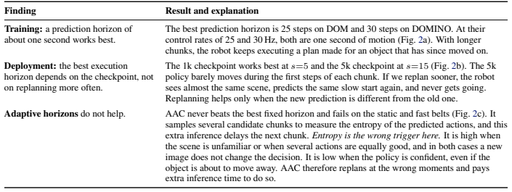
Table 2 :RQ1: How do prediction and execution horizons affect dynamic manipulation?
Original paper · CC BY 4.0The execution horizon is a different knob: it sets how many actions from a predicted chunk the robot actually executes before it looks again. On the conveyor belt, the best execution horizon depends on the checkpoint: s=5 for the 1k checkpoint and s=15 for the 5k checkpoint. The 5k policy moves slowly at the start of each chunk, so replanning early returns nearly the same prediction and the robot barely progresses.
The authors read this as replanning paying off only when the fresh prediction actually differs from the old one. The authors keep the trained checkpoint and prediction horizon fixed when they vary the execution horizon, and they report checkpoint comparisons separately.
Asynchronous execution was also part of these runs, since the checkpoint comparison used 45 trials per belt condition at H=20. The execution horizon choice therefore interacts with how the next chunk is computed, not only with how often the robot replans.
Can entropy choose the horizon
Adaptive Action Chunking (AAC) lets the policy pick its own execution horizon instead of using a fixed one. AAC samples several candidate chunks and measures the entropy of the predicted actions. The 5k checkpoint with AAC never beat its best fixed horizon, and AAC failed on the static and fast belts. Each configuration in this comparison used 45 trials, with H=20 and asynchronous execution.
The authors explain the failure by looking at what entropy actually signals. In both cases a new image doesn't change the decision, so replanning gains nothing. Entropy can also stay low when the policy is confident, even as the object is about to leave. Sampling extra candidate chunks adds inference time, so AAC replans late as well as at the wrong moments.
The authors didn't test an entropy-free trigger, so their conclusion is limited to entropy-based selection. Their conclusion is that adaptive horizon strategies should weigh replanning benefit, inference overhead, and trajectory continuity, not action uncertainty alone.
Asynchronous execution and chunk continuity
A shorter horizon only helps when new actions arrive in time, so the authors compared synchronous and asynchronous execution. On DOM the gap grows as the horizon shrinks. In synchronous mode the robot waits for each new chunk, and the object keeps moving during every wait.
Continuity matters beyond latency: ABPolicy is the best method, and RTC matches FASTER even though FASTER has lower inference latency. The authors explain that a fresh action helps only if the robot can follow it, and a jump between chunks costs more than the speed gained.
The authors explain the gain by the chunk finishing sooner, which leaves the object less time to drift before the next observation.
Motion cues and latent steering
PUMA changes the policy itself by giving it information about how the object moves. PUMA beats π0.5 on the conveyor belt, reaching 50 to 60 percent against 45 to 70 percent in the comparison shown. On the rolling can, however, PUMA does worse than π0.5, so the motion cues don't help every task. The authors show that asynchronous execution is what makes the motion cues count.
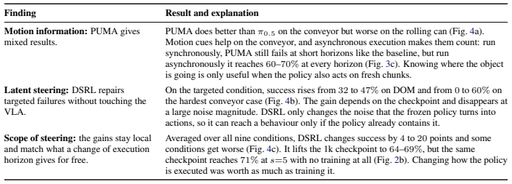
Table 4 :RQ3: Can temporal information or reward-guided adaptation make the policy itself more reac- tive?
Original paper · CC BY 4.0DSRL takes a different route and leaves the VLA frozen. It trains a latent-space actor and critic, and the actor picks the latent input that the VLA turns into an action chunk. DSRL steers the noise that the frozen VLA turns into actions, so it can only select behaviours the policy already contains. The gain depends on the checkpoint and fades at a large noise magnitude.
The same checkpoint reaches 71 percent at s=5 with no training at all, so the steering gains stay local.
Limits of the real-robot evidence
The real-robot comparisons in this study run 15 to 20 trials per setting, which is a small sample. With samples this small, a gap of a few successes between two methods can easily come from chance. Each bar in the conveyor comparison of Figure 3b is built from 15 trials. The targeted DSRL conveyor counts rest on 5 trials before adaptation and 15 trials after it.
The authors flag that the can and cup tasks depend on object motion that a person induces by hand. Because that motion varies from run to run, the authors ask readers not to over-interpret small differences. The conclusion repeats this caution and frames the findings as characterising pi0.5-based adaptations on a small set of tasks.
They don't rely on action uncertainty alone as the trigger for replanning.
Paper info
- Authors
- Zhuoyue Li, Zhendong Han, Pankhuri Vanjani, Wenting Li, Rudolf Lioutikov
- Venue
- arXiv · Preprint
- First published
- 2026-11-11
- Added
- 2026-11-13
- Updated
- 2026-11-11
- Version
- v1
- arXiv
- 2611.15491
- Category
- cs.RO · cs.CV · cs.LG
- Original paper terms
- CC BY 4.0
- What we show
- Paper info, commentary and permitted figures from the original paper
AI commentary is a separate explanation from the original paper and may contain errors. The original paper and figures follow each source's terms of use and any rights noted separately.
Abstract
Vision-language-action (VLA) models predict chunks of future actions, and when objects move, those chunks go stale before they are executed. We study what makes a pretrained VLA reactive, using \pihalf{} on two dynamic simulation benchmarks and three real-robot tasks. We vary the prediction and execution horizons, compare synchronous and asynchronous inference, test methods that deliver actions sooner or keep successive chunks continuous, and adapt the policy with motion cues and latent-space reinforcement learning. The best prediction horizon is about one second, and the best execution horizon depends on the checkpoint. Short horizons help more with asynchronous execution, and methods that keep the trajectory continuous outperform those that only reduce latency. Adapting the policy repairs targeted failures, but on the conveyor task changing the execution horizon gained as much. Reactivity depends on the execution pipeline as much as on the policy, so both should be evaluated together.
Quote from the paper
Zhuoyue Li, Zhendong Han, Pankhuri Vanjani, Wenting Li, Rudolf Lioutikov (2026). What Makes a VLA Reactive? A Study of Execution Strategies for Dynamic Manipulation. arXiv:2611.15491v1. https://arxiv.org/abs/2611.15491v1
BibTeX
@misc{li2026what,
  title = {{What Makes a VLA Reactive? A Study of Execution Strategies for Dynamic Manipulation}},
  author = {Zhuoyue Li and Zhendong Han and Pankhuri Vanjani and Wenting Li and Rudolf Lioutikov},
  year = {2026},
  eprint = {2611.15491},
  archivePrefix = {arXiv},
  url = {https://arxiv.org/abs/2611.15491v1}
}