Paper commentary
Towards interpreting any residual stream direction by scaling activation inversion
Scaled activation inversion writes text that activates any residual stream direction
- Problem Corpus search only returns text the corpus happens to contain, so its best examples may activate a residual stream direction only weakly. Those examples can also fire the direction for unrelated reasons.
- Method MAEM is a copy of the subject model that reads a direction and writes text. Unlike corpus search, it is trained with reinforcement learning to maximise the cosine similarity between the direction and the text's activations.
- Results A Qwen3.6-27B MAEM inverts held-out activations better than corpus search or a natural-language autoencoder. It also activates 89% of held-out SAE features.
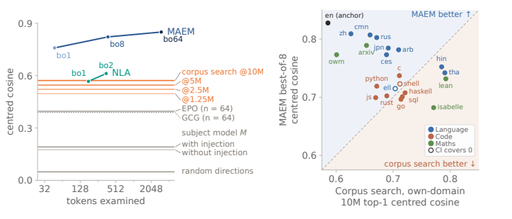
Figure 2 :(left) Held-out text activations.MAEM best-of-k, corpus search top-1 (gains 0.0251 per doubling); NLA (best-of-2 of four exemplars); EPO and GCG (n= 64each); the untrained base at best-of-8 with and without injectingv; random directions.(right) Generalisation across 21 unseen domains and languages.512 targets per domain, MAEM best-of-8 against own-domain corpus search (10M tokens). Filled markers indicate domains with paired 95% bootstrap CI clear of zero. The English anchor shown for reference. (See Appendices C and D.) We report thecentred scores µ(v, x): the score of Equation 1 with a fixed corpus mean activationµ subtracted fromvand from everyh t(x), reducing the influence of the shared component of residual activations on the score. For each target, we generate 64 MAEM exemplars of at most 64 tokens each and report best-of-kfork= 1,8, and64.Corpus searchselects the 64-token window (stride 32) containing the token with the highest cosine tovof a 10M-token sample of the checkpoint’s training ranges. Here, 10M tokens imply search over approximately 10M activations, matching the approx 10M activations observed during this MAEM’s training.
Original paper · CC BY 4.0 · Celeste De Schamphelaere, Juan J. Vazquez, Ari Spiesberger, Tomáš Gavenčiak, Gavin Leech, Euan Ong, Jiahai Feng · Towards interpreting any residual stream direction by scaling activation inversion · Original paper figure · Extracted the figure area from page 4 of the original PDF.Why corpus search runs out
Many interpretability questions reduce to understanding one direction in a language model's residual stream. Examples of such directions include an SAE feature, a linear probe's weights, a steering vector, or a direction derived from a fine-tuning weight diff. The usual way to read such a direction is to find maximally-activating examples by scanning a large corpus.
A corpus was never optimised for activation, so its best examples may activate the target direction only weakly. Some of those best examples fire the direction incidentally, because they are about something else.
Description-based readers avoid this limit by writing a label, but they don't escape the judging problem. Corpus search also has a hard ceiling, because it can only return text the corpus happens to contain.
The work closest to this idea is activation inversion, where a decoder is conditioned on an activation to produce source-like text. InversionView inspects the inputs that produce activations similar to a target activation. So the question becomes whether a model can write text that the subject model itself maps to a given direction. The authors call such a model a Maximally-Activating Example Metamodel, or MAEM.
Rewarding text by the subject model's own activations
MAEM is a copy of the subject model's weights that reads a direction and writes text whose activations under the subject model line up with it. The label-free objective is what lets training use any direction, including directions that have no labels. Earlier inverters are trained to reconstruct one source text, whereas MAEM samples are pushed towards any text that lies in the direction's preimage.
Because the conditioning can be any direction, the same model can read SAE features, steering vectors and LoRA directions, although it was never trained on the last two.
The reward is \( s(v,x) = \max_t \cos(v, h_t(x)) \), the largest cosine between the direction and the per-token activations of the generated text at the read layer. One well-aligned token is enough to set the score, because the maximum runs over the whole generated span. The direction is injected at a placeholder token after the MAEM's second transformer block, so the placeholder residual becomes \( r'_m = r_m + \|r_m\|_2 \frac{v}{\|v\|_2} \), with the direction entering at the residual's own norm.
Generated text is then scored by the frozen subject model without any injection.
Training runs in two stages, and the second depends on the first. SFT first teaches the policy to write text from its injected direction, using direction and text pairs with 8 to 64 tokens of context and a negative log-likelihood loss. RL then rewards the policy with the frozen model's score over the last 16 generated tokens, using an even split of corpus activations and SAE directions.
The RL recipe is ScaleRL, with no KL term and a small length penalty used for regularisation.
Held-out inversion, SAE coverage and diversity
At 10M tokens, the MAEM beats corpus search on a majority of held-out languages and domains. The same exemplars exceed their corpus peak on 30% of the features.
To check fluency, the authors drew 400 layer-42 activations of Qwen3.6-27B, one per Ultra-FineWeb document. MAEM received each activation centred and normalised, and it drew 64 samples plus one greedy decode per activation. The untrained base model generated under the same prompt, injection and decoding.
A Claude Sonnet 5 judge compared each MAEM passage with the source passage and picked the preferred one. LM judges prefer MAEM exemplars to model continuations. An independent model finds MAEM exemplars slightly more probable than the source text. Taken together, the authors place the exemplars roughly level with the source in fluency.
The cost of the objective shows up in sample variety, which the authors measure with the Vendi score over sentence embeddings. An LM writing new examples from 16 corpus windows scores 3.4, while the NLA scores 2.0. Descriptions written from MAEM exemplars accept 38% of a feature's held-out activating windows. The authors attribute the low variety to an objective that rewards the single most aligned text and has no diversity term.
Backdoor payloads and steering vectors
The authors trained 48 rank-one LoRA adapters on Qwen3.6-27B, each installing one trigger and one payload. Thirty-two adapters use a thematic trigger word, and sixteen use a numeric three-digit SEP code. Each adapter has a read vector a and a write vector b, and the write payload is read from unit(W_down b). MAEM reads the read vector against the trigger and the write direction against the payload.
A rank-one adapter is invariant to flipping both vectors' signs, so each row keeps the sign that scores better.
On the theme write direction, MAEM's best of 16 samples recovers the payload verbatim at 85 percent. Corpus search at 10M spans reaches 2 on that same write row. On the theme read direction, MAEM reaches 69 verbatim, while corpus search at 10M spans reaches 49. Corpus search is scored verbatim, and its semantic rate sits within 5 points of that on every row.
The numeric-code adapters are harder for MAEM, which reaches 21 on the write row and 0 on the read row. Corpus search reaches 2 on the numeric write row and 5 on the numeric read row at 10M spans.
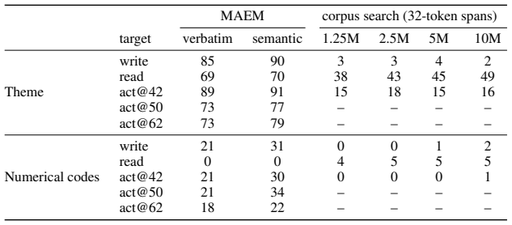
Table 19 :Reading rank-one trojans: Percentage of 16 candidates naming the target, averaged over adapters (32 theme, 16 numerical codes; corpus search on the first 16 theme adapters, the set scanned to 10M spans). Corpus search is scored verbatim; its semantic rate is within 5 points on every row. write:unit(W downb), scored against the payload;read:unit(a), scored against the trigger;act@L: poisoned-minus-clean residual at the trigger token at layerL, scored against the payload; corpus search not run at layers 50 and 62. A rank-one adapter is invariant under(a, b)→(−a,−b), so each direction is scored at both signs and the better one kept: for a read row the sign that maximises trigger recovery, for a write or act row the sign that maximises payload recovery. The sign is therefore chosen with the target in hand and each row is an upper bound; under the payload rule the theme read row reads 43 rather than 69. Against a mismatched adapter’s target every row is≤2% (per adapter at most 1 of 16 samples); against random directions every row is 0%.
Original paper · CC BY 4.0Mismatched targets stay at 2% or below on every row, so the semantic scorer is not simply lenient. For 16 random unit vectors, MAEM recovers 0% verbatim and 0% semantically. On the same random directions, corpus search recovers 0% verbatim and 2% semantically.
On steering-vector concept identification, MAEM matches NLA and beats the J-lens and corpus search.
Limitations of MAEMs: single model, uncompared training, and unelicited features
The limitations section starts from a simple admission: each experiment uses only one subject model. The authors also didn't compare SFT and RL at matched compute levels. High alignment of exemplars with a target direction doesn't rule out limited coverage, poor readability, or a wrong semantic account of the direction. The paper points to earlier work on these risks, including feature visualisation caveats from Nguyen et al.
(2016b), Zou et al. (2023) and Geirhos et al. (2024).
The first active problem is that MAEMs fail to elicit about 11% of features. A feature counts as elicited when a draw's peak activation exceeds the SAE threshold, τ≃1.6. Failure concentrates among rare features, and also among positional features.
The second problem is lower sample diversity, which the authors measure with the Vendi score over sentence embeddings. The Vendi score counts the distinct texts among a feature's eight samples. The authors attribute this to an objective that rewards the single most aligned text and has no diversity term.
Paper info
- Authors
- Celeste De Schamphelaere, Juan J. Vazquez, Ari Spiesberger, Tomáš Gavenčiak, Gavin Leech, Euan Ong, Jiahai Feng
- Venue
- arXiv · Preprint
- First published
- 2026-11-5
- Added
- 2026-11-7
- Updated
- 2026-11-5
- Version
- v1
- arXiv
- 2611.08465
- Category
- cs.LG · cs.AI
- Original paper terms
- CC BY 4.0
- What we show
- Paper info, commentary and permitted figures from the original paper
AI commentary is a separate explanation from the original paper and may contain errors. The original paper and figures follow each source's terms of use and any rights noted separately.
Abstract
To interpret a direction in a language model's residual stream, we can look for text that strongly activates it. But when such text is found by scanning a corpus, it is limited to what that corpus contains. We develop Maximally-Activating Example Metamodels (MAEMs), language models which map residual stream directions from a subject model to text exemplars that strongly activate those directions. Our objective is to maximise the cosine similarity of a supplied residual stream direction with the activations of the text generated by the MAEM. This label-free RL objective helps to scale MAEMs on diverse sources of residual stream directions. Empirically, we find the resultant metamodel produces informative exemplars: a Qwen3.6-27B MAEM inverts held-out activations better than corpus search or a natural-language autoencoder (NLA), beats corpus search (at 10M tokens) on a majority of held-out languages/domains, and activates 89% of held-out SAE features. It also identifies concepts behind steering vectors about as well as NLAs, recovers the payloads of LoRA backdoors more often than corpus search, and can even verbalise some model workspace inner monologue. Unlike explanations produced by other metamodels (e.g. NLAs), MAEM exemplars can be verified with a forward pass on the subject model, making the MAEM objective a grounded alternative for scaling the training of metamodels.
Quote from the paper
Celeste De Schamphelaere, Juan J. Vazquez, Ari Spiesberger, Tomáš Gavenčiak, Gavin Leech, Euan Ong, Jiahai Feng (2026). Towards interpreting any residual stream direction by scaling activation inversion. arXiv:2611.08465v1. https://arxiv.org/abs/2611.08465v1
BibTeX
@misc{schamphelaere2026towards,
  title = {{Towards interpreting any residual stream direction by scaling activation inversion}},
  author = {Celeste De Schamphelaere and Juan J. Vazquez and Ari Spiesberger and Tomáš Gavenčiak and Gavin Leech and Euan Ong and Jiahai Feng},
  year = {2026},
  eprint = {2611.08465},
  archivePrefix = {arXiv},
  url = {https://arxiv.org/abs/2611.08465v1}
}