Paper commentary
Agent-R$^2$: Scaling Agents for Realistic Productivity Work via Real-Source Data Synthesis
Agent-R2 trains small agents on real web files for office productivity work
- Problem Current training data teaches one office skill at a time, so agents struggle with full productivity workflows. Hand-written workflows don't scale, and generated files lack the layouts and cross-file references of real documents.
- Method Agent-R2 builds training tasks from real web material instead of hand-written workflows or generated files. It mines workflow blueprints from web corpora, searches for and verifies matching public files, and pairs them with rubrics for SFT and RL.
- Results Agent-R2-4B scores 51.0 Pass@1 on GDPval, compared with 48.0 for Qwen3-235B-A22B-Thinking-2507, after training on only 4k instances.
Why current training data falls short
Agents are now asked to take over productivity work that ends in analytical reports, spreadsheets, presentations, and structured documents. That work is hard for three reasons, and the paper treats each one as a separate failure mode for current agents. Real professional workflows have interdependent steps, implicit domain conventions, and evolving intermediate states.
Real file contexts are heterogeneous and messy, so models must integrate evidence across different formats, layouts, and levels of completeness.
The third demand is that real deliverables meet fine-grained requirements on factual consistency, evidence coverage, structure, formatting, and practical usability. An output file doesn't meet these standards by itself, so a deliverable can look finished and still fail. Mastering all three demands at once is what current training data fails to teach.
Existing data covers each demand only in isolation: instruction following, multidisciplinary reasoning, document-grounded question answering, or generation of one deliverable type. These sources can be effective in their own settings, but they don't supervise real work objectives, cross-file evidence, workflow execution, and deliverable constraints together.
Hand-written workflows don't scale, so the authors don't rely on them for training data. LLM-generated files lack the layouts, gaps, and cross-file references of real documents, which is why Agent-R2 starts from authentic web files. Agent-R2 instead mines file-oriented workflow blueprints from web corpora using occupational activity seeds, which improves both realism and scalability.
It then searches for and verifies public files that support each workflow, keeping their heterogeneous formats and incomplete structures.
Building tasks from real sources
Agent-R2 builds each task by grounding every stage in real web material rather than in hand-written workflows or generated files. The pipeline has three stages, and the output of each stage becomes the input of the next. Figure 2 shows the path from web-corpus segments to the final task, with the sandbox used at the synthesis step.
In the first stage, Agent-R2 treats web-corpus segments as evidence of how file-based work gets done. Each segment must pass both a workflow filter and a file-oriented filter before it is kept. The segment's discipline metadata maps to an occupational category, and O*NET seeds from that category guide the extraction. Qwen3.6-Plus, as the synthesis model, turns each kept segment into a workflow blueprint with information dependencies, required file types, and expected outputs.
In the second stage, the synthesis model runs a multi-turn search-and-verification loop for each blueprint. Each turn writes a search query from the workflow, the required file types, earlier queries, and earlier results. Promising results are downloaded and checked with bash and view_image, looking at cover pages and tables of contents. A workflow and file set pair survives only when the retained files jointly meet the workflow's needs, because unsatisfied pairs are dropped.
Because these files are real rather than LLM-generated, they keep the layouts, gaps, and cross-file references that synthetic files usually lack.
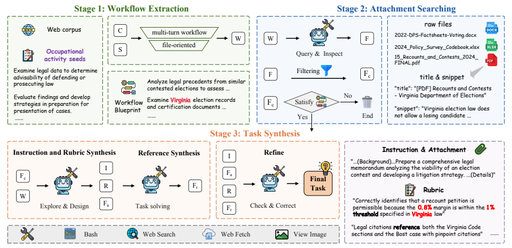
Figure 2 :Agent-R2 data synthesis pipeline.The framework extracts file-oriented workflow blueprints from real web-corpus evidence, retrieves and verifies public attachments, and synthesizes instructions, rubrics, and references in sandbox.
Original paper · CC BY 4.0 · Teng Pan, Zixuan Wang, Yuchen Yan, Qifei Wu, Yao Chen, Yingqi Qu, Ruiqing Zhang, Yongliang Shen · Agent-R$^2$: Scaling Agents for Realistic Productivity Work via Real-Source Data Synthesis · Original paper figure · Extracted the figure area from page 3 of the original PDF.In the third stage, Agent-R2 renders paginated files as page images and parses spreadsheets into sheet-level tables inside the sandbox. The originals stay in place for inspection, so the model can check the raw files as well. The synthesis model chooses which candidate files become attachments and writes the instruction and rubric together.
Claude-Opus-4.5 then solves the task as the expert policy, and its deliverables become the reference files. A verifier checks each rubric item against the reference files, and unsupported or unreasonable items are revised.
Each task carries 2.51 attachments on average, so the agent has to integrate several artifacts. Each task has 15.3 rubric items on average, covering both content and formatting requirements.
Training with SFT and then rubric RL
The base model is Qwen3-4B-Thinking-2507, and it is first trained with supervised fine-tuning on 3k of the synthesized instances. The remaining 1k tasks go to RL, and the two splits share no task.
RL starts from the SFT model and optimizes the policy with GRPO inside the persistent sandbox. RL further optimizes the policy for rubric-scored outcome quality, encouraging error recovery and stronger satisfaction of task requirements. The authors use Qwen3.6-Plus as an MLLM-as-a-judge instead of agent-as-a-judge, because agent-as-a-judge needs extra interactive tool use.
That extra tool use is inefficient during RL training, so the judge scores outcomes directly.
Before judging, the generated deliverable, file evidence, and reference files are converted into model-consumable representations.
The reward is zero when no deliverable is produced, and otherwise it is the judge score divided by the maximum score. Only this outcome reward is used, so the policy isn't pushed toward particular tool-call habits. The authors add no explicit penalties for intermediate tool-call errors.
Does the 4B model beat larger baselines
On the full GDPval set, Agent-R2-4B reaches 51.0 Pass@1 after starting from a base model at 32.4. The 51.0 score sits above Qwen3-235B-A22B-Thinking-2507 at 48.0 and Qwen3-VL-235B-A22B-Thinking at 49.7. Agent-R2-4B also beats DeepSeek-v3.1 and GPT-4.1 on the full set, even with a much smaller backbone. Claude-Opus-4.5 still leads the main table with 72.6 Pass@1 on the full set.
Table 1 splits the results into office, non-office, and full subsets, each with Pass@1 and Pass@3.
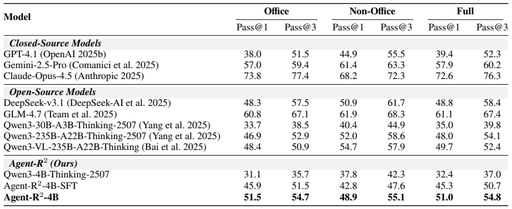
Table 1 :Main results on GDPval.Pass@kallows up tokattempts and scores the first attempt that produces a deliverable; results are reported for office, non-office, and full subsets. Agent-R2-4B consistently improves over its base and SFT variants and outperforms several larger open-source baselines on the full set.
Original paper · CC BY 4.0The split by deliverable type shows where the training gains come from. On office tasks, the base model's 31.1 rises to 45.9 after SFT and to 51.5 after RL. On non-office tasks, the same path moves from 37.8 to 42.8 and then to 48.9. SFT gives the larger jump on office tasks because it imitates expert trajectories. RL gives the larger jump on non-office tasks, which the authors read as help beyond the formats SFT targets directly.
On Pass@3 for office tasks, Agent-R2-4B comes within 4.7 points of Gemini-2.5-Pro.
OfficeQA is the out-of-domain check, since it sits outside the synthesized productivity training distribution. The base Qwen3-4B-Thinking-2507 scores 2.2 Pass@1 on OfficeQA, and Agent-R2-4B reaches 14.8. Agent-R2-4B surpasses Qwen3-235B-A22B-Thinking-2507, which scores 13.8 Pass@1 on the same benchmark. Agent-R2-4B-SFT scores 11.4 on Pass@1, so most of the OfficeQA gain comes after RL.
The authors read this as transfer to inspecting files and extracting numbers, not only to building deliverables. OfficeQA scoring combines rule-based matching with model-based assessment, run on the official Markdown version.
Real files and rubric rewards
The real-file question starts from a simple swap in the synthesis recipe, with the rest of the pipeline held fixed. Both sides end up with a similar number of attachments, so the comparison isolates where the files come from. Under the same SFT recipe, the real-file model reached a GDPval Pass@1 of 43.3, compared to 41.4 for the synthetic-file model.
The authors link this gap to layouts, structures, and cross-file dependencies that demand more inspection and processing.
The rubric question isolates the reward design instead of the data. The authors trained an RL variant from the same SFT model and removed only the rubric rewards. Under the evaluation protocol of Section 4.2, Pass@1 falls from 51.0 with rubric rewards to 49.5 without them. This is a single point comparison, and the table reports each variant as one number.
Because each variant has one reported number, the paper shows no spread across runs. Rubric rewards therefore add a measurable gain on top of the SFT model, under this single setup.
Shortcut behavior and exploration
Training changes how the agent explores, and the paper measures this apart from the final GDPval score. The authors read the extra errors as a side effect of longer exploration, since the model kept attempting corrections after failures. Completion, however, fell from 86.8% to 78.2%, so not every longer attempt ends in a deliverable. Figure 4 shows completion rate, steps, and errors for the three variants, along with RL-versus-SFT outcomes on tasks both completed.
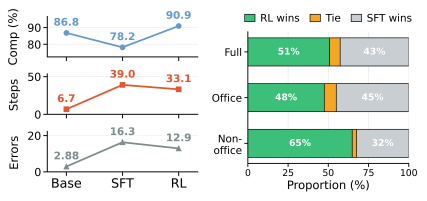
Figure 4 :Model behavior and completion quality.Left: completion rate, average tool-call steps, and average tool- call errors across the base, SFT, and RL variants. Right: win/tie/loss outcomes of the RL-trained model against the SFT-only model after valid completion on GDPval, where green,orange,andgraysegmentsindicateRLwins,ties,and SFT wins, respectively.
Original paper · CC BY 4.0The authors define effective steps as tool-call steps minus tool-call errors. Across the compared models, higher effective steps go with higher GDPval Pass@1, which the paper presents as an association across models. The authors call the low-effective-step pattern shortcut behavior, where a plausible deliverable is produced before enough grounding or checking.
Table 3 gives direct evidence on shortcut behavior, measured on GDPval. Writer code that masks errors with except-to-default or pass falls from 4.1% to 0.9% from SFT to RL. The share of traceable numbers in deliverables rises from 34.6% under SFT to 38.8% under RL.
In the materials-test case, the base model wrote a report from dummy evidence after failing to locate the spreadsheet values. Gemini-2.5-Pro inspected more, but silently turned key measurements into NaN and produced empty charts. Agent-R2-4B instead recovered from parsing, computation, and drawing errors, and it verified the final plots.
Limitations of the Agent-R2 results
The results rest on one trained backbone, Agent-R2-4B, which starts from Qwen3-4B-Thinking-2507. The paper reports no other trained backbone, so the gains aren't shown to hold for other model sizes. Training uses Qwen3.6-Plus as the MLLM-as-a-judge, while GDPval evaluation uses Gemini-3.1-Pro as the judge model. The training and test judges differ, so the reward signal and the reported scores come from different evaluators.
Completion drops from 86.8% to 78.2% under SFT, so more exploration alone doesn't guarantee a finished deliverable. The effective-step link in Figure 5 is an association across models, so it doesn't show that more steps cause higher scores. Synthesis relies on Qwen3.6-Plus for workflow extraction and task synthesis, with Claude-Opus-4.5 as the expert policy.
Non-office tasks fall outside the paper's primary focus, so the office results carry the main claim.
Paper info
- Authors
- Teng Pan, Zixuan Wang, Yuchen Yan, Qifei Wu, Yao Chen, Yingqi Qu, Ruiqing Zhang, Yongliang Shen
- Venue
- arXiv · Preprint
- First published
- 2026-11-5
- Added
- 2026-11-7
- Updated
- 2026-11-5
- Version
- v1
- arXiv
- 2611.08219
- Category
- cs.CL
- Original paper terms
- CC BY 4.0
- What we show
- Paper info, commentary and permitted figures from the original paper
AI commentary is a separate explanation from the original paper and may contain errors. The original paper and figures follow each source's terms of use and any rights noted separately.
Abstract
Large language models have made rapid progress in agentic reasoning and tool use, raising expectations for agents that can take over realistic productivity work from humans. However, current agents still struggle to finish such tasks, where success requires following long-horizon professional workflows, understanding heterogeneous file contexts, and producing usable deliverables under fine-grained requirements. A key bottleneck is the lack of scalable post-training data that reflects real work intent, authentic file environments, and deliverable-level evaluation. To close this gap, we introduce Agent-R$^2$, a $\textbf{r}$eal-source data synthesis framework that scales training data for $\textbf{r}$ealistic productivity work. Instead of relying on manually specified workflows or LLM-generated files, Agent-R$^2$ grounds synthesis throughout the pipeline in real occupational seeds, corpus-derived workflow evidence, and authentic web-sourced files. From 10k web-corpus candidates, Agent-R$^2$ distills 4k task instances that pair real multi-format attachments with fine-grained, deliverable-level rubrics. On this data, we train Agent-R$^2$-4B via supervised fine-tuning and rubric-based reinforcement learning, improving both end-to-end productivity performance and file-grounded reasoning. Trained on only 4k instances, Agent-R$^2$-4B surpasses Qwen3-235B-A22B-Thinking-2507 on both GDPval (51.0$\%$ vs. 48.0$\%$) and OfficeQA (14.8$\%$ vs. 13.8$\%$). Further analysis shows that Agent-R$^2$ mitigates shortcut behavior, where agents produce superficially plausible deliverables before sufficiently grounding, constructing, or verifying them, while promoting sustained exploration.
Quote from the paper
Teng Pan, Zixuan Wang, Yuchen Yan, Qifei Wu, Yao Chen, Yingqi Qu, Ruiqing Zhang, Yongliang Shen (2026). Agent-R$^2$: Scaling Agents for Realistic Productivity Work via Real-Source Data Synthesis. arXiv:2611.08219v1. https://arxiv.org/abs/2611.08219v1
BibTeX
@misc{pan2026agent,
  title = {{Agent-R$^2$: Scaling Agents for Realistic Productivity Work via Real-Source Data Synthesis}},
  author = {Teng Pan and Zixuan Wang and Yuchen Yan and Qifei Wu and Yao Chen and Yingqi Qu and Ruiqing Zhang and Yongliang Shen},
  year = {2026},
  eprint = {2611.08219},
  archivePrefix = {arXiv},
  url = {https://arxiv.org/abs/2611.08219v1}
}