Paper commentary
NPCBench: A Clinical Apprenticeship Benchmark for Multimodal Care-Pathway Reasoning in Nasopharyngeal Carcinoma
Benchmark tests whether models get both diagnosis and treatment right for one patient
- Problem Medical benchmarks score isolated questions or single images, so they miss whether a model's image reading and treatment choices hold together across a patient's course of care. Strong individual scores do not show this.
- Method NPCBench is a clinical apprenticeship benchmark for nasopharyngeal carcinoma. It orders tasks from guideline recall to following 100 patients through care, and it scores whether diagnostic and care answers are jointly correct.
- Results Among 21 multimodal models, strict CarePath success reaches at most 23%. Strong per-task scores did not guarantee jointly correct answers for the same patient.
Why exam-style scores miss the care pathway
Medical LLMs and multimodal LLMs already score well on exams, visual question answering and broad benchmark suites. Exam-style accuracy, however, says little about whether a specialist's chain of decisions holds together across a course of care. In nasopharyngeal carcinoma that chain starts with histopathology, multi-sequence MRI and plasma EBV DNA, which feed diagnosis and staging.
Treatment and follow-up then add tumor response, toxicities and recurrence, so each later decision depends on what came before. Because a later choice rests on earlier evidence, a single correct answer can hide a broken sequence.
NPCBench asks whether diagnostic and care answers are jointly correct for the same patient, even when component scores look strong. Two models with similar average accuracy can still make different patient-level errors. A model may pick the right treatment while misreading the MRI evidence beneath it. The paper's strict CarePath endpoint therefore pairs task-level scores with patient-level correctness, which a per-question average does not capture.
Across 30 models, the paper reports a composition gap between strong individual scores and jointly correct answers for the same patient.
A ladder from guideline recall to linked care episodes
The core idea is to order the tasks the way a subspecialist is trained, from recalling guidelines to following one patient through a course of care. Each rung isolates one capability, so a weak result can be attributed to a named skill. L1 and L2 test guideline recall and application, and L3 tests pathology and MRI evidence grounding. L4 tests case planning from one patient state, L5 revises decisions across checkpoints, and L6 links pathology, MRI and care decisions in one episode.
O1 scores free-text consultations separately.
Four design rules hold the ladder together: each level measures a distinct skill, evidence is cut at the decision point, answers must be clinically determinate, and open-ended answers are scored with case-specific rubrics. Cutting the evidence at the decision point keeps later treatment and outcomes from leaking the answer. Figure 1 summarizes how the levels map onto NPC care, from guideline and pathology inputs to the CarePath episodes.
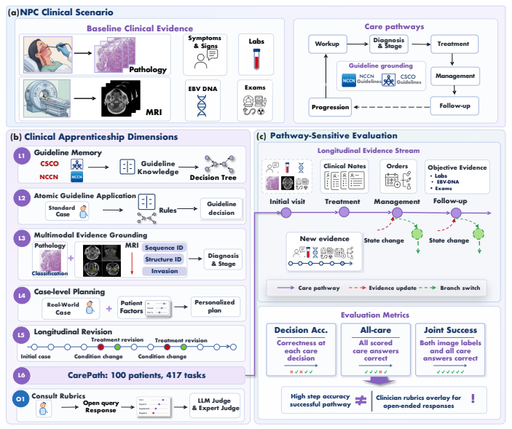
Figure 1 :Overview of NPCBench. (a)NPC care combines pathology, MRI, biomarkers, and clinical records under guideline constraints.(b)The apprenticeship framework spans component skills, longitudinal revision, and CarePath evaluation; O1 assesses consultations.(c)Changing patient states drive reporting of local and joint correctness. CarePath evaluates each decision using the provided clinical context; separate serial controls examine feedback from prior answers.
Original paper · CC BY 4.0 · Pengkai Wang, Wei-Wei Zhang, Yan Li, Min Tang, Zhitian Hou, Zeyu Liu, Guanghao Zhu, Yuanyi Wang, Yanggan Gu, Wenjun Wang, Minheng Ni, Congkai Xie, Zhijie Sang, Jianmin Wu, Ying Sun, Hongxia Yang · NPCBench: A Clinical Apprenticeship Benchmark for Multimodal Care-Pathway Reasoning in Nasopharyngeal Carcinoma · Original paper figure · Extracted the figure area from page 2 of the original PDF.L1 and L2 come from CSCO and NCCN guidelines, L3 from pathology and multi-sequence MRI, and L4 to L6 with O1 from de-identified real-world records. The L1 set has 250 questions, L2 has 185 vignettes and L4 has 165 questions. NPC oncologists verified component validity and decision determinacy, and reviewers checked the evidence available at each decision point.
How CarePath scores a patient
CarePath is the episode-level layer, built from 100 patients who each have a pathology assessment, an MRI T-stage assessment and care decisions. Reference N, M and overall stages are supplied where a question requires them.
Two endpoints summarize these answers, and both are computed from the same per-decision correctness marks. Care is the share of all scored care decisions answered correctly across patients, so every decision counts once. Strict is a patient-level flag that is set only when the pathology label, the T label and every selected care answer are correct.
Care is reported as 89.9% for Gemini-3.1, but Strict falls to 11.0% for the same model.
Let P be the number of patients and S_p the nonempty set of scored care decisions for patient p. Let n_p equal |S_p| and N equal the sum of n_p, so N is the total number of decisions. Care divides the summed correct marks c_pj by N and multiplies by 100. Strict multiplies d_p, t_p and the product of c_pj over S_p, then divides the sum over patients by P and multiplies by 100.
The product is what makes Strict strict, because a single wrong care answer sets that patient's term to zero.
Care answers are scored independently, so a model can answer most decisions correctly and still fail the joint endpoint. Claude-4.6 has the highest Strict success at 23.0%, despite lower Care accuracy than Gemini-3.1. Appendix C.2.1 defines the remaining task metrics and their 95% confidence intervals.
Stage labels and anatomical evidence
Strict success needs correct T labels, so the authors first asked how well models assign report-derived T and N categories. The best T-stage accuracy is 43.5% across 400 patients, compared to a majority-class baseline of 37.5%. Each T-stage and N-stage cohort holds 400 patients, and the two cohorts are kept patient-disjoint. The best N-stage accuracy is 42.8%, reached by Qwen3.6-27B, against an N1 majority baseline of 40.0%.
Qwen3.6-27B reaches only 31.9% balanced accuracy on N staging, so overall accuracy can hide a shortcut toward the majority class. Gemini-3.1 kept more consistent performance across stages, which the authors contrast with that shortcut.
The anatomical panel asks whether those labels rest on visual evidence. It covers 100 patients and 2,700 structure cards spanning 18 base structures, and it scores both structure identification and invasion. On this panel, direct T-stage accuracy reaches 43.0%, yet complete 18-structure invasion correctness is at most 5.0%. Evidence-grounded T-stage success also stays below 5.0%, so correct labels often lack full anatomical support.
To locate the failure, the authors fix a staging rule and vary the evidence it receives across three conditions. The conditions are reference findings, predicted invasion with known anatomy, and fully predicted evidence. With reference findings, a deterministic rule and a fixed GPT-OSS-120B stager both reach 99.0%, so the downstream staging logic looks sound.
Gemini-3.1 drops to 49.0% with known anatomy and to 36.0% with fully predicted evidence. The authors read this as flawed invasion recognition staying the main bottleneck, even when the anatomy is located correctly.
History and decision revision on L5
L5 covers 305 decisions over 100 patient trajectories, each with one to five scored checkpoints. Gemini-3.1 reaches 87.9% turn accuracy and 71.0% all-turn success, while Claude-Sonnet-4.6 reaches 85.2% and 63.0%. All-turn success is much lower than turn accuracy because a single misstep invalidates the whole trajectory.
The paired controls ask whether the format of the record matters, by comparing full chronological history with a snapshot that strips time markers and regroups records by content. Full history gives higher turn-accuracy point estimates for 14 of 20 models, but the patient-bootstrap 95% intervals span zero for 19 models. DeepSeek-V3.1 gains 4.9 percentage points and Gemini-3.1 gains 3.3 percentage points.
One reported example pairs a 1.0 percentage point turn-accuracy gain with a 1.0 percentage point drop in all-turn success.
An order-only control keeps all time markers but shuffles whole record lines, which separates record order from temporal information. Nineteen of 20 models have intervals spanning zero. Gemini-3.1 is the single exception, at +3.0 percentage points with a 95% interval of 0.6 to 5.7.
Joint patient success versus care accuracy on CarePath
A high Care score on CarePath doesn't guarantee a high Strict score, because Strict needs every part of a patient's record to be right at once. Across the 21 multimodal models, strict CarePath success reaches at most 23%. Gemini-3.1 achieves the highest Care accuracy, with 195 of 217 decisions correct, which is 89.9%. Its All-care success is 83.0%, yet its Strict success is only 11.0%.
Claude-4.6 reaches lower Care (80.6%) and All-care (64.0%) than Gemini-3.1, but it has the highest Strict success at 23.0%. Care accuracy alone therefore doesn't reveal which models answer every diagnostic and care question correctly for the same patient.
Strict requires correct pathology, a correct MRI T-stage, and every selected care answer for the same patient. Patient-level counts show the gap directly, since Gemini-3.1 has all care decisions correct for 72 of 100 patients. Those same patients still carry at least one incorrect pathology or MRI T-stage label. Claude-4.6 has this pattern for 41 patients.
The reverse also happens, because Hulu-Med-32B has 38 patients with both diagnostic labels correct but at least one incorrect care decision. So care answers and diagnostic labels can disagree in correctness for the same patient.
To test whether diagnostic evidence drives care decisions, the authors compared predicted and reference pathology, MRI T-stage, and invasion findings in 25 CarePath patients. Patient-averaged care accuracy, excluding diagnostic scores, changed by −3.2 to +4.1 pp. Twelve of 14 intervals include zero, so reference evidence gave no consistent care benefit under the supplied clinical context.
Care and All-care outcomes also shift with the episode group, since nine of 21 models have lower Care but higher All-care in the 75 assigned-pathology episodes. Claude-4.6 scores 76.5% versus 84.3% for Care, but 68.0% versus 52.0% for All-care across the two groups. The grouping contributes 102 and 115 decisions, respectively, which keeps the comparison grounded in decision counts.
Patient-level success therefore depends on every scored decision being correct, not on the average of decisions.
Scoring free-text consultations and checking the judge
O1 is the open-ended consultation suite, with 103 consultation items spanning 42 patients and 1,726 rubric criteria. The 1,726 criteria split into 1,069 positive requirements and 657 negative criteria. Each satisfied positive requirement adds weighted credit to the item score. A triggered major error deducts two points, and a triggered minor error deducts one point.
Under the primary GPT-OSS-120B judge, GPT-5.1 has the highest ConsultRubrics score at 58.4. The same judge flags major-error criteria in 14.6% of GPT-5.1's responses.
The authors score errors and calibrate the judge against physicians, because a judge's labels are only useful when they match human labels. They built two calibration sets: a Targeted Audit of 548 criterion labels and an Expanded Audit of 1,013 labels. The Expanded Audit covers 54 responses from nine models on six cases. On the Targeted Audit, GPT-OSS-120B reaches 81.4% agreement with physicians and a Cohen's κ of 0.610.
Its sensitivity is 51.8% and its specificity is 85.8%, so it misses many satisfied requirements.
Judge rankings change with the calibration sample, so one audit can't settle which judge is best. Qwen3.6-27B leads the Expanded Audit at 77.8% agreement and κ of 0.544. Because the judge's sensitivity and specificity are uneven, the authors read rubric scores beside explicit error rates.
Weighting the 42 cases equally, rather than the 103 items, moves model scores by only −2.0 to +0.1 points. GPT-5.1 stays highest under that case-level weighting, so the ranking is robust to item weighting. Major-error rate and C-Rub. score are strongly negatively correlated, with r = -0.96.
Limits of the evidence
The evaluation rests mainly on single-center records, and that limits how far the results travel beyond one hospital. The authors name this constraint directly in their limitations paragraph. Pathology is assigned rather than patient-matched in 75 model-selected CarePath episodes. Only 25 CarePath episodes have patient-matched pathology, so the joint endpoint mixes two evidence sources.
The Expanded Audit covers only six cases, which keeps the judge calibration narrow.
The MRI evidence is 2D, so the T-stage cards don't capture full three-dimensional anatomy. Scores depend on class balance, and the paper reports that constant T3 predictions reach 58% in CarePath. Scores also depend on episode length, because the depth of scored decisions varies across patients. Consultation scores depend on an automated judge, so the rubric results inherit that judge's error profile.
Scoring depth is variable across patients, which adds another source of uneven weight.
They also call for prospective studies before claiming that benchmark gains improve clinical care. The paper doesn't test prospective outcomes, so its claims stay at the level of benchmark behavior. The benchmark's intended use is research comparison, and it isn't meant for direct clinical decisions.
Paper info
- Authors
- Pengkai Wang, Wei-Wei Zhang, Yan Li, Min Tang, Zhitian Hou, Zeyu Liu, Guanghao Zhu, Yuanyi Wang, Yanggan Gu, Wenjun Wang, Minheng Ni, Congkai Xie, Zhijie Sang, Jianmin Wu, Ying Sun, Hongxia Yang
- Venue
- arXiv · Preprint
- First published
- 2026-11-5
- Added
- 2026-11-7
- Updated
- 2026-11-5
- Version
- v1
- arXiv
- 2611.08369
- Category
- cs.AI
- Original paper terms
- CC BY 4.0
- What we show
- Paper info, commentary and permitted figures from the original paper
AI commentary is a separate explanation from the original paper and may contain errors. The original paper and figures follow each source's terms of use and any rights noted separately.
Abstract
Current medical benchmarks typically break down clinical competence into isolated factual questions, single-image tasks, or static case vignettes. These tests score individual answers, but reveal less about whether a model can integrate subspecialty knowledge with multimodal evidence and track a patient's condition throughout a course of care. To close this gap, we introduce NPCBench, a clinical apprenticeship benchmark for nasopharyngeal carcinoma (NPC). NPCBench mirrors specialist training, from guideline and foundational knowledge to case planning, longitudinal review, CarePath integration, and open-ended consultation. It contains 4,777 component and consultation items and a 100-patient CarePath cohort with 417 scored diagnostic and care tasks. The episode-level evaluation tests whether diagnostic and care answers are jointly correct within a care pathway. By linking stepwise tasks to patient-level care trajectories, NPCBench evaluates whether models ground decisions in visual evidence, interpret changes in patient state, and meet clinical requirements in consultation. Across 30 evaluated models, we observe a composition gap: strong performance on individual tasks does not ensure jointly correct diagnostic and care answers for the same patient. Among 21 multimodal models, strict CarePath success reaches at most 23%. Paired controls and physician calibration further examine evidence grounding, longitudinal revision, and consultation judging. Overall, NPCBench broadens the evaluation of medical artificial intelligence beyond static question-answering paradigms to an apprenticeship-oriented assessment of clinical workflows, thereby offering a testbed for evidence-based and temporally coherent reasoning in oncology care.
Quote from the paper
Pengkai Wang, Wei-Wei Zhang, Yan Li, Min Tang, Zhitian Hou, Zeyu Liu, Guanghao Zhu, Yuanyi Wang, Yanggan Gu, Wenjun Wang, Minheng Ni, Congkai Xie, Zhijie Sang, Jianmin Wu, Ying Sun, Hongxia Yang (2026). NPCBench: A Clinical Apprenticeship Benchmark for Multimodal Care-Pathway Reasoning in Nasopharyngeal Carcinoma. arXiv:2611.08369v1. https://arxiv.org/abs/2611.08369v1
BibTeX
@misc{wang2026npcbench,
  title = {{NPCBench: A Clinical Apprenticeship Benchmark for Multimodal Care-Pathway Reasoning in Nasopharyngeal Carcinoma}},
  author = {Pengkai Wang and Wei-Wei Zhang and Yan Li and Min Tang and Zhitian Hou and Zeyu Liu and Guanghao Zhu and Yuanyi Wang and Yanggan Gu and Wenjun Wang and Minheng Ni and Congkai Xie and Zhijie Sang and Jianmin Wu and Ying Sun and Hongxia Yang},
  year = {2026},
  eprint = {2611.08369},
  archivePrefix = {arXiv},
  url = {https://arxiv.org/abs/2611.08369v1}
}