Paper commentary
Hierarchical Incremental Beta Splatting for Online Reconstruction
Beta kernels let online reconstruction fix poor primitives while building the scene
- Problem Online 3D Gaussian Splatting spawns primitives once and refines them for only a few dozen iterations. A poor initialization or missing detail rarely gets fixed, and Gaussians need many overlaps to form solid surfaces.
- Method HIBS replaces the Gaussian with a beta kernel whose shape parameter acts as a confidence dial. Geometric evidence sets each new primitive's opacity and shape, and error-driven relocation moves stale primitives to high-error regions.
- Results On Mip-NeRF 360 in the on-the-fly protocol, HIBS improves PSNR by up to 0.8 dB over i3DGS. It also reduces optimization time by up to 40%.
Why spawn-once reconstruction gets stuck
Offline 3DGS can run tens of thousands of optimization iterations after poses are recovered beforehand. Online reconstruction works differently: each keyframe spawns its primitives once and gets only a short optimization burst. Tools that could fix a bad start, such as gradient-driven clone/split densification or opacity resets, have little time to act.
So the decisions about where to place a primitive and how far to trust it must be made at initialization, from measurable evidence.
A solid surface therefore needs many overlapping Gaussians, plus the densification and long optimization that offline 3DGS can afford. Online systems must spawn translucent Gaussians and hope a short burst arranges them correctly.
A low photometric error doesn't guarantee correct geometry, so the evidence has to be geometric as well. Only a narrow range of those depths stays consistent under parallax. The authors therefore use the beta shape parameter as a confidence dial, rather than fixing the primitive's shape at spawn time.
Since offline densification is absent, the authors add error-driven relocation to add capacity where the model is deficient. A lifetime controller then updates the shape parameter from accumulated multi-view evidence as more views arrive.
The beta kernel as a confidence dial
The beta kernel's footprint is set by the opacity o and the shape parameter b, with x = r²/9 in the primitive's local frame. The contribution is alpha = o times (1 − x) raised to beta(b), where beta(b) = 4e^b. The support is bounded at r ≤ 3, which follows the common 3σ extent used for Gaussians. At b = 0, beta equals 4, and the profile closely matches a Gaussian.
Decreasing beta flattens the profile toward a solid plateau, so the footprint becomes nearly opaque across its whole extent. Increasing beta produces a soft, rapidly vanishing blob instead. The parameters split the work: opacity o controls how strongly the primitive contributes, while beta controls how committed its geometry is.
The kernel's bounded support is what stays fixed in this design, because the cutoff at r ≤ 3 doesn't change with b. Figure 2 shows the loop these kernels feed: keyframe spawning, relocation, a 30-iteration burst, and periodic merging. The spherical-beta color basis follows DBS, but the authors set every lobe amplitude to zero with random orientations.
Offline DBS starts with nonzero lobe amplitudes and removes them over thousands of iterations. Online primitives get only a few dozen updates, so they can't afford that cleanup. Starting at zero removes the persistent view-dependent color bias, and the amplitude gradient stays nonzero at zero.
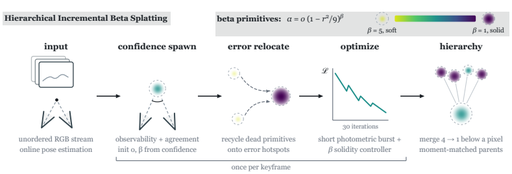
Figure 2 .Overview of our pipeline.An RGB stream is registered with camera parameters estimated online [42]. Each keyframe spawns beta primitives using geometric observability and depth agreement, keeping uncertain primitives soft. Near-dead primitives are relocated to high-error regions, followed by a short 30-iteration optimization burst with our fused rasterizer. Periodically, small-footprint primitives are merged hierarchically using closed-form moment matching that preserves their solidity.
Original paper · CC BY 4.0 · Linus Franke · Hierarchical Incremental Beta Splatting for Online Reconstruction · Original paper figure · Extracted the figure area from page 3 of the original PDF.The shape parameter is set from geometric evidence rather than learned over a long schedule. Depth observability gives a confidence value c_z from the covisible baseline B, the candidate depth z, and theta_0 = 2 degrees. A large c_z means depth is geometrically constrained, while a small c_z means many depths explain the training views.
Setting opacity and shape at spawn and afterwards
Confidence-aware spawning combines two cues that don't depend on each other: depth observability and agreement between two depth estimates. A large \(c_z\) means the depth is geometrically constrained, while a small one means many depths fit the training views.
The second cue compares candidate inverse depths from guided MVS with a metrically aligned monocular prior. The two terms multiply into \(c=(c_{\mathrm{mvs}}\,c_z)^{\gamma}\) with γ = 4, which then sets opacity and β. Opacity rises from 0.1 to 0.3 as c grows, and β falls from 5 to 1, so well-constrained primitives start solid. Figure 3 shows the same two cues deciding between a hard patch and a soft probe.
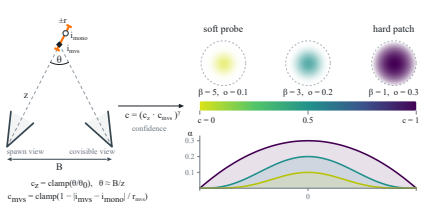
Figure 3 . Spawning/parameter initialization. Based on depth observability cz and agreement of depths (orange window) cmvs, the beta primitives are initialized as hard patches or soft probes.
Original paper · CC BY 4.0When MVS gives no reliable correspondence, the opacity drops to a floor of 0.02. The scale is then adjusted so the half-maximum footprint stays the same, with \(u_{1/2}(\beta) = 1-2^{-1/\beta}\) relating the scale to β. A primitive is hardened when it is at least 10 keyframes old, has opacity above 0.7, is well observed, and has low error.
It is softened toward β = 5 only when its error is high and view-inconsistent, because view-consistent error points to geometry and is left to relocation. Updates are clamped to β in [1, 5], although gradient descent may move β outside that range.
Recycling dead primitives and keeping the burst fast
Dead primitives are recycled once per keyframe, so the model moves unused capacity instead of cloning or splitting in place. A primitive qualifies as a source only if it is below the recycling-opacity threshold, sits outside the hierarchy, and is past the spawn-protection window. Each selected source becomes a copy of the destination's position, shape, and color, so high-error regions collect stacks of copies whose size grows with residual error.
Small positional jitter and optimizer resets let the subsequent burst separate the copies and represent more detail.
The per-keyframe burst minimizes the photometric objective from 3DGS, with learned exposure/ISP correction applied before comparison. The opacity and scale regularizers from 3DGS-MCMC, also used by DBS, enter the objective with weight 10 to the power of -2. The opacity penalty pushes unsuccessful primitives toward the recycling band instead of pruning them outright, so they feed the relocation step.
The beta kernel's bounded support gives a tighter rasterization bound than the Gaussian, with a cutoff at the 1/255 threshold. The Gaussian's 3DGS threshold can discard tiles that hold nonzero contributions for solid, low-opacity kernels, so the beta bound is a correctness fix as well as a speedup. A FasterGS-style fused rasterizer further speeds the burst by recomputing forward quantities in the backward pass and applying sparse Adam directly to the optimizer state.
Primitive gradients never materialize in memory in this design, and the regularizers are applied analytically inside the fused update. The authors report that this rasterizer substantially reduces computation time.
Merging small primitives for large captures
A Gaussian merge would only need position and spread, but a beta primitive also carries a shape that the merge has to keep. Each primitive has an opacity o, center µ, shape matrix Σ, and shape parameter b, with β = 4e^b. Its mass Z, covariance Cov = ξ(β)Σ with ξ(β) = 4.5/(β + 2.5), and Mardia kurtosis κ(β) all have closed forms. Here Σ describes the support ellipsoid rather than the spread, because peakier profiles concentrate mass near the center.
The kurtosis is strictly monotone in β, so its closed-form inverse recovers the profile within the family on the band (75/7, 15). The authors merge by moment matching instead of KL minimization, because any nonzero mass outside the parent's support makes the KL divergence infinite. The parent mean is the mass-weighted mean, and the mixture covariance Σ_mix adds each child's ξ(β_i)Σ_i to its offset term δ_iδ_i^T.
Mass conservation then sets the parent opacity, so the merged primitive keeps the footprint of its children rather than averaging it away.
The merge is compared against an opacity-weighted baseline on the large-scale captures, and it avoids overly large parent primitives. The gap is largest on CityWalk, at +2.27 dB, where several hierarchy levels are needed. Resolution-aware weighting and error-based repair add further quality, and the paper reports them in the same ablation.
What the benchmarks show
The online comparisons follow the Meuleman et al. protocol on three MipNeRF360 (otf) scenes, three TUM scenes and three StaticHikes captures. The held-out views are the same for every method, and the reported values average five runs on an RTX 5090. Against i3DGS on MipNeRF360 (otf), the method reaches a PSNR of 27.47 and a total time of 0:01:18, while i3DGS takes 0:02:09.
Figure 1 and Table 1 show the time gap behind the claim of up to 40% less optimization time, on the MipNeRF360 scenes used for the on-the-fly protocol. Across the same scenes, the method also surpasses i3DGS on SSIM and LPIPS, with 0.852 and 0.204 against 0.835 and 0.224.
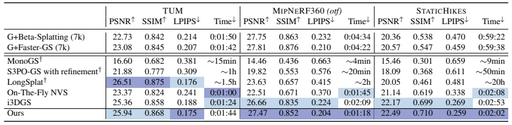
Table 1 . Results for novel view synthesis on pose-free methods. The best and second best are color coded for pose-free methods. Times for G+Beta-Splatting and G+Faster-GS (offline baselines at 7k as a reference) include GLOMAP pose estimation (about 50s for TUM, 174s for MipNeRF360 (otf) and 58min for StaticHikes). † numbers taken from i3DGS [42], with times roughly scaled to our setup.
Original paper · CC BY 4.0LongSplat scored slightly higher PSNR and SSIM, at roughly 50 times the cost. LongSplat's numbers come from i3DGS with times roughly scaled to the authors' setup, so they are not from the same controlled run. The authors' exhaustive GLOMAP references at 30k iterations reach higher quality, at roughly 6 to 12 times the authors' runtime. Octree-GS is marginally better on SSIM and LPIPS on SmallCity, but needs about one hour compared to about 4 minutes for the method.
Removing error-driven relocation lowers the nine-scene average PSNR from 25.30 to 25.09. These are leave-one-out and kernel ablations on the nine OtF scenes, so they show what each piece adds on that set. Over the capture, mean test PSNR for the method stays above i3DGS on MipNeRF360 (otf), TUM and StaticHikes. Nearly all points lie above the diagonal, so later keyframes improve earlier test views.
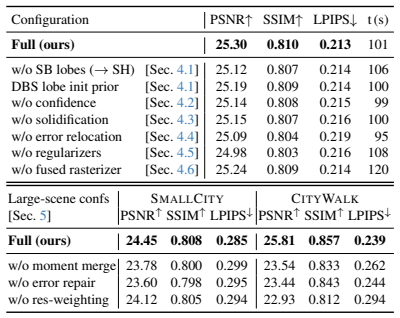
Table 4 .Component ablation(leave-one-out from full method). Top table: Metrics are averaged over all nine OtF scenes (Tab. 1).
Original paper · CC BY 4.0Where the evidence stops
They attribute that gap to online pose refinement, which they call orthogonal to their own work, and point to it as the promising route to closing the gap. The authors also note that shuffled input can reduce quality, so the method's results depend on the order of frames.
Sequential matching on MipNeRF360 drops some frames, so the metrics there count only successfully registered views. Against exhaustive GLOMAP references, the method stays competitive at 7k iterations, while 30k iterations reach higher quality at roughly 6 to 12 times the runtime. On Deep Blending, the method's PSNR of 26.49 trails i3DGS at 27.16.
Replacing spherical-beta colors with SH improves that Deep Blending result by about 0.3 dB, and the authors leave this as a noted option rather than the default.
The authors list integration with VR and use of the confidence map for refinement as further directions. They don't test these directions in the paper, so the confidence-map refinement stays a proposal.
Paper info
- Authors
- Linus Franke
- Venue
- arXiv · Preprint
- First published
- 2026-11-5
- Added
- 2026-11-7
- Updated
- 2026-11-5
- Version
- v1
- arXiv
- 2611.08288
- Category
- cs.CV · cs.GR
- Original paper terms
- CC BY 4.0
- What we show
- Paper info, commentary and permitted figures from the original paper
AI commentary is a separate explanation from the original paper and may contain errors. The original paper and figures follow each source's terms of use and any rights noted separately.
Abstract
Online 3D Gaussian Splatting reconstructs a scene during capture: each keyframe spawns primitives once and refines them for only a few dozen iterations, leaving little chance to fix poor initialization or missing detail. Gaussians are also inherently soft, needing many overlaps for solid surfaces. We present Hierarchical Incremental Beta Splatting (HIBS), which brings beta kernels to incremental reconstruction. Their shape parameter interpolates between a soft, Gaussian-like profile and a flat-topped, near-opaque surfel, acting as a confidence dial for geometry. Our confidence-aware spawning uses geometric observability and multi-view depth agreement to initialize both opacity and shape, producing solid primitives where geometry is verifiable and soft, correctable primitives where it is not. As online densification, error-driven relocation recycles stale primitives into photometric-error hotspots. Bounded beta kernel support enables exact tile culling and faster rasterization, and a closed-form, shape-preserving merging formulation provides a level-of-detail (LOD) hierarchy for fast optimization and real-time rendering. On Mip-NeRF 360 in the on-the-fly protocol, HIBS improves PSNR by up to 0.8 dB while reducing optimization time by up to 40%. Project page: https://linus-franke.com/hibs/
Quote from the paper
Linus Franke (2026). Hierarchical Incremental Beta Splatting for Online Reconstruction. arXiv:2611.08288v1. https://arxiv.org/abs/2611.08288v1
BibTeX
@misc{franke2026hierarchical,
  title = {{Hierarchical Incremental Beta Splatting for Online Reconstruction}},
  author = {Linus Franke},
  year = {2026},
  eprint = {2611.08288},
  archivePrefix = {arXiv},
  url = {https://arxiv.org/abs/2611.08288v1}
}