Paper commentary
Kimera: from SLAM to Spatial Perception with 3D Dynamic Scene Graphs
- Problem Robot maps usually hold either geometric primitives or a set of detected objects, with no single layered structure that links objects, places and moving people.
- Method Kimera builds a layered 3D Dynamic Scene Graph from visual-inertial data by chaining VIO, a semantically labelled TSDF mesh, loop-closure optimization of pose graph and mesh, and scene-graph layers for humans, objects and rooms.
- Results Kimera-Semantics updates averaged 65.8 milliseconds across EuRoC with default settings.
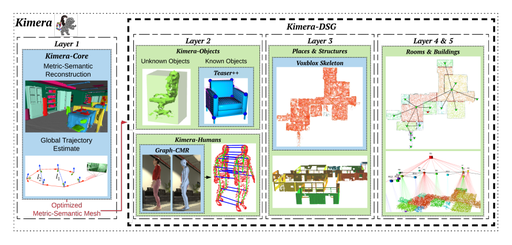
Figure 6 . Kimera’s architecture, with Kimera-Core and Kimera-DSG as sub-modules. Kimera-Core generates a globally consistent 3D metric-semantic mesh (Figure 5) that represents the first layer of the DSG and is further used by Kimera-DSG to build the subsequent layers. Kimera-DSG further comprises three key modules: Kimera-Objects, Kimera-Humans, and Kimera-BuildingParser (which generates layers 3 to 5).
Original paper · CC BY 4.0 · Antoni Rosinol, Andrew Violette, Marcus Abate, Nathan Hughes, Yun Chang, Jingnan Shi, Arjun Gupta, Luca Carlone · Kimera: from SLAM to Spatial Perception with 3D Dynamic Scene Graphs · Original paper figure · Extracted the figure area from page 7 of the original PDF.Why flat maps fall short
Earlier hierarchical map representations were mostly two-dimensional, assumed static environments and predate the deep-learning methods that make dense semantic labels possible. A planner also needs to know how objects relate to one another and to people, because identifying obstacles alone does not make navigation safe in a crowded building.
Earlier 3D scene graphs for robotics capture objects but miss several levels of abstraction, or they describe a hierarchy that does not encode traversability. Neither of those approaches models dynamic entities, which matters for robots that operate among people.
A layered graph for spatial perception
The 3D Dynamic Scene Graph groups its nodes into layers, and each layer corresponds to one level of abstraction of the scene, such as objects, rooms and agents. Its edges encode pairwise spatio-temporal relations, so the graph can describe how an agent and an object or place relate at a given time.
Because places and their connectivity are part of the graph, it generalizes topological maps and can serve directly for navigation and planning. Humans are represented in the graph by 3D poses over time, estimated with a pose graph, together with a dense mesh for each person.
How Kimera is organized
Kimera has two groups of modules: Kimera-Core performs real-time metric-semantic reconstruction, and Kimera-DSG builds the scene graph on top of it. Kimera-Core contains a VIO module for pose, Kimera-Mesher for a fast local mesh, Kimera-Semantics for a global labelled mesh, and Kimera-PGMO for loop closure.
Kimera-Semantics relies on the poses from Kimera-VIO, and Kimera-PGMO corrects the mesh that Kimera-Semantics produces, so each module consumes the output of an earlier one. Kimera-DSG adds human meshes, object models and the building layers on top of these outputs.
Feature tracking and the VIO back-end
The front-end tracks features with the Lukas-Kanade tracker and seeds each track with a rotational optical flow predicted from the IMU, which helps when the scene contains moving people. Feature detection, stereo matching and geometric verification run only at keyframes, while intermediate frames just track existing features. By default, the verification uses 2-point RANSAC for stereo and 1-point RANSAC for mono, and the IMU rotation prunes outlier correspondences.
At each keyframe, preintegrated IMU measurements and visual measurements are added to a fixed-lag smoother, which is a factor graph solved with iSAM2 in GTSAM. The structureless vision model triangulates each feature with DLT and then removes its 3D point from the VIO state, first discarding points behind the camera, with too little parallax, or with large reprojection error.
States that leave the smoothing horizon are marginalized out.
From per-frame meshes to a labelled global mesh
The per-frame mesh is a 2D Delaunay triangulation of tracked features, back-projected with the VIO 3D points, and it is meant for low-latency obstacle detection. The multi-frame mesh merges per-frame meshes over the VIO time horizon, moves vertices with the latest VIO estimates and drops vertices tied to features that left the horizon. When planar surfaces are detected, regularity factors are added to the VIO back-end, which couples mesh regularization with the VIO estimate.
For the global mesh, dense stereo or RGB-D depth is integrated into a TSDF through bundled raycasting, and marching cubes extracts the mesh. Semantic labels come from 2D segmentation, and each bundle of rays yields a vector of label probabilities from the observed label frequencies. The label probabilities are updated with a Bayesian update only within the TSDF truncation distance, which avoids updating the empty label.
The resulting mesh is more accurate than the multi-frame mesh but takes approximately 0.1s to compute.
Loop closures and mesh deformation
DBoW2 with ORB descriptors proposes putative loop closures, which are checked by mono 5-point RANSAC and stereo 3-point RANSAC. Perceptual aliasing can still leave outliers, and the authors make the back-end robust to them rather than making loop detection more conservative.
The authors use PCM, adapted with an odometry consistency check, in which the poses around a cycle formed by the odometry and a loop must compose to the identity within a Chi-squared test. The consistency matrix is built incrementally, so each new loop is tested only against earlier loops, and a maximum clique search selects the consistent set.
Kimera-RPGO optimizes only the pose graph, whereas Kimera-PGMO optimizes the pose graph and the mesh together through a deformation graph that combines a simplified mesh with the robot poses. The mesh is simplified by clustering vertices in an octree, with voxel sizes of 1 to 4 meters in the authors' tests. The authors position this joint optimization as the first approach to optimize the pose graph and the mesh simultaneously.
Humans, objects and building layers
Kimera-Humans detects people with GraphCMR, which runs in about 33 ms per image on an Nvidia RTX 2080 Ti GPU, while tracking runs on the CPU in about 10 ms. Kimera-Humans parametrizes the dense human meshes with SMPL and estimates their trajectories with a pose graph.
Kimera-Objects estimates bounding boxes for objects of unknown shape and fits CAD models to objects of known shape with TEASER++, which runs in milliseconds. Kimera-BuildingParser builds an ESDF from the TSDF with Voxblox, then a topological map, then the rooms and their connectivity, and the authors estimate approximately 30 min for the large Subway scene.
Pose estimation accuracy
Kimera-VIO is compared with OKVIS, MSCKF, ROVIO, VINS-Mono, Basalt and ORB-SLAM3 by Absolute Translation Error RMSE, using values reported by prior work and by the respective authors. Some baselines use a monocular camera and others a stereo camera, and the authors state that Kimera-VIO, Kimera-RPGO and Kimera-PGMO achieve competitive performance.
Trajectories are aligned with SE(3), because the IMU makes the scale observable in VIO, and the authors note that a Sim(3) alignment would give a smaller error for Kimera.
In the authors' tests, PCM makes Kimera-RPGO fairly insensitive to the DBoW2 threshold alpha, which was varied across the Table 2 values, and the results in Table 1 use alpha of 0.001. Table 4 compares 5-point RANSAC, 2-point RANSAC, and 2-point RANSAC with IMU-aware tracking (DVIO) on static EuRoC sequences and on uHumans and uHumans2 with increasing numbers of humans.
On the uHumans and uHumans2 rows, the authors report that DVIO stays robust as the number of dynamic humans grows.
Accuracy of the reconstructed mesh
The mesh is checked against the ground-truth point clouds of the EuRoC V1 and V2 scenes, using accuracy and completeness as metrics. The mesh is sampled into a point cloud, registered to the ground truth with ICP in CloudCompare, and then distances are averaged in both directions to obtain accuracy and completeness. For the global mesh of Kimera-Semantics on V1_01, Figure 15 shows the estimated cloud colored by distance to the ground truth for accuracy, and the ground-truth cloud colored by distance to the estimate for completeness.
Runtime on a development run and on the TX2
Figure 19 breaks down the runtime of Kimera-VIO, Kimera-Mesher, loop-closure detection, Kimera-RPGO and Kimera-PGMO on the EuRoC V1_01 run, which has 728 poses, 71 loop closures and a final mesh with 324474 vertices.
With default settings and a voxel size of 0.1 meters, updates to Kimera-Semantics took 65.8 milliseconds on average across EuRoC. Kimera-VIO ran in real time on EuRoC with default settings on the Nvidia Jetson TX2 in MAXN mode, and only Kimera-Core was timed there.
The default, fast and faster configurations extract a maximum of 300, 250 and 200 features, with horizon sizes of 6, 5 and 4.5 seconds. Front-end time on non-keyframes averaged 10 ms for all configurations, while the fast and faster configurations take about 85% and 75% of the keyframe processing time of the default, and about 65% and 50% of its back-end time.
On difficult machine hall sequences of EuRoC, the reduced configurations raise the APE, so the speed gain costs accuracy there.
Real-life reconstructions
The two RealSense cameras are arranged without overlapping fields of view, with the infrared emitter disabled on the camera used for tracking, so the pattern does not disturb feature tracking.
On 'School', the Kimera-Core mesh is globally consistent but noisy and incomplete, because of the RealSense depth stream. Kimera-Objects finds most objects, but some detections are spurious, such as refrigerators in a scene that has none, and the authors suggest raising the smallest valid object size or retraining Mask-RCNN. The room layer of 'School' is correct, with a corridor 'R3' and three rooms 'R1', 'R2' and 'R4', and the edges represent traversability.
With the Azure Kinect, 'White Owl' gets a denser mesh, and the authors report a globally consistent mesh and coherent DSG for both 'White Owl' and the simulated 'Apartment' with the same parameters. These real-life results are qualitative, and they are presented as scene-graph reconstructions rather than measured against ground truth.
What the graph enables
Because bounding boxes in higher layers contain those in lower layers, the graph forms a bounding volume hierarchy, which can speed up collision checks in planning. The graph supports time-aware queries, such as where a person was at a given time, and it can be extended with human trajectories and dense poses.
Higher layers are more compact, so a robot can prune a branch of the graph to forget a room, or keep the objects while dropping the heavier mesh. The authors also note that a single CAD model can be shared by several nodes that represent instances of the same known object. The authors suggest that feeding the mesh to a physics simulator could roll out possible actions of human agents, but these uses are presented as motivating examples rather than measured results.
Limits of the evidence
The uHumans trajectories differed between runs, so localization errors from dynamic humans are coupled with the intrinsic VIO drift, which motivated the uHumans2 release. The uHumans2 dataset includes the Apartment, Subway, Office and Neighborhood scenes, and the Office scene has the same layout as in uHumans but different trajectories.
Semantic accuracy and robustness to dynamic scenes are not evaluated on EuRoC, because it has no dynamic elements and no semantically meaningful objects. The Kimera-Semantics voxel size may need tuning for other data, since EuRoC has no semantic labels. The Kimera-PGMO voxel size is tuned to the environment or dataset, between 1 and 4 meters in the authors' tests.
Kimera-BuildingParser can over-segment rooms when the sensor passes close to walls, and spurious objects appear in the real-life scenes.
Paper info
- Authors
- Antoni Rosinol, Andrew Violette, Marcus Abate, Nathan Hughes, Yun Chang, Jingnan Shi, Arjun Gupta, Luca Carlone
- Venue
- arXiv · Preprint
- First published
- 2021-1-18
- Added
- 2026-11-6
- Updated
- 2021-10-20
- Version
- v3
- arXiv
- 2101.06894
- Category
- cs.RO · cs.CV
- Original paper terms
- CC BY 4.0
- What we show
- Paper info, commentary and permitted figures from the original paper
AI commentary is a separate explanation from the original paper and may contain errors. The original paper and figures follow each source's terms of use and any rights noted separately.
Abstract
Humans are able to form a complex mental model of the environment they move in. This mental model captures geometric and semantic aspects of the scene, describes the environment at multiple levels of abstractions (e.g., objects, rooms, buildings), includes static and dynamic entities and their relations (e.g., a person is in a room at a given time). In contrast, current robots' internal representations still provide a partial and fragmented understanding of the environment, either in the form of a sparse or dense set of geometric primitives (e.g., points, lines, planes, voxels) or as a collection of objects. This paper attempts to reduce the gap between robot and human perception by introducing a novel representation, a 3D Dynamic Scene Graph(DSG), that seamlessly captures metric and semantic aspects of a dynamic environment. A DSG is a layered graph where nodes represent spatial concepts at different levels of abstraction, and edges represent spatio-temporal relations among nodes. Our second contribution is Kimera, the first fully automatic method to build a DSG from visual-inertial data. Kimera includes state-of-the-art techniques for visual-inertial SLAM, metric-semantic 3D reconstruction, object localization, human pose and shape estimation, and scene parsing. Our third contribution is a comprehensive evaluation of Kimera in real-life datasets and photo-realistic simulations, including a newly released dataset, uHumans2, which simulates a collection of crowded indoor and outdoor scenes. Our evaluation shows that Kimera achieves state-of-the-art performance in visual-inertial SLAM, estimates an accurate 3D metric-semantic mesh model in real-time, and builds a DSG of a complex indoor environment with tens of objects and humans in minutes. Our final contribution shows how to use a DSG for real-time hierarchical semantic path-planning. The core modules in Kimera are open-source.
Quote from the paper
Antoni Rosinol, Andrew Violette, Marcus Abate, Nathan Hughes, Yun Chang, Jingnan Shi, Arjun Gupta, Luca Carlone (2021). Kimera: from SLAM to Spatial Perception with 3D Dynamic Scene Graphs. arXiv:2101.06894v3. https://arxiv.org/abs/2101.06894v3
BibTeX
@misc{rosinol2021kimera,
  title = {{Kimera: from SLAM to Spatial Perception with 3D Dynamic Scene Graphs}},
  author = {Antoni Rosinol and Andrew Violette and Marcus Abate and Nathan Hughes and Yun Chang and Jingnan Shi and Arjun Gupta and Luca Carlone},
  year = {2021},
  eprint = {2101.06894},
  archivePrefix = {arXiv},
  url = {https://arxiv.org/abs/2101.06894v3}
}