Paper commentary
Moving Object Segmentation in 3D LiDAR Data: A Learning-based Approach Exploiting Sequential Data
- Problem Separating moving from static LiDAR points is needed for online SLAM and planning, and semantic segmentation alone does not tell a driving car from a parked one.
- Method Feeds range images and residual images from past scans, computed with odometry poses, into existing range-projection segmentation networks retrained on two classes, moving and static.
- Results Reached an IoU of 62.5 on test sequences 11-21 with SalsaNext, N=8 residual images and semantics, above KPConv's 60.9.
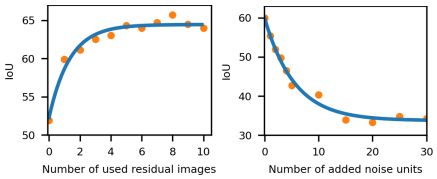
Fig. 4 : Ablation studies. The left figure shows the ablation study on the MOS performance vs. the number of residual images N. The right figure shows the ablation study on the MOS performance vs. the number of added noise units to the poses during the inferring.
Original paper · CC BY 4.0 · Xieyuanli Chen, Shijie Li, Benedikt Mersch, Louis Wiesmann, Jürgen Gall, Jens Behley, Cyrill Stachniss · Moving Object Segmentation in 3D LiDAR Data: A Learning-based Approach Exploiting Sequential Data · Original paper figure · Extracted the figure area from page 5 of the original PDF.Why moving and static points need separating
Knowing which parts of a scene are moving supports predicting future states, avoiding collisions and planning, and it can also make pose estimation, sensor registration and SLAM more robust. A semantic label does not supply this on its own, since a moving car and a parked car fall into the same semantic group. The task is therefore binary for each range measurement: it belongs to a moving object or it does not, and the moving class covers moving vehicles and humans.
Because the goal is to support a SLAM pipeline, the method has to work online, using only the current scan and earlier scans without a pre-built map. The target is urban scenes at the sensor frame rate, which is 10 Hz for a typical rotating 3D LiDAR.
Earlier LiDAR methods that clean point cloud maps mostly run offline on a prebuilt map, and some rely on time-consuming voxel ray casting over densely aligned scans. Their dependence on such a cleaned map is why they usually cannot run online.
Map-free work includes semantic segmentation of things that could move, learned probabilities of movable objects, and scene flow, but these methods either label movable classes without separating moving from parked objects or are heavy to run. The closest prior work, by Yoon et al., relies on heuristics such as residuals between scans, free space checking and region growing.
From scans to range images and poses
Each LiDAR point is mapped to spherical angles and then to pixel coordinates on a grid of height h and width w, where the vertical field of view is \(f = f_{up} + f_{down}\) and the range of a point is \(r = \lVert p_i \rVert_2\). Every pixel stores the point's coordinates x, y and z, its range r and its remission e, so a pixel can carry several channels instead of a single range value.
Because the extra channels are just image channels, an existing 2D segmentation network can take them without a change of architecture, and the same representation is tested with three networks.
Past scans are placed into the current frame with relative transforms from SLAM or odometry, and the scan with index k is moved into the frame of scan l. Each point is written in homogeneous coordinates \(p_i = (x, y, z, 1)\), and the transformed scan is \(S_{k \to l} = \{T^l_k p_i \mid p_i \in S_k\}\), where \(T^l_k\) is the chain of relative transforms between the two scan poses.
Residual images as the temporal cue
After a transformed past scan is re-projected into the current range image, the residual of pixel i is the absolute difference between the current range and the range from the transformed scan, divided by the current range. The residual is written as \(d^l_{k,i} = |r_i - r^{k \to l}_i| / r_i\), so it is a relative change rather than a metric difference.
Pixels without a valid measurement receive a residual of zero.
A moving point changes its position between the two viewpoints by more than the static background does, so its residual is large. The authors note an ambiguity: a single moving object can produce two large residual patterns, and slowly moving objects produce faint ones. Residuals therefore do not segment well on their own, but they give the network a cue that separates moving from non-moving pixels.
The residual channels are concatenated with the current range image, so the range image carries spatial information and the residual channels carry temporal information. With N residual images the input has 5 + N channels, where the five are x, y, z, r and e. The two-frame variant instead attaches the full previous frame and gives 2 × 5 input channels.
Retraining the segmentation networks
SalsaNext and RangeNet++ are encoder-decoder networks, and MINet is a light-weight multi-path network. Only the input and the output change: the fused range image is the input, and the output is reduced to two per-point classes, moving and non-moving, while the original loss functions are kept.
Each network is trained with its own training hyperparameters for 150 epochs on sequences 00-07 and 09-10, with sequence 08 as the validation set. Training uses the binary labels derived from SemanticKITTI, so the trained network is fixed to the sensor setup and the residual channels it was trained with.
After segmentation, a GPU-based k-nearest-neighbor search over the point cloud removes artifacts that the range projection produces. All three networks are described as light enough to run faster than the 10 Hz frame rate of common Ouster and Velodyne scanners.
A two-class benchmark from SemanticKITTI
The benchmark regroups the 28 semantic classes of SemanticKITTI into two sets, with moving vehicles and humans as the moving set and all other classes as static.
Input and architecture on validation sequence 08
For each network, three input setups are compared on sequence 08: the current frame alone, two frames, and the current frame with N=1 residual image. RangeNet++ scored 38.9, 40.6 and 40.9 for the three setups, MINet 9.1, 35.0 and 38.9, and SalsaNext 51.9, 56.0 and 59.9.
The residual setup scores highest for every network in this table. The authors suspect that a single frame lets a semantic network learn heuristics, for example that cars on the road usually move while cars in parking lots are static, and that the light-weight MINet cannot learn such heuristics.
With SalsaNext, the score rises with the number of residual images, and N=1 gives the largest gain. Gains continue with more residual images but show diminishing returns beyond N=8.
Pose noise was added to the SLAM poses in steps of 0.1 m, 0.1 m and 1° for x, y and yaw, and the score drops as the noise grows. Beyond 20 units, which is 2 m, 2 m and 20°, the score no longer gets worse, and the authors attribute this to the network ignoring the noisy residual images.
Comparison on the test sequences
SalsaNext applied directly to movable classes reached 4.4, while SalsaNext retrained with the binary labels reached 46.6. The residual heuristic reached 1.9, 14.1 with region growing and 20.6 with semantics added.
The scene flow baseline reached 4.8, and 28.7 with semantics added. SqSequence reached 43.2 and KPConv reached 60.9 in the same table. The semantic variant labels a point as moving only if it is also assigned to a movable class, using SalsaNext with pre-trained weights for the semantic labels.
With N=1 on SalsaNext the method reached 52.0, above the retrained SalsaNext and most baselines but below KPConv. With N=8 and semantics it reached 62.5, the highest value in the table.
KPConv is a dense point cloud method that the authors say cannot reach real-time speed because of its computational burden.
Odometry and mapping with MOS masks
The predicted moving points are removed from the input scans before SuMa runs, and the best setup with N=8 and semantics is used. The evaluation uses the KITTI odometry benchmark and compares SuMa, SuMa++ and SuMa+MOS.
Relative errors are given as rotational error in degrees per 100 m and translational error in percent, averaged over trajectories of 100 to 800 m. On the training split SuMa reached 0.36/0.83, SuMa++ 0.29/0.70 and SuMa+MOS 0.29/0.66. On the test split SuMa reached 0.34/1.39, SuMa++ 0.34/1.06 and SuMa+MOS 0.33/0.99.
Aggregated maps are shown with and without the masks, and the moving objects that remain in the unmasked map are removed in the masked one. The mapping comparison is visual, and no map metric is reported.
Runtime budget
Runtime was measured on sequence 08 with an Intel i7-8700 at 3.2 GHz and a single Nvidia Quadro P6000 graphics card. Residual generation with odometry takes about 10 ms per scan, and the inference time stays close to the original networks' times, which are 75 ms for RangeNet++, 42 ms for SalsaNext and 21 ms for MINet.
Pose history is already available from SLAM, so the pose estimation and residual generation run once per incoming frame. The authors report approximately 51 ms per scan with SalsaNext, which corresponds to 20 Hz and is faster than the 10 Hz frame rate of a typical LiDAR sensor. The paper does not give a separate timing for the second semantics network that can run in parallel.
Limits of the evidence
Residual information alone is weak, with an IoU of 1.9 on test sequences, and slowly moving objects give faint residual patterns. The best result also depends on a second network for semantic labels.
Noisy SLAM poses lower the score, and this pose-noise study is run with SalsaNext as the segmentation network. The N=8 setting was fixed on the validation sequence.
The experiments use SemanticKITTI for the MOS benchmark and the KITTI odometry benchmark for odometry. The runtime was measured on one hardware setup.
The single-frame failure of MINet is explained only by the authors' hypothesis about its light-weight architecture.
Paper info
- Authors
- Xieyuanli Chen, Shijie Li, Benedikt Mersch, Louis Wiesmann, Jürgen Gall, Jens Behley, Cyrill Stachniss
- Venue
- arXiv · Preprint
- First published
- 2021-5-19
- Added
- 2026-11-6
- Updated
- 2021-7-13
- Version
- v2
- arXiv
- 2105.08971
- DOI
- 10.1109/lra.2021.3093567
- Category
- cs.RO
- Original paper terms
- CC BY 4.0
- What we show
- Paper info, commentary and permitted figures from the original paper
AI commentary is a separate explanation from the original paper and may contain errors. The original paper and figures follow each source's terms of use and any rights noted separately.
Abstract
The ability to detect and segment moving objects in a scene is essential for building consistent maps, making future state predictions, avoiding collisions, and planning. In this paper, we address the problem of moving object segmentation from 3D LiDAR scans. We propose a novel approach that pushes the current state of the art in LiDAR-only moving object segmentation forward to provide relevant information for autonomous robots and other vehicles. Instead of segmenting the point cloud semantically, i.e., predicting the semantic classes such as vehicles, pedestrians, roads, etc., our approach accurately segments the scene into moving and static objects, i.e., also distinguishing between moving cars vs. parked cars. Our proposed approach exploits sequential range images from a rotating 3D LiDAR sensor as an intermediate representation combined with a convolutional neural network and runs faster than the frame rate of the sensor. We compare our approach to several other state-of-the-art methods showing superior segmentation quality in urban environments. Additionally, we created a new benchmark for LiDAR-based moving object segmentation based on SemanticKITTI. We published it to allow other researchers to compare their approaches transparently and we furthermore published our code.
Quote from the paper
Xieyuanli Chen, Shijie Li, Benedikt Mersch, Louis Wiesmann, Jürgen Gall, Jens Behley, Cyrill Stachniss (2021). Moving Object Segmentation in 3D LiDAR Data: A Learning-based Approach Exploiting Sequential Data. arXiv:2105.08971v2. https://doi.org/10.1109/lra.2021.3093567
BibTeX
@article{chen2021moving,
  title = {{Moving Object Segmentation in 3D LiDAR Data: A Learning-based Approach Exploiting Sequential Data}},
  author = {Xieyuanli Chen and Shijie Li and Benedikt Mersch and Louis Wiesmann and Jürgen Gall and Jens Behley and Cyrill Stachniss},
  year = {2021},
  eprint = {2105.08971},
  archivePrefix = {arXiv},
  doi = {10.1109/lra.2021.3093567},
  url = {https://arxiv.org/abs/2105.08971v2}
}