Paper commentary
CTformer: Convolution-free Token2Token Dilated Vision Transformer for Low-dose CT Denoising
- Problem Low-dose CT images carry more noise and artifacts than normal-dose scans, and CNN denoisers capture long-range context poorly. Transformers have been little tested for this task, and the one prior transformer model mixes in convolutions and gives little attention to interpretability.
- Method Replaces convolution with Token2Token Dilation blocks that combine cyclic shift and dilated unfolding, inside a residual encoder-decoder transformer trained with MSE. Outputs of overlapping patches are stitched by keeping only each patch's central part.
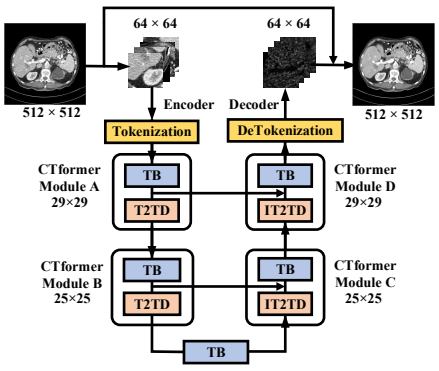
Fig. 2 : The CTformer consists of the residual encoder-decoder structure with tokenization/detokenization blocks, four CT- former modules with different sizes of feature maps, and an intermediate transformer block. Tokenization block unfolds image patches into sequential tokens, while detokenization block converts tokens back to the image. Each encoder CTformer module includes a transformer block (TB) and a Token2Token dilation block (T2TD), while each decoder CTformer module consists of an inverse Token2Token dilation block (IT2TD) and a TB, symmetrically.
Original paper · CC BY 4.0 · Dayang Wang, Fenglei Fan, Zhan Wu, Rui Liu, Fei Wang, Hengyong Yu · CTformer: Convolution-free Token2Token Dilated Vision Transformer for Low-dose CT Denoising · Original paper figure · Extracted the figure area from page 3 of the original PDF.Why a transformer for low-dose CT denoising
Low-dose CT lowers X-ray exposure, but the images it produces carry heavier noise and artifacts than normal-dose scans, which limits their clinical use. Learned denoisers for this task have mostly been CNNs, and CNNs reach long-range context poorly, which weakens the structure they can restore. Transformers capture global context and offer attention that can be inspected, so they look like a natural fit, yet the one earlier transformer model for LDCT denoising keeps convolutions in its design and says little about interpretability.
CTformer answers this by dropping convolution altogether. Its argument is that token rearrangement can supply the local information that convolution would otherwise provide. On top of that base it adds dilation and cyclic shift inside tokenization, an overlapped inference procedure for patch seams, and interpretation tools built on attention.
Residual encoder-decoder built from tokens
CTformer keeps a residual encoder-decoder layout. Encoder modules A and B each pair a transformer block with a Token2Token Dilation block, while decoder modules C and D each pair an inverse Token2Token Dilation block with a transformer block. An intermediate transformer block sits at the bottleneck. A tokenization block at the input unfolds the noisy image into tokens, and a detokenization block turns tokens back into an image.
Shortcuts connect encoder and decoder layers of similar level, so encoder feature maps reach the decoder and help keep structural detail. The authors also cite shortcuts as a remedy for gradient vanishing in deep models.
Training treats denoising as regression from a noisy input x to the normal-dose target y. The network f(W; x) is fitted by minimizing a mean squared error, \(J(W;x)=\|f(W;x)-y\|^2\), where W collects all trainable parameters. Because the output is an image, the objective compares pixel values directly, and the same loss is used for every module in the network.
Cyclic shift and dilated unfolding in the Token2Token block
Plain tokenization by reshaping or by a strided convolution treats neighboring tokens as unrelated, which leaves attention redundant and the features poor. The T2T block replaces it with cascaded tokenization that unfolds local neighborhoods, and CTformer extends that block with cyclic shift and dilation.
The first step reshapes the transposed token sequence into a 4D feature map, \(F=\mathrm{reshape}(T_a^\top)\), where the height and width both equal the square root of the token count. The second step applies a cyclic shift, \(F_c=\mathrm{cyclicshift}(F)\). In practice the map is shifted by two pixels, so the tokens come from positions that a fixed patch grid would not produce.
The matching inverse shift in the decoder removes any pixel mismatch from the final output.
The third step retokenizes the shifted map with dilated unfolding, \(T_s=\mathrm{dilatedunfold}(F_c)\), which converts the 4D map back into 3D tokens using overlapped splits so that neighboring tokens share pixels. The perceptive field is given as \[P=\prod_{i=0}^{1}(2K_i+D_i-1)\] where K_i is the kernel size and D_i the dilation rate in dimension i.
With the chosen settings this gives 841 tokens for module A, 625 for module B and 529 for the intermediate layer, and the token count falls in the encoder and rises in the decoder.
Attention and Performer in the transformer block
The attention output is \(\mathrm{MHA}(Q,K,V)=\mathrm{softmax}\left(\frac{QK^\top}{\sqrt{d_k}}\right)V\), where the scaling factor depends on the network depth. The softmax term \(\mathrm{Att}=\mathrm{softmax}(QK^\top/\sqrt{d_k})\) is the attention map that the interpretation analysis later reads.
The softmax can be approximated with a kernel method, which lowers the cost of the attention computation. Performer is the transformer that uses this approximation. The CTformer modules use Performer in their transformer blocks, while the intermediate transformer block keeps the standard attention.
Overlapped inference at patch seams
A transformer works patch by patch rather than on the whole image. Information lost in the encoder-decoder bottleneck makes neighboring patch outputs disagree at their edges, so the stitched image shows a mosaic pattern with artifacts along all four directions. The residual map between the prediction and the normal-dose image makes these boundary artifacts visible.
For a patch of size p × p, only the central part of size (p − 2η) × (p − 2η) is kept for the final image, where η is chosen larger than the width of the artifacts. The margin therefore trades computation for artifact removal.
Attention maps and explanatory graphs
Saliency maps suit classifiers, not image-to-image regression such as denoising, so CTformer's interpretation relies on its own attention modules. Attention shows where the model looks, but only statically, and it does not show how the attended parts pass from one layer to the next. An explanatory graph is added for that dynamic view.
In the explanatory graph, attended parts are nodes and attention flow is the edges. Two nodes linked by an edge are treated as co-activated and as performing a similar denoising mapping. Nodes come from TopK selection, which takes the K highest activations across the attention maps, or from local maximum selection, which takes the local peaks.
An edge is built by masking a feature map to keep the region around a node, forwarding it to get the next layer's attention map, and linking the highest activation of that map back to the node. Repeating this over two neighboring layers at a time builds the full graph.
Data and training setup
The data come from the 2016 NIH-AAPM-Mayo Clinic LDCT Grand Challenge and contain 2, 378 CT slice images with 3.0mm thickness, in low-dose and normal-dose pairs, from ten patients. Patient L506 is held out for evaluation and the remaining nine patients are used for training. Training images are augmented by rotations of 90, 180, or 270 degrees and by up/down and left/right flips.
Training draws 4 random patches from each available slice, which the authors chose so that a batch is not dominated by many patches from one image. Overlapped inference uses a margin of 16.
Within the CTformer modules the embedding dimension is 64, the tokenization kernel is 7 with a stride of 2, and the unfolding kernels are 3 with dilations of {2, 1, 1, 2}. The cyclic shift strides in the T2TD and IT2TD blocks are {2, 2,−2,−2}, and the experiments ran on four NVIDIA GTX 2080Ti 11G GPUs. The comparison models were retrained from their officially released code.
Comparison with denoisers on patient L506
The authors describe a lesion at Lesion No. 575 on L506, where WGAN-VGG and MAP-NN add shadows and tissue that are not in the reference. RED-CNN and AD-NET give smoother images but leave blotchy noise around the lesion, whereas CTformer suppresses noise and artifacts while keeping structural detail, according to the same description. The display window is [-160, 240] HU.
Table I reports SSIM and RMSE averaged over all slices of L506, along with parameter count and MACs for each method.
AD-NET was the closest competitor with an SSIM of 0.9105 and an RMSE of 9.0997. MAP-NN reached 0.9084 and 9.2959, and RED-CNN 0.9077 and 10.1044.
MAP-NN has the highest MACs at 13.79G because it repeats many modules, while CTformer has the fewest trainable parameters and the lowest MACs. The authors conclude that CTformer is the best denoiser among the compared methods on this patient.
The quantitative comparison uses one held-out patient, and each score is an average over that patient's slices. The text reports these scores as single values, without repeated runs or variance across training seeds.
Effect of the overlap margin
Non-overlapped and overlapped results are compared visually, with ROIs at margins of 0, 1, 2, 4 and 8. Artifacts are obvious when η is 0 or 1 and become hard to perceive as η increases.
On L506, SSIM rises from 0.9071 at margin 0 to 0.9121 at margin 16, and RMSE falls from 9.5671 to 9.0233.
At margin 16 on 512 by 512 images with 64 by 64 patches, the ratio of extra to authentic computation, σ, is 4. The overlap step therefore raises inference cost by this ratio in exchange for the score gains.
Token2Token dilation and cyclic shift ablations
The Sole-ViT ablation drops the T2TD module and uses a single convolution with filter size 8 and stride 8 for tokenization. Five transformer layers follow, and a detokenization with deconvolution returns tokens to the image domain.
Sole-ViT uses an embedding size of 256 rather than 64, chosen because the authors state its model size and MACs are then close to CTformer's. Its tokenization and its embedding size both differ from CTformer, so the gap reflects these changes together.
On L506, CTformer converges faster than Sole-ViT and ends with a higher SSIM by 0.0235 and a lower RMSE by 3.3362. Sole-ViT also shows extra blotchy tissue in the magnified ROI, as the authors observe.
Removing cyclic shift from the T2TD blocks gives a lower SSIM by 0.0026 and a higher RMSE by 0.1337 in the reported comparison, so the shift improves both scores. The visual comparison shows the version with cyclic shift is smoother, while the version without it adds some noise components.
Computational cost rises slowly with more blocks, but training time rises sharply.
Accuracy against model size
For CTformer the size changes through the intermediate embedding size, set to 64, 256, 512 and 1024. The other models change size through their filter counts: RED-CNN uses {64, 96, 128, 256}, MAP-NN {64, 128, 256, 400}, and AD-NET {64, 96, 128, 256}.
Fig. 8 plots SSIM and RMSE against parameter count and MACs, and the authors state that CTformer's SSIM curve lies at the upper left and its RMSE curve at the lower left. The efficiency result is shown as curves, so the text gives no per-point values for it.
What the attention maps and graphs show
The authors describe the first-layer attention as emphasizing edges and bone-like structures, with dotted attention on protruding texture. The second layer resembles the first but is sparser, the third layer becomes semantically implicit, and the fourth layer ignores object edges and focuses on regions where noise concentrates.
In the local maximum graph, groups of peaks often converge onto one point in the next layer.
The authors conclude that the latent behavior can be read both statically and dynamically, which they argue makes the model more transparent for diagnostic decisions. These readings rest on visual inspection of selected slices and positions, and the text gives no score for the graphs.
Limitations
The main quantitative comparison uses one held-out patient, L506, while nine patients are used for training. Overlapped inference adds computation, and the paper gives the ratio of extra to authentic computation as 4 at margin 16. The Sole-ViT ablation changes both the tokenization and the embedding size, so it does not isolate the tokenization alone.
The model-size comparison is given only as curves, and the interpretation graphs are read by eye. Within the ranges tested, the one-block CTformer gave the best scores, and more intermediate blocks did not help.
Paper info
- Authors
- Dayang Wang, Fenglei Fan, Zhan Wu, Rui Liu, Fei Wang, Hengyong Yu
- Venue
- arXiv · Preprint
- First published
- 2022-2-28
- Added
- 2026-11-6
- Updated
- 2022-2-28
- Version
- v1
- arXiv
- 2202.13517
- DOI
- 10.1088/1361-6560/acc000
- Category
- eess.IV · cs.CV
- Original paper terms
- CC BY 4.0
- What we show
- Paper info, commentary and permitted figures from the original paper
AI commentary is a separate explanation from the original paper and may contain errors. The original paper and figures follow each source's terms of use and any rights noted separately.
Abstract
Low-dose computed tomography (LDCT) denoising is an important problem in CT research. Compared to the normal dose CT (NDCT), LDCT images are subjected to severe noise and artifacts. Recently in many studies, vision transformers have shown superior feature representation ability over convolutional neural networks (CNNs). However, unlike CNNs, the potential of vision transformers in LDCT denoising was little explored so far. To fill this gap, we propose a Convolution-free Token2Token Dilated Vision Transformer for low-dose CT denoising. The CTformer uses a more powerful token rearrangement to encompass local contextual information and thus avoids convolution. It also dilates and shifts feature maps to capture longer-range interaction. We interpret the CTformer by statically inspecting patterns of its internal attention maps and dynamically tracing the hierarchical attention flow with an explanatory graph. Furthermore, an overlapped inference mechanism is introduced to effectively eliminate the boundary artifacts that are common for encoder-decoder-based denoising models. Experimental results on Mayo LDCT dataset suggest that the CTformer outperforms the state-of-the-art denoising methods with a low computation overhead.
Quote from the paper
Dayang Wang, Fenglei Fan, Zhan Wu, Rui Liu, Fei Wang, Hengyong Yu (2022). CTformer: Convolution-free Token2Token Dilated Vision Transformer for Low-dose CT Denoising. arXiv:2202.13517v1. https://doi.org/10.1088/1361-6560/acc000
BibTeX
@article{wang2022ctformer,
  title = {{CTformer: Convolution-free Token2Token Dilated Vision Transformer for Low-dose CT Denoising}},
  author = {Dayang Wang and Fenglei Fan and Zhan Wu and Rui Liu and Fei Wang and Hengyong Yu},
  year = {2022},
  eprint = {2202.13517},
  archivePrefix = {arXiv},
  doi = {10.1088/1361-6560/acc000},
  url = {https://arxiv.org/abs/2202.13517v1}
}