Paper commentary
Decision Models as Retrieval Gates Against Injection and Pollution
Small decision models screen retrieved web pages for injected instructions and pollution
- Problem Published mitigations still let hidden instructions through, and pollution from fake pages pushes real ones out before ranking. Injected instructions survive sanitisation and citation prompting because the generator still reads them.
- Method The Kev-4B gate is an open-weight decision model that reads each retrieved HTML page and answers typed questions without generating tokens. It drops a passage when its instruction or filler score is too high, before the generator sees it.
- Results The gate cut attack success from 13.6% to 5.7% over the mitigations.
Why visible injections survive the usual fixes
Retrieval-augmented generation puts into the prompt text that the operator never wrote. Some of that text is written for the model, such as instructions hidden in HTML that survive conversion to plain text. Guo and Wei reported that sanitising, normalising Unicode and requiring a citation per sentence lowered attacks from roughly a quarter of queries to below five percent.
This study measures the remaining gap on forum-style pages that carry hidden injected instructions.
The baseline uses the 8B generator with the guard prompt, where attack success is 27.9% (275/986). Without the guard sentence, attack success rises to 30.9%. Sanitisation plus normalisation brings attack success to 13.1%. Adding citation prompting leaves it at 13.6% (134/986). Each hidden carrier drops to zero, while visible text, look-alike letters and code blocks still succeed near their undefended levels.
Undefended, zero-width insertion lands on 1 of 109 retrieved attack pages, yet 35 of 109 once normalisation strips the characters. Normalisation therefore repairs the attacker's obfuscation, so the pipeline needs a detector beside it.
A larger generator doesn't close the gap. Llama-3.3-70B reaches 57.4% attack success on the same queries, against 27.9% for the 8B model. The combined mitigations bring the 70B pipeline to 21.7%, so model size alone doesn't explain the gap.
Pollution is a separate threat, where synthetic pages push real ones out before the generator sees them. Without a gate, at two thirds contamination, accuracy falls from 84% to 28%. The pollution testbed adapts Yu et al.'s clickbait scenario with 200 MS MARCO queries.
A decision model as the gate
The gate replaces a second large language model with a small decision model that screens each retrieved passage. The authors use released Kev-4B weights with no fine-tuning, so the gate works as an off-the-shelf scorer. Kev-4B covers every question in one pass, returning a score per answer without generating tokens.
Each retrieved passage gets three questions: whether it instructs an AI (Q1), whether it is filler or engineered to mislead (Q2), and whether it is relevant to the query (Q3). Q3 was pre-registered for re-ranking and is left to future work, so it only adds to the measured latency. Q1 and Q2 decide whether a passage is dropped, while a middle Q1 score keeps it under a citation-requesting prompt.
On Corpus A the gate reads each page once and drops a passage when s1 exceeds t_drop or s2 exceeds t_pol. The pollution threshold is fixed at 0.95, while the drop threshold is swept across the experiments. If s1 passes the gate threshold but not the drop threshold, the whole answer is generated under a citation-per-sentence prompt.
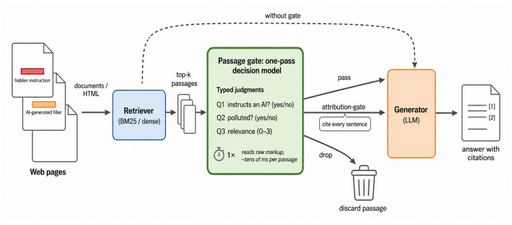
Figure 1 : The gate between retriever and generator. A decision model reads each retrieved passage once, on its HTML, and answers three questions. A high Q1 or Q2 score drops the passage. A middle Q1 score keeps it, but the whole answer is then generated under a prompt that asks for a citation per sentence. Q3 is kept for future re-ranking. On Corpus B the gate can also screen the candidate pool before ranking. All results use BM25 retrieval.
Original paper · CC BY 4.0 · Mahdi Ghadamyari, Reza Habibi · Decision Models as Retrieval Gates Against Injection and Pollution · Original paper figure · Extracted the figure area from page 2 of the original PDF.The gate reads the page's HTML rather than the plain-text chunk the retriever indexed. Kev reaches an AUROC of 0.94 on HTML against 0.87 on plain text. HTML beats plain text for every gate that works, which is why the headline results use it. At threshold 0.5 over the combined mitigations, Kev lowers ASR from 13.6% to 5.7%.
Kev against the published mitigations
The test asks whether a Kev-4B gate lowers attack success on top of the published mitigations without hurting clean answers. The published mitigations first cut attack success from 27.9% to 13.6% with the 8B generator and guard prompt. Stacked on those mitigations, Kev at drop threshold 0.5 reaches 5.7% attack success, which is 56 of 986 queries with a 95% CI of 4.3 to 7.2.
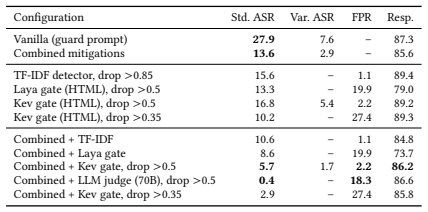
Table 2 : Corpus A with the 8B generator and guard prompt. ASR (%) on the 986 queries with the attack page retrieved, mean ASR over the four rewritten variants, FPR on retrieved hard negatives, and responsiveness on 1,000 clean queries. Gates read HTML and TF-IDF reads plain text. Bold marks the headline comparison and the judge trade-off.
Original paper · CC BY 4.0Used alone, the gate trades attacks for benign imperatives rather than blocking attacks for free. At threshold 0.5 it gives 16.8% attack success at 2.2% FPR, and at 0.35 it gives 10.2% at 27.4% FPR. A lower threshold therefore blocks more attacks but drops far more benign hard-negative passages. Kev's 2.2% FPR is 4 of 186 hard-negative passages, so the estimate rests on a small count.
Responsiveness on clean queries barely moves, at 87.3% undefended, 85.6% with the mitigations and 86.2% with Kev at 0.5. Laya's false positives cost ten points of responsiveness in the same comparison. Agreement with the top-voted human answer is 49.8%, 50.1% and 51.4% across the compared configurations. The authors read this as no detectable loss of correctness, though agreement is only a coarse proxy for correctness.
Figure 2 breaks the attack success down by carrier, and the operating-point table reports the same benchmark. Every hidden carrier falls to zero under the combined mitigations, but visible instructions still succeed at close to their undefended rates. Kev at 0.5 with the mitigations is the headline configuration, and 0.35 is reported beside it.
How the gate compares with LLM judges
Large LLM judges separate attacks more cleanly, so the question is what the extra accuracy buys. On HTML, Llama-3.3-70B and DeepSeek V4.1 Flash reach AUROC 0.992 and 0.998, compared to 0.938 for Kev-4B. Kev-4B reaches 0.94 on HTML and 0.87 on plain text for the instruction question, so HTML helps it as well.
The ranking advantage costs about ten times more. Kev takes 76 ms per passage on one GPU, about $0.015 per 1,000 passages, at $0.72 per GPU-hour.
Judges used as a drop gate change the trade-off rather than remove it. The 70B judge reaches 0.4% attack success at drop threshold 0.5 over the combined mitigations, but its FPR is 18.3%. Other gates fare worse: Von reaches AUROC 0.40 on HTML, which is below chance, and Tev1 reaches 0.85 on HTML.
Pollution and where the gate sits
Corpus B tests pollution on 200 MS MARCO queries, each with ten original passages and 20 clickbait documents. Without a gate, 92% of the retrieved ten are synthetic at two thirds contamination, and accuracy falls from 84% to 28%.
Kev gives generated clickbait a median score of 0.92, while 1.2% of the original MS MARCO passages score above 0.7. Dropping only from the retrieved top ten keeps exposure at 2.5%. That leaves 0.8 documents per query, so accuracy is 23%, no better than with no gate.
Dropping from the whole pool before ranking keeps exposure at 0.5% at threshold 0.5. Accuracy stays at 83%, within a point of the clean pool at 84%. At threshold 0.7, the same pool-level filter gives 7% exposure and 73% accuracy. This works because Kev separates generated clickbait from the original passages.
Yu et al. proposed filtering at indexing time, but they didn't test it.
Adaptive attackers and obfuscation
An attacker who sees the gate's scores can rewrite its instruction, and Llama-3.3-70B did this on 200 retrieved attack pages. Each attempt showed the attacker Kev's score and the generator's answer, and the rewriting ran up to eight times per page. After rewriting, every page scored below 0.35 on Kev. Attack success still reached 3.5% with the gate, compared to 6.5% with the mitigations alone.
For the original instructions, attack success was 6.5% with the gate and 14.5% with the mitigations alone. The authors read this as a sign that rewrites which stop addressing the AI also lose their effect on the generator.
Across the four rewritten variants, mean attack success is 7.6% undefended. It falls to 2.9% with the combined mitigations and to 1.7% with Kev added. The four variants come from Llama-3.3-70B paraphrasing instructions, giving false authority, phrasing them to satisfy the generator's prompt, or obfuscating characters.
It succeeds on 1 of 109 retrieved attack pages undefended. Once normalisation strips the characters, it succeeds on 35 of 109 pages. Normalisation therefore repairs the attacker's obfuscation, so the authors argue it needs a detector beside it.
Limitations of the gate evidence
The TF-IDF baseline's false-positive rate is optimistic, because it was trained on payloads and hard-negative templates that match the evaluation. Kev's false-positive rate of 2.2% rests on 4 of 186 hard-negative passages, a small count.
Hard negatives come from eight templates that recur across queries, so the false-positive estimates may not generalise to other benign pages. The corpus follows the source study's design, not its data, so the benchmark inherits that design's choices.
The planned ablations are missing from the paper. The TF-IDF and perplexity baselines are weak as implemented, so the comparisons against them say little about stronger detectors. The Qwen3-0.6B perplexity filter uses running statistics, so its scores depend on the order of documents.
Those gaps leave the 5.7% attack success with the gate as an estimate under the tested attackers only.
Paper info
- Authors
- Mahdi Ghadamyari, Reza Habibi
- Venue
- arXiv · Preprint
- First published
- 2026-11-5
- Added
- 2026-11-7
- Updated
- 2026-11-5
- Version
- v1
- arXiv
- 2611.08325
- Category
- cs.CR · cs.IR
- Original paper terms
- CC BY 4.0
- What we show
- Paper info, commentary and permitted figures from the original paper
AI commentary is a separate explanation from the original paper and may contain errors. The original paper and figures follow each source's terms of use and any rights noted separately.
Abstract
Retrieved web text can carry instructions aimed at the language model, or synthetic pages written to mislead. We test whether released open-weight decision models, which answer typed questions about a text without generating tokens, can screen retrieved passages against both threats. On a benchmark of 1,000 questions over forum-style web pages with hidden injected instructions, a Kev-4B gate reads each passage's HTML. Attack success, measured automatically, falls from 27.9% with no defence to 13.6% with the published mitigations (sanitisation, normalisation and citation prompting) and to 5.7% with the gate added. The gate takes 76 ms per passage and wrongly flags 4 of 186 benign pages with instructions for human readers. Responsiveness on clean queries stays within a point (85.6% to 86.2%). On a 200-query pollution testbed where two thirds of the candidate pages are fake, filtering the pool before the top ten are chosen keeps fake pages out of the answer (0.5% exposure) and holds accuracy at 83%, against 28% with no filter. Filtering only the top ten leaves the generator too few pages to answer. Large LLMs used as judges rank attacks better (AUROC 0.99 against 0.94) but cost ten times more. Gates catch more attacks when they read the page's HTML than when they read its plain text. Every model is open-weight.
Quote from the paper
Mahdi Ghadamyari, Reza Habibi (2026). Decision Models as Retrieval Gates Against Injection and Pollution. arXiv:2611.08325v1. https://arxiv.org/abs/2611.08325v1
BibTeX
@misc{ghadamyari2026decision,
  title = {{Decision Models as Retrieval Gates Against Injection and Pollution}},
  author = {Mahdi Ghadamyari and Reza Habibi},
  year = {2026},
  eprint = {2611.08325},
  archivePrefix = {arXiv},
  url = {https://arxiv.org/abs/2611.08325v1}
}